
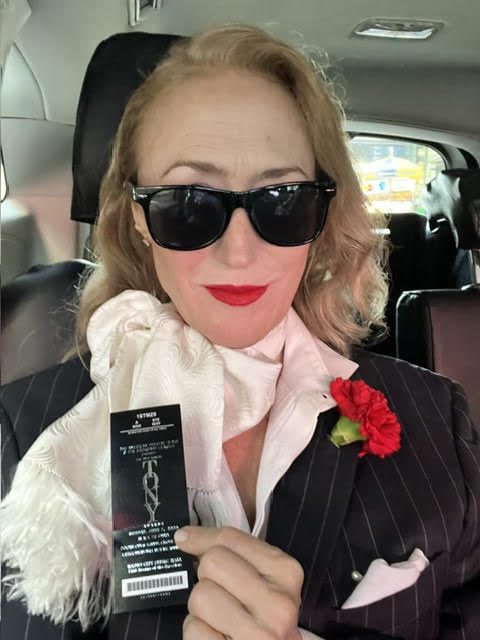
On Sunday, June 7, LeeAnne Hutchison was at the Tony Awards, watching her Broadway debut Liberation win for Best Play. The next morning, she woke up and clocked in at Defenders Academy, a week-long trial skills program for public defenders from across the country. She’s spent the last two decades using her acting skills to teach lawyers how to be more compelling in court.
Hutchison and I met over Zoom to talk about what a courtroom has in common with a theater, and what keeps bringing her back to share her talents with public defenders. Our conversation has been edited for length and clarity.
How did you become a teacher at Defenders Academy?
About 20 years ago, the former head of the Bronx Defenders had this really transformational experience working with a couple of performance coaches, partly encouraged by a neighbor of hers who’s a professional opera singer. He told her that every time she was heading to court, she needed to sing to the radio in the car, and that when she got to the courthouse, she needed to go into a stairwell and do vocal exercises—scales and sirens, sound making. She just never encountered anything like that, and that alone changed her whole feeling about her power in the courtroom.
So she got this crazy idea. She decided, I need to get some grant money together to pay a couple of performers to come and work with young lawyers. Somehow she put the money together, and she reached out to a very good colleague of mine. So that was how I got invited.
What was your initial reaction when your colleague reached out and was like, “Hey, will you do this thing with me?”
I just laughed. I was like, “This is wild.” We know actors who work with CEOs of companies, like executives. And then, as you also may know, there’s another crossover field, which is hospitals. Performers work with new doctors who have to communicate and have a bedside manner, and also actors go and roleplay as patients with students in their last year of med school.
So those things were familiar, but this idea was something we had never thought of—strangely, because lawyers really do have to perform in a high-level, persuasive way to a real audience. A jury is 12 people in a little group, like an audience. And defense attorneys really have to be able to reach the public. They can’t be in lawyer-speak, and they write their own material. They have to be playwright, director, and performer.
I can imagine that lawyers might be a particularly tough audience to teach the lesson “Please talk normal.”
It can be tough. Some of them are like, “Oh my god, this is great,” and then some of them are like, “Why are they here and why do they think this has anything to do with my work?”
We don't just get up there and talk. We do a scene from—I can say this word because I'm not in a theater—Macbeth. We'll do a Shakespeare scene immediately, without any introduction. We'll turn out the lights and confuse them, and there'll be blood, and it’s something shocking. And then we'll stop and turn on the lights and say, “So, why did we do that?” By making the elements of performance very extreme, we can speak about them more easily, and you can see the distance that we’re inviting you to travel—somewhere toward this far destination that we’ve now put in the space with voice, with emotion, with visuals, with atmosphere.
What kinds of lessons are coming through, where you’re seeing overlap between a courtroom and a stage?
A couple of categories. Vocal—speed, volume, pitch, the power of the pause and emphasizing different words. Physical, in terms of blocking—where do you move to be most effective? That's something you have to design in advance. You are probably used to seeing lawyers pace back and forth a bit, but often that leads to aimless wandering. Also, things like what to do with your hands, and the engagement of the emotions and the five senses as a storyteller, without which people will not remember your story. We have goldfish minds. We only remember facts if they’re given to us in the container of a story with dynamic shifts and very visually expressive language.
It's interesting because as non-attorneys, we’re used to seeing a “trial” that’s blocked—an actor in a courtroom drama moving to very specific places. Our “memories” of trials come from movies and TV. But I haven’t spent a ton of time observing real trials, so I don't know what it looks like to see an attorney just kind of walk around randomly.
If you’ve ever done jury duty, you’ve seen some really terrible performances. It's no good. The lawyer has to begin to understand they are giving voice to another person’s story, which is actually exactly what I do as an actor. Maybe the lawyer has seen the movies too, and they've seen the senior lawyers do trials well, so they have the impression that people just know how to do it. We're like, “Guys, that's not how it is.” You have to develop a process that gets you there.
You're playing the role of an advocate, and you want to play that role extremely well. A human life is at stake.
With blocking, is it like taking time to address yourself to the jury in a specific way? And the judge? What does blocking look like in a court?
So for one thing, there are different practices in different courts. Some allow a lot more movement, some have courtrooms where the current fashion of the court is to be at the podium the whole time. So for that, we go, okay, but can you move around to the side of the podium? Can you keep one hand on it? Sometimes they say, “I can't, I have to be speaking into the mic.” Okay. Then you have your body, and your blocking is what direction you're facing. Blocking is not just walking in space. It’s also when you turn your body or make physical gestures, and you can pair that with when you take silences.
You have to decide what different areas of meaning are in the court. Where is the place of innocence going to be? Obviously, really close to the client. So when you want to relay innocence, that’s where you block. When you talk about the bad guys, where is that going to be? It’s going to be near the prosecutor’s table, isn’t it? Maybe at the witness stand where the bad guys just spoke, but really it’s the prosecutors table. It’s not just standing in a room. It’s all in a relationship, because that’s how people are going to remember it.
I'm curious about the extent to which the people you're encountering as students have had space to practice in this way before.
They do moot courts and sit for each other, which have the five-act play structure. They go from voir dire, where they have to communicate with potential jurors in a very specific way, to their opening statements. Then they have different witnesses, and they have to present differently if their client or a key witness is taking a stand. They need to make that person the star of the thing, not themselves.
But then in cross-examination, they have to be the star of the show and really control the scene and control the stage. We introduce a lot of improvisation games during that part of the trial practice work—a few games that require you to think on your feet and discover that actually, you can do it even more than you might know. Depending how cross-examination goes, they have to take a lot of turns, and they have to know how to deal with objections, which is very scary for a lot of the younger lawyers, and still stay on track, and be an improviser in the space of the courtroom.
And then they have to pull it all together and bring it home with an amazing closing.
Improv is kind of defined by freedom, versus being a lawyer, the courtroom, it’s defined by rules.
Improv can help them in anything from opening someone up, how to tell a good story in the first place, or how to pivot in the moment. If you listen, breathe, and accept whatever is thrown at you, that’s your best chance at your brain actually providing you with what you need to get through these tricky moments. So that’s the main thing. That’s really the connector.
There must be so many ways in which it’s changed over the last 20 years, both what you guys are teaching and how receptive the attorneys are.
Definitely growing receptivity, for sure. And part of that is the fact that some people we trained have now been practicing for a long time, and they have seen that the things that we bring, which might have sounded a little woowoo at first, actually give them and their clients an edge.
And they say that when they introduce us, so there's mad support in the air. Still, we work constantly to try to make it not a mystery about how this is connected. And we are honestly 20 years in, and still, like, I’ll finish a big session and go, “No! Somehow I just didn’t nail that.” I could feel it, I could see that some people got it and some people didn't.
Is there anything I didn't ask about that you want to mention?
The thing I would just love to say is, it makes me feel emotional to say it: I feel very honored to interact with this field and the people who are working in this field. It gets to me all the time what the level of challenge is for public defenders.
Several weeks ago, we were working with people who work in immigration court, who are just the walking wounded, and who have to practice at a table, sitting down. It’s like, how do you take a disempowered situation, and even with all the restrictions in different courtrooms, how can they power up? There would be no real justice without public defenders. It's like public school teachers. There would be no real democracy. So it is my honor to support. They’re all advocates for how the carceral system should be completely overhauled. And so am I now. I learn so much from these people.