
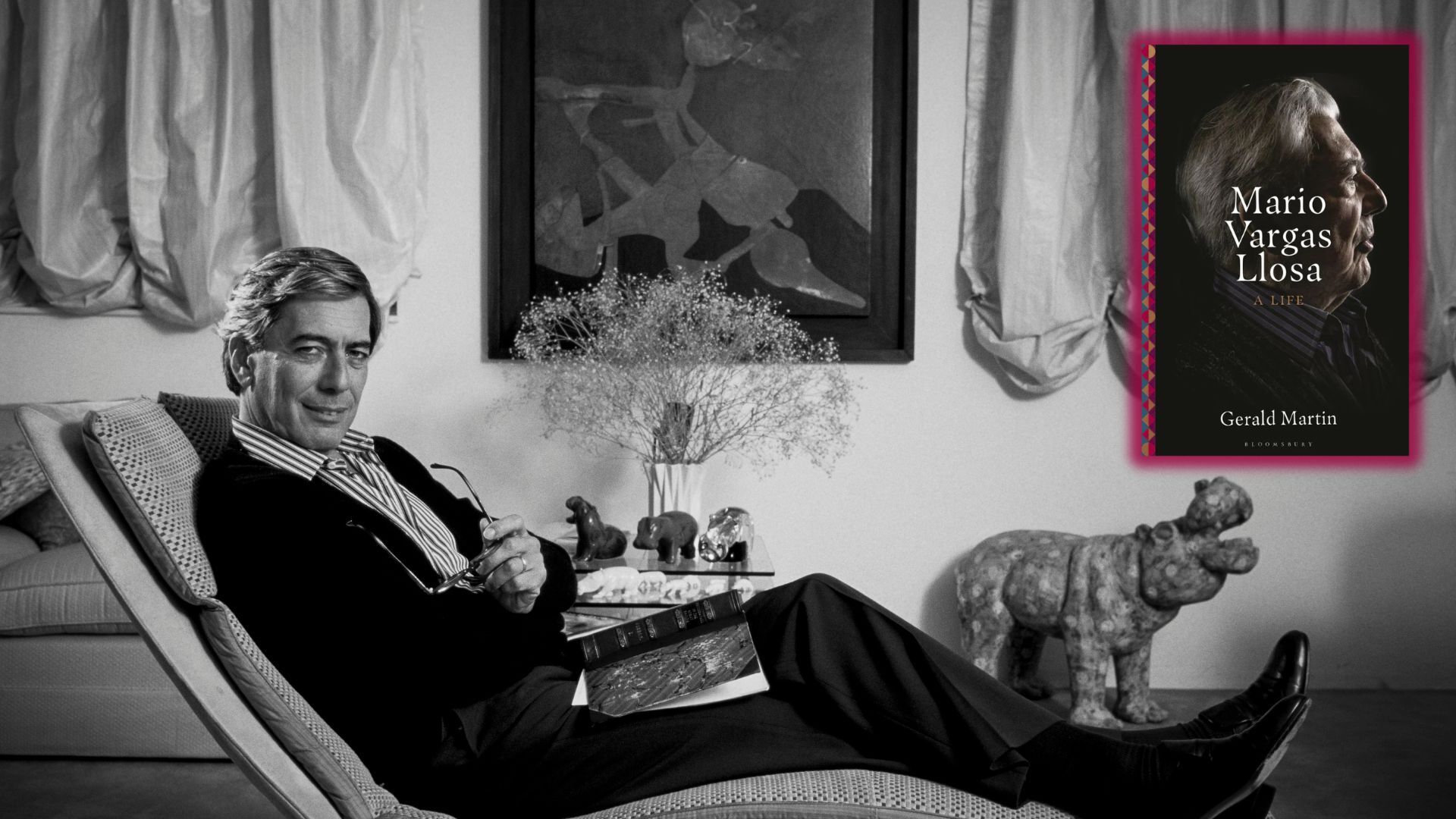
Mario Vargas Llosa: A Life might seem like a bland title for a biography, until it dawns on you exactly how much living the man did. He eloped with his aunt at 19, then humiliated her by writing a novel about it translated into more than 30 languages; divorced her for her much younger niece, his first cousin; and, after a scandalous 50-year marriage beset by separations, walked out one last time for the Spanish socialite and tabloid favorite Isabel Preysler, ex-wife of Julio Iglesias, mother of Enrique.
Arguably the world’s most famous Peruvian after Paddington, Vargas Llosa would have been president if not for the dark-horse populist Alberto Fujimori—father of the current president—who handily defeated Vargas Llosa’s platform of neoliberal shock economics in 1990. And in 2010, at age 74, he won the Nobel Prize in Literature, joining the pantheon alongside his lifelong frenemy Gabriel García Márquez, whom he famously punched in the face at a film premiere, for reasons that remain unclear.
Thus the page count of the new biography—the first since his death in 2025 and almost certainly the last word on the subject—clocking in at 812. Gerald Martin, a British critic who also wrote the definitive book on García Márquez, spent 25 years interviewing Vargas Llosa and those who knew him. The result is a monumental achievement: a synthesis of his subject's personal and political life with a surgical yet shockingly breezy analysis of the writing itself. And while it’s not always right to conflate fictional characters with their creator, Vargas Llosa is a special case, Martin argues: a novelist who peppered his work with confessions.
Writing is invariably an exhibitionist act. But some are driven first and foremost by a compulsive, even perverse, desire to reveal themselves to the world. Vargas Llosa described writing a novel as a striptease in reverse: The novelist starts out naked, with his own experiences and obsessions, and gradually covers them with fiction until they're unrecognizable. Martin takes the image further: For Vargas Llosa, writing didn’t just mask his true self but helped him fashion a new one, remaking both the private man and the public figure, fiction and life feeding each other in a constant loop.
Which is why it was so head-scratching for friends and followers to realize he was not who they thought, as his allegiances drifted over the course of the Cold War from leftist militant and friend of Fidel Castro to Thatcherite pundit and one of the Spanish-speaking world's most prominent anticommunists. Martin makes no attempt to hide how he or the novelist’s ex-comrades felt about that, even quoting one former best friend who confided “over a whisky” that the rightward turn didn’t surprise him: “Let’s face it, the right is a very comfortable place to be. You live in big houses with big cars, everyone is very polite to you, you are surrounded by beautiful women and you don’t have to worry about very much. I mean, one can see the attraction.” Though Martin still insists on the novelist’s greatness, he never shies away from the unsavory stuff, which may be why Penguin Random House recently canceled its contract for the Spanish edition, saying only that the book “did not meet its editorial standards.”
More than a psycho-literary profile, A Life is a study of drive itself: Vargas Llosa, as Martin shows, was ambition incarnate, a workhorse whose greatest novels owe less to any preternatural sense of style than to a sheer will to be the best, resulting in a realist architecture so painstakingly built that its complexity seems effortless. The signs of this desire for greatness, no matter the human toll, were always there if you knew where to look.
Born in 1936 into a white, bourgeois family in the stratified southern city of Arequipa, young Marito ("Little Mario") spent an idyllic early childhood in Cochabamba, Bolivia, where the Llosa clan had settled. Shuttling between Sunday feasts at the family compound and Bolivia's top Catholic school, he was, in his own words, "as innocent and pure as a lily.”
Until about ten, when his dead father, Ernesto, suddenly reappeared, very much alive—and nothing like the boy's romantic notion of him—to spirit him and his mother away to Lima. His childhood ended in a hotel in Chiclayo, where he lay alone in his room, straining to hear his parents through the wall, certain, as Martin puts it, that his mother "was engaging in the loathsome acts his friends in Piura had told him about, that only prostitutes could actually enjoy, and that she was loving it and that she had lied to him and betrayed him."
Ernesto was, by all accounts, an authoritarian asshole. He scorned his son's interest in poetry as effeminate, and the boy spent four years trapped under his roof, escaping into books. Ernesto's decision to send him to military school, to turn the coddled brat into a man, was in fact a godsend. Marito, enchanted by tales of sailors and pirates from his adventure books, even considered enlisting in the navy as a way out from under Ernesto’s thumb. But he would spend the rest of his life molded by this lapsarian event, and much of it working it out on the page.
One of the first stories Vargas Llosa ever wrote, at about twenty, retells his first taste of power. "The Leaders," the title story of his debut collection from 1959, is about a strike he helped lead at his high school in Piura over a change in the exam schedule. The narrator, having lost the role of strike leader to a boy who beat him in a fistfight, pretends to back his rival, then betrays him by quietly returning to class with a splinter group of panicked kids. "Deep down," he tells the reader, "I knew that what was at stake was not the exam schedule, not even a question of honour, but a personal vendetta."
What this tells us, according to Martin, is that even barely out of adolescence, Vargas Llosa had already taken sides in the age-old battle between the idealists and the cynics. "Morality, ideology and politics are just masks," Martin writes. "Behind the slogans and values of politics there is apparently always, and whatever principles are espoused, an essentially unprincipled struggle for power."
This is an unexpected worldview for a kid who worshiped Jean-Paul Sartre and, at university, belonged to an underground communist cell. The central question A Life sets out to answer is whether he was, like all of us, a bundle of confused contradictions, or something more sinister: a master of disguise who for decades said one thing in public while leaving a trail of bread crumbs to the real Vargas Llosa in his novels.
By the time The Leaders, his first book, appeared, he was living in Paris with Aunt Julia, née Julia Urquidi. At 19 and 29, respectively, they had embarked on a furtive romance that led to a secret ceremony in the only town near Lima where a local functionary—a mayor with no shoes on—would officiate their illegal marriage. Their apartment in the sixth arrondissement was a hub for writers and revolutionaries, welcoming everyone from Che Guevara’s first wife—who brought news of Cuba’s nascent revolution—to the Peruvian poet Javier Heraud, who would, shortly thereafter, lead a guerrilla expedition where he was killed almost immediately. Writing what would become his first novel, Vargas Llosa eked out a living in between magazine assignments, parties he was forced to attend, and fights with Julia over his constant infidelities, which tended to end in public blowouts. On one occasion, when Julia overheard her husband discussing his tryst with a jet-setting Mexican actress, she ran to the bathroom and swallowed a number of pills, which he and a friend forced her to vomit. Then they all went out to the theater.
That first novel, The Time of the Hero, published in 1963 by Barcelona's premier literary press, Seix Barral, follows another student conspiracy—this time cadets at a military academy—that leads to a murder and subsequent cover-up, exposing the rot of corruption running through Peru's institutions. It made Vargas Llosa an overnight star in the world of Spanish-language letters, introducing the 27-year-old as an heir to the meticulous realism of French authors like Balzac, a genre whose whole point was "to question power and undermine it," Martin writes.
But it was Conversation in the Cathedral, six years later, that secured his place as a titan of world literature. Set in Lima during the Odría dictatorship of the 1950s, it gave the world a line that became a national catchphrase: "¿En qué momento se había jodido el Perú?" ("At what precise moment had Peru fucked itself up?"). It cemented all the elements of a great Vargas Llosa novel: not just his ice-cold, bird's-eye view of power's brutal machinations, but of the psychosexual sadism that fuels its unfolding.
Vargas Llosa is often grouped with the other giants of what became known as the Latin American Boom, rule breakers like Carlos Fuentes, Julio Cortázar, and García Márquez, who blurred the lines between the real and the fantastic. But Martin reminds us that Conversation, like his other great works, was a "pre-Boom novel" in both form and content: "pre-Freudian, pre-Communist, pre-twentieth century." And as Vargas Llosa distanced himself creatively, he began to speak openly about his political differences too. The shift accelerated with the Padilla affair of 1971, when the poet Heberto Padilla was jailed in Cuba as a dissident and forced to recant in a public humiliation ritual. It drove battle lines through the Latin American left, with Vargas Llosa—once an honored guest of Castro's—emerging as the revolution's most high-profile defector.
Signs of the new Vargas Llosa started appearing in the press. In 1975, he was the subject of a splashy New York Times profile where he dog-whistled about freedom of speech and other points amenable to the liberal democratic world order whose interests the paper represents. Crucially, this was not "Sartre's form of freedom," Martin writes, "which implied myriad personally chosen commitments and an unceasing self-analysis. Vargas Llosa wanted to be free of responsibilities: free of engagement, free of Marxism, free of Cuba and its Revolution, free of Peru, its nationalism and all its insoluble problems."
Then came Aunt Julia and the Scriptwriter (1977), a hormonal comedy about his real-life teenage romance, and his first crossover hit with casual Spanish readers and the English-language market alike. After that, my personal favorite, despite its occasionally wooden English translation: The War of the End of the World (1981), a sprawling historical novel about a messianic figure who led a movement of zealots in a doomed, utopian uprising in nineteenth-century Brazil. "The battle scenes," Martin writes, correctly, "are some of the greatest in world literature."
Lectures, essays, op-eds, conferences, TV appearances. Vargas Llosa was inexhaustible and traveling constantly. Peru was in the news more than usual because of the rise of the Shining Path, the Maoist group that declared war on the state in 1980 with a series of bombings, assassinations, and rural massacres. When then-president Alan García moved to nationalize the banks, Vargas Llosa warned that Peru would become another Nicaragua and soon announced his run for president, backed by the country's bankers and tycoons.
But the man was so out of touch with Peru, having spent most of his life abroad, that he fumbled what should have been a shoo-in. What killed his campaign was a TV spot he personally approved that cast government workers as monkeys in long red ties, one of whom ends up taking a shit on the floor. The Catholic Church, which stood to benefit from his presidency, even offered to stage a literal miracle, wherein a 17th-century religious painting would whisper his name during a procession. To his credit, he declined.
Back to work. Next was The Feast of the Goat (2000), about the sadistic Dominican dictator Rafael Trujillo, which I remember enjoying many years ago, though in Martin’s eyes it’s a compelling story told without much artistry. Then his first outright clunker, The Bad Girl (2006), a sex comedy whose entire existence seems driven by spite toward women, and The Dream of the Celt (2010), about the Irish anti-slavery crusader Roger Casement. It’s a poorly paced, structureless slog, and yet it somehow convinced the Nobel committee that Vargas Llosa’s time had come. "Few topics were more liable to attract the attention of the Nobel Prize authorities," Martin writes, "than a favourable novel on a great humanitarian hero."
Vargas Llosa was a Nobel laureate, and all it took was alienating himself from anyone he once called a friend. ("The fact is, Mario doesn't have proper friends, he has no idea what a friend is," one Peruvian poet who knew him told the biographer.) One of the only allies left by his side, his lover, Isabel Preysler, finally left him in 2022, a year after he published "The Winds," a short story about a decrepit old man wandering a future Madrid who confesses that his greatest mistake was leaving his wife for a woman who wasn't worth it. The tabloids loved it, as did the Vargas Llosa family, "who never saw Mario since he had been kidnapped by that Wicked Witch."
His final novel, I Give You My Silence (2023), a comparatively quaint homage to Peruvian culture and folklore, seems an attempt at reconciliation. Written while Vargas Llosa was dying of cancer, it follows a second-rate author obsessed with the creole genre known as the vals (“waltz”), who believes he can unite his fractured, dysfunctional country by writing a book about vals and its greatest practitioner, the guitarist Lalo Molfino. Stymied by the fact that he sucks and nobody cares, the writer finally gives up and finds peace in acceptance—a peace Vargas Llosa never seemed to know, though he managed to write the book his protagonist couldn’t, one that “unifies rather than divides.” It was all too little, too late, Martin writes: “He had finally gone too far when—or perhaps because—he himself did not have far to go.”
A novelistic line like this one could sound a touch dramatic in the hands of a lesser biographer. But by the time we reach it, Martin has more than earned our trust, not only by reckoning openly and in good faith with his subject’s contradictions but through the sheer rigor and scope of his reporting. He conducted more than 80 formal interviews, many with sources he hounded for years before they opened up, and he even recalls sitting in the front row at a Vargas Llosa lecture at the University of Southampton as a literature student—in 1970!
His ensemble cast of dishy sources also keeps the pages turning, not least of them the legendary Carmen Balcells, alias la Mamá Grande: Vargas Llosa’s literary agent, the greatest Svengali Spanish-language letters have ever known, and a notorious planter of gossip in the press. For nearly a quarter century, Balcells had rebuffed Martin’s efforts to dig up the dirt on closely guarded episodes in the novelist’s life. Then one day, something changed. “Write a soap opera all about his love affairs,” she told him. “We can do it together.”