

Mom’s phone number was 620. If a friend wanted to reach her on her family’s farm just outside the rural Missouri town of Alma (pop. 400, more or less), they had to buzz the operator at the Alma Telephone Company and ask for the Corders or say, “Give me 620, please.” The operator, who probably knew by heart which circuit the Corders were on, would ring line No. 6 with the prescribed sequence: two long rings, zero short rings. The phones in 10 or so households all along the party line would let loose, with the ring pattern signaling to the other farmsteads that the call was for the Corder household. But anyone who wanted to pick it up could—and sometimes did.
“You could usually tell when somebody else was on the line,” Mom said. Most often that somebody was Grandma Dieckhoff, who lived one house down the line with her son’s family. The ever-present possibility of eavesdroppers disciplined Mom’s high school chatter—except when it supercharged it: “We sometimes exaggerated a little to give her something to talk about.”
Mom remembers precisely when her parents finally got off the party line, much later than most of the U.S.: December 1972, her freshman year at the University of Missouri. Late-adopting Alma Telephone skipped over rotary phones altogether, heading straight to direct dial. Grandma and Grandpa called her up, marveling at the ability simply to punch in 10 numbers to reach her, and only her.
More than 50 years later, I ask my students, mostly college freshmen, about their phones, which they mostly don’t use to talk to people. One student tells us about a day this summer when, horrified, he realized he’d spent eight hours watching Instagram Reels. He doesn’t know where the time went, or what he watched. The others describe disrupted sleeping habits, compulsive checking—you know the feeling.
Almost everyone has the sense of spending too much time on their phones, but they’re not as worried about themselves as much as they are even younger people. They can’t believe what children get away with: speaking in brain-rot non sequiturs and YouTuber “like and subscribe” cadences, refusing to look away from their devices to engage their older cousins in conversation. “I do think you should be more worried about the next generation,” one said.
“Using a technology changes a person. Using a technology changes a culture,” James Gleick asserts early in his excellent The Telephone: A New History. He spends the next 400 pages outlining the development of this specific technology while describing the changes and effects wrought by its widespread use.
Gleick, whose previous books include The Information: A History, a Theory, A Flood and Chaos: Making a New Science, is a biographer of ideas: information theory, chaos theory, the telephone. With Gleick, the device is a stand-in for something we take for granted today: simultaneous communication across distance. The phone, he writes, extended "presence—the quality of being present, formerly confined, now anywhere."
The ubiquitous availability of that presence, the possibility of instant and constant contact with basically anyone we know anywhere in the world, is one of the miracles and maladies of our moment. According to Gleick, it’s “a degree of connectivity that Alexander Graham Bell could not have envisioned and would not have liked.”
Shortly before he died, Gleick writes, Bell told an interviewer he refused to have a telephone in his study. He resisted the persistent possibility of intrusion, one that lives today in our pockets.
Gleick’s history of the transformative technology known as “telephone” begins with the development of our modern understanding of electricity. We’d ruled out “fluid,” and in the process of figuring out whether it was a particle or a wave (kinda both), we learned about conductivity and resistance. Along the way, various people discovered that wires transmitting electricity could also pick up and convey noises from their surroundings.
“It was only a question of how to convert the aerial vibrations made by the production of any sound whatsoever into the electrical vibrations of a similar character.” This was not Bell but Elisha Gray, who filed a patent similar to Bell’s on the same day: Feb. 14, 1876.
Gray knew a lot more about electricity than did Bell, who came from a long line of elocutionists—speech coaches; his father was possibly the model for the character Henry Higgins—and arrived at the telephone from his interest in the behavior of the human voice. Bell’s victory, despite his technical ignorance, resulted in AT&T. That company, via its research arm, led to the development of information theory and the transistor which, respectively, constitute the underpinning logic behind and the fundamental technology of the computer chip.
Fittingly for the origins of something so fundamental to the history of modern tech, this is not a story of meritocracy. Sure, Bell and his assistant Thomas Watson were each industrious trial-and-error tinkerers, but rather than working harder than the other guy, Bell’s besting of Gray was mostly a matter of luck, connections, and conniving. Bell’s father-in-law knew a guy who knew a guy in the patent office.
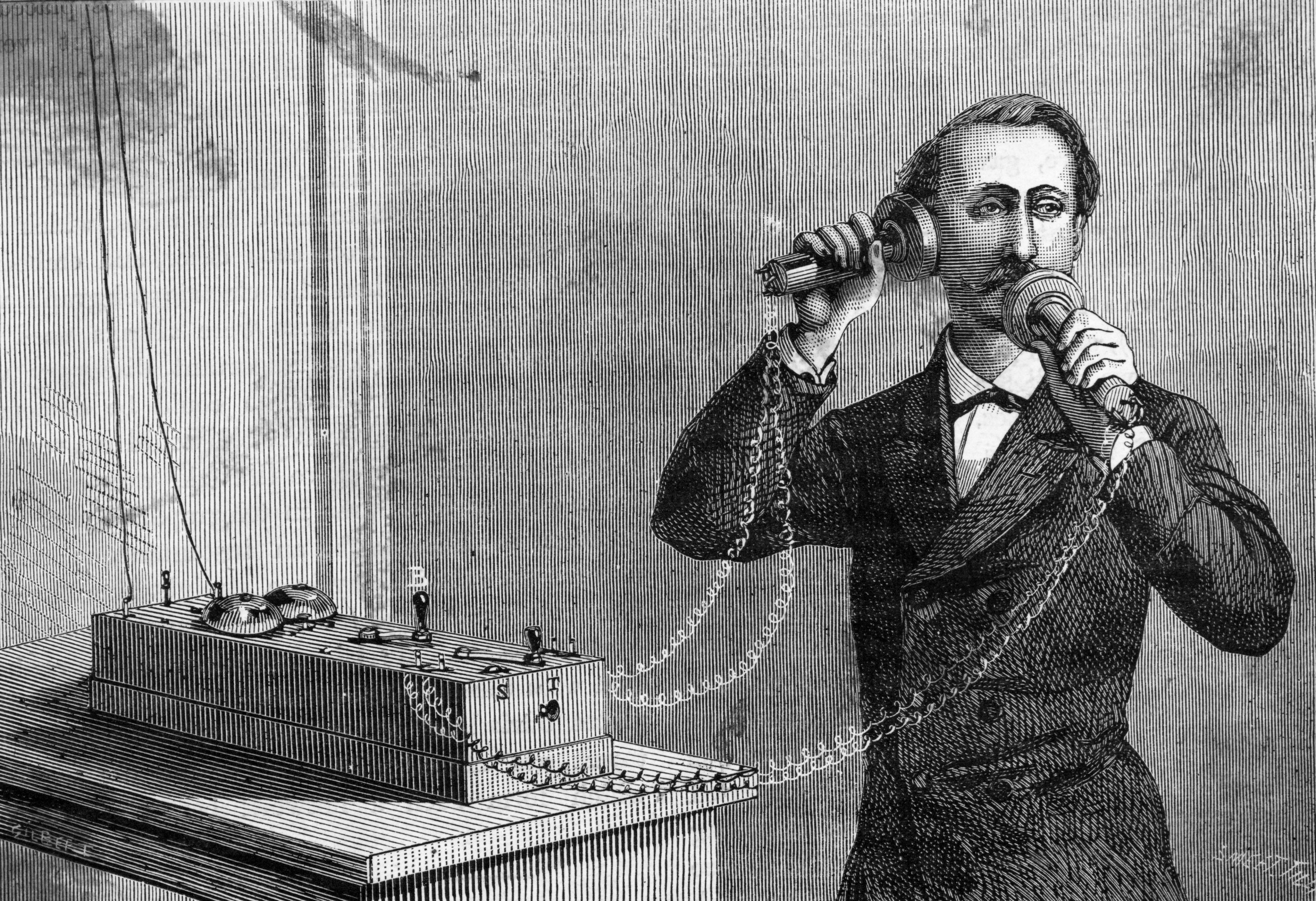
So Gray became the Winklevoss of the telephone, and the rest of the country spent a couple of decades trying to figure out how exactly to use the thing. The first phone lines were point-to-point connections; people set up direct lines from office to factory or from an executive’s home to the office. Quickly obviating that arrangement was the telephone exchange, with each line connected to a central switching station where it could be connected to any other line connected to the station. There was some thought of the telephone as a broadcast medium: Churches sent sermons to shut-in old folks; a theater in France offered a subscription that let you call up and listen to the production.
Soon enough, practice and convention coalesced around the telephone as a medium for person-to-person communication. Its two main purposes were there all along, in Bell’s first message—“Mr. Watson, come here, I want you”—the working out of logistics and the expression of desire.
The AT&T of the 20th century was the phone company, colloquially known as Ma Bell: a government-enforced monopoly that, as part of the deal for market control, wasn’t allowed to set its own prices and nevertheless saw its protected profits pile up. The surplus and lack of competition enabled it to set up a corporate research arm unlike any other: Bell Labs, according to Gleick, “allowed itself the luxury of hiring abstract theorists and quirky oddballs, and gave them offices and a degree of free rein.” Inventions were “not to be scheduled nor coerced,” according to its director, Harold Arnold. Arnold, in what he considered the cultivation of “genius,” expected his staff to stay abreast of the scientific literature and meet with experts in their fields while he provided them with any equipment they needed.
“Its scientists had specific problems to solve,” Gleick writes, “but when the problems were examined from so many divergent perspectives, general principles came into focus.” And so, “without meaning or planning to, Bell Labs enabled the information age.”
Enter Claude Shannon, a melancholic juggler who sometimes rode a unicycle. In 1940, Shannon began a doctoral dissertation titled “An Algebra for Theoretical Genetics,” in which, even before the discovery of DNA, he worked out principles for thinking about its combinations that had to be “rediscovered later,” because he never published the paper. He is the centerpiece of both The Information and The Telephone for good reason. While figuring out how to help the phone company boost signal, reduce noise, and tell one from the other, Shannon published a treatise called “A Mathematical Theory of Communication,” in which he coined the term “bit”—short for “binary digit”—as a fundamental unit of measurement. The thing being measured was information.
Information theory is the foundation upon which so many of the technologies we take for granted are built. To say Claude Shannon’s insights enabled the 21st century as we know it is to sound grandiose, but it’s not wrong. There’s a reason Anthropic named its chatbot Claude. A counterintuitive thing about the Information Age is that in its fundamental text, Shannon made a curious stipulation meant to divorce “information” from its semantic content, in order to focus on its “physical” factors rather than its “psychological” ones. The stipulation is this: “The ‘meaning’ of a message is generally irrelevant.”
Gleick’s words, my emphasis:
As the printing press, the telegraph, the typewriter, the telephone, the radio, the computer, and the Internet prospered, each in its turn, people said, as if for the first time, that a burden had been placed on human communication: new complexity, new detachment, and a frightening new excess.
Two of the latest to make these observations, as if for the first time, are James Marriott and August Lamm. The criticism is right—a new burden has been placed on human communication. The dissemination of messages of any kind, regardless of “meaning,” has become essentially frictionless. Information in the Shannon sense is everywhere all the time, as each author notes. Lamm: “How could I forget that the infinitude of human knowledge was in my pocket?” Marriott: “Everyone in the world has all the world’s knowledge slotted neatly in their pocket.” And Gleick, who is not writing a polemic: “instantaneous access to some approximation of all human knowledge.”
When information is abundant, attention gets scarce. We have only so much of it, and we haven’t yet learned to guard it as jealously as we should. Marriott, in The New Dark Ages: The Death of Reading and the Dawn of the Post-Literate Society, is worried about the effect of the attention shortage on our public discourse. Lamm, in You Don’t Need a Smartphone: A Practical Guide to Downgrading Your Phone and Upgrading Your Life, is worried about its effect on our inner monologues. They each put a lot more faith in the past than is warranted. Take it from someone who used to live there.
Marriott is a columnist for The Times of London and a Substacker with more subscribers than I would have guessed. Like any good op-ed page resident, he’s worried about kids today. “People really used to read more,” he writes, without bothering to note that there used to be a lot less to do. “The age of print is giving way to the age of the screen.” They’re not only reading less, but less well. One university lecturer “used to expect students to easily read a novel in a week” but “had already given up trying to teach George Eliot’s Middlemarch and James Joyce’s Ulysses.” Marriott points to a 1940 George Orwell review of a study of children’s reading habits, which included Dickens, Stevenson and Shakespeare, among others.
“By contrast,” Marriott writes, “a recent study of English literature students at American universities found that many struggled to understand the first paragraph of Bleak House.”
The first two sentences of Bleak House: “London. Michaelmas term lately over, and the Lord Chancellor sitting in Lincoln’s Inn Hall.” Do you know what Michaelmas term is? Lincoln’s Inn Hall? Does the Lord Chancellor rank above or below the Sheriff of Nottingham?
This study—of 85 Kansas college students in 2015, as it turns out—doesn’t suggest much beyond the unsurprising fact that it’s not very easy for a student to quickly parse a 165-year-old text originating from a different country. I had some trouble when I read Bleak House last year, a quarter-century after I wrote a paper on the presence of smallpox in the book, for Elaine Freedgood’s Major British Novels class. I got a C, probably because I only made it through the first 100 pages. I mention this to suggest it’s not news that students generally prefer less work to more work.
I will concede that students generally seem to read fewer books than they did 10 years ago—their attention is literally elsewhere. If you want, we can call this a lowering of standards. The thing I won’t call it is the fall of civilization. But Marriott thinks it might be. He’s worried that our collective reduction in reading will see our reversion to an “oral” culture, and that “we may be about to find out that it is not possible to run the most advanced civilisation in the history of the planet with the intellectual apparatus of a pre-literate society.”
Without the steady hand of print culture requiring its participants to make arguments rooted in facts and reason, Marriott worries we’ll find ourselves awash in superstition and appeals to emotion. Imagine.
“Effective democracy requires an informed and reasonably critical citizenry capable of understanding and debating the issues of the day in detail and at length,” Marriott writes. His conclusion is that we need to cling to reading. Mine would be that “effective democracy” has never been tried.
Marriott is rehearsing an old worry: This time is different. These new anxieties are the oldest anxieties, about entering and inhabiting a world different from the one we’ve known. Socrates had them. Via his student Plato, we have some griping about the very thing Marriott reveres: “For this invention will produce forgetfulness in the minds of those who learn to use it, because they will not practice their memory. Their trust in writing, produced by external characters which are no part of themselves, will discourage the use of their own memory … you offer your pupils the appearance of wisdom, not true wisdom.”
And, well, Socrates was right. We did not practice our memory. We had to write down The Odyssey because no one could remember it anymore. In that exchange, we got new kinds of literature—more interiority, less one damn thing after another.
Moreover, we got new kinds of brains. As Walter J. Ong argues in an article whose title is its thesis, “Writing is a Technology that Restructures Thought.” Ong, a Jesuit whose hugely influential Orality and Literacy is a seminal book in media theory, holds that literate cultures, as opposed to oral cultures, are not only able to do things like keep complicated accounts but are able to “separate the knower from the known,” to deal in abstractions, to fix an idea in space and return to it for re-examination. But where Ong makes an observation—“Without writing the literate mind would not and could not think as it does”—Marriott makes a value judgment: “Society is a better and more rational place thanks to the advancement of reading.” It probably is. We can’t prove otherwise. But society was never a purely rational place.
Marriott suggests that if your argument tries to appeal to feelings (that’s pathos, in case my students are reading), you’re cheating. Same goes for the ethical appeal: “The authority of many public ‘thinkers’ in the age of video is founded not on their superior skills or argument or their unusual analytical abilities but on charisma, fluency and confidence,” he writes in The New Dark Ages.
It’s too bad Marriott finds the emotional appeal undignified, because I’m emotionally on his side. Text is my preferred medium for engagement with ideas, and I do think it requires a quality of attention different from other media. But film, YouTube video essays, or even TikTok shorts are not necessarily devoid of sophisticated thought and argument. Conversely, very well-read people make shoddy arguments all the time. One need only look at Marriott’s book.
Marriott takes a swipe at the (unnamed) woke, calling it “[a] disaster if contemporary anxieties about Western civilization or sophisticated scepticism about the myth of progress led us to become complacent about the disappearance of one of our most important achievements.” Reading and literacy are shifting, not disappearing. While I, with Marriott, might long for the time when “[w]riters were both the entertainers of the masses and the consciences of the age,” that age was gone before Marriott or I were born.
Marriott happily deploys Ong while building his case for the many consequential benefits of literacy, but Ong suddenly disappears when Marriott wants to argue that we’re headed for a pre-literate age. That’s because Ong disagreed.
Gleick puts it well in The Telephone: “In the 1960s and ’70s, Ong declared the electronic age to be a new age of orality—but of ‘secondary orality,’ the spoken word amplified and extended as never before, but always in the context of literacy: voices heard against a background of ubiquitous print.”
Marriott’s worry about a reversion to pre-modern modes of thought ignores an important fact: Technologies live alongside each other. The technology that restructured thought persists, and it will live alongside—informing and providing the foundation for—whatever technologies come after.
If I spent the bulk of Marriott’s book thinking, “Citation needed,” I spent much of my time with Lamm’s You Don’t Need a Smartphone thinking of the opening line from Andy Daly’s great Comedy Central show, Review: “Life: It’s literally all we have. But is it any good?” Lamm is in some ways the mirror opposite of the tech bro who thinks anything that can’t be quantified or automated is beneath consideration, like that guy who recently bragged about setting up an AI replica of his voice to read to his kid. Conversely, Lamm would have us believe that anything we can do with a smartphone, that “guaranteed evil,” is better done any other way.
Lamm got her first smartphone at 14. Not long after, she found some success selling her art on Instagram. But soon she was spending more time setting up videos than she was drawing. She started to hate it. Eventually she divested herself of her smartphone. Later, she got off social media and even sold her laptop. Lamm now checks her email at the public library. She wrote and illustrated a pamphlet in which she offered people practical tips on going no-contact with their smartphones. In this book-length self-help expansion, she tries and fails to give her how-to guide some philosophical underpinnings.
Just as Marriott points to a more literate, more rational time that, if it ever existed, ended at least two generations before he was born, Lamm has blamed on the smartphone one of the oldest problems of human existence: We don’t want to be alone—with ourselves, or with our thoughts. The issue isn’t that the smartphone caused this unease, but that it makes this escape easier than ever.
I don’t know about you, but time alone with my thoughts doesn’t often lead me to more acutely tune in to the world around me. It leads me to the all-night movie house in my brain that runs a supercut of my failures and faults as a teacher, writer, father, and husband. The film is called Mistakes, Mortifications, and Missed Opportunities, and it’s always showtime. So, yeah, sometimes I listen to a fantasy football podcast while on the Red Line.
Lamm would argue that desire for distraction makes me somehow less authentically myself. “It is important to recognize that regardless of how much or how little you engage with screens, the very fact that they are a part of your routine affects how you perceive reality,” she writes. True! But screens are part of my reality. Aren’t they part of yours? I’m writing this on one. You’re reading on one. Are we not real? I think we are, but Marriott and Lamm both make a distinction between the “real world” and screens.
“For a lot of people,” Marriott writes, "reality is an increasingly marginal phenomenon that occurs around the edges of screen time.”
I can think of at least one 80-something for whom screen time constitutes a significant part of his waking existence, and whose responses to those stimuli have physical, material effects all over reality. One last time, let’s hear from Ong: “Technologies are artificial, but—paradox again—artificiality is natural to human beings. Technology, properly interiorized, does not degrade human life, but on the contrary enhances it.”
“Properly interiorized” is doing a lot of work. It matters what we read and watch, and who we talk to and how. It always has. I think it’s important to retain as much of our capacity for attention as we can, and to always keep in mind that these interfaces and the various media we access on them are controlled by tech cartels who do not have our best interests at heart.
The tonic of a thorough history like Gleick’s is the long view: Everything is always getting worse; we’re always already tumbling from Eden. In 1877, an editor at The Stark County News in Toulon, Ill., warned that the telephone, “The New Terror,” would “deluge the world with talk.”
“He imagined,” Gleick writes, "everyone placing the telephone at the bedside, where it would issue news and gossip and entertainment all day and night. … ‘We shall all thus live,’ he said, ‘with all our nerves bared to the least vibration of the roaring world.'”