

It’s hard to overstate just how absurd we thought the whole thing was, even as we purchased tickets and organized getting to the theater. A Paranormal Activity play. Not a musical, I stressed, though my friends and I kept laughing at how funny that idea seemed. I don’t live in New York and am therefore distant from its many stage sensations, though I’ve been hearing about movies and TV shows, well-known IP, popping up on Broadway for years.
I remember when the American Psycho musical premiered with Doctor Who (Matt Smith) in the starring role in London in 2013, when they turned The King’s Speech into a play the year before. I was particularly taken with the Once musical as a teenager, though less so with the Moulin Rouge! musical that added more contemporary songs to the jukebox. Last year, Stranger Things: The First Shadow made its way to New York from the UK, a whirlwind of impressive special effects and basically nothing else.
Then Instagram ads for Paranormal Activity populated my feed in late August. I thought maybe a nationwide rescreening was being teased for Halloween. It’s been almost 20 years since the first installment came out, so why not? But I’d missed the tag that read “A New Story Live on Broadway” until a close friend whose critical opinion I value said she was going to see it. I’m an evangelist for the third Paranormal Activity movie, but that’s only because I’m an evangelist for the found-footage form, and that film’s admittedly dumb but effective scares are still some of my favorites.
And while I love horror, I’m often reluctant to get my hopes up when a new sensation rocks the world of my fellow fans. I’ve never thought that the genre needs elevating, but that it could use a bit of renewed enthusiasm. Even the work from younger directors feels warmed over. So when my friend got out of Paranormal Activity and texted me that she liked it, I squinted at my phone. Surely not. How could a Broadway spectacle create the same feeling as a jump scare? What do you do when you take away the camera from a found-footage story?
I didn’t go to New York only to see Paranormal Activity, but as soon as I knew I’d be in the city, I started making plans. The play had just been extended past its original run, and when I told people I was going to see it, I was met with a uniform “I’ve been meaning to go!” The week after Halloween, my friends and I arrived downtown on our way to the August Wilson Theatre and were met with a buzzing line snaking around the block. It became clear, though, that this was a queue for the Michael Jackson musical across the street, a chilling way to begin the evening. Inside the theater, ’90s alt rock was playing, Soundgarden’s “Black Hole Sun” into Smashing Pumpkins’ “Cherub Rock” into Nine Inch Nails’ “Ruiner.” What these songs had to do with the play, I still don’t know—if I hadn’t looked at the Playbill, I would have assumed the story took place in the ’90s—but it made a strong, if slightly confusing impression.
Beyond the change in both medium and format, a Paranormal Activity stage adaptation has to address any number of alterations. As the critic Helen Shaw points out in her New York Times review, horror films are cheap to make, but productions on a Broadway scale are notoriously expensive. It’s not a matter of adequate special effects—the stage is where the optical illusions of early cinema were born—but of the recreation of the outside world within the bounds of the proscenium. Without the editorial trick of cutting to a jump scare, other methods would have to be used in order to startle the audience.
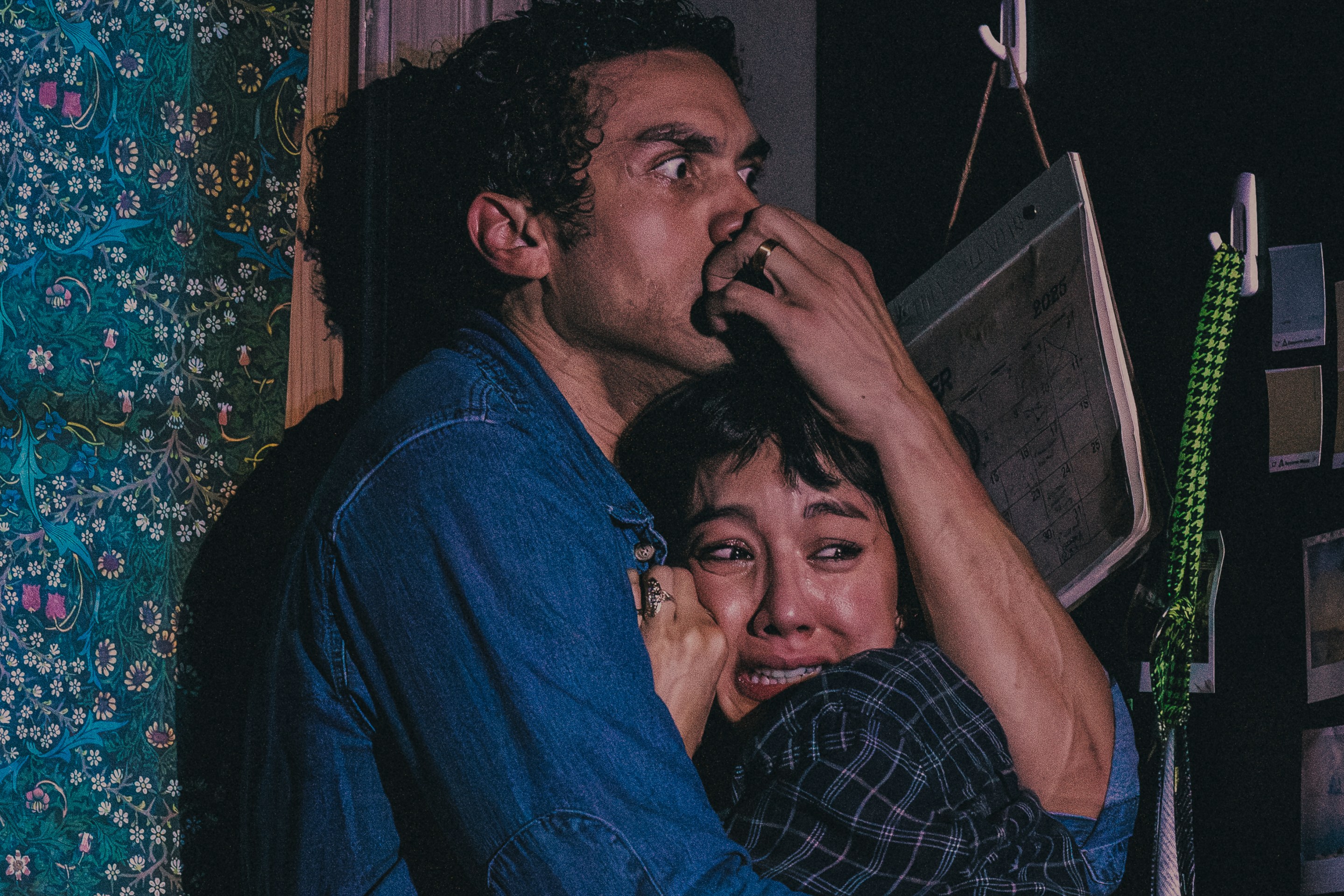
I kept all this in mind as the lights dimmed and Radiohead’s “Just” got louder and louder through the auditorium’s speakers, crescendoing on Thom Yorke screaming, “You do it to yourself!” This new story within the Paranormal Activity universe takes place in present-day London, a vestige of the play’s original run in the West End. Newlywed Yanks James (Travis A. Knight) and Lou (Cher Álvarez) have just moved to the city after a murkily described but clearly harrowing episode in Chicago. The play’s most consistently impressive central element, and the defining difference between it and the film franchise’s use of found footage, is the set designed by Fly Davis: A stunning cross section of a two-story house that grants the audience a view of the kitchen, living room, bathroom, and bedroom all at once. A canny exploitation of negative space, Davis and director Felix Barrett understand that no matter what action is happening in one part of the house, throughout the play, as characters move around the set, the audience’s eyes will be drawn to the dark corners where they’re expecting something to emerge.
Knight plays James as an attentive husband whose goodness feels suspicious, a tall and boisterous man who projects a sincerity that’s just slightly off. Álvarez has the more difficult role as Lou, a woman reeling from traumatic occurrences back in Chicago and even further into her childhood. She is at once combative and vulnerable, quick to call out James’s hypocrisy when it comes to the emotional toll of their relationship, while nurturing a private obsession with the occult and supernatural. Lou is a classic horror archetype, a woman besieged by otherworldly forces whose fear and aberrant behavior as a result of that fear is understood as mental illness by her male partner.
Much of the first half of Paranormal Activity is devoted to sketching out the contours of the problems, recognizable but generic, between James and Lou. He’s condescending and defensive. She’s pleading and stubborn. He wants a baby and fixates on the spare room being called a nursery. Lou isn’t so enthusiastic. These are broad gendered brush strokes occasionally (and thankfully) troubled by Knight and Álvarez’s performances, physical actors who bound up and down the set with welcome energy, especially when their rote dialogue drags on. Still, theirs is an obnoxiously straight and anodyne relationship, with any texture or complication to their individual personalities sanded down in favor of mass appeal.
The play runs just over two hours, including the intermission, and the first half is not only the longest, it feels like it, too. There are more than a few grating jokes about how strange England is compared to America. The presence of various devices—phones, TV screens, Alexa—situates the play in a straining-for-relevance mode of pandering. See, playwright Levi Holloway seems to say throughout, these are normal, modern people. James and Lou argue about the presence, or not, of a malevolent entity that’s attached itself to Lou. It’s not places that are haunted, the show is at pains to point out, but people. And so, it doesn’t matter where you flee. This is an intriguing idea that also acts as an alternately creative/contrived (you decide) reason to keep James and Lou in the house.
In the middle of the night, the house alarm goes off. The electricity in the house is on the fritz. Doors open and close on their own. A bird slams into the window, killing itself. The challenge with tropes is that you know how they appear and in what order. I felt impatient for the play to justify its existence in this format, an admittedly heavy burden of meaning to foist on an adaptation of a franchise I don’t care all that much about. But I’d heard so much hyperbolic praise about this production. I was hoping to be shaken out of my critical distance. I wanted to gasp.
To its credit and its detriment, Paranormal Activity achieves its best moments through clever, seamless special effects. The most impressive scare comes after James and Lou have had a particularly bad fight. Lou storms upstairs into the nursery/spare room while James sulks downstairs. When Lou returns, she and James share a tentative embrace and she goes into the kitchen. Wearing a hooded bathrobe with her back to the audience, Lou goes still while James talks on the couch on the opposite side of the stage. In quick succession, the real Lou bolts out of the spare room on the second floor in the same outfit, while the Lou in the kitchen disappears, the bathrobe dropping, the body beneath vanishing as a loud sting on the soundtrack emphasizes the moment. We have just seen a ghost materialize and wink out of existence before our eyes.
The audience, up to that point quick to laugh but not necessarily impressed, howled and screamed. I smiled, nodding my head. James looked to Lou at the bottom of the stairs as she said, “Do you believe me now?” and the stage went dark in the transition between scenes. Everyone clapped and hooted. The play was finally finding its legs. The end of Act One is a doozy which I won’t describe, but it’s also the zenith of Paranormal Activity’s ingenuity and narrative energy.
The second, shorter half forgoes the setup for a series of set pieces where scares are frequent but illogical. Suddenly, the focus changes from Lou to James, who is given a late-in-the-game backstory meant to shift everything we’ve seen up to that point. What Holloway intends to illustrate is a gradual spiral into paranoia and terror that isolates the couple from the outside world. Perhaps this works better on paper. In the performance, this fearful retreat from a shared reality happens suddenly, and the potential for James and Lou’s characters to wrinkle into interesting, unique people is truncated in favor of increasingly horror-movie-brained poor judgment. James and Lou finally reach out to an expert, the paranormal scholar Etheline Cotgrave (Eva Kaminsky, who gets far too little time in the spotlight), and the insular dynamic between the couple changes completely. But this is a momentary opening-up of the proceedings. Whatever interruptions come later are merely intrusions the playwright is constructing to keep the audience awake.
Indeed, it’s in the less exciting but nonetheless important details of story and character, rather than the moment-to-moment thrills the play executes with precision, that Paranormal Activity fails. It’s one thing to posit that Lou is the haunted one rather than her new home. But Holloway merely makes this a reason for James and Lou to never leave the house, which transforms the novelty of the set into an obvious limitation. Frequent fades to black seem to erase events that came before rather than stitch them together. The couple ask for outside help exactly once and then, after every subsequent scenario in which the vindictive supernatural entity stalking them makes itself known, the stage fades to black and illuminates again on a new scene where, in the intervening time, it seems as if James and Lou have done almost nothing.
Suspense is, in part, built on revelation and the consequences of that revelation, an elastic band that stretches and snaps back in increasingly rapid succession until it breaks. As cookie-cutter as the first half of Act One is, it also makes the audience lean forward, waiting for something bad to happen. Act Two overdelivers on the promise of more scares. They come often and without much inspiration, the effects—and their effect on the audience—dissipating quickly. I started counting to three during scenes where a character did something more than once—lighting and blowing out a candle, covering and then uncovering their eyes—because so many of the scares happened after an action was repeated three times. It’s actually when things are stripped down that the play excels.
Late in the second act, James and Lou sit down on the floor of their dining room and tell each other foundational secrets about their youths. The set hasn’t moved, but the audience’s focus in that moment is winnowed down to two actors sitting on a blanket next to a lamp. It’s in this scene between two characters swapping unsettling and troubling histories that Paranormal Activity finds the kernel at the heart of a successful horror story. The fanfare and bluster can be diverting, but the essential building block of something that gets under your skin is when you’re pulled into a new reality. In the case of this late scene, Knight and Álvarez skillfully do what the rest of the play is trying to: convince you that what is happening onstage might follow you home.