
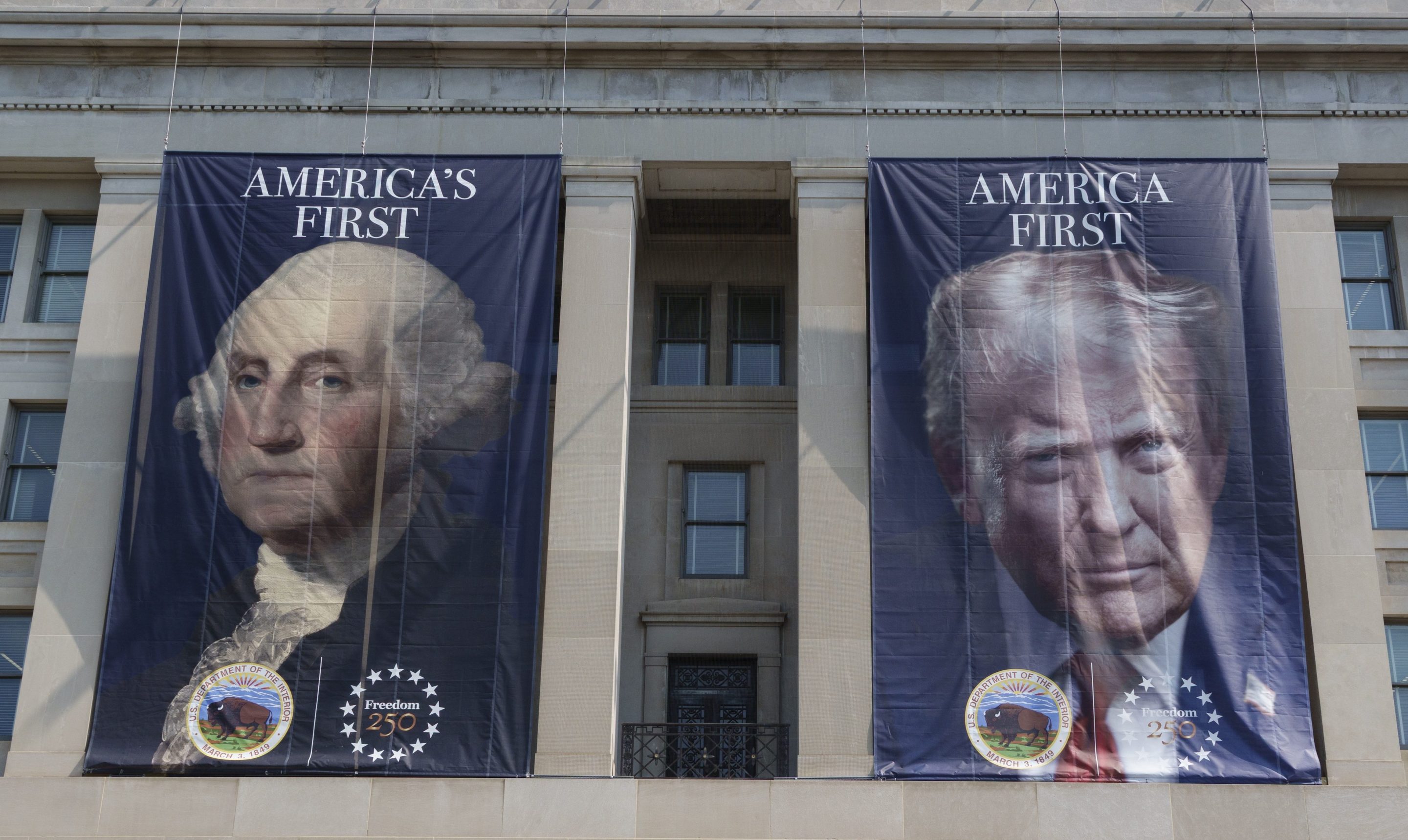

As the nation marked its 250th anniversary this summer, Donald Trump could not stop posting AI-generated images of himself alongside George Washington. In one, Trump and Washington ride horses through a bucolic landscape, the sun setting in the distance. In another, Trump saves Washington from falling off a cliff; this one is styled as a movie poster for a time-traveling buddy cop film. These are in addition to the very real images of Washington’s and Trump’s faces hanging side by side on massive banners outside the Department of Interior building.
More than any others though, Trump posted images of him and George Washington in the proposed White House ballroom. There's one in which Trump holds rolled up architectural plans (in an already-completed ballroom) while pointing out some distant feature to George. In another they both stand in the ballroom staring directly at the camera; even from the front you can tell they’ve both adopted Trump’s signature ass-out posture. There are at least five different versions of this particular scene.
Trump’s insistence on posting images of himself alongside George Washington offers the perfect distillation of how he thinks about history. For him, history is synonymous with celebrity—and there could be no higher honor for our historical VIPs to be feted in Trump’s glimmering new ballroom. Unwilling, for obvious reasons, to wait for history’s judgment, Trump uses AI to place himself alongside the past’s most famous figures.
During his second term in office, Trump has tried to reshape the country’s museums according to this facile logic, seeing them as little more than halls of fame; like Madame Tussaud’s or the stars along Hollywood Boulevard, they’re places to remember the names of famous people, and then appreciate just how famous they are. This might all be comical if administration officials and a coterie of opportunists weren’t using Trump’s convenient fascination with celebrity as a vehicle for advancing their own long-held ends. Though slightly more intellectually robust (if no less dishonest) than Trump’s name-dropping, they’ve censored some histories and totally recast others to propagate a distorted, narrow, and blithely celebratory vision of American history.
This is at odds with the work that history museums actually do. What’s more, it presents a version of history that Americans again and again insist they do not want.
For roughly as long as the nation has been around, histories of the United States have used heroic figures to inspire patriotism or instill lessons in moral character. The first biographies of George Washington—they began to appear within months of his death—made him a symbol of American virtue. The volumes were often dedicated to the “youth of America” and focused on Washington’s “private virtues,” like sacrifice, determination, piety, or thrift. This emergent, mythic Washington was a model for children to emulate to become good Americans. In his 1807 biography, South Carolina politician and historian David Ramsay urged America’s youth to see that Washington’s “life affords the brightest model for imitation.”
A similar focus on how “great men” shaped the nation and the world persisted throughout much of the 19th century. These works didn’t only focus on a small number of “heroes”; they often suggested that these individuals had been marked for greatness since birth through some genetic predisposition or divine selection. The great man theory of history is often linked to the Scottish writer and early historian Thomas Carlyle, who wrote in 1840 that “The History of the World,” was little more than “the Biography of Great Men.”
Yet as history formalized into a professional discipline in the early 20th century, it began to jettison the work of gentleman scholars that had defined much of the previous century and instead adopted increasingly rigorous, evidence-based methods. Historians began emphasizing the ways in which broader, more impersonal economic, social, and political forces had shaped the lives and actions of political and military leaders. These “New History” scholars insisted that American history wasn’t just about George Washington, but also about ordinary people and material conditions.
For some, this change was too much to bear; more importantly, it stood in tension with what they viewed as history’s civic purpose, namely, providing inspirational lessons for children. Some Americans objected, attempting to keep the “New History” out of schools and confined to university seminars where it belonged. They insisted that only an emphasis on “heroes” could properly educate the nation’s young people at a time of profound social upheaval. State laws attempted to bar texts that might “defame our nation’s founders” or “belittle illustrious American patriots.” What’s more, these objections came not only from groups like the KKK, who sought to preserve reverence for white founders, but also from African-Americans and other ethnic groups who sought to place their own ancestors alongside them in the American pantheon. “All these groups,” historian Jonathan Zimmerman has written, “rallied behind hero worship in history, challenging any text that dared to question the courage or conduct of America's multi-ethnic founders."
A century later, Trump’s fawning over icons of the past offers an even shallower interpretation of history than even the earliest proponents of the “great man” approach to history. While previous generations of writers and scholars may have overestimated the importance of individual figures in shaping world events in service of teaching broader moral lessons, Trump celebrates the past’s most famous figures for their fame alone. While early biographies may have carefully avoided mentioning that George Washington owned slaves, in 2023 Trump told an audience outright that “he probably didn’t.” For Trump, it seems, historical relevance doesn’t just start at celebrity—it ends there too.
This tendency at least explains some of Trump’s more mystifying statements. Like how he could, in 2017, express his gratitude that the Smithsonian’s National Museum of African American History and Culture honored Frederick Douglass, “somebody who’s done an amazing job and is being recognized more and more,” while last year complaining that the museum focuses too much on “how bad slavery was.” Honoring people who Trump has heard of is good; talking about their lives in ways that might make him sad is bad.
It also helps explain Trump’s objections to the recontextualization or removal of monuments and statues of historical figures. When protests against racial injustice in the summer of 2020 questioned who we, as a nation, quite literally choose to put on pedestals, they targeted monuments of people like George Washington, Thomas Jefferson, and other enslavers. Trump decried this in a major speech at Mount Rushmore on July 4. “We will never let them rip America’s heroes from our monuments,” he said.
He went on to bring these ideas to their largest and dumbest possible conclusion: the “National Garden of American Heroes.” Becoming one of Trump’s signature initiatives for commemorating the nation’s 250th anniversary, the proposed “Garden” would bring together statues of 250 “legends of America’s past” so they could be appropriately honored. The list of figures to be included in the statue garden reads more like a textbook index than a serious proposal. It is a dizzying, logic-defying mix of presidents and professional athletes, authors and inventors, generals and civil rights heroes, all linked by little more than name recognition. Kobe Bryant is on the list. John Glenn, John Adams, John Muir, Johnny Appleseed, and Johnny Cash all made the cut. So too did Sam Houston and Whitney Houston; Billy Graham and Billie Holiday; Marie Curie, notably not American, is in there.
Now that the 250th has passed, along with Trump’s attention, it seems unlikely the garden will ever come to fruition. Still, it offers a neat illustration of Trump’s view of history. According to Trump, statues are “silent teachers” that “inspire those who are to come.” In this formulation, a gross simplification of the “great man” school, the entirety of the past exists for the inspiration of the present and there’s no better way to do that than by remembering some guys.
This childish conception of history is what makes the images of Trump and Washington in the ballroom so apropos. For Trump, historical figures are little more than VIPs who should be fawned over and treated well, and he certainly believes he belongs alongside them. One should not, just to pull examples at random here, talk about the decades they spent owning other people as property, or their close friendships with the nation’s most notorious sex criminal. Interrogating who these people were or what they did or the broader cultural, social, or political contexts in which they lived—in short, treating them “very unfairly”—isn’t just un-American, it’s gauche, like insulting a party guest.
Unfortunately, however, Trump’s obsession with celebrity has served as a convenient vehicle for better-read conservatives to advance their own long-standing views of history. These efforts go far beyond Trump’s concern about whether we’re properly appreciating Evel Knievel’s heroism or whatever, instead using “great man” history in classrooms and museums to inspire uncritical national pride.
To understand today’s history controversies, we have to also understand the longer trajectory of America’s “history wars.” In the second half of the 20th century, historians continued to transform both how and what they investigated in the nation’s past. Amid movements to achieve both civil rights and women’s liberation, historians increasingly told stories about ordinary people—doing history “from the ground up”—and emphasized the ways race, gender, and class were key to how we viewed historical developments. Armed with new methods and sources, historians began expanding whose stories counted as part of our history.
As with the emergence of “New History” 50 years earlier, this new “social history” faced backlash, particularly in the classroom. In 1959, writer E. Merrill Root complained that history texts only emphasized America’s faults and only linked patriotism with “the excesses of the extremist.” When California tried in the mid-1960s to adopt textbooks that better reflected recent scholarship’s emphasis on a more inclusive vision of the nation’s history and people, some complained about “derogatory statements allegedly made about famous Americans.” History class, they claimed, was no place to “debunk our heroes.” Reflecting on the episode for The Atlantic in 1967, historian Harry N. Scheiber noted that the American right “commands both ample funds and sufficient public relations expertise to conduct a highly effective campaign against textbooks that offend conservative concepts of patriotism.”
Scheiber’s observation was prescient. In the decades that followed, conservatives had far more successes than failures when it came to determining the content of textbooks and school curricula. In 1985, conservative Texas education activists Mel and Norma Gabler published a book titled What Are They Teaching Our Children? They complained about textbooks’ lack of attention to national heroes. They asked, “Who deserves more attention in an American history text: George Washington or Marilyn Monroe?” Thanks to conservative activism—and the massive Texas market—textbooks around the country have become more focused on the founders over the past three decades, even as historical scholarship has mostly moved the other direction. According to an analysis by scholar Rachel D. Hutchins, George Washington appeared in elementary school textbooks on average about five times in 1982. By 2003, that number had grown to 17.
In the 1990s, amid concern that American students were falling behind in an increasingly globalized world, there was a brief effort to establish national standards for history education. Conservatives sunk that plan after years of work because of the proposed standards’ supposed inattention to American heroes. “Imagine an outline for the teaching of American history in which George Washington makes only a fleeting appearance,” wrote former National Endowment for the Humanities chair Lynne Cheney, criticizing the standards. According to her, these guidelines lacked a proper “tone of affirmation.”
More recently, after The 1619 Project tried to reorient the framing of American history to place slavery at the center, followed by the broader popular effort in 2020 to reassess the country’s legacy of slavery and racism and the role of many traditional “heroes” in perpetuating it, conservatives yet again doubled down on “patriotic” history. Between 2021 and 2024, Republican-led legislatures across the country introduced hundreds of what free speech advocacy organization PEN America has termed “educational gag orders” to ban the teaching of critical race theory, or even just “divisive concepts.” Dozens of those bills became law.
By almost any measure, conservatives have won the history education controversies of the past 50 years; for the most part, it’s been a rout. So, with this project seemingly complete by the time Trump returned to office in 2025, conservatives’ focus shifted to the next arena: museums.
This battle kicked off in March of last year when Trump issued an executive order titled “Restoring Truth and Sanity to American History.” In effect, the order demanded the removal of content that might “inappropriately disparage” famous Americans at any federal history installations, namely the Smithsonian museums and National Park Service sites. In the year that followed, the Department of the Interior removed interpretive signage and publications and redacted website content from dozens of NPS sites to comply with the order. The most notable among these was the removal of an outdoor exhibit at the “President’s House Site” in Philadelphia that told the story of the people George Washington enslaved while serving as President. Park Service staff first began removing the signs in January of 2026 and, after months of legal wrangling, replaced it with a new exhibit in June. The new exhibit uses Washington’s private statements opposing slavery to paint him as an early abolitionist.
(Disclosure: The American Association for State and Local History, where I worked from 2017 to May 2026 and for which I now serve as a research consultant, is one of the plaintiffs in a lawsuit against the Department of the Interior challenging the removal of content at National Park Service sites.)
During this second term, the Trump administration has also cancelled grants to history museums and others from the National Endowment for the Humanities and the Institute of Museum and Library Services. In its attempt to gut the NEH, the DOGE boys cancelled anything ChatGPT designated as “woke.” The NEH even began redirecting funds to statues for Trump’s National Garden of American Heroes; it later settled for a student art contest. IMLS has remained open despite huge layoffs, but now recommends grant applicants read and consider the “Truth and Sanity” executive order.
On July 4, 2026—the 250th anniversary of the nation’s independence—the White House’s Domestic Policy Council issued a report denouncing the Smithsonian’s presentation of American history. Full of conservative intellectual jargon, the 162-page report accuses the Smithsonian of “ideological capture” and of attempting “to divide, discourage, and dispirit our citizens.” Predictably, the report complains that visitors to the National Museum of American History (NMAH) “will find no major exhibit dedicated to America’s founding era, George Washington, Thomas Jefferson, other founding fathers, the Continental Congress, the pilgrims, the Puritans or major moments of the American Revolution.”
The executive order the White House issued to take action on the report complained that the history shared by NMAH didn’t include a sufficient expression of “gratitude.” The order also instructs the Department of Interior to install signage outside NMAH to warn visitors of the alleged distortions they’ll find inside and to direct them to other (as yet unnamed) resources on American history.
Donald Trump, for his part, offered an even simpler solution: Erect a giant statue of George Washington in front of the museum.
The administration’s focus on museums, whether that’s accusing them of indoctrination on a grand scale or lamenting that they do anything beyond offering a chance to marvel slack-jawed at titans of yore, both belie a fundamental misunderstanding about what history museums are and what they do.
The United States is home to more than 21,000 history museums and related organizations—historical societies, historic houses, historic sites and the like. There are more history museums in America than there are public libraries or McDonald’s. In many communities, they’re one of the few nonprofit institutions other than churches. Yet while the term “museum” might call to mind places like the Smithsonian or The Met, most history museums are operated on shoestring budgets by aging volunteers for the good of a small community. Their ubiquity and the amount of volunteer time needed to make most of them run reveal just how deeply committed Americans are to the civic project of preserving and sharing their history.
Indeed, despite a general lack of resources, history museums across the country do far more than just display old objects in glass cases. Increasingly, museums invite the communities they’re serving into the process, collaborating with them as partners in research, exhibit development, and programming. Rather than a few experts deciding what stories to tell and how to tell them, museums are now remarkably participatory.
What’s more, Americans trust museums. Recent research from the American Alliance of Museums revealed that Americans trust museums more than any other information source outside of “friends and family” or “public libraries.”
What Americans don’t seem to want is whitewashed, censored versions of the past. For example, a recent survey found 69 percent of Americans opposed efforts to pressure museums into removing certain types of content. They also express incredibly broad agreement that history should include the good, the bad, and all the messy complexity in between. In 2022, 87 percent of Democrats agreed that “George Washington and Abraham Lincoln should be admired for their roles in American history,” while 83 percent of Republicans agreed that “it’s important that every American student learn about slavery, Jim Crow, and segregation.” A study from the American Historical Association found that two-third of Americans agreed it was important to teach about historical injustices, even if that makes people uncomfortable.
Time and again Americans make clear that it isn’t woke social justice museums they’re worried about; they generally trust museums to do their work. And they don’t want what the Trump administration is offering them: a version of the past that has been edited and distorted for political ends. People can see the difference between Madame Tussaud’s and a history museum. They don’t think a stroll down the Hollywood Walk of Fame offers substantive lessons about the past. No matter how tall or shiny the statues, most Americans don’t accept them as a stand-in for actual, interesting, educational history. The unpopularity of this approach is precisely why the Trump administration finds it necessary to use the power of the federal government—by censoring content, cancelling grants, and issuing executive orders—to install its worldview. That’s not history; that’s propaganda. And it’s why these efforts, just like nearly all censorship efforts ever, are doomed to fail.