

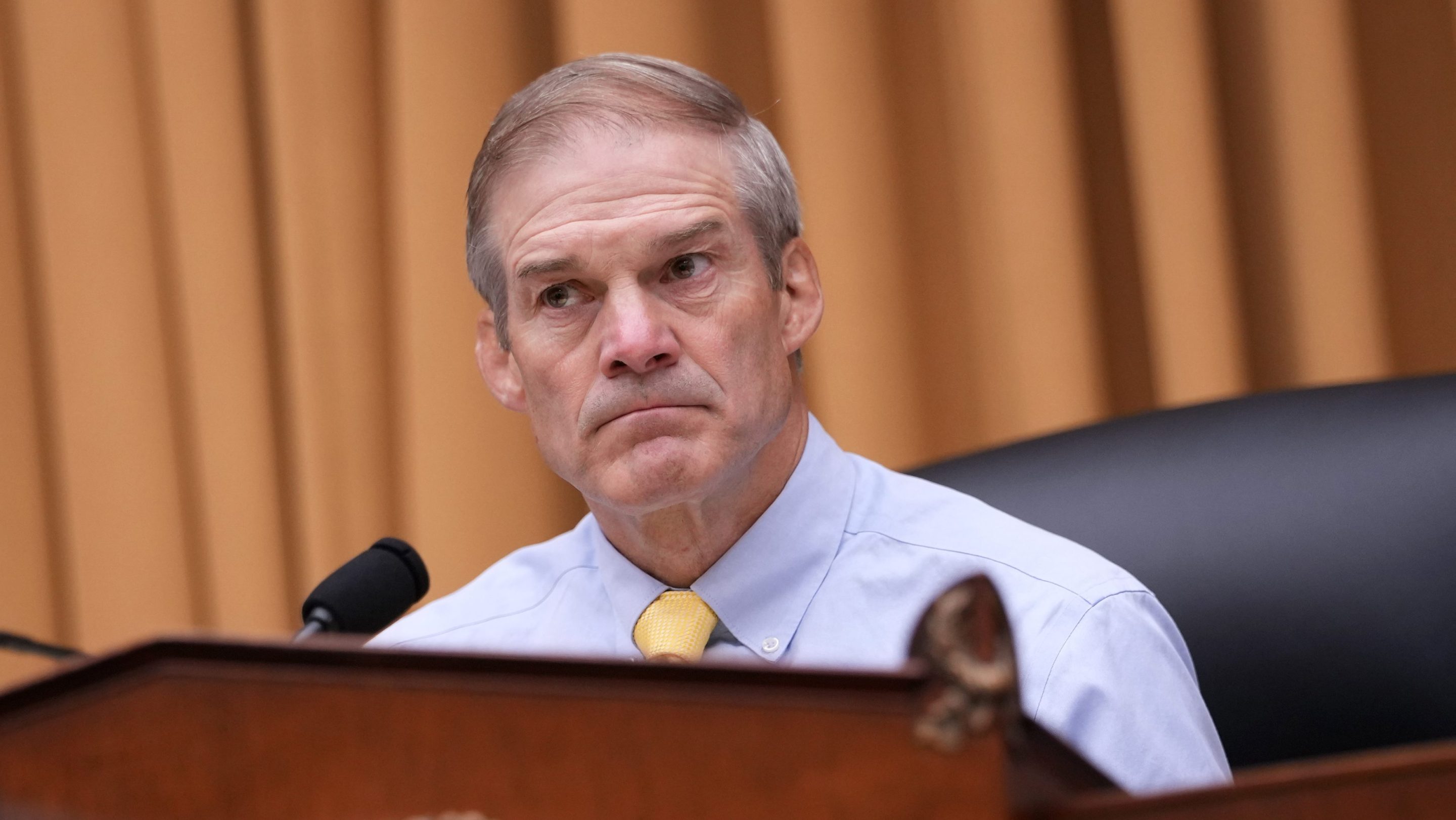
House Republicans elected Rep. Jim Jordan of Ohio this week as their new minority leader. He won 106-73 on a secret ballot. Those who follow politics will know his name as a staunch Donald Trump ally who served as chairman of the Freedom Caucus, voted to overturn the 2020 presidential election results, and ignored a subpoena from the House panel that investigated the Jan. 6 insurrection.
Jordan previously ran for the role of Speaker of the House in 2023 but failed three times to get a majority of the votes needed. This too was voted on by secret ballot. At the time, those who did speak about their "no" votes told NPR they voted against Jordan because of bullying and threats being made to them and their families by either Jordan or Jordan supporters.
But at that time, Jordan also was continuing to face questions about his connection to Ohio State's sexual abuse scandal. In 2018, former wrestlers for the university came forward, saying they had been sexually abused by a team doctor under the guise of him providing them with medical treatment, usually during a physical exam. The wrestlers forced an independent investigation, and the ensuing published report said that Dr. Richard Strauss sexually abused "at least 177 male student-patients" at Ohio State, many of them while he worked in the athletics department from the late 1970s until 1998. Strauss died by suicide in 2005.
Jordan "has made protecting Donald Trump his priority and still denies knowing about the sexual abuse we endured at Ohio State," Mike DiSabato, the first wrestler to speak publicly about Strauss's abuse, said on Wednesday.
Before he became a politician, Jordan was a scholastic wrestling legend. He grew up in Ohio, won four state championships as a high schooler, then won two NCAA championships at Wisconsin. Afterward he came back to Columbus, where he served as an assistant wrestling coach at OSU through the mid-1990s. At the time Strauss was abusing students, Jordan shared a locker room with the athletes and their abuser.
For many years, multiple wrestlers have said, on the record, that they believed Jordan knew about what was happening. DiSabato told CNN in 2018 that Jordan's locker was next to Strauss's. "I consider Jim a friend. But for whatever reason, he has made the decision to deny something that was absolutely happening," he said. "He had knowledge of it."
Another former wrestler, Dunyasha Yetts, told NBC News: "I remember I had a thumb injury and went into Strauss' office and he started pulling down my wrestling shorts," he said. "I'm like, what the f— are you doing? And I went out and told [wrestling coach] Russ [Hellickson] and Jim what happened. I was not having it. They went in and talked to Strauss."
Former wrestler David Range told the Washington Post, "Jordan definitely knew that these things were happening—yes, most definitely. It was there. He knew about it because it was an everyday occurrence."
Wrestling referee Fred Feeney, who said Strauss once masturbated beside him and grabbed his rear end in the shower after a match, said in the documentary Surviving Ohio State: "As I'm walking out, at the very end of that walkway, Russ Hellickson and Jim Jordan were both standing there, and I looked at both of them, and I said, 'Hey, Strauss is in there masturbating beside me in the shower.' And both of them looked at me, Jim Jordan looked at me straight in my face, and said, 'It's Strauss. You know what he does.' And Russ agreed."
Jordan denied having known anything about the sexual abuse. No "smoking gun" evidence ever became public—though it's worth remembering that Jordan's time at Ohio State mostly predated our digital lives, before text messages, social media, and ubiquitous pocket video cameras. Whatever conversations happened between Jordan and the wrestlers could only be documented if someone chose to take notes. And that would have been unlikely in the environment described by the wrestlers, who at the time didn't associate what happened with abuse. As former wrestler Mark Coleman said in the documentary, watching more than 150 gymnasts speak out in 2018 about their abusive physician prompted him to call up DiSabato. They talked and DiSabato realized, "Wow, that's us."
Jordan was interviewed as part of the investigation done for Ohio State, NBC4 in Columbus reported. An attorney who oversaw the inquiry said in a deposition for the civil suit that lawyers spoke with Jordan. There is no direct mention of Jordan in the investigative report—in it, coaches are not referred to by name—but "22 coaches confirmed to the Investigative Team they were aware of rumors and/or complaints about Strauss."
Since then, Ohio State tried and failed to stop a civil suit brought by those Strauss preyed upon. Jordan did sit for a deposition last year in a lawsuit brought by the men, court documents showed. In June, Ohio State's board of trustees approved a $100 million settlement, bringing the total paid to survivors up to more than $160 million.
After Jordan's new job hit the news, DiSabato posted a statement to Facebook. It suggested that Jordan use his new position to "join House Democrats in calling for a congressional investigation into campus sexual abuse."
"He would have the opportunity to explain under oath why he still says he didn’t know what Richard Strauss did to us," DiSabato said. "I’m willing to testify under oath about what I saw, what I heard, and what I experienced. Is he?"