
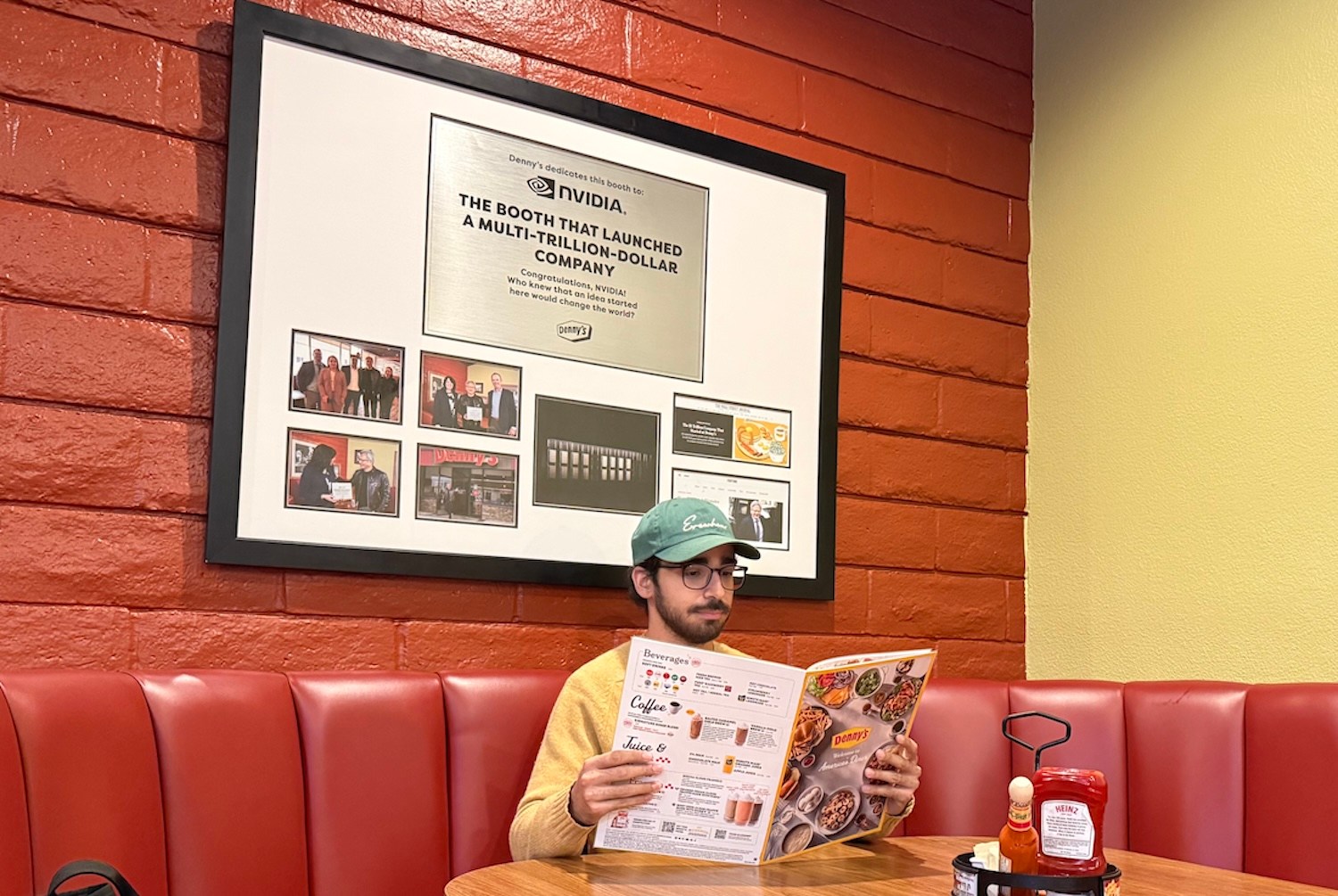
SAN JOSE, Calif. — "Excuse me, can you move so I can take a photo?" a woman asked me and my friend Adam, referring to the large plaque above us bearing seven photos and an inscription: The Booth That Launched A Multi-Trillion-Dollar Company. How could we deny a fellow pilgrim this humble reliquary? We were all here on this rainy Sunday evening to feel the weight of history settle lightly on our shoulders, and also to have some pancakes. We shuffled out into the otherwise empty room while she took a couple pictures, her solemn bearing occasionally quivering out into a quarter of a grin.
For Steve Jobs, inspiration struck in the garage at 2066 Crist Drive in Los Altos. For Mark Zuckerberg, there was room H33 at Harvard's Kirkland House Dorm. For Jensen Huang and his Nvidia co-founders, it all started at the Denny's at 2484 Berryessa Road in San Jose, specifically the big booth in the far corner.
Those looking to get closer to the Huang story have few options. You'll have a hard time founding a $4 trillion company, cheating on Jensen Huang's wife, or unwittingly passing on sensitive information to the Chinese government via a mysterious business executive. You have to go back to the beginning. Before Huang was the load-bearing joist propping up the American stock market and an alleged disgrace to the leather jacket community, he was simply a tech worker kicking around Silicon Valley during the first boom. The foundational myth of Nvidia, and by extension Huang, is grounded in the mundane social reality of life in Silicon Valley in some critical ways.
When one imagines what a place called "Silicon Valley" might look like, one might think of something grandiose, mildly fantastical, or, at the very least, impressive. One might be surprised then to find a horizontal region, one whose built environment and social superstructures are defined and limited by freeways and eight-lane surface streets, moving walls of cars that circumscribe a vast archipelago of strip malls and business campuses. Silicon Valley has neither the engineered beauty of San Francisco nor the topographic wonder of its surrounding mountain ranges. You can't walk here. Public transit is intermittently functional. Which is to say, a Denny's by the side of the 680 freeway isn't a bizarre or strikingly humble place for a company like Nvidia to have been thought up. It makes perfect sense.
If you happen to take the humble pilgrim's path to the Berryessa Denny's, traveling via public transit, you first see the red neon logo 12 lanes of traffic away, floating through the open spaces of an Arco. The Denny's is flanked to the north by a Chevron, one of three gas stations at the sprawling intersection, and to the south by a dentist, a printing shop, and the office of chiropractor Dr. Gia-Hung Phan, who claims to "Specialize in Car Accidents."
As Adam and I waited to cross the street, we compared our levels of Denny's experience. I told him I'd gone maybe twice, notably throwing its food up on a family road trip in San Diego as a child, while he hit me with the biggest surprise of the night: Not only is he a self identified "IHOP guy," he is descended from what he describes as "IHOP royalty." Though he possesses no noble title himself, he told me that his dad's brothers and cousins are the administrators of a vast IHOP empire, one that at its peak comprised more than 200 locations across the nation. He told me about the contraction and re-consolidation of the empire's core holdings as we walked across the lawn to peek into the Denny's and found, to our shared glee, that the corner booth was unoccupied.
The Denny's was surprisingly packed all the same, with one harried waiter named Sonny attending to maybe 20 people spread across seven or so tables in the chiropractor-facing south wing. We took our seats in the corner booth, which is in the otherwise completely empty north wing. In the past few days, contradictory reports have surfaced over whether or not this very Denny's took down or put up the plaque above the corner booth. Sonny told us that the plaque was never taken down, though I don't think I believe him, since there's a good deal of evidence to the contrary. He said people have been coming in to ask about it.
The uncertainty about the fate of the plaque mirrors the strange, paranoid state of discourse about Huang's ouster and the subsequent factionalization of the highest levels of tech and government. The superficial read of the Huang story is that it's about hubris: Nvidia got so big that Huang's ego overinflated and he started wearing leather jackets and having affairs. He was too blinded by self-regard to see that he was being honeypotted by China. The reality is significantly more complicated. The headline-grabbing infidelity is a way into understanding the broader aspects of the story that make it so fascinating.
Huang sits astride a number of tectonically active geopolitical and technological fault lines. He favors freer trade with China and open-source AI models, as opposed to a hawkish relationship with China and AI development led by private frontier labs like OpenAI and Anthropic. As such, the internal contradictions of both the Trump administration and the tech world are riven open by Huang's removal by the Nvidia board.
Before we ordered, Adam and I discussed the many related conspiracy theories, most of which are simply restatements of established ideological and business premises with an exaggerated degree of causality. Was Alice Huang actually spying for China or was her involvement overstated by China hawks who wanted Huang out? It doesn't really matter, as Huang by his own public admission wanted to sell as many high-end Nvidia chips as he could to Chinese customers anyway, and didn't need a spy to trick him into doing so. Was Huang's ouster organized as a secret liquidity event, a way for AI investors to unwind their positions before an imminent collapse without spooking the market? While the warning signs exist for those willing to read them, far more certain than the short- and medium-term future of AI is the uncomfortable fact that Nvidia stock has propped up the economy and that the company's roles as central bank of AI and market maker via its monopoly power on chips makes the whole edifice quite rickety.
Better question: What do you eat at Denny's when you make the pilgrimage? Adam and I found a March 2025 press release announcing the limited-edition NVIDIA® Breakfast Bytes, a dish which featured "sausage links that guests can wrap in Denny's signature buttermilk silver-dollar pancakes and dip in maple syrup—mirroring Huang's favorite way to eat the dish." We watched a Google Drive–hosted video of the announcement—per metadata, we were the 598th and 599th people to do so—and ordered a Grand Slam featuring the individual components of the NVIDIA® Breakfast Bytes, which is no longer available as a discrete menu item.
Obviously we needed more. In an April 2026 interview with Stanford's Anjney Midha, Huang was asked about his Denny's order. He said that the Super Bird sandwich—turkey breast, Swiss cheese, bacon, and tomato, on sourdough—is "excellent if done right," so we ordered one of those as well. The most interesting part of his order was dessert. "I had my first apple pie with cheese on top," Huang said of Denny's. "That's like, for a Chinese kid, it's like, what is that about? That doesn’t make any sense. But now you think about it, it makes perfect sense, you know, apple and cheese." Bang, more sweet-meets-savory, order completed.
We pondered the place of Denny's in the larger Huang mythos as we ate. It occupies a key place in his story as both an immigrant and a founder. In between bites of the Super Bird, a sandwich that Adam deemed "too moist in the wrong places and too dry in the wrong places," he noted that the social reality of Americanness is cleanly constituted in places like this Denny's. It's accessible, in terms of both labor (Huang worked at a Denny's in Oregon shortly after coming to the U.S.) and consumption.
As I rolled up resiliently salty sausage links in generously buttered pancakes, a combo that is ultimately undone by its own maximalism, I wondered about the ways this booth underscores the humility of Nvidia's foundation. According to a 2023 Wall Street Journal story, whose headline is framed on the plaque looming over me, the three co-founders met at this Denny's because it was centrally located between their respective offices and was open all night. In other words, it passes for a third space in the otherwise parceled out and sectioned off spatial terrain of Silicon Valley. Though Denny's is invoked in the sacred texts primarily to show that these unfathomably wealthy tech executives were once regular people like you and me, I see it as a profound example of the Valley's parched social geography. Space is so intensively privatized that even guys founding trillion-dollar companies have to do so in a Denny's by the side of the freeway.
As the cheesed-up apple crisp hit the table, we were trying to channel the power of the Nvidia booth and come up with trillion-dollar ideas of our own. Adam, who is about to get his PhD in geography from Berkeley and will need a job come springtime, liked his idea so much that he told me not to publish any details. As I failed to taste the cheese in the dish, sensing it merely as a textural afterthought and finding myself bowled over by the sickly sweet, resiliently chewy apples, I unveiled my plan, which is more of a vague ambition: Find a way to control the world's oceans.
"That's a good idea, the ocean is important," Adam said. "This is a perfect place for someone who wants to have it all and thinks they deserve it."
The corner booth did not feel like a fount of trillion-dollar inspiration. Mostly it felt lonely. Adam and I were totally undisturbed, having to go find Sonny anytime we wanted to order anything. The lone Huang fan who came in at the start of our dinner was the sole other devotee, and the steadily drumming rain outside served to underscore the would-be welcoming aspects of Denny's design. The walls were an anonymous off-green that Adam compared to the color they paint the insides of submarines to promote calming thoughts. The aesthetic palate is an uncanny blend, halfway between global village coffeehouse and traditional diner. I don't feel like I understand Jensen Huang as a person or founder any better, though I did enjoy the experience of having the psychic weight of Silicon Valley atomization pressed down on me for a few hours.
After Adam lost a few rounds at the claw machine, we asked Sonny a little about Huang. He said he'd never waited on the Nvidia founder, but a lot of people had been coming by to check out the booth lately. "He's a special guy," he said, grinning, before leaving us to go deal with his restive tables.