

A 4K re-release of Sylvester Stallone’s uplifting 1976 boxing classic, Rocky, will roll out across American cinemas this November to mark the film’s 50th anniversary. As will Peter Farrelly’s likewise uplifting making-of biopic, I Play Rocky, starring Anthony Ippolito (fresh off playing Al Pacino in the Godfather making-of biopic The Offer) as a young, hungry Stallone, warring with naysaying studio heads who don’t want him to play Rocky. Stallone himself is releasing The Steps, a memoir of his youth, his rise to Hollywood stardom, his lifelong love affair with abstract impressionist painting, the triumphant making of Rocky, and his more frustrated efforts to get a biopic of (of all people) Edgar Allan Poe greenlit.
Philadelphia, the Italian Stallion’s ancestral home, will host the “Rocky Steps Challenge,” which sees competitors racing up the Philadelphia Museum of Art’s steps. (All entrants will receive a commemorative Rocky headband.) The Philadelphia 76ers hosted a “Rocky Night” on November 2. Gulp down a tall glass of eggs and take your best gal to the zoo, folks. America has Rocky Fever.
Yet all the hubbub around Rocky risks distracting from another, only-slightly-less significant anniversary. Although 2026 may be the big 5-0 for the Oscar-winning Rocky, which is arguably one of the greatest sports movies of all time, it also marks the 41st anniversary of 1985’s Rocky IV, which is itself arguably, well … one of the sports movies of all time.
Rocky IV sees an older, much wealthier Rocky Balboa squaring off against the made-in-a-lab Soviet superman Ivan Drago (Dolph Lundgren), in a high-stakes bout that climaxes in our slurring, punch-drunk Philadelphian hero effectively ending the Cold War. It has a James Brown musical number. And a training montage that sees Stallone chopping wood, lifting big fat bags of rocks, and trudging through heavy Soviet snow drifts, set to a rousing original musical number called “Hearts on Fire.” It also features, quite memorably, Paulie’s robot.
Early in the film, the Balboa family celebrates the birthday of Rocky’s surly, alcoholic brother-in-law, Paulie (Burt Young). Rocky gifts him a full-scale, bug-headed automaton that ferries him a birthday cake, while chirping “Happy Birthday Paulie.” Later in the film, Paulie apparently reprograms the robot to serve him beer, and changes its voice to sound like a sexy lady. Paulie’s Robot signals a drastic shift in both the Rocky character, and franchise. Gone is the humble, aw-shucks underdog, boxing slabs of meat in an industrial cooler. By Rocky IV, our guy is now making enough dough to buy his friend a novelty robot that serves cake and pours beer.
The robot’s presence in the movie may be perplexing—Stallone would later have all of its scenes removed from a 2021 director’s cut—but not without explanation. The robot actually had its own ties to the City of Brotherly Love. Those who spent parts of the ‘80s and ‘90s in an infamous Delaware County nightclub know that this clanker was much more than a guest star in a few throwaway movie scenes. It was a nightlife attraction, a sexual prop, and perhaps even a spiritual icon.
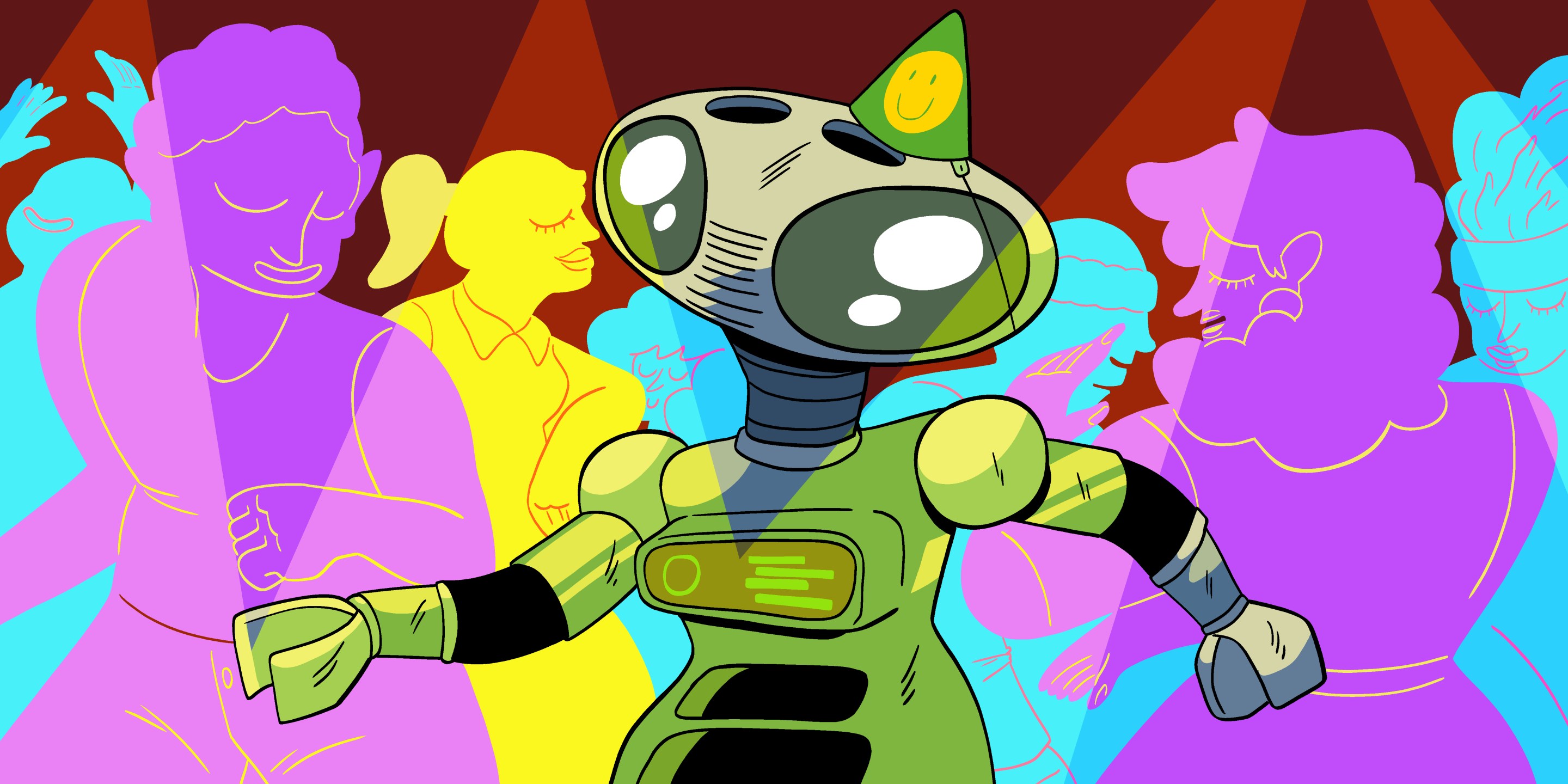
In the early 1980s, Jon Taffer, host of TV’s long-running saloon reno show Bar Rescue, was part of a team responsible for Pulsations: a state-of-the-art 50,000 square-foot night club, boasting 11 bars across multiple levels, shining like a futuristic beacon along Route 1 in Delaware County, Penn. (Pulsations has been called “The Club 54 of Delco”; a classic example, perhaps, of damning with faint praise.) The $8 million club’s centerpiece was an enormous spaceship prop, which would climatically lower over the main dance floor, releasing a seven-foot, $400,000 dancing robot. That robot was Pulsar.
“It was a big thing,” says Matt Cord, a radio host at Philadelphia’s WMMR radio and in-arena voice of the Philadelphia 76ers, who worked as a Pulsations bartender back in 1986. “People waited for the spaceship to come down, and Pulsar to come out. A lot of people were there just to see the robot. It was crazy. You had people coming from Delaware, Maryland, New Jersey. People came quite a distance to go to Pulsations.”
According to Taffer—interviewed on a recent episode of the Good Guys podcast—Pulsar was the same robot leased to the production of Rocky IV, to play Paulie’s birthday gift-turned-animatronic-bride. Operated remotely, the robot would boogie across the dance floor, admire women with its enormous mechanical bug-eyes, and issue what would become his trademark catchphrase: “My! What bodacious ta-tas you have!” Speaking to the New York Times in 2016, Taffer called the spectacle, “the closest to a religious experience that I’ve seen without it being religious.”
Before he was a popular reality television personality and world-renowned bar scientist, Taffer was working at Grossinger’s resort in the Catskills, managing the Borscht Belt hotel’s food and beverage program. One day, he received a call from a headhunter, who was eager to retain his services for a new endeavor. As Taffer puts it: “He asked me if I was interested in coming on board with the greatest nightclub ever built.”
It has been said there are cathedrals everywhere for those with eyes to see them. And for many coming of age in the mid-’80s, Pulsations was such a cathedral—a shrine to the opulence and excess of the decade. It was the brainchild of Philly-era developer J. Leon Altemose, who was renowned in construction circles for his staunch anti-union, “right-to-work” stances, and lambasted by unionized tradesmen, who would protest and even firebomb his construction projects. (An obituary for Altemose, who died in 2008, called him “a threat to union power and organized labor's efforts to ensure higher pay, benefits and safety protections.”)
“Leon was a visionary,” says Barry Gutin, one of the club’s former general managers. “Pulsations was his grand vision.”
The club’s grand opening was certainly an event—albeit not for the reasons Altemose and other Pulsations stakeholders had intended. On the club’s first night, a lighting fixture (retrofitted from a police cruiser) crashed on the dance floor, injuring five patrons, and killing one, a 37 year-old club-goer named Margaret Jones. Despite the commotion, the party proceeded more-or-less uninterrupted.
“Very few people actually knew it had happened,” says Jim Digby, a technician who was working on opening night. “The club was sold out. It was the grand opening for the press. And it was isolated in a corner, by the DJ booth.” (Digby, who currently works as a tour director for nu-metal heavies Linkin Park, has gone on to devote himself to live event safety, as co-founder of non-profit Event Safety Alliance.) Following the tragedy, some employees were a little uneasy. Gutin recalls one “psychically sensitive” employee who maintained that Margaret Jones’s ghost haunted the club—a spectre that apparently lingered until the family’s wrongful death lawsuit was settled in 1987.
Phantom nightclubbers weren’t Pulsations’ only attraction. The cavernous space also operated the Encore Dinner Theater, hosting stage magicians Carlton Beck and husband-and-wife illusionist duo the Pendragons. Their acts demanded lodging for large jungle cats, and other stage show fauna. At its peak, Gutin estimates that the building was housing a lion, a lioness, five whole Bengal tigers, leopards, a horse, an emu, and 50 white pigeons, which were routinely passed off as doves. An animal trainer also resided on-site, in one of the attached hotel rooms. But the highlight of the sprawling event space’s many features remained the nightly spaceship landing routine, and the emergence, from billows of dry ice smoke, of Pulsar.
Decades later, Taffer still remembers seeing Pulsar emerge on the club floor for the first time. On that fateful opening night, after the evidence of the calamitous accident had been cleared up, the 27-foot spaceship reemerged, lowered, and released the dancing robot. Taffer remembers standing nearby, next to Digby. “I looked to my right, and Jim looked at me,” he says. “He was crying. There were tears rolling down his face. I had these vibrations in my stomach. And I realized I was crying myself. I’ve been running nightclubs for 50 years. To this day, I’ve never felt anything like that electricity—or spirituality, if I can call it that.”
“Pulsar would come out anywhere between 12:30 and 1:00, generally,” recalls Chris Nierintz, one of the robot’s in-house operators. “You could hear a pin drop. It was dead silence in the club. It was full attention, on him.” Nierintz operated Pulsar by radio control, using a 16-point keypad, and a microphone that was filtered through a soundboard to make his voice sound more robotic. Beautiful women—or the odd man, celebrating their birthday—would hop on Pulsar’s platform-like-base, and ride him around the dance floor, encircled by security guards in place to protect the pricy robot’s safety.
Occasionally, Pulsar would propose to guests, revealing a wedding ring in his claw-like hand. One time, Nierintz had to apologize to a guest after “motorboating” (his words) a particularly busty female guest. “Her boyfriend got pissed off,” he remembers. “Good for him! It’s his girlfriend! Good for him.”
This wasn’t the only time Pulsar found himself in compromising sexual situations. James Fullington, a Philadelphia native who gained fame in the 1990s as five-time world champion of the Extreme Championship Wrestling (ECW) promotion, where he fought under the names Hardcore Hak and The Sandman, briefly worked at Pulsations as a member of a Chippendales striptease revue. “I fucked a girl riding that robot,” Fullington recalls. “Everybody did, after hours … It was the greatest job ever. There’d be 500 women every Wednesday, Thursday, Friday. You’d get laid every single night.” (Fullington was later canned from the Chippendales crew for soliciting prostitution, parlaying his erotic dance shtick into sex work services by charging interested parties $100 to meet him at a nearby inn.)
When it didn’t have its teardrop-shaped metal head buried in guest’s breasts, or was stuck bearing silent witness to after-hours backroom liaisons, Pulsar became something of a local celebrity. He would appear at kids’ birthdays, hosted on site. And, yes, pop up on film and TV. The robot appeared in the music video for Carly Simon’s 1985 single “My New Boyfriend,” playing the titular “new boyfriend,” bringing the pop singer flowers in a hair salon, and proceeding to twirl around with her, as she perches upon his iconic platform. And of course, there was Paulie’s robot chambermaid from Rocky IV.
There is, however, some debate among Pulsations insiders about that Rocky connection. While Taffer had initially claimed that the actual Pulsar robot was rented to the production, others maintain that it was another model, also designed by the New York-based “anthrobot” (for “anthropomorphic robot”) manufacturer, International Robotics Incorporated. “I think it may have been Pulsar’s brother,” Gutin speculates, referencing an earlier model of the same design, named SICO—a robot initially built as a therapy tool for autistic children.
Digby, who also worked as in-house robot operator, demystifies the whole situation. “SICO was the predecessor to Pulsar,” Digby says. “SICO was actually the night club robot for the first few months, because Pulsar wasn’t finished yet. SICO opened the club. SICO was there on the day of the tragedy. I can say with absolute confidence that SICO was the robot that opened the nightclub.”
“I completely forgot about SICO!” Taffer laughs, when asked about the mix-up. “We had SICO before Pulsar was delivered.” And there it is: both Pulsar and his “brother” SICO worked the dance floor at Pulsations, beguiling partygoers, and admiring the assembled “ta-tas.” Sort of like the robot version of movies like The Parent Trap or Dead Ringers, where interchangeable twins engage in hi-jinx together.
Requests for comment to Stallone’s management regarding SICO’s status and removal from the 2021 director’s cut of Rocky IV were not returned. But one imagines they may have seemed, in hindsight, a little silly, too cartoony, or merely extraneous to the movie’s overarching Cold War beat-‘em-up plotting.
In time, however, the entertaining—and, to some, spiritually transcendent—display of a dancing novelty robot ran its course. Taffer refers to Pulsar as something of a “double-edged sword.” As Pulsations’ main draw, Pulsar and the whole spacecraft spectacle began resonating differently with different crowds.
“Here’s the problem with something like that,” Taffer says. “People drive down from New York. They drive up from D.C. They want to see the freakin’ spaceship and they want to see the robot. But if you come there all the time, how many freakin’ times are you gonna see this thing fly out and come down? It takes away your opportunity to dance.” That may explain why, across hundreds of episodes of Bar Rescue, he has never recommended a dancing robot to struggling bar and club owners.
As the ’80s bled into the 1990s, nightclub culture was changing, too. Showy, meat-market dance clubs were replaced by a more industrial rave and dance culture. Pulsations attempted to keep pace with changing tastes by becoming a venue for punk, heavy metal, and hardcore shows. Philly musician Steve Saputelli, of local synth-punk band Crucial Device, has fond memories of seeing Cro-Mags there in the ‘90s, as frontman Harley Flanagan menaced the teenage crowd by stalking the stage with a machete. Philly’s Dead Milkmen played there. As did New Jersey’s favourite spooky son, Glenn Danzig. The futuristic nightclub became a mecca for punks, goths, and suburban weirdoes.
“I thought they were space aliens!” laughs Lisa Hernandez, a local who was a fixture at the club’s Sunday night all-ages dance parties. While the metal-heads and freaks head-banged in a smaller room, Hernandez and her friends were on the main club floor, dancing to house, rap, and Latin freestyle deep cuts. “It was what the cool kids were listening to, honestly,” she says. “It was not Top 40. That would have been lame to us.” (Hernandez also claims she and her friends were “too cool for Pulsar.”)
All-ages shows are fantastic. But kids, of course, don’t buy booze. And Pulsations’ massive footprint and pricy layout became increasingly difficult to support. By 1995, the club had shuttered. The enormous spaceship prop was dismantled. And the club was demolished two years later. But what of Pulsar?
The robot’s last known owner was Joseph Scott McArdle, a realtor who dealt extensively with the Altemose family and Pulsations’ ownership group. He was gifted the robot after working with the owners on a development deal, and began trotting it out to local events. It took part in a holiday parade in Coatesville, Penn. and even appeared at a local Ronald McDonald House, delivering Furbys to children over the holidays, back when that brand of robot was all the rage. “Furbys were the most valuable gift that Christmas,” McArdle says. “And to have a robot delivering, essentially, baby robots to the kids going through medical treatment? That was something that gave me great pleasure.”
Eventually, the upkeep on the actual dancing robot became too much to bear. McArdle was hemorrhaging thousands on routine repairs. And the robot’s analog electronics were frequently stymied by emerging digital signals and wi-fi devices. McArdle returned Pulsar to its maker, at International Robotics, where it became, in his words, “an organ donor.” Stripped for parts, in other words.
An ignominious end to one of nightclubbing’s—and cinema’s—most iconic fixtures. But if there is a robot heaven, it’s nice to imagine Pulsar, and his twin brother SICO, up there, somewhere, twirling eternally, charming the celestial throng of sweaty, coked-up Delco club kids, at home among the most “bodacious ta-tas” the mechanical hereafter has to offer.