

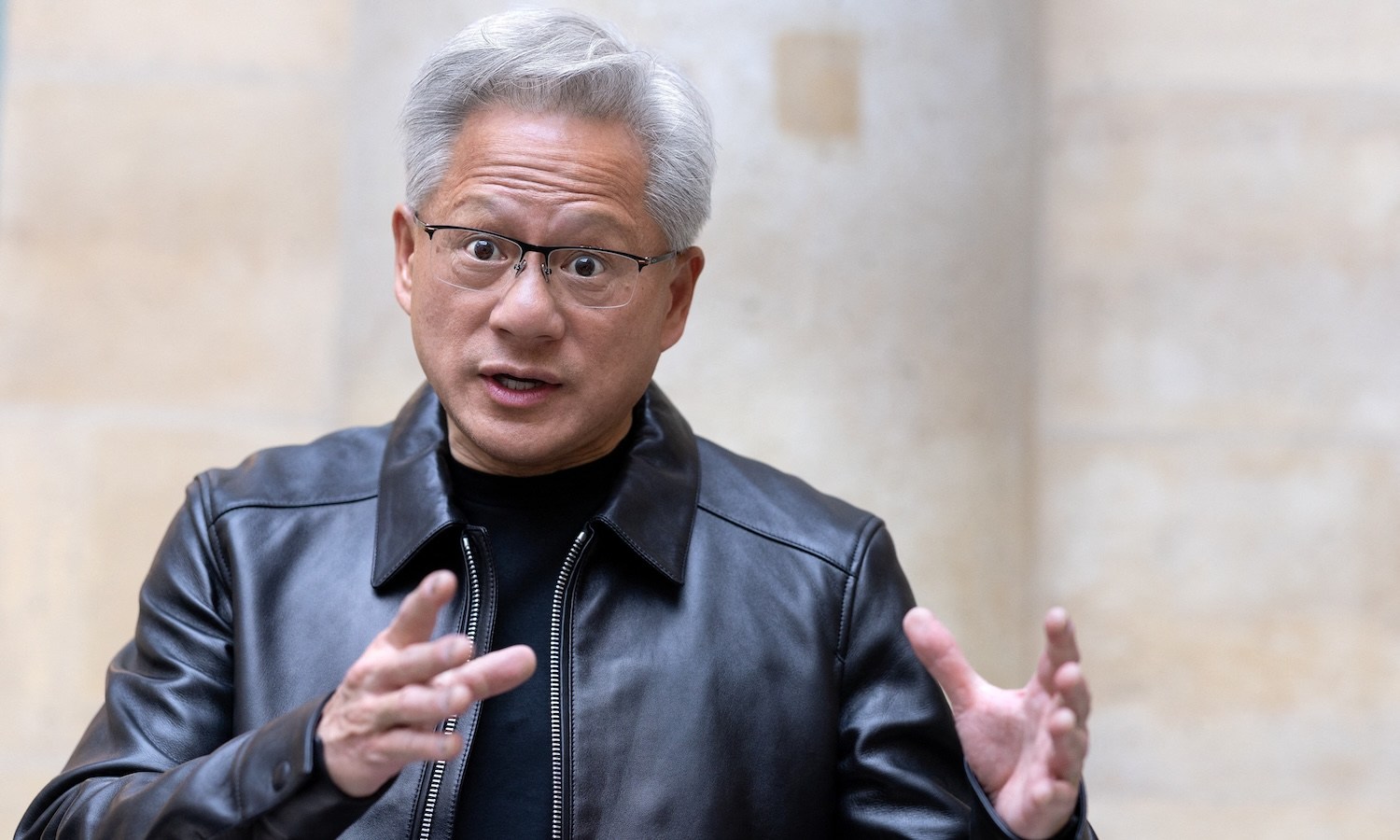
Nvidia co-founder Jensen Huang, who is worth over $100 billion, resigned as CEO on Thursday morning, following an emergency board meeting prompted by several reports that he'd been having various affairs, most notably with someone U.S. officials believe was spying on behalf of the Chinese government.
Nvidia has an unorthodox corporate structure, built around Huang, which largely eschews traditional executive roles in favor of a large council of vice presidents who report directly to Huang, which makes the matter of his succession trickier to game out than it would be in other cases of a CEO doing sex stuff. He'll be succeeded on an interim basis by Colette Kress, formerly the CFO, whom Wired characterizes as one of the few people with a high-level grasp of the company's finances and ties to Wall Street.
A quick recap of how we got here: Nvidia is the single most important hardware technology company in the world, a chip designer that boosted its market cap to more than $4 trillion by making the must-have picks-and-shovels of the ongoing AI boom. As such, Nvidia is something like a shadow arm of the U.S. government, the latter of which is engaged in the stupidest-ever version of the space race with China over who can build the machine god first. Nvidia wants to sell its best stuff to Chinese companies because it doesn't really care who wins, as long as it makes money for investors, but the Trump administration won't allow it. Meanwhile, the tip-top Chinese AI companies have found ways to smuggle in the best Nvidia chips via third parties mostly based in Southeast Asia.
Over the weekend, the New York Times broke the news that U.S. Secretary of State Marco Rubio had personally overseen the drafting of a memo for Donald Trump detailing Huang's extramarital affair with a woman named Alice Huang (no relation), and that Alice Huang was working as a spy for Beijing. Jensen and Alice Huang were photographed together several times last year in Taiwan after Nvidia signed a $2 billion deal to sell chips to the Singapore-based data center company Megaspeed International, where Alice Huang worked as an executive. Megaspeed is a spin-off from a Chinese state-affiliated mobile gaming company, pretty obviously retains its ties, and served as a vector for Beijing to import valuable Nvidia chips. The Commerce Department was investigating Megaspeed last year, until Nvidia intervened with the Trump administration and got that investigation squashed. That was the state of things as of Monday afternoon.
Since then, more reporting has surfaced new information about Jensen Huang's affairs and about Nvidia's relationship with Megaspeed. As to the former, the New York Times reported Wednesday that Huang had also been having an affair with Nvidia’s vice president of health Kimberly Powell, who reports directly to him. The Reuters news agency then reported Thursday afternoon that Huang also had a relationship with a second Nvidia employee, though they neither named the employee nor reported any other details. Per the Times, the Powell assignation wasn't super-secret at the highest levels of the company, after someone spotted the two "being affectionate at the hotel" and took a video on their phone. Huang's security detail reportedly got the bystander to sign an NDA, though Nvidia higher-ups reportedly learned what was going on shortly afterward. As to the concept of "Nvidia higher-ups," the Nvidia board is made up of Huang's allies, his family members hold a lot of power, and several Nvidia employees said Huang views the "board primarily as a governance requirement, rather than as an important part of the company's strategy or execution."
More interesting than the in-house affairs is the strange, entangled relationship between Nvidia, Megaspeed, and the governments of Singapore, Taiwan, China, and the United States. Though Nvidia is headquartered in Silicon Valley, most of its chips are produced in Taiwan, where Jensen Huang was born and where he became something of a celebrity. The island is the global center of chip production; the Taiwan Semiconductor Manufacturing Company produces "at least 90 percent of the world's most advanced computer chips," per a 2024 Wired story, and consumes 7.2 percent of the island's electricity as of 2022. Huang said earlier this year that Nvidia would spend $150 billion per year in Taiwan, and Nvidia recently announced plans to build a headquarters on Taiwan by 2030. Taiwanese authorities have revoked Alice Huang's entry permit, and they're conducting an investigation into her activities. I will note here that in August, the Taiwanese government charged nine people, including an Nvidia employee, with smuggling Nvidia chips into China.
The Wall Street Journal reported that Jensen Huang was first introduced to Alice Huang by her husband and Megaspeed co-executive, the businessman Kang Wei. But more interesting than Kang's connections to Huang is the way Megaspeed set up and ran its Singapore-based operations, as a means of bypassing the U.S. government's export controls against selling chips to China. Megaspeed's anchor customer was Chinese tech giant Alibaba, and per the Journal and the Information, Megaspeed's data centers were not only used to power Alibaba operations: Megaspeed was also smuggling a bunch of chips into China. Singapore investigated Kang and Alice Huang earlier this year, and though Huang was cleared, she was barred from returning to the city-state for lying to investigators.
The Journal also reported that Nvidia switched up the way it reported its revenue shortly after both Singapore authorities and the U.S. Commerce Department began investigating Megaspeed. As recently as last summer, Singapore accounted for 22 percent of Nvidia's global business, but once the glare of investigative scrutiny brightened, Nvidia began, per the Journal, "reporting geographic revenue 'based upon the location of the customers' headquarters,' rather than 'customer billing location' as it previously had done." Under the new method, the Singapore line went to zero and got reshuffled under revenue from the U.S. and Taiwan instead. Around this same time, Nvidia cut off its relationship with Megaspeed, and it seems like the former shuffled revenue reporting around in an attempt to hide the sudden cessation of that relationship, which would have raised regulatory eyebrows.
(Speaking of cessations of relationships, the final thing to note here is that Jensen Huang is a signature-jacket guy, which has generated some of the funniest coverage. "Jensen Huang Betrayed the Leather Jacket Community" reads a Times opinion column from Anand Giridharadas, that includes perhaps the first sincere [and sincerely misguided] straight-world invocation of the "leather lifestyle." It's all a bit much, but does serve as a nice onramp to this week's fantastic Michael Waters story about the battle for control of the estate of artist Tom of Finland.)
Nvidia shares are down 13 percent over the last five days, including a five percent dip after Huang's resignation. This down period comes within a prolonged broader slump for technology and AI stocks, as several huge companies like Apple and Amazon have cut back on their token usage. If only I had access to Chinese AI stocks. Seems like a good time for those.