
On the morning of Game 1 of the NBA Finals, I received an email from the U.S. Semiquincentennial Commission (better known as “America250”) promoting the release of new commemorative apparel to mark the occasion. The shirt designs have little connection to the NBA Finals—“NBA” is nowhere to be found, and the only logo on it is America250’s—but somehow even less connection to the country’s birthday.
One has a basketball going into a net, flanked by the phrase “Game seven grit and American spirit” on one side and “America 250” on the other. On another, “CHAMPIONS” cascades down the front, topped by the phrase “Victory Runs Deep.” What I can only assume is a now-middle-aged And1 guy streaks across the middle, gliding over the America250 logo and “2026 Finals.” There’s no real explanation why the entity responsible for planning a historic national anniversary is dropping unlicensed-looking hoops shirts. (America250 does actually have a formal partnership with Fanatics and every major pro sports league, so allow me to be the first person to ever write the sentence “This apparel would be better if Fanatics were involved.”)
I wish I could tell you this was the dumbest 250th-anniversary memorabilia I’ve seen. Unfortunately, it’s not even close. This is formalwear by comparison. Semiquincentennial (think “half of five hundred”) merchandise has emerged slowly over the past 18 months—a shot glass here, a stuffed animal there. But just a few short days out from the Fourth of July, 250th-anniversary memorabilia is suddenly available pretty much everywhere I look.
As a historian, I have watched this slow-moving avalanche of 250th stuff, wondering if I might discover the one item that best defines this anniversary—America, where it’s been, where it’s going, the state of a democratic experiment that looks messier every day. Among an endless array of tchotchkes, knick-knacks, trinkets, and schlock, was there a single item that truly captured the “spirit of 2026”? Could such an item even exist in our fragmented, algorithmic shopping age? I visited airport gift shops and mall kiosks, waded through online marketplaces filled with AI-generated retail sludge, got banned from Etsy, and talked to researchers, curators, and cowboy hat–wearing travelers to try to find out.
I began my search with officially licensed products. At the federal level, 250th anniversary planning is led by two separate entities: America250, established by Congress in 2016, and Freedom 250, established last year by the White House when President Donald Trump decided the existing commission wasn’t fast-moving or patriotic enough (and wasn’t an efficient way to channel money to his pet projects).
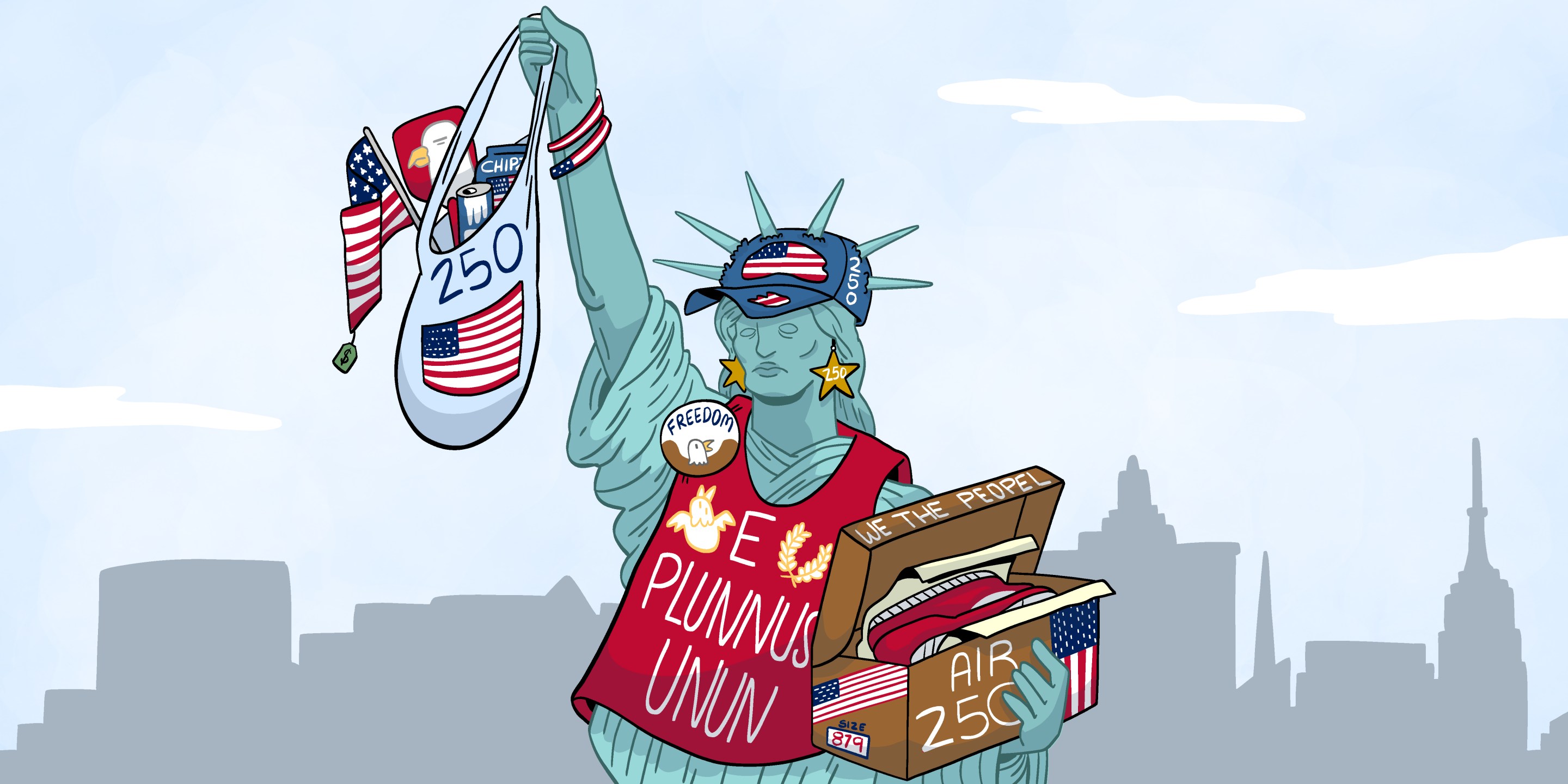
For the most part, the kinds of products offered in their online stores resemble the convention hall of a well-funded corporate expo, except with more AI-generated models. Both sell hats and shirts, keychains and stickers, tumblers, blankets, and flags. They both sell the same exact “Ceramic Trinket Dish” to hold all the patriotic coins, Zippos, and sprinkle star earrings you’re planning to buy, just with different logos.
The offerings include virtually every conceivable item in the “to-be-branded” space: aprons, dog bandanas, at least eight different pillows; wine glasses, pilsner glasses, rocks glasses, sunglasses. You can get a shirt with Abraham Lincoln in a pitching wind-up that just says "BASEBALL" on it. You can buy an America250 pickleball paddle for $150, or, if you need it to be truly special, you can shell out an extra $50 for the white and gold "Limited Edition" version. You can buy an $8,000 custom painting of a bald eagle. You can buy a $7,800 Diamond Commemorative Lapel Pin. For $130, you can buy The Patriot Shoe, which is “reminiscent of Skechers type footwear” and, according to non-verified buyer Pam W., goes “perfect with my dark blue Lululemon’s.”
Officially branded America250 items are available in brick-and-mortar stores too. I saw a middle-aged man in a black America250 logo T-shirt at Independence Hall, and he told me it was a souvenir from Washington, D.C.; in Philly, he opted to buy a Rocky shirt, he said. At Baltimore-Washington International Airport, I met Edwina while she browsed America250 shirts (and a suspiciously familiar red hat) in a gift shop next to Chick-fil-A. “It’s a big celebration,” she told me, “and I’m not sure if they have these in Florida yet.” She bought a white one.
Another traveler on a layover picked up an America250 shot glass to add to his collection. At the airport’s dedicated “America!” shop, the clerk told me they had just gotten a display of America250 merchandise set up in the first week of June. It was only about a quarter of the size of the Trump merchandise section. On the National Mall, you can buy a souvenir Freedom 250 refreshment cup for $18; refills are $1.
Despite this vast array of official products, none really fit what I was looking for. They all felt like the equivalent of Rob Lowe’s NFL shield hat. The quintessential item to mark the 250th anniversary of the Declaration of Independence—an audacious attempt to seize power from a tyrannical ruler—just couldn’t come from an official government entity. I pressed on.
Thankfully, the market for 250th-anniversary merchandise is a broad one. America250 has inked dozens of different brand partnerships, including with Xochitl tortilla chips, Domino Sugar, KraftHeinz, and a company called “RuffleButts,” which makes children’s bloomers, swimwear, and pajamas. All of these brands are offering limited-edition products or wrapping their usual stuff in special commemorative packaging.
Brands without a formal partnership with the America250 commission have rolled out anniversary packaging for their products too. At a Walmart Supercenter in suburban Maryland, I discovered that Hellmann’s mayonnaise, Wonder Bread, Hostess cupcakes, and Crunch Berries all have special 250th packaging. I found two of the three special 250th-anniversary blends from Black Rifle Coffee Co., a veteran-founded company that already markets itself as a Tactical Hot Beverage For Operators. There was plenty more: Kingsford charcoal, kites, coloring books, flip-flops, wooden signs, and Squatch brand Squatch brand soap and deodorant (for men!), all proudly sported some kind of 250th-anniversary packaging. The red, white, and blue “Poopsicle” Dude Wipes did not say “250” anywhere so it didn’t count for my purposes, but I think it honors the spirit of what I was looking for.
I then made inquiries at the Walmart’s firearms counter, where Winchester has created a series of nine limited-edition USA 250 boxes for various calibers of ammunition. That’s definitely a contender.
Brian Spaid, a professor of marketing at Marquette University and an expert in consumer collecting practices, told me these packaging decisions don’t happen unless corporations see some potential return on the investment. “These brands have all these ways of measuring things now,” Spaid said. “If they’re gonna tinker with their branding and with their packaging, they’re doing it for a reason.”
When it comes to big consumer packaged goods companies—think breakfast cereal or detergent or yogurt in a tube—“you’re not allowed to tinker with the brand much,” Spaid told me. Major events like the semiquincentennial offer a rare exception to that rule. It’s a chance to make products stand out on the shelf, or at least to make sure a product doesn’t look unpatriotic next to star-spangled competitors.
According to Spaid, any special 250th-anniversary packaging that makes it onto the shelf has certainly gone through several layers of vetting. This analytics-driven, risk-averse approach has rendered these products pretty boring. Brands have carefully calibrated what amount of 250th-anniversary branding can grab a customer’s attention without alienating the less patriotic ones. It’s an astounding range of products, yet it all feels pretty soulless. The spirit of 2026 should be much weirder.
To fully and maturely appreciate these semiquincentennial souvenirs, it helps to know a bit about the broader historical trajectory that led to 250th-anniversary Hellmann’s mayonnaise. For the entirety of our history as a nation, Americans have marked major events by producing commemorative objects both for personal collections and for profit. Even while the American Revolution was still happening, the Continental Congress struck medals to commemorate major battles and heroic individuals. A reproduction of one such medal, the Libertas Americana commissioned by Benjamin Franklin, was used for the coin toss of the 2026 Super Bowl.
In the centuries that followed the Revolution, Americans have continued marking major national anniversaries through the production of commemorative objects, their quantity and variety expanding alongside American capitalism. While the 1826 anniversary featured new commemorative half dollars, fine art, furniture, and expensive, handmade bedspreads, by 1876 that had expanded to a whole range of patriotic fabrics (often stitched into quilts), paper fans, mustache cups, and even a special edition revolver. In 1932, for the 200th anniversary of George Washington’s birth, retailers went all in, hoping the anniversary’s commercial appeal could provide a much-needed economic spark during the Depression; some even believed it could help stem the spread of socialism. Companies produced George Washington lampshades, wallpaper, ashtrays, soap, and much, much more.
Yet the crass commercialism of the 1976 Bicentennial put all earlier anniversaries to shame. Companies and retailers slapped a “bicentennial” or American flag on everything you can imagine: burger wrappers, sugar packets, Pez dispensers, toy robots, egg cartons, soda bottles, shopping bags, clothes hangers, even condoms. Critics called it the “buy-centennial.”
Joshua Cochran, curator of the Bicentennial Schlock collection at Yale, told me that part of what makes these items remarkable today is that they were saved at all. “A lot of this stuff was destined for the dumpster in ’77,” he said. Yet through a combination of novelty and sheer quantity (and the foresight of one historian), some of it wound up getting saved. So while it feels doubtful any of the junk getting produced now will last, you might be surprised.
“I’ve interviewed a lot of people that collect a lot of weird stuff,” said Spaid, the consumer collecting expert. “They’re not necessarily collecting it for its future value.” Who knows, future Americans may line up to view limited-edition RuffleButts swimsuits in a museum exhibit at the Tricentennial.
Ultimately, commemorations and the objects they inspire reflect the specific moments when they’re created, a tendency that bridges the wide gulf between hand-crafted commemorative ceramics and a mass-produced Bicentennial dry cleaning bag. “They’re always informed by their own cultural and political and social context,” M.J. Rymsza-Pawlowska, a historian of commemorations and the bicentennial era, told me. The items already popular in a particular era—whether they’re silver spoons, Frisbees, or Yeti tumblers—tend to end up as commemorative objects.
The ease with which I found these products also made me wonder whether I was only seeing the tip of the iceberg. How high up did the market for 250th-anniversary memorabilia go? Could I find sequined semiquincentennial handbags? Jewel-encrusted 250th-anniversary watches? My search would have to continue.
The King of Prussia Mall, in the Philadelphia suburbs, is enormous. If George Washington could have ridden the three miles from Valley Forge during his freezing winter of deprivation in 1777–78, he would have been instantly vaporized by the sheer abundance. This was the next stop on my quest. I wanted to see if the 250th-anniversary memorabilia market extended to high-end, luxury goods.
The answer is a resounding no. Asking about 250th anniversary-related items at Hermès, Rolex, and Bulgari, the sales staff looked at me as if I was asking where I could find their coonskin caps and corn cob pipes. I didn’t think it was that ridiculous a question, but I got the distinct sense I was the only one who had come asking about it.
These luxury stores reminded me repeatedly that they were European brands; I couldn’t expect them to care about our provincial little anniversary. But I even came up empty even at American stores like Levi’s, Ralph Lauren, and Vineyard Vines. The King of Prussia Mall does not have a RuffleButts outlet.
Some really expensive stuff does exist. You can buy straight-up gold bars with “250th anniversary” stamped on them. Solid gold collector coins will run you anywhere between $5,000 and $20,000. Snap-on made 1,776 limited-edition, 250th anniversary tool boxes that sold for about $20,000 each.
Dodge, Ram, Jeep, Chrysler, and Chevy all have 250th-anniversary editions of their most popular vehicles. A 2026 Ram 1500 Rebel America250 Edition has an American flag on the hood, red leather trim and other subtle patriotic nods, and will cost you around $72,000.
Still, it felt like my search had gone too far afield. America, or at least the America in the stories it tells itself, shouldn’t be about high-end luxury. After whiffing at King of Prussia, I made the obligatory stop at Wawa, where I was delighted to find an aggressively patriotic, 250th-anniversary special edition of Monster Energy. It was covered in tattoo-like red, white, and blue drawings (an eagle, a Liberty Bell, a monster truck) on a white can—“not a tiny Euro can… an American size 16oz. can!” It was strawberry-lemonade flavored and had 160mg of caffeine.
I had seen, more or less, what the brands had to offer. Keeping in mind the lessons from 1976, I decided to boomerang to the other end of the market, looking for more handcrafted pieces. Fifty years ago, Americans crafted thousands of their own objects: quilts, birthday cards, denim shirts, and purses, many of which they sent as gifts to President Gerald Ford. These items were never listed for sale; people made them because they wanted to, as Spaid put it, feel “authentically part of an experience.”
On Facebook Marketplace, I found a guy making custom 250th-anniversary tins for holding Zyn pouches (for people who haven't already bought the 250th-anniversary Copenhagen tins). He told me he wasn’t moved by patriotism, just profit and timing: He had just started selling items this summer, and the 250th was the biggest event. “When Christmas rolls around, I’ll be making Christmas stuff,” he said. On Etsy, I found only a few creators offering hand-made commemorative items, like needlepoint and paintings. When I messaged a few such sellers to ask about why they felt compelled to make these things, I discovered this was apparently a violation of Etsy’s terms of service. I earned a permanent ban before I heard back from anyone.
Casey Lynch, owner and operator of Squirrel Tacos, has created a set of laser-cut wooden “light catchers” to commemorate the 250th. Lynch offers these items—basically ornaments you could hang on a tree at Christmas and from a window the rest of the year—for sale online and in the “Art Star” gift shop in the visitors center near Independence Hall. One celebrates “250 years of resistance.” To Lynch’s surprise, these semiquincentennial ornaments have sold “very, very well,” among the best-selling items in the Art Star shop. For Lynch, the “250 years of resistance” piece spoke to an idea missing from commemorations of what was after all a revolution. “I feel like that is the heart and soul of this country,” she said.
After weeks of trawling through corporatized junk, finding items actually made by a real person felt like a win. Lynch’s light catchers may have been motivated by their commercial appeal, but she also clearly thought about the spirit of this moment in a way the designers of semiquincentennial Cheez Doodles had not. Yet I have to admit I’d be surprised if there was a large grassroots movement of people who felt personally compelled to make this stuff, rather than sell it. Most buyers, too, are simply opting for the lowest hanging fruit: online shopping.
If you search “250th anniversary” on Amazon, Walmart, or Google Shop, you will find thousands of listings for the same ugly hat. It’s a baseball cap clearly designed with (or possibly by) AI, featuring a bald eagle, the Statue of Liberty, and the Liberty Bell over a waving American flag in incredibly detailed embroidery. It includes “United States of America” at the top, “250th Anniversary” at the bottom, with “1776” and “2026” on either side. It comes in a bunch of different colors.
In online searches, this specific hat is inescapable. Hundreds of vendors with unpronounceable names are selling it, using the same product images. It usually costs between $5 and $20, depending on when, where, and from whom you’re buying. On Instagram and TikTok, there are AI-generated videos of people wearing the hat or explaining its incredible features to you. (I’ll believe AI is the future when these videos can show a realistic depiction of someone putting on a hat. We’re not there yet.) There’s no effort to make the videos look like anything but AI slop, either. Some contain pure gibberish, while others have obvious tells, like this couple patriotically strolling away from Costco’s “Rat” aisle in their matching hats.
The lack of effort put into marketing it certainly makes it feel like a scam. But it is possible to order it, though the hat that arrives is not much like the product listing; I’m not sure an embroidery machine exists that could produce the advertised hat. When mine arrived, in both red and navy, even my children were disappointed. Not only did they not look like the pictures, they had bizarrely long brims. My 7- and 4-year-old are not exactly discerning customers, but they instantly recognized these hats were pieces of shit. Later I would see it for sale at a D.C. souvenir store a few blocks from the National Mall. The "eagle" on this one had the kind of beady-eyed stare that comes from drinking an American-sized Monster Energy.
This is the experience of looking for 250th-anniversary souvenirs online: You’re inundated with slop. It’s all-pervasive. AI-generated banners, hats, flags, and, though the listing is now deleted, I swear I saw for sale a patriotic rubber duck recording a podcast. AI images show you that these gifts will be the perfect item for the traditional Fourth of July BBQ gift exchange with your identical twin. The more you let these items take over your TikTok feed and browser history, the more ridiculous they get. If you’re interested in a trucker hat with a three-buckled belt around it, you can buy it. I found a commemorative coin with a bald eagle holding a banner that reads “WE HOLD THESE TRUDS...” Disappointingly, the coin that arrives correctly says “truths.”
I’m sure you’re thinking, Surely no one is buying this crap. It’s a reasonable sentiment, one I shared. Then I started seeing the ubiquitous liberty-eagle hat design out in the wild. I had to fly to South Carolina in early June, and ended up on a parking shuttle across from an older gentleman wearing one in olive green; he got it as a gift, he said, but told me you can buy them at military exchange stores. Later, in the terminal, I saw another guy with the same design on a black cowboy hat, as a cheap-looking, iron-on decal. He told me the stores are full of them in Daytona Beach. On a basic level, someone must be buying these things, or there wouldn’t be so many places selling them.
It was here, wading through a cesspool of AI-generated retail sludge, that I found what I believe to be the quintessential piece of semiquincentennial merchandise. It is a distressed denim hat. It’s embroidered with “250th anniversary” in an arch along the front, above a manufactured hole that reveals an American flag. Below that, “1776–2026” is embroidered, like the dates on a tombstone. The hat is adjustable.
Like the liberty-eagle hat, the product image for this hat was generated by AI and is listed hundreds of times in various places across the internet. I bought mine from GYNLEUX. There’s an endless number of AI-generated videos on TikTok encouraging you to buy it. AI voices tell you how to “get it on a triple discount.” Many of the videos feature Nate Dogg singing that he’s “been to the motherfucking mountaintop,” for some reason.
What earns this hat the distinction of being the consummate 250th-anniversary item is that there are also many videos of real people trying to sell it to you. They tell you it’s a “must have” for patriots. They claim it sells out quickly—hard to believe, considering the vast number of listings. They extoll its “vintage, worn, rustic detail.” They eagerly encourage you to click the orange cart for their affiliate link. When I ordered mine from the TikTok shop—another satisfied GYNLEUX customer!—it arrived in under a week, looking more or less as advertised. I paid $6.58, using a double discount. It was only later that I learned I had left an additional discount on the table.
So, after weeks of looking through thousands of products in dozens of stores in multiple states, I had found the item that captured the spirit of 2026. It was advertised with AI, listed thousands of times by internet bots, hawked in videos by good-old-fashioned American hustlers, cheap as hell, and shipped directly from China. But it’s also a product vast swaths of this country will never even see. If your algorithm isn’t hitting the right Trump-adjacent cues, and you don’t feel inspired to go searching for it, you wouldn’t ever learn it exists. Meanwhile others will believe this is the must-have item of the season, that they have to tap the orange cart before they miss their opportunity. Between its AI design, its social media promotion, and the global logistics required to manufacture and ship it to me, it’s a product that Americans could barely have conceived of 50 years ago.
I do find it a little depressing to admit that an AI-driven grift best captures our 250th. Ultimately, that’s less a comment on the historic nature of the anniversary than it is about where America happens to be right now. At a time when corruption and self-dealing run rampant at the highest levels of government, when artificial intelligence is being shoehorned into every aspect of our lives, and when the highest calling many young Americans can imagine is “influencer,” this stupid denim hat sits at the center.
More generally, today’s commemorative merchandise is no less connected to its respective anniversary than the mementos of 50 or 150 years ago. If we’re awash in stupid crap for the 250th, it’s because we’re also trudging past it every other day of every other year, too. We’re the nation that invented protein water and corn-on-the-cob holders that look like tiny corns on the cob. We’re the nation where Boris Yeltsin’s trip to a single Texas grocery store immediately ended communism. 250th-anniversary products just highlight our proud tradition, for better or worse, of excess.
And if we’re dissatisfied or embarrassed by that conclusion, we can do what Americans have always done on our anniversaries: Imagine how the next one will be different.