

Aldous Huxley likened the exorcism of the prioress Jeanne des Anges to “a rape in a public lavatory.” It was this horrific description that director Ken Russell shared with production designer Derek Jarman before they set out to tell that story. Russell wanted to capture the spirit of Huxley’s nonfiction book, The Devils of Loudun, about the 17th-century incident in which a convent of nuns claimed possession, exhibiting wild and lewd behavior, leading to the sorcery conviction and execution of the priest Urbain Grandier. For that 1971 adaptation, The Devils, Jarman took the assignment quite literally. Large, white tiles cover every inch of Loudun’s Ursuline convent in the film, from floor to wall to arched ceiling. Tiles, and iron bars. It’s a gorgeous set, photographed by cinematographer David Watkin in anamorphic widescreen grandeur, and immerses the audience in the suffocated, cloistered lives of the nuns. Its starkness is at once mesmerizing and maddening. It is the perfect place for a case of possession—or many—and a likely site for clinically staged abuse.
This wasn’t the first time I’d seen the scene in question, which is somehow more and less disturbing than Huxley’s six words suggests. I first watched The Devils some 15 or 20 years ago, on a pirated copy. It was a film whose reputation preceded it, and I was a young guy, barely out of high school, titillated by its scandalous history. Even before it was originally released, The Devils was heavily cut to appease British censors. It was cut further still for its American release. Though it earned respectable sums at the U.K. box office, the lavish Warner Bros. production received a critical thrashing—Roger Ebert’s sarcastic review is a classic in the genre of getting it completely backward—and essentially buried thereafter, popping up on a couple of VHS releases in the ’80s, but never on DVD or Blu-ray. In the early 2000s, British film critic Mark Kermode rediscovered the censored footage, helping Russell put together a director’s cut that screened only once, off a DigiBeta tape.
The copy I’d watched years ago was an earlier cut, likely the original theatrical version minus the most controversial scenes, but all that history had me primed for an outrageous film, and an outrageous film is very much what I got. Sister Jeanne’s exorcism—set in that white, tiled lavatory of a convent, molested by priests wielding giant syringes to perform forced enemas—was sensational, as was the rest of the film’s high-toned lunacy. Rampant nudity, violence, actors gesticulating wildly, saying things like, “They say they can stand up to the Church, but they can't stand up to this bitch.” A movie for sickos. I loved it, naturally, but I don’t think I took it very seriously.
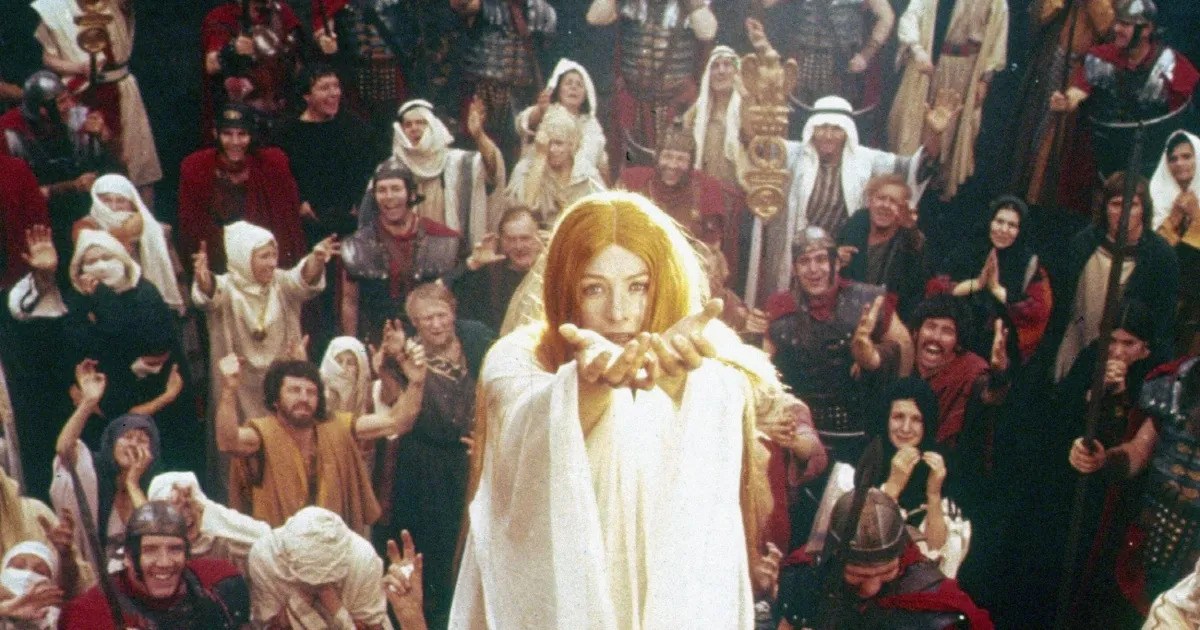
Kermode is the man largely responsible for The Devils reclamation project, and rallied to the film’s cause well before it became popular to sing its praises. There’s a reason he was the one to unearth the footage that Russell had told him was long missing and likely destroyed. The bulk of that footage comprises a single sequence, the film’s most infamous, often referred to as “The Rape of Christ.” Though viewable in a heavily degraded form traded around by online bootleggers, the recent 4K restoration of Russell’s director’s cut by Warner Bros. Clockwork is the first time almost anybody is able to see that scene, and this film, in its full debauched glory. In the scene, the nuns have been paraded about, manipulated by politically motivated priests to perform lewd orgies in a church, culminating in an extremely graphic defiling of Jesus on a torn-down crucifix. Blasphemous in content, the scene is a revelation.
“For Ken, it was also the heart of the film—the point at which the two key narratives intersect,” Kermode explained to me. “One is the debasement of Christianity and church rituals for devious political purposes. The other is Grandier’s own journey to faith.” As he pointed out, the sequence in question is more than just the rape of Christ. All that vulgarity is intercut with a scene of Grandier on a quiet road by a lake, taking communion. It’s a startling juxtaposition of, as Kermode puts it, “spiritual enrichment with performative debasement,” and one which gives lie to the notion that Russell’s aim was mere depravity. “This sequence is the point where those two themes cross, and when you remove it from the film, you effectively cut out its political and religious heart.” This was no small thing to Russell, who maintained well into old age, “I am a devout Catholic. Always have been, always will be.”
To see a work anew is an exciting proposition. Times change, people change, and so art changes right alongside. In the case of The Devils, the film has quite literally changed from its initial release, and that too reflects changing times. When Kermode helped put the director’s cut together in 2004, he and Russell were hopeful for a proper restoration and release. But at the height of the Bush era, Warner Bros. wasn’t about to tempt fate Last Temptation-style by releasing a work offensive to religious sensibilities. 2004 was also the year of Mel Gibson’s The Passion of the Christ. It sat.
What changed with the bigwigs at Warner is anyone’s guess, but Kermode credits Clockwork President Christian Parkes and VP of Marketing and Creative Spencer Collantes, both of whom had come up at buzzy indie distributor Neon, for The Devils getting its belated push. “From what I understand, once they presented it, they had nothing but support,” Kermode said. “It’s wild!” The Devils is the first release from Clockwork, and a clear mission statement for the shingle, which even now under Skydance apparently still has a mandate to handle similarly cool new productions and re-releases of underserved classics.
So some hip, young executives finally thawed corporate hearts. It makes some sense. These days, when a film gets buried, it’s more likely for a tax write-off or because it criticizes a billionaire in business with the studio—keep an eye out for whether Alex Gibney’s Musk still streams on HBO Max after Elon Musk invested $1 billion in Skydance. Silicon Valley titans are our deities now, so blaspheming against God is of no real concern. It’s into exactly this modern political reality that the director’s cut of The Devils has arrived, finally complete and finally ready to be appreciated for its “political and religious heart.”
Watching the restoration at the Toronto International Film Festival, I was first struck by the film’s visual splendor. It was always beautiful, but don’t let anyone deceive you about the revelatory power of a good 4K scrub-up. To see, at last, the bold colors and incredible detail of Jarman’s sets, and Watkin’s cinematography, and Shirley Russell’s costumes, and the actors’ faces, all projected huge, is itself worth the price of a ticket. I was transported. “He wanted to make a movie that would give the audience a sensory overload, dazzling them with the modernity of the city and the contemporary nature of the story,” Kermode said of Russell’s direction. “Everything in that film is cutting-edge.” Its modernity remains captivating 55 years later, lending what might otherwise be alien-seeming events from a bygone age an unrelenting immediacy. It’s a film about the 17th century, but it’s also a film about 1971, and it’s about now, too.
The story of the Loudun possessions, as Aldous Huxley tells it in his book, is one of demagoguery and distorted realities. “By paying so much attention to the devil and by treating witchcraft as the most heinous of crimes, the theologians and the inquisitors actually spread the beliefs and fostered the practices which they were trying so hard to repress,” he writes. Published in 1952, Huxley’s book was historical, but his concerns were entirely based in the present:
“By the beginning of the eighteenth century witchcraft had ceased to be a serious social problem. It died out, among other reasons, because almost nobody now bothered to repress it. For the less it was persecuted, the less it was propagandized. Attention had shifted from the supernatural to the natural. From about 1700 to the present day all persecutions in the West have been secular and, one might say, humanistic. For us, Radical Evil has ceased to be something metaphysical and has become political or economic. And that Radical Evil now incarnates itself, not in sorcerers and magicians (for we like to think of ourselves as positivists), but in the representatives of some hated class or nation. The springs of action and the rationalizations have undergone a certain change; but the hatreds motivated and the ferocities justified are all too familiar.”
Huxley’s political perspective was the animating spirit driving Russell’s production. It was the reason he latched onto descriptions like “a rape in a public lavatory.” The very modernness of the book’s interpretation of Loudun’s descent into mass hysteria defines the film’s aesthetic and moral approach. The film’s reconstitution and restoration at this moment in history only further clarifies its moral potency. It’s not blasphemous, but deeply engaged in the idea of a spiritual life co-opted by politics to malicious ends. Urbain Grandier, played by a never-sexier Oliver Reed, begins the film as a priest disillusioned by the dogmas of the Church. No Protestant, he nonetheless justifies his frequent fornication as holy in itself, in contravention of an authority he can’t bring himself to respect. His commitment is to God, not necessarily the Pope, and certainly not the corrupt Cardinal Richelieu.
The stands Grandier takes early on, though, are basically narcissistic, and his actions are those of a loutish libertine abusing his position to woo women—and boy does he ever woo the women of Loudun. Sister Jeanne and the other repressed nuns of her convent fall for him by way of mere rumor, so strong is his sexual magnetism. It’s a status the priest courts happily, and with ugly self-righteousness. But all that too is quickly disrupted by events outside Grandier’s control. When, under influence from Richelieu, the defensive walls of the Huguenot-populated Loudun are ordered torn down, Grandier understands it as an attack on essential, God-given freedom.
And he’s correct. Richelieu meant to crush Protestant opposition and centralize French authority in the King, and thus the King’s corrupt circle. Unable to bring the walls down, those authorities conspire to defame and defrock Grandier by the invention of mass panic, with help from the lustfully disturbed Sister Jeanne’s spurious accusations. The debauchery onscreen is exciting, but also an expression of demagogic malevolence. Neither a celebration of hedonism, nor conservative castigation of moral degradations, The Devils is about the elite roots of fascistic social contagion.
“It is a powerful story ripped from the headlines of the past that has lessons for all of us now, and in the future,” Kermode told me. “It is a stark warning about the dangers of using religion to push through a political agenda; about the way in which people can be brainwashed—by a corrupt establishment, by the ruling classes, by TV, by social media—to believe things that are patently untrue, for terrible ends.” The timelessness of the film is there in Huxley’s book, certainly. “By those who serve him, a great man must be treated as a mixture between a god, a naughty child and a wild beast. The god must be worshiped, the child amused and bamboozled and the wild beast placated and, when aroused, avoided,” Huxley writes.
After finally seeing The Devils director’s cut, with all those thoughts about religion and politics consuming my mind, I went down a bit of a rabbit hole. I read the Huxley book, but also sought out other tellings. Jerzy Kawalerowicz’s 1961 film Mother Joan of the Angels, for example, which is based on a novella inspired by the Loudun possessions, by Polish writer Jarosław Iwaszkiewicz. That film takes place after the execution of Grandier—with its setting and character names transposed to Poland—when some of the nuns, including the prioress Jeanne, still appeared possessed. The film is a sparse, tough expression of European art film, finding beauty in an almost Bergman-like questioning of faith; it’s told from the perspective of an exorcist sent to take care of the matter. Though political by implication, Mother Joan is a far more inward-looking work concerned with the individual soul.
The Poles must really love the Loudun story, because Krzysztof Penderecki also composed an opera about it based on a play by John Whiting, itself based on Huxley’s book. A filmed version of the opera from 1968 brings Penderecki’s atonal, often upsetting music to dreary life in punishing fashion. That’s a compliment, mostly, but the filmed opera nonetheless feels trapped within its fealty to grim historical realism. Its political interpretation is drawn from Huxley, but its tone reflects none of his wit. It’s serious stuff, presented seriously.
“He never saw it as a ‘cult movie’ as such,” Kermode said of Russell’s feelings about his movie’s reception over the years. “He made it for a popular audience.” The film’s aesthetic maximalism—more in line with a British cinematic tradition found in the opulence of Michael Powell and Emeric Pressburger than the kitchen sinks of Lindsay Anderson and Ken Loach—was directed precisely at the mainstream. Russell meant the film to be inviting despite being met with scandal. “I think it always broke his heart that the film had had such a rough ride,” Russell said. “He described it to me as ‘my most—indeed my only—political film’ and he was really proud of it.”
In a strange way, the history of The Devils mirrors its story: The good-faith work of an artist is met by government censorship and media denunciation, which creates around it a mystique of scandalousness that becomes its primary identity. The Devils became a film to see because of its lewdness, not its meaning, not unlike those nuns hauled from church to church and made to perform their possession in stupendous public orgies. Freak-outs encouraged and instrumentalized to distract from the nefariousness of power. The film’s restoration, beyond revealing new scenes or new visual textures, reveals the lie inherent in the propaganda, and the truths obscured. Kermode agrees: “It is somehow fitting that the film itself suffered from the whims of political and religious persecution, only to emerge decades later as one of the most powerful and truthful tales of any age.”