

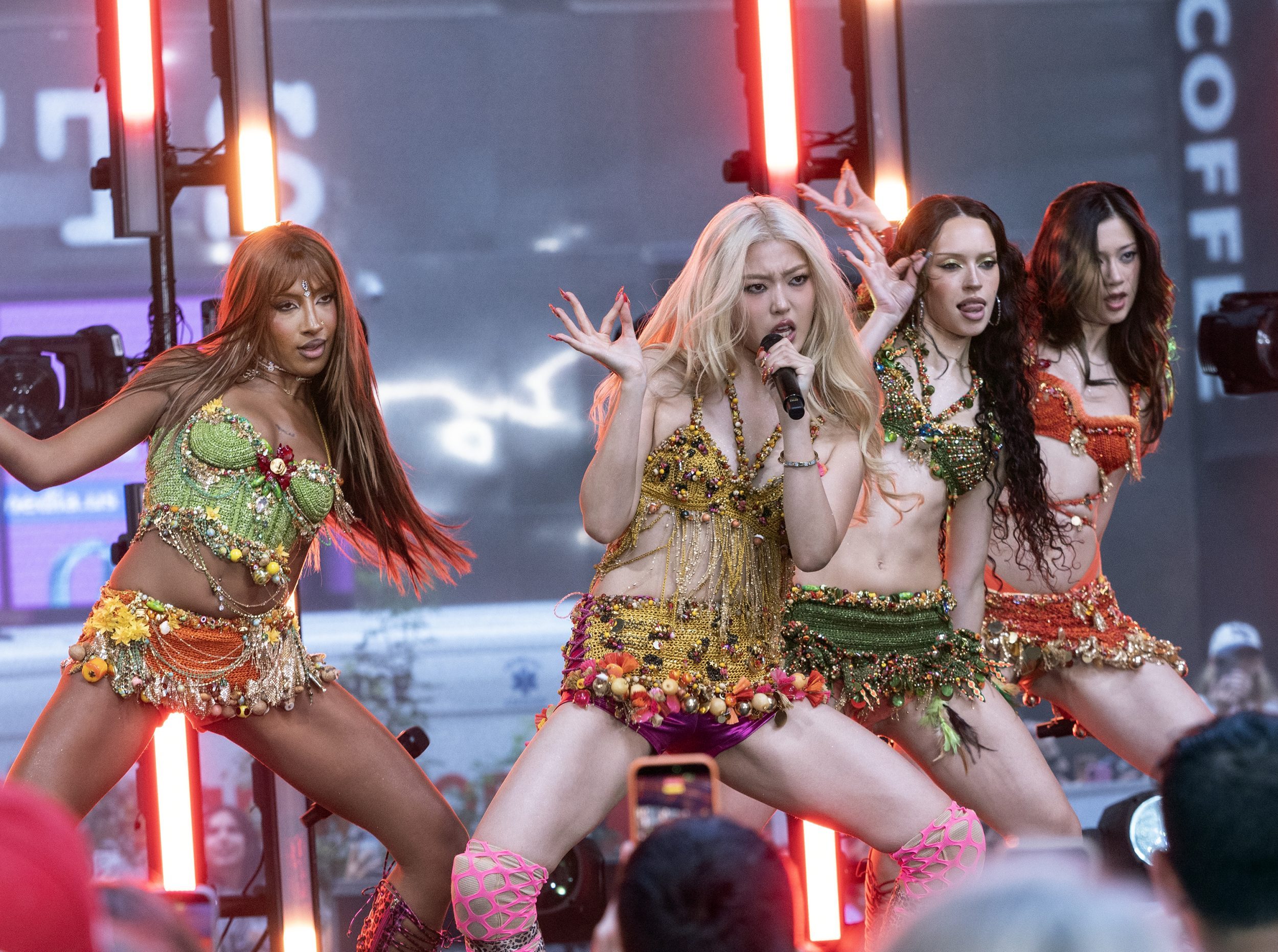
Last week, I couldn’t stop watching videos of Katseye's performance in Austin, Texas, where three members of the group writhed on stage while a fourth, Megan Skiendiel—who had recently suffered a concussion—wore protective sunglasses and was propped up on a stool to the side. She sat with her legs crossed, expressionless, as if she were not on stage under flashing lights but instead waiting for her name to be called at the DMV. Mere feet away, her comrades in ass-shaking executed their choreography with their usual precision.
Skiendiel’s presence on stage adds so little to the performance that you wonder why she’s even there. Every once in a while, she raised her mic to sing her part in a song, devoid of any expression or movement. The dissonance of the scene was so absurd that it generated memes of its own, and even fan art; this week, Skiendiel posted backstage photos of herself in her sunglasses, with the caption “Cuntcussion.”
The bizarre image of a concussed, stoic Skiendiel perched on a stool, while her fellow members go full-out right beside her, was a perfect illustration of the broader ongoing conversation among the Katseye fandom: about the incessant pace of performance, the members' exhaustion, and the underlying assumption that these groups are built on exploitation which fans must organize against. In the days since, that discussion has grown to include whether a video of another member, Yoonchae Jeung, showed her crying or just wiping her nose at the group's Nov. 17 show in Seattle.
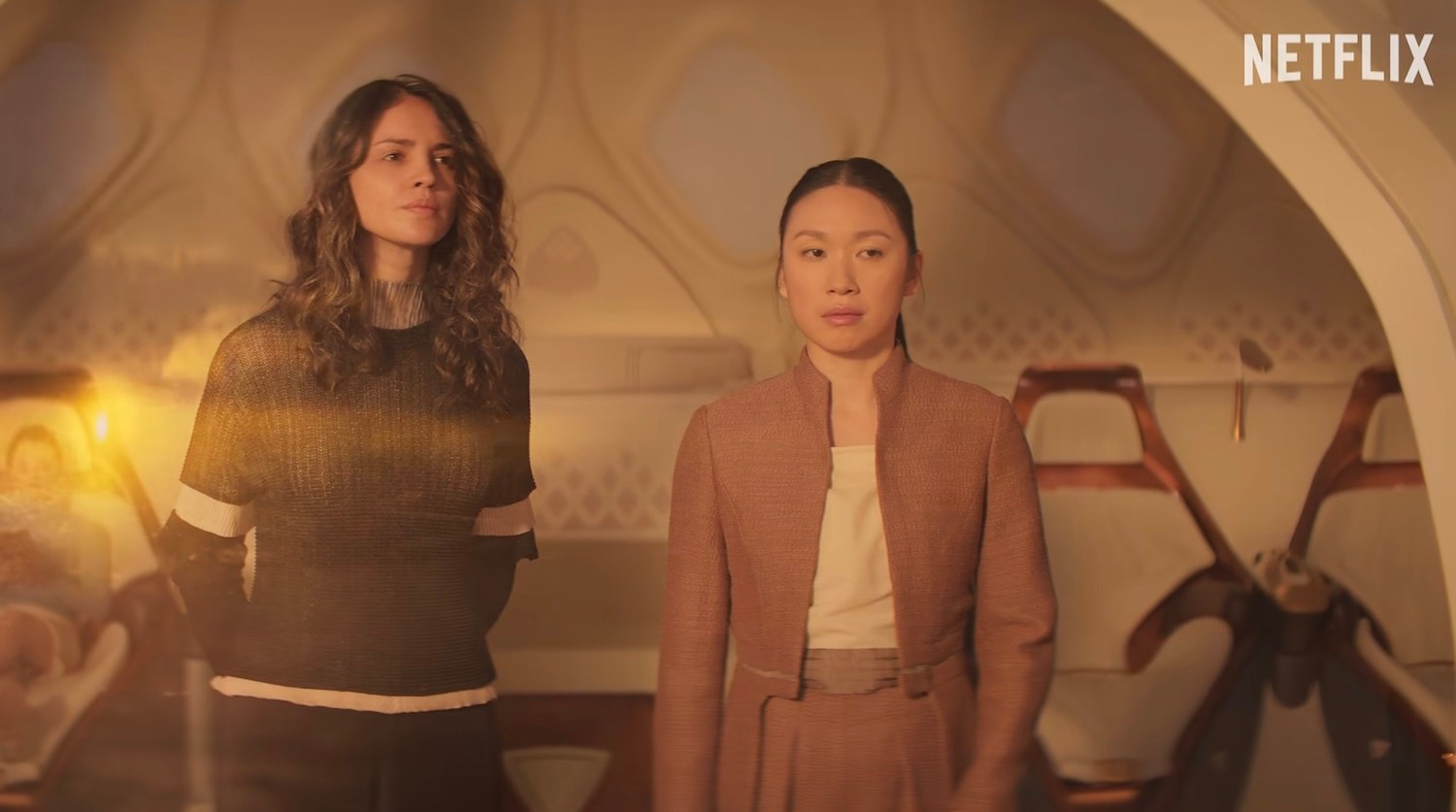
Katseye was created in 2023 after its six members were selected from a trainee pool of more than 20, some of whom trained for up to two years, in a process documented on the Netflix show Pop Star Academy: Katseye. The group was a joint venture between the American company Geffen Records and the Korean company Hybe, with the goal of creating a K-pop style girl group with global appeal. The group released its first single, “Debut,” in the summer of 2024, and since then has released three EPs, 11 singles, countless brand partnerships, and an endless amount of social media videos. The schedule has taken a toll on the members.
It’s been almost a year since the original sextet performed together on stage at the Grammys. Weeks later, Manon Bannerman went on an unexplained hiatus from which she still hasn’t returned. Then in August, Sophia Laforteza also went on hiatus and announced that she would return to the group in early 2027. In that time, other members have sat out occasional performances, blaming injuries. The group canceled their performance at Olivia Rodrigo’s Daisy Chain Fields festival when Skiendiel sprained her ankle. In clips of the Austin performance on Nov. 10, you can clearly see gaps in the choreography where additional members are supposed to be. It looks less like a polished world tour and more like a rehearsal where a couple performers have called out sick.
The group’s relentless performing schedule has drawn criticism from fans, who also spoke out in concern over Skiendiel’s health after the Austin performance. On social media, fans blame not Skiendiel or her fellow bandmates, but the group’s management companies, Hybe and Geffen, for allowing her to perform while recovering from a brain injury. It's possible that the nature of Skiendiel's injury is why fans are focused on management; when someone's concussed, their decision-making ability can be impaired. Some of the comments: “Blink if you’re in danger Megan 😢💔”; “I’m so sorry they’re forcing you to perform like this. You deserve so much better than how you’re being treated and I hope they let you guys rest. ❤️ love you Megan. Try to get better”; “Free you, and the rest of the girls omg :/”
Hybe, the Korean conglomerate that also represents K-pop megagroup BTS, is also under scrutiny for a separate but similar issue involving the girl group NewJeans, which the New York Times reported earlier this month was coerced into signing exploitative contracts that undercut guidelines laid out by the South Korean government, guaranteeing the rights to education and physical and mental health for underage performers. NewJeans quit their label Ador, a subsidiary of Hybe, in 2024, after they alleged that Hybe broke their contract by firing their mentor, Min Hee-jin. Hybe took NewJeans to court, where a judge ruled that the members were contractually prohibited from releasing music independently until 2029. A few members returned, though the lineup is still in flux. K-pop fans tend to pay attention to these issues. In fact, the invisible hand of “management” looms large over the parasocial relationship between fan and artist.
I found it fascinating that the negative reaction to Skiendiel’s cuntcussion was directed so clearly at Katseye’s management, essentially taking it as a given that the performer was being puppeteered by behind-the-scenes agents. According to Stephanie Choi, an assistant professor in ethnomusicology at the University of Colorado Boulder, this mindset reflects a fundamental difference between the U.S. and Korean pop enterprises.
“The American pop music industry sells an artist’s persona as a genius—someone who creates their own music and visual productions without a systematic support system of hundreds of staff members,” Choi told me. “This is a myth, a way of claiming authenticity, because the industry has to maximize its profits by establishing the artist’s persona as an independent and powerful individual.”
The fan-artist relationship is fundamentally different in a K-pop context, because “the virtue of K-pop does not come from a heroic saga—it comes from the transparency between the industry and fans about the collaborative nature of its production,” Choi said. The K-pop group is a fantasy—of moral purity, beauty, talent—but one whose artifice is understood by all of its co-creators: fans, management, and the performers themselves.
This reorientation is a long way from the fan culture of my youth, which placed heavy emphasis on authenticity and the importance of not “selling out” or being a “poser.” Such distinctions in motivation have vanished, in many ways, with younger generations consuming art in a context that is both more precarious for the artist and also constantly mixed up with commerce. In much of the internet's economy of attention, an artist is an influencer is a product but, as Choi said, “corporate involvement becomes grounds for questioning authenticity only when Western media discusses K-pop.”
Maybe she’s right. But Katseye’s artifice feels particularly hollow to me when I consider their work in the aggregate. Still, I keep watching. What do I find so compelling? It’s not like these endless videos ever change. Following the conventions of K-pop, Katseye sticks to each song’s music video choreography in concert so fans can dance with them. It’s ultimately just satisfying to see people execute the same choreography to absolute perfection over and over again, in different countries, different outfits, and different configurations. It's not unlike the ritualized appeal of other forms of entertainment: You can see a wrestler perform a suplex or a baseball player hit a home run countless times, and the act fundamentally remains the same, but each rendition is different and satisfying in its own way.
The more enduring appeal of Katseye for me is that because I watched the Netflix show, I feel a small connection to each of the members from when they were anonymous trainees who gave up everything for the chance to be picked. The creation of Katseye was a Cinderella fantasy, and I still feel a small pang of pride when I come across a video of them twerking upside down on a wall in some nondescript dance studio. It’s absurd, but part of me must still believe in a trace of authenticity in these women. So if that authenticity includes what seems like a visible desire to not want to be there, it raises the question of whether the group should take a break altogether.
The night after Skiendiel's seated performance in Austin, the group performed in Dallas. She still wore her protective sunglasses, but the stool was gone. She filled in her spot in the group’s choreography, though with a noticeable drag in her usually sharp movements. Wide shots show the audience miming the “Pinky Up” choreography with the group (a song which can be described as “sexy Vengaboys”), and one line from the song is particularly resonant: “Us against the world, shaking ass in the parking lot."
If the goal of Katseye was to bring a K-pop sensibility to new markets and audiences, I am evidence of that goal's success. While I'm compelled by the argument to de-center the myth of individual genius in the arts—I am writing a book about that very idea—what's happening with Katseye is an extreme expression of that aim. Two members going on hiatus, followed by another performing while concussed, suggest that someone has to be making these decisions. It's only natural that in the absence of sufficient information, fans would blame the entity that handles the contracts.