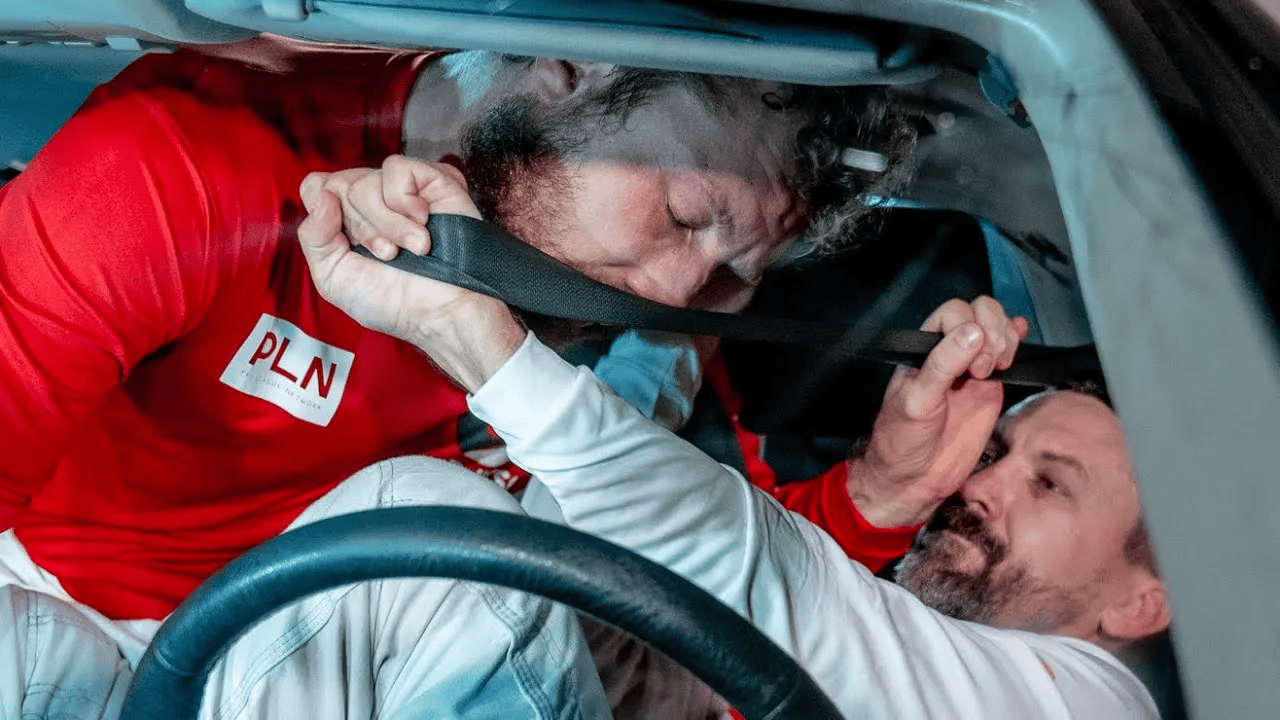
I discovered CarJitsu this past April at the Minneapolis-St. Paul International Airport, where a bout was broadcast on a wall-mounted television above a display of Doritos. There is, truthfully, not much to explain about this newfangled sport. CarJitsu is an athletic contest, really a wrestling match, between two people who grapple inside a small car until one of them submits to some sort of chokehold or pin. There are two three-minute rounds but possibly a third if the match is tied after the second round. The combatants start buckled next to each in the passenger and driver seats (selection determined by a coin toss), then unbuckle themselves and attack. They are not allowed to punch or strike each other, much less jab or poke an eye. They can use the seatbelt to strangle each other, however, and this is in fact one of the crowning tactical maneuvers in the sport. They can trap someone’s head underneath the steering wheel or manipulate the levers that adjust the seats, weaponizing the seat itself to pin or press their opponent. Though the FAQ on Pro League Network’s CarJitsu website specifies that wrestlers cannot open the car’s doors during a fight, they have done exactly that during some matches I’ve watched. Perhaps the rules of CarJitsu are evolving, much like human culture in general. The advantage of opening the door and touching the ground is that it resets the round. CarJitsu wrestlers have accomplished all these feats and more in the interest of securing a sign of submission, either a tap or a verbal indication, like a scream, from their opponent. And that’s CarJitsu.
It’s worth emphasizing that in the ideal state of submission, a CarJitsu combatant has been reduced to red-faced immobility and crammed into a crevice where most of us grimace to reach on the occasions we are obliged to retrieve an escaping M&M during a long car trip. None of this was clear to me back in April, when all I had planned was a flight to Oklahoma. But there’s something to be said for the unaided experience of not understanding what you see. A little instruction or experience will help you to appreciate the pleasures of Mark Rothko paintings or the finer points of bebop, but buying a banana at a Hudson News in the airport doesn’t help anyone immediately grasp why a man on the television wearing a skin-tight polyester workout shirt sprinkled with corporate logos is choking another man with a seatbelt inside a Toyota Scion. Especially puzzling are the onlookers sitting in folding chairs. A citizen of the world sometimes proceeds alone, hoping to gain knowledge and wisdom. I became fixated and proceeded to watch as much as I could take.
If it counts as an invention, CarJitsu was invented by a mathematics graduate student from Russia named Vik Mikheev. A couple of entrepreneurs from the “alternative sports creator” Pro League Network (PLN), which also broadcasts slap fights, slap poker, as well as whatever Beastball and Coffin Wars are, then acquired the rights to CarJitsu and turned it into one of their premier products. They have been broadcasting since 2022 on their website, on YouTube, and on whatever backwater channels show up on airport convenience-store TVs. The PLN has a television studio in Branson, Mo., and perhaps will spread farther afield, like an infection. This past spring, they filmed a competition in Dubai.
This all sounds a bit Idiocracy, to be sure, an impression that CarJitsu fight commentators can’t help but supplement. They are stuck between cheeky self-awareness and juvenile appreciation. “Somewhere around 520 pounds of man meat in the front seat of a Toyota Scion,” intones a voiceover before the broadcast of CarJitsu Grand Prix 2024. In almost every clip I’ve seen, one or both commentators, JT Tilley and Mark Coleman, will duly remark that watching CarJitsu is like watching “a crime scene in process” or, if they’re feeling especially feisty, a “murder in progress.” The former phrase is repeated in advertising copy on the PLN website. Probably their corporate managers have obligated Tilley and Coleman to say it sometime during each match.
Everyone involved must know that the appeal of CarJitsu lies in its inviting the viewer to go ahead and condescend to this obvious bullshit. It’s so ludicrous on its face. At least that’s the subtext of remarks from fight commentator JT Tilley, such as, “For the first time ever at CarJitsu Championship, we’ve decided to leave the horn active. Not only would it be annoying but slightly humorous.” Tongue in cheek, sure, but talking like this is the pre-distressed jeans of rhetoric, as if CarJitsu were already a storied sport, with a variety of legendary prior rulings or even rule changes. What mythic, game-changing scandals have defined the history of fighting inside a sub-compact sport utility vehicle? And yet the referee during the first match in Grand Prix 2024 laughs visibly at one moment, shortly after the horn is accidentally honked by the wayward limb or ass of one of the men grappling in the car.
It may be stupid, vulgar, and boring, but there’s a beautiful lunacy to CarJitsu. The joke gets old almost instantly, sure. Fights confined inside a reasonably sized car don’t attain the drama of boxing, with its mixture of exhausted dance and balletic punching. CarJitsu does of course borrow a bit from the brutality of mixed martial arts, assuming that appeals. It is also clearly painful and difficult, a tussle in a space simply not made for attacking one’s fellow passenger, as so few spaces are. In addition to the obstacles presented by features of the vehicle, “No one is prepared for how hot it is in there,” as fighter Fletcher Estes pointed out before his second match in 2024. The fighters exhaust themselves, heaving with deep breaths between rounds and guzzling branded energy drinks when they win. But whatever it is that car combat lacks in grace, it makes up for in squirming tension and bizarrely humble spectacle. Just look beyond its uniquely televisual sense of humiliation, reminiscent of attitudes that go back to America’s Funniest Home Videos and beyond.
The beauty of CarJitsu is in its cockeyed, dumbass elegy to the automobile and the twilight of driving. Some people claim it has a shred of practical wisdom. Kyron Bowen, both a combatant and a referee, told the New York Post that there are self-defense lessons in the sport. The commentator Mark Coleman agreed, specifically suggesting that Uber drivers should watch it.
Yet beyond the desire to sell a product or a desire for notoriety, however cheap and silly, there is in CarJitsu this craving to make something more out of the experience of being in a car, especially at this stage in history when cars are mostly Bluetooth speakers with wheels glued on.
The craving spirit in CarJitsu longs for fresh excitement. No longer drivers, maybe we could be fighters. An obviously ludicrous notion. A demented and strangely beautiful passage in J.G. Ballard’s novel Crash comes to mind, a few sentences in which spectators at a multi-car wreck watch the “deformed vehicles” more than the human victims. Ballard’s narrator wonders if these witnesses “saw within [the deformed cars] the model for their own future lives.” CarJitsu falls short of Ballard’s portrait of ecstasy and transcendence, to say the least, but it does imply a certain tryhard yearning, like it wants to recreate in another venue the carnage associated with motor vehicles. Do the crash inside the car perhaps, rather than out. Making the seatbelt unsafe again does constitute, after all, the philosophy at work here.
Consider too the fact that while CarJitsu favors the unsexy Toyota Scion for its boxing ring, the computer-generated imagery that precedes some CarJitsu matches, reminiscent of the football robots on certain NFL broadcasts, always shows a generic but clearly identifiable BMW or Porsche. In one animation the speedometer shows the stylish car revving at high RPM before speeding away. The fantasy of the car, one of the icons of 20th-century technology, has always been race cars or spaceships or missiles with fins and aerodynamic recesses. They’re modernist machines of freedom and escape, not holding pens for psyched-up goofballs. The workaday cars used in CarJitsu, so different from its little animations, call to mind the utility of transport and daily commutes, not dreams of transformation. That iconography of speed is only window dressing.
While a car as fight venue surrenders the dream of speed, it tries out a laborious alternative, the cramped battle for your life. Whose dream is this? And what kind of dream? Boasting that a fight inside a sub-compact SUV resembles a “murder in progress,” for example, makes it sound less like a dramatic reenactment of homicide and more like a roleplay of a scene from a generic action film. It’s a copy of a copy. Dreams should be a bit bolder than this, at least as homage to the ruins of what cars once meant. Yet I have to admit that I find the juvenile fantasy of CarJitsu poignant, as if this is some last-ditch attempt at meaning before human beings fully give up their autonomy as drivers.
The beauty in CarJitsu is also the people, meaning the fighters. As a sport, CarJitsu is such an undisguised bid to generate clicks and revenue that the fighters themselves come off almost unworldly and innocent. They mumble their way through interviews. They seem in large part slightly bemused that they’ll be wrestling in a Toyota (that makes two of us). Their interview style might be explained by the fact that in the rooms where CarJitsu matches are filmed, the audience is small and quiet. No one really treats them like stars, because they aren’t stars, so they don’t act like it. The requisite ego seems lacking.
The commentators don’t always seem to know what to make of the contenders, either. During a bout between Jonathan Chambers and Rodrigo Contreras, the latter known by the nom de jitsu “Mexicutioner,” Tilley points out that the two opponents are like “teenage brothers fighting over the last French fry.” It’s not clear what that means for men who’ve agreed to strangle each other inside a car for the purposes of combat sport. Tilley adds, at some point, “The Mexicutioner, also a father.” More charming is a fighter like Katie Bochenek who mugs for the camera, mouthing “Call me,” while wearing a T-shirt that says, “Aspiring Stepmom.” All this is part of her hammy seduction of the single dads of the world, or at least her attempt to sell the T-shirts.
Waymos encroach on our cities. The modern car is a smartphone with aggressively bright headlights. Self-driving cars need input from remote managers. But inside the car where it’s still warm, we could make a bizarre playpen for the road rage we won’t get to exercise any longer, a supernova of wrestling violence but on the smallest scale. Driving has always been associated with aggression and self-defense (it has to be, since cars are dangerous). Airbags and seatbelts in fact only tipped the car’s hand and admitted the thoroughness of the physical dangers. Maybe safety is too safe now, too well-managed. CarJitsu wants to give us back our ridiculous fury, but with more energy drink commercials and the promise of being a meme. So be it. In the future, everyone will be choked with a seatbelt for 15 minutes.