

“I’m coming to the cottage,” Ilya Rozanov growled, and Canada has never been the same—at least the American film and TV industry’s depiction of it. The final episode of the first season of Heated Rivalry introduced the world to Canada’s cottage country, presenting the regions to the north of major cities where many families own second homes as a soft escape from the friction of urban life. In Heated Rivalry, as well as a slew of other recent shows, Canada’s rural expanses are not only lush, they’re sexy.
There’s something about lakes, trees, and short shorts that loosens inhibitions, lest the summer be wasted. “A Canadian summer is fleeting and precious,” Every Summer After author Carley Fortune said after her romance book was adapted into a British Columbia-based show in June. “That feels Canadian to me—it’s the lake, the dock, the boat, the mosquitoes.”
As an American who’s lived in Canada for five years, I think the liberal American perception that Canada offers the American Dream without the fascism has contributed a great deal to the country’s recent turn in the spotlight. The reality up here is less idyllic: Canada’s social programs are getting weaker, their discriminatory immigration system is simply less attention-seeking than the States’, and their right-wing figures are often just as repugnant. But Canada is nevertheless preferable to Trump’s America in many ways, and besides, romanticization has never relied on realism. Romance media set in rural Canada doesn’t look to be stopping anytime soon.
Enter: Sterling Point. Megan Park’s show, which debuted in August, starts in a huge New York City home where grey and white dominate, but that washed-out palette is not where the show stays. Before long, the lush blues and greens of Ontarian wilderness and the golden tones of soft wood in a sun-soaked cottage fill the screen.
Annie (Ella Rubin) is a goody-two-shoes 17-year-old whose mom died when she was two, and she’s just found out that her estranged grandfather has passed and left her and her twin brother a parcel of land in Muskoka. Like any good coming-of-age drama protagonist, she immediately and easily evades her father’s oafish grasp and makes her way north, where she is determined to prod at the secrets tucked away in the Canadian side of her family tree.
The episodes that ensue do have some big-city-girl-moves-to-the-wilderness clichès: Annie panics about not having phone service on the lake, discovers that a squirrel has been stashing nuts in the cottage, and flips a canoe. And the region’s surface-level beauty is highlighted in frequent lingering shots; from experience, I assure you it’s impossible to be in Ontario’s cottage country and not be thoroughly and ceaselessly gobsmacked by the beauty you somehow, by some blessing, find yourself in. But the picturesque lakes and forests of Muskoka are more than pretty things to gaze at, and Park leverages the area to fuel the show’s meaty plotlines and emotional arcs.
Muskoka’s status as a playground for the ultra-rich means that class tensions thrum behind each stunning landscape, except for when bright-white mega mansions impose themselves over it. A boy Annie knows from New York named Rory (Daniel Quinn-Toye) summers in one of those mansions. It has a garage with at least six fancy cars, and a detached boathouse as big as Annie's cottage on Sterling Point. The kinds of people that buy up properties around the lake and attend Rory’s mom’s parties treat everyone they don’t know like staff—this, I am told by a friend from the Greater Toronto Area, is typical of the region’s private school elite.
Annie’s own family wealth means that she feels perfectly comfortable at said parties. But she’s also just discovered she has a sister, Ramona (Amélie Hoeferle), who is decidedly not part of this glamorous set. Annie spends the rest of her summer naively flitting across the line between the swells at the party and those in the catering kitchen.
As this is a teen drama, this tension is brought to the fore by a love triangle. Annie’s chemistry with Rory is gracefully and torturously explored alongside her flirtations with Ellis (Jacob Whiteduck-Lavoie), Ramona’s friend who juggles jobs as a seaplane chauffeur and cashier at his family’s general store on Sterling Point. In the love triangle, all of the feelings are messy but none of them are used for evil; both of the boys are sweet and Annie is admirably curious about her connections without turning it into a season of The Bachelorette.
Annie isn’t left to do all the romantic heavy-lifting; Ramona navigates a perfectly taut homoerotic friendship with the larger-than-life Oona (Bo Bragason) that is brutal to watch until the rope snaps and all the pieces fall into place, euphoric and well-worn.
Muskoka’s summery shimmer makes everything sexier. Park captures the young, lithe bodies in wet bathing suits with windblown hair as nothing less than a teenage dream. Sterling Point perfectly delivers the feeling you have when you’d nearly drown someone for the pleasure of tying your crush’s bikini string, and the feeling that you’re an idiot newborn baby when you finally get what you’ve wanted but have no idea what to do about it. “I actually can’t even think of one thing I don’t like about you” might actually be the sexiest line a television show has ever delivered, save for “I don’t know any other girls.”
The show’s romances come to life thanks to the characters’ breezy, naturalistic dialogue. Annie, Ramona, and the ensemble around them deliver lines littered with stuttering and filler words that make it feel more real than written—indeed, some dialogue was improvised. Half-sentences are more than completed by the actors’ perfectly cooked facial expressions. Strings of eye contact—hopeful, knowing, hurt—are given as much attention in the edit as the banter that zips naturally between the teenagers.
The show is exceptionally funny, too. I’ll remember Annie’s gay boyfriend, Hoeferle’s duck-like delivery of the word “math,” and a child’s delight at receiving a stack of “long-form journalism!” for a long time.
It’s no surprise that Sterling Point hits home run after home run—the showrunners have made some of the best teen dramas out there. Josh Schwartz and Stephanie Savage did The O.C. and Gossip Girl, and Park’s dazzling 2024 film, My Old Ass, is also a tender coming-of-age dramedy set in Muskoka. The familiar beats are all there: romantic tension, family mysteries, and class commentary. It’s got the charm of Gilmore Girls plus a considerable amount of intrigue, but it doesn’t get as dark as Veronica Mars or even Off Campus, Amazon Prime’s other summer blockbuster.
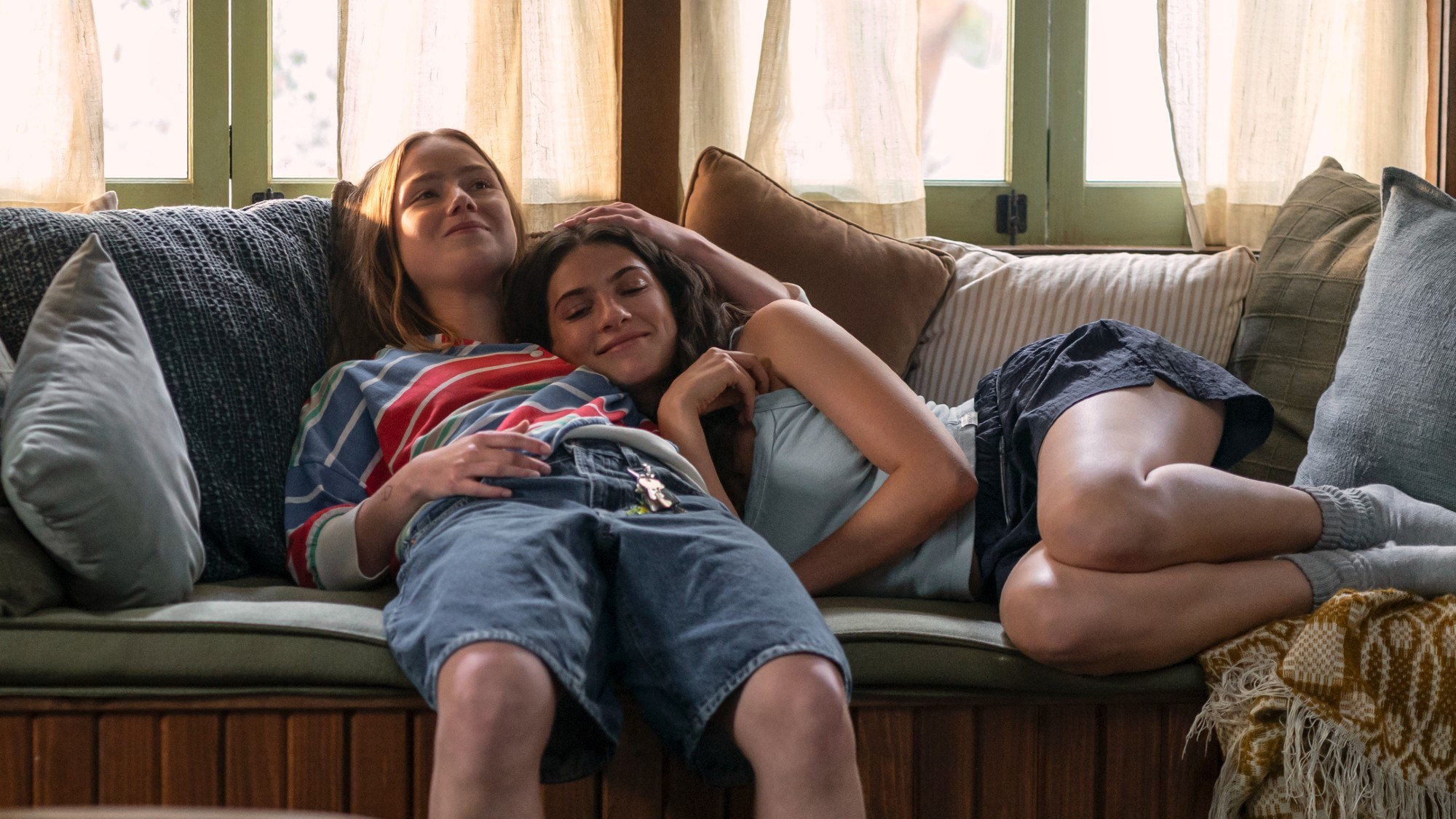
What sets Sterling Point apart is that, beyond the romance and the mystery and the scenic location, at its heart it’s a show about sisterhood.
In all the obvious ways, Annie and Ramona couldn’t be more different. Annie is the opposite of nonchalant, her neuroses leaking out through Rubin’s exuberant, elastic portrayal. Her speech detours into series of sentence fragments, like a split ends down a beachy wave. Ramona, on the other hand, plays everything as cool as her chunky jorts. Guarded to a fault, her capacity for affection is expressed only in the rare moments when she feels loved. Ramona severely underestimates her own merits, always appearing shocked at her own bravery. “Being hot isn’t exactly my brand,” she tells Annie, like a true hot gay dummy.
Neither have ever (knowingly) had a sister, but as soon as they meet, they play the part perfectly. There are the sweet, tender moments: talking to each other about their crushes, brushing each other’s hair, cuddling in bed. There are also cutting words, the barbs that sisters can launch at each others’ softest spots when they’re in pain, dealing with the same shit dumped on them by their parents but not knowing what to do about it. And there are the profound moments when they take some responsibility for helping each other through that shared baggage. “God, I wish our little kid selves got to hang out,” Ramona said, and I cried.
Annie and Ramona must deal with more than their emotional worlds—their shared ownership of Sterling Point is just as salient a manifestation of Muskoka’s class divide as Annie’s love triangle. Annie and Ramona might be sisters, but they have not grown up with the same opportunities, and their prospects in the world outside Sterling Point are not the same.
The world beyond Muskoka is mostly faint, however. The show makes summer feel permanent, like if there was a whole season of Gossip Girl in the Hamptons rather than just two glorious episodes. But summer is too sweet to last—much like life, as the death of the sisters’ mother constantly reminds us.
It’s death that follows the characters around, bringing everyone to their knees in acknowledgement. Death makes the adults act like kids, too busy protecting their pride and holding onto secrets to live life for what it is.
That leaves the kids to act like the grown-ups. Annie and Ramona help each other understand the voices that speak to them from the past, and come to terms with the fact that their parents had whole lives before they were born. They freak out over taxes. They think about who they want to be, and who they want to be around. What Sterling Point does so effectively is convince you that these sisters and their gang of earnest weirdos are exactly the kind of people you want to be around, too.