

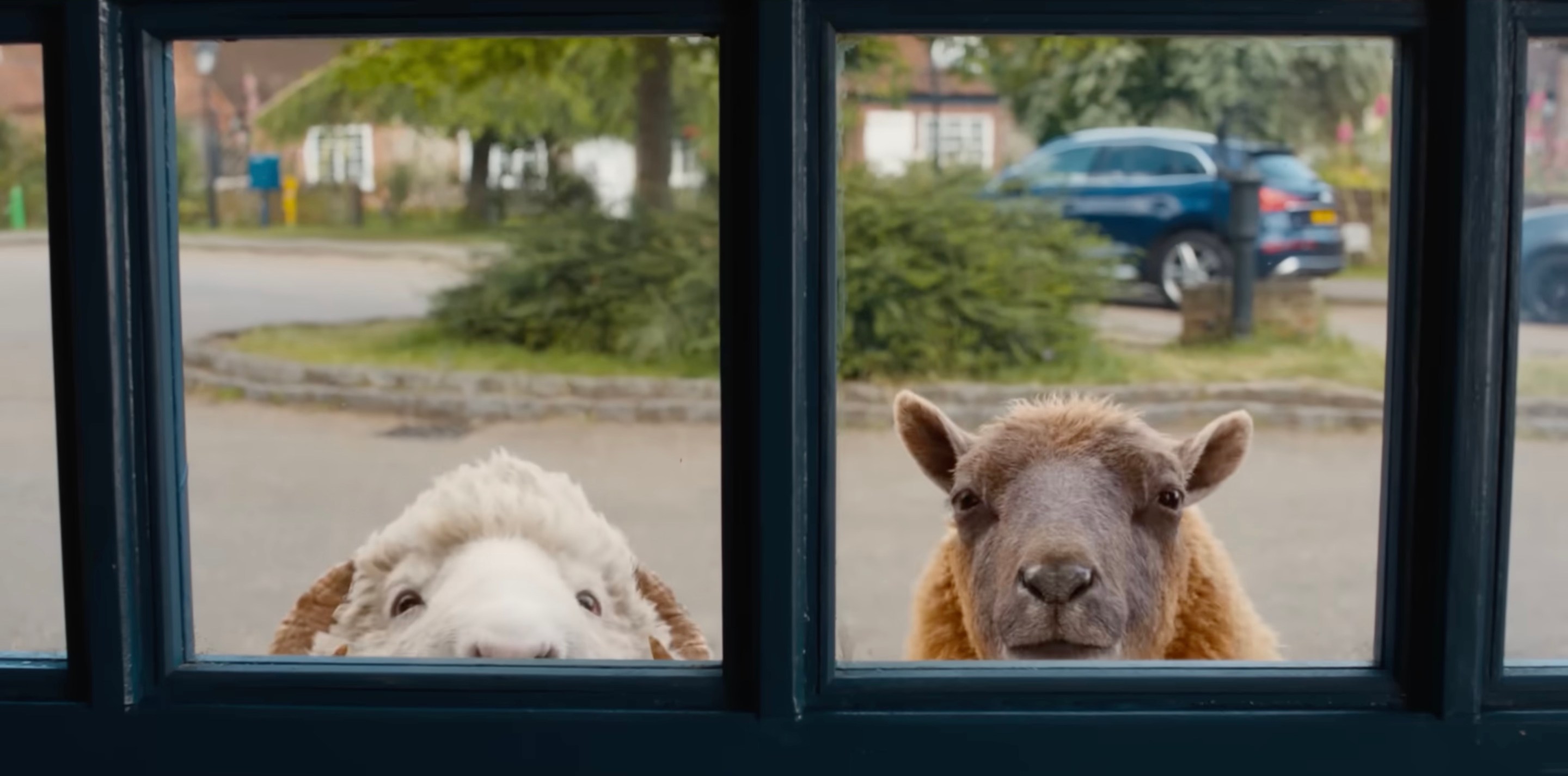
Earlier this spring, when I saw the trailer for The Sheep Detectives, I had what I have come to understand is a universal experience. When I watched Hugh Jackman, a kindly shepherd named George, read murder mysteries to his impressively realistic animated flock of sheep, I found this premise odd but charming. When I learned that George was murdered, his flock suddenly tasked with solving the crime, I found this baffling. When I saw Emma Thompson play a snappily dressed estate lawyer who reveals George's enormous fortune, I wondered how on earth someone convinced her to be in this movie. When I saw one sheep tell another sheep that he was, in fact, "a sheep detective," I found this turn of phrase ridiculous. When I saw the movie's title, The Sheep Detectives, appear onscreen, I had to laugh. What a fake-sounding title for a fake-looking movie, I thought, smugly, before watching my feature presentation, a movie about a girl who uploads her consciousness into a beaver.
And yet The Sheep Detectives never left my mind. Sometimes, as I was walking down the street, the phrase would burble up—sheep detectives!—and I would chuckle. When a friend asked if I wanted to watch a movie together, I suggested The Sheep Detectives, only slightly as a bit, and then found myself genuinely sad when my suggestion was politely rejected and we went, instead, for a walk. And then the rumors began, meaning multiple Instagram stories from distant acquaintances posting about how they had sobbed during none other than .... The Sheep Detectives. Someone offered to go with me to The Sheep Detectives out of pity, I think, because I kept bringing it up, and so this week I found myself in a 2 p.m. screening along with a smattering of retirees. I emerged two hours later with bleary red eyes and the knowledge that I had, as many others had before me, underestimated The Sheep Detectives. The wool had been lifted from my third eye: The Sheep Detectives is a marvelous movie. Emma Thompson would never have lent her formidable talent to anything less!
Before you ask: Does The Sheep Detectives accurately represent what it means to be a sheep? Not really. But this is not its remit. The movie is not about sheep; the movie is about sheep detectives, and I believe it represents this phenomenon ably.
The Sheep Detectives did not invent the concept of sheep detectives. The movie is an adaptation of Leonie Swann's novel Three Bags Full, a murder mystery narrated by the sheep who solve the crime. The mystery itself is a good one. After George is found dead in his field, his big-city estate lawyer gathers some townspeople for a reading of the will, which reveals George has amassed quite a fortune after patenting a cure for a disease called Orf. Motive! Despite the initial dismissal of the case by the town's bumbling policeman (Nicholas Braun as a British Cousin Greg), George's flock knows their shepherd was killed, and they spend the rest of the movie clopping around the town and countryside trying to figure out whodunnit. To the movie's credit, I could not guess who done it, but then again I am neither a sheep nor a detective.
The movie's humans, Thompson aside, are somewhat forgettable. The real stars are found in George's extremely diverse flock of sheep, whose accents would seemingly only collide in an episode of Love Island: All Stars. There are American sheep, Irish sheep, Kiwi sheep, as well as English sheep whose voices hail from Yorkshire, London, and whatever streets upon which Victorian orphans once starved. Regina Hall plays a hot North Country Cheviot. Patrick Stewart is a grizzled Boreray. Bryan Cranston is a loner black Icelandic Leadersheep, Rhys Darby is a daffy Lincoln longwool, Brett Goldstein voices pugnacious twin Norfolk horns, and the adjoining flock in the other pasture is exclusively Valaise Blacknose sheep. All of the sheep look great, with the exception of Bella Ramsey's Danish Landrace sheep, who unsettled me in a Polar Express kind of way.
Despite the movie's title, there is primarily one sheep detective: Lily the Shetland sheep, voiced by Julia Louis-Dreyfus and considered by George to be the smartest sheep in the world. This superlative takes on special meaning as Lily and her flocculent comrades succumb to and resist various sheep stereotypes, including that they are dumb and scared, or incapable of thinking for themselves or acting on their own. Lily leads the charge. She remembers the book George was reading that could help solve his murder. She brings clues to the idiot policeman. And yet Lily is not some ruminant saint. She, like the rest of her flock, upholds a sort of sheep caste system that only recognizes lambs born in the spring as a part of the flock. Lambs born in winter, on the other hand, are the subaltern. They are excluded from the flock, and their very name—winter lamb—is deployed in the movie like a slur. The merry flock's withering rejection of an aggressively chibi winter lamb is the first hint of The Sheep Detectives' dark undercurrent, which ultimately proves to be the heart of the movie. The script was, after all, written by the guy who made Chernobyl and was also freshman-year roommates with Ted Cruz.
Although George's flock understands they are considered dumb and gullible animals, they have exploited this connection to their collective to an oddly magical end. The flock has engineered a telepathic technology that allows them to erase their own memories of anything unpleasant, keeping their spirits blithe. This means that for a large chunk of the movie, the sheep do not comprehend death. Each time they have glimpsed it, they have chosen to forget. After George dies and Lily makes an impassioned plea, the flock chooses, for the first time, to remember. But they do not yet understand that death can come for sheep, too, until one of the movie's most devastating scenes.
There is one sheep who remembers. Mopple the Merino (Chris O'Dowd) has somehow become Lois Lowry's The Giver. He is the sheep who knows death, has stared it in its black-hearted eye. He alone carries all the flock's memories, the good and the bad. He remembers, he tells Lily, old friends and how they loved him. He remembers his mother's face. I would say I began to weep when he tells her "it's our memory that keeps the ones we love alive," but this would only be partly true, because I was weeping already, had been weeping constantly, in fact, for the last stretch of the movie. Because the true mystery of The Sheep Detectives is not who killed George, but rather how we manage to go on after we lose the ones we love. I wish I knew how a child might understand The Sheep Detectives' exploration of grief and death, what parts they might find funny or dark or thought-provoking. Even as an adult, I felt struck by Mopple's wisdom. And I learned, as Lily does, that you do not have to grieve alone, that you can share memories of the people you loved with the people who loved them, and it's as if a part of them lives on.
Of course The Sheep Detectives is not a perfect movie. Some of the human characters are boring, and there are occasional plot holes that threaten to wake you from the spell. You might find yourself wondering, for example, why British Emma Thompson tells a captive audience of British people that the British George's fortune amounts to 30 million dollars. You might wonder who was hand-feeding the runty winter lamb after George's death, or why every window in the town has its own conveniently placed stack of boxes, perfect for a sheep to scamper up and peer inside. Near its end, the movie veers into treacly territory, and yet I welcomed each new opportunity to cry. After all, it is a gift to remember, and mourn. I'm grateful to Mopple the Merino for reminding me of this. All cops might be pigs, but at least some detectives can be sheep.