
Pixar has always been investing in protecting the Earth, at least in its movies. A Bug's Life illuminated the role of insects in an ecosystem, Finding Nemo called attention to marine pollution and coral reefs, and WALL-E, the most radical of them all, imagined a planet destroyed by corporate greed and rapacious consumption. These films all concerned a non-human protagonist leaving home and engaging with the world, an era followed by a slew of films more concerned with the interiority of humans, such as Inside Out, Soul, and Turning Red. In this way, Hoppers, a movie about a girl who uploads her consciousness into a lifelike beaver robot to save a patch of forest, feels like a return to form.
Hoppers, like Pixar's pre-Disney films, is a delight. The beavers' world is immersive and richly realized, grounded in science but never dry. The plot zigs and zags between moments of absurdity and emotional heft to stirring effect; I cried multiple times, and not just because of the low-hanging fruit of grandma death. Despite the film's ultimate conclusions—about the rather pressing matter of what activism can and should look like, which left me bitter and jaded like the old man from Up before he gets his groove back—I had a blast. (Warning: Spoilers ahead!)
Hoppers tells the story of Mabel Tanaka, who we meet as a child as she attempts to liberate the captive turtles, guinea pigs, and birds from her elementary school. Heist foiled, Mabel visits her grandmother, who takes her to a forest glade fringing the city of Beaverton that teems with beavers and birds. Here, Mabel's grandmother teaches her that she is a part of nature, and it is her job to take care of it.
Time passes, as it does; grandma dies, as they do; and suddenly Mabel is a rebellious and skateboarding (read: gay) 19-year-old in college. When she learns the glade is set to be razed by the foppish Mayor Jerry (read: Gavin Newsom) to make way for an unnecessary highway, Mabel throws herself on the dynamite-riddled beaver dam, which has been curiously evacuated of wildlife. This protest fails when she's carted away by cops. A jeering Mayor Jerry tells her she can try collecting signatures as a means of protest, but this fails too.
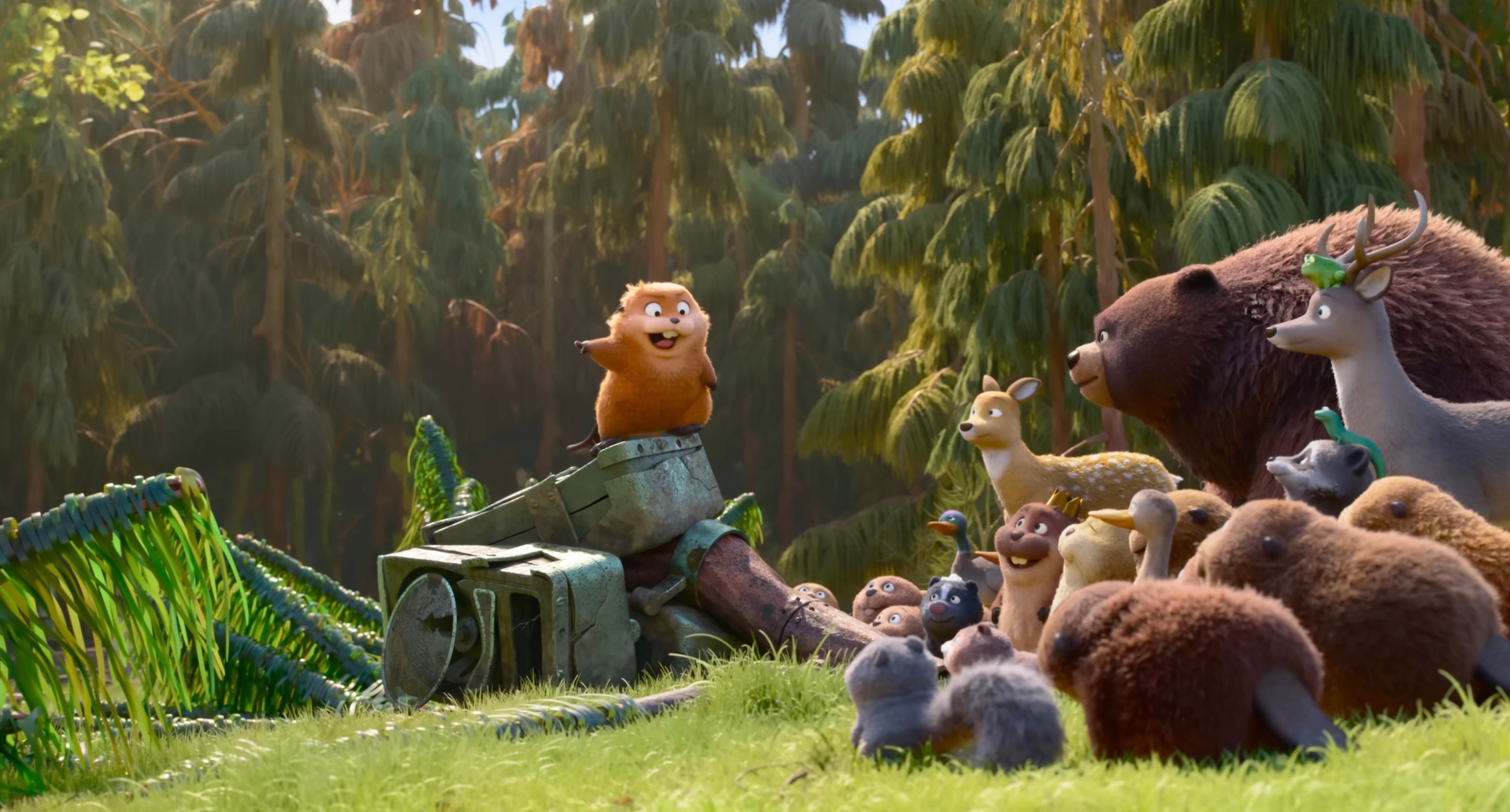
After these more traditional modes of direct action prove unsuccessful, Mabel learns that her professor has developed a technology called "hopping" that allows people to upload their consciousness to lifelike animal robots. Mabel's professor informs her that only a beaver can restore the glade and bring back the animals, so she hatches a plan to "hop" into a beaver suit and convince one to move in. As a beaver, Mabel can understand the language of every animal, allowing her to converse with any species except Homo sapiens. Soon she meets George, a kindly beaver anointed king of the mammals, who governs a de facto refugee camp for any animal displaced by human development.
Together, George and Mabel discover why the animals abandoned the glade: Major Jerry has surreptitiously installed machines that blare horrifying noise at a pitch only audible to non-human animals. After Mabel engages in a virtuous act of property destruction, George summons a council of all the animal rulers, including a monarch-esque butterfly, voiced by Meryl Streep, who represents the insects. The meeting goes awry when Mabel accidentally kills the insect queen, or, to use the movie's PG parlance, "squishes" her. In response, the queen's diabolical-looking son, a caterpillar named Titus, pupates immediately, becomes a butterfly, and is crowned the new insect king.
The rest of the movie traces two opposing possible paths to rectify Mayor Jerry's political and ecological oppression. Titus, along with the rest of the animal kingdom, believes that squishing Mayor Jerry would set things right. George, who leans centrist, opts for nonviolence. Everyone is good deep down, George reassures a skeptical Mabel, if you only give them the chance to be. As the animal kingdom unites to deposit Jerry into the jaws of an enormous shark named Diane, Mabel and George conspire to save the loathsome mayor's life. This reveal, that the true villain of the movie is not the human man who seeks to raze the animals' home for arrant political greed, but a vengeful boy-king given power too soon, is when Hoppers lost me.
This might seem an unfair judgment against a children's film. Sure, it's more fun to watch our beaver heroes try to vanquish a tiny tyrant whose master plan escalates to killing anyone who's ever squished anything spineless. But Pixar movies have never only been for children, and children deserve complex villains too. Making Titus the villain fundamentally misunderstands the face of cruelty as children are most likely to encounter it. True despots are real, but so are men like Jerry, who will sell out anyone less powerful to gain advantage, land, and money, who operate enough within the realm of respectability that society deems their actions excusable.
This twist felt surprising given the sensitivity of Hoppers' treatment of the interiority of non-human animals. When Mabel is among non-human animals, her beaver face is anthropomorphized and cartoonishly expressive, just like theirs. But as soon as a human enters the scene, Mabel and the animals become flattened and impenetrable, their eyes black and beady as a real beaver's. This design choice smartly flips on its head the old intellectual hierarchy that places humans at the top, and suggests that animals understand each other in ways that remain incomprehensible to us. In this way, it seems a cheap shot to make an insect—an animal that is least like us, is most frequently forgotten to be an animal, and also sits at the bottom of the food chain—an irredeemable villain. If any taxonomic class has proved its capacity for evil, it's us mammals.
Hoppers is shrewd to remind us that the rich inner worlds of animals cannot be hacked by something as simple as a beaver suit. Mabel might pass as a beaver, but she does not understand beaver culture—not only how to swim, dam, and gnaw, but also the covenant of the forest animals, called Pond Rules. One such Pond Rule mandates that all animals respect the food chain, briefly demonstrated when Mabel's conversation with a worm is interrupted by said worm being eaten. If Hoppers means what it says, that humans are just as much a part of nature as a beaver, why shouldn't Pond Rules also apply to Beaverton? Do humans really deserve to be exempt from the food chain? Is justice not a nobler cause than hunger? Is it so wrong to root for a lying slimeball with no care for animals or the environment to be eaten by a shark?
I suppose I did not expect a children's film to come down on the side of political assassination, especially not one under the iron helm of Disney. (If an animation studio one day transposes the saga of Luigi Mangione onto a sentient squeaky toy, I will be sat!) But I was rankled by the premise that we should be repelled by the idea that animals would want to kill an individual who has razed their home and displaced them to an increasingly fragmented wild. Allowing this righteous anger to be subsumed by Titus's convenient megalomania felt like a cop-out, humanity giving itself a Get Out Of Jail Free card. So murder's off the table, but could we please have some consequences? Maybe Mayor Jerry's noise-machine scheme is found out and he is run out of public life. Maybe Mabel canvasses again, this time for the DSA.
At the very end of the movie, Mabel and Mayor Jerry have one last faceoff in the glade. Mayor Jerry has brought in a construction team, presumably to get back to work on building his highway. Then, surprise! The workers are here to restore the pond to its former glory. Mayor Jerry has seen the light, and the glade is saved, all thanks to the decision of one guy who will apparently remain in office, as was always his goal. Did he change his mind about the glade out of a burgeoning morality or the near-death experience he had with a shark named Diane? I suppose this is an example of effective activism, even if Hoppers did not intend it to be. Maybe if someone were to dangle a wriggling Gavin Newsom over the gnashing maws of a great white shark, even he might develop a conscience. But this seems a dishonest lesson to impress upon children, that activists should appeal to a powerful person's better nature. I'd wager more often than not, they don't have one.
Another thing Hoppers got right, if perhaps unintentionally: In the denouement, Mabel learns that her professor has lost her funding to study hopping technology, given the fallout from Titus's last stand. But, the professor assures Mabel with glee, she has other projects to work on, such as a collar that allows dogs to talk. This is ostensibly a reference to Up, but it is also an extremely depressing example of how funding determines what science is made and how radical it is allowed to be. Of course a university would be less invested in a technology that, however chaotically deployed, is fundamentally interested in creating interspecies dialogue between people and wild animals, than a technology that would let us chat with the one animal humans have bred to near-total subservience. If we talked to wild animals, we might have to listen to what they would say.
Maybe the most radical thing a children's movie can do is take its cues from reality and make its most menacing villain not a laughably Mephistophelian larva but a blandly handsome white man. This is who is obliterating the rainforests, displacing beings of all species. This is who is cheating, lying, and bending the law to accrue personal power. Unlike George, I do not believe all beings are fundamentally good. I do not believe that respecting the rules of respectability set by undeservedly powerful people will deliver the radical change we need to save the Earth from all the ruin they cause. We may still have to live alongside them, but we should be making their lives hell. I think Mabel knows how to do this, if only Pixar would let her show us how. Maybe the kids aren't ready for How To Blow Up A Pipeline, but they can certainly handle How To Blockade A Highway.