
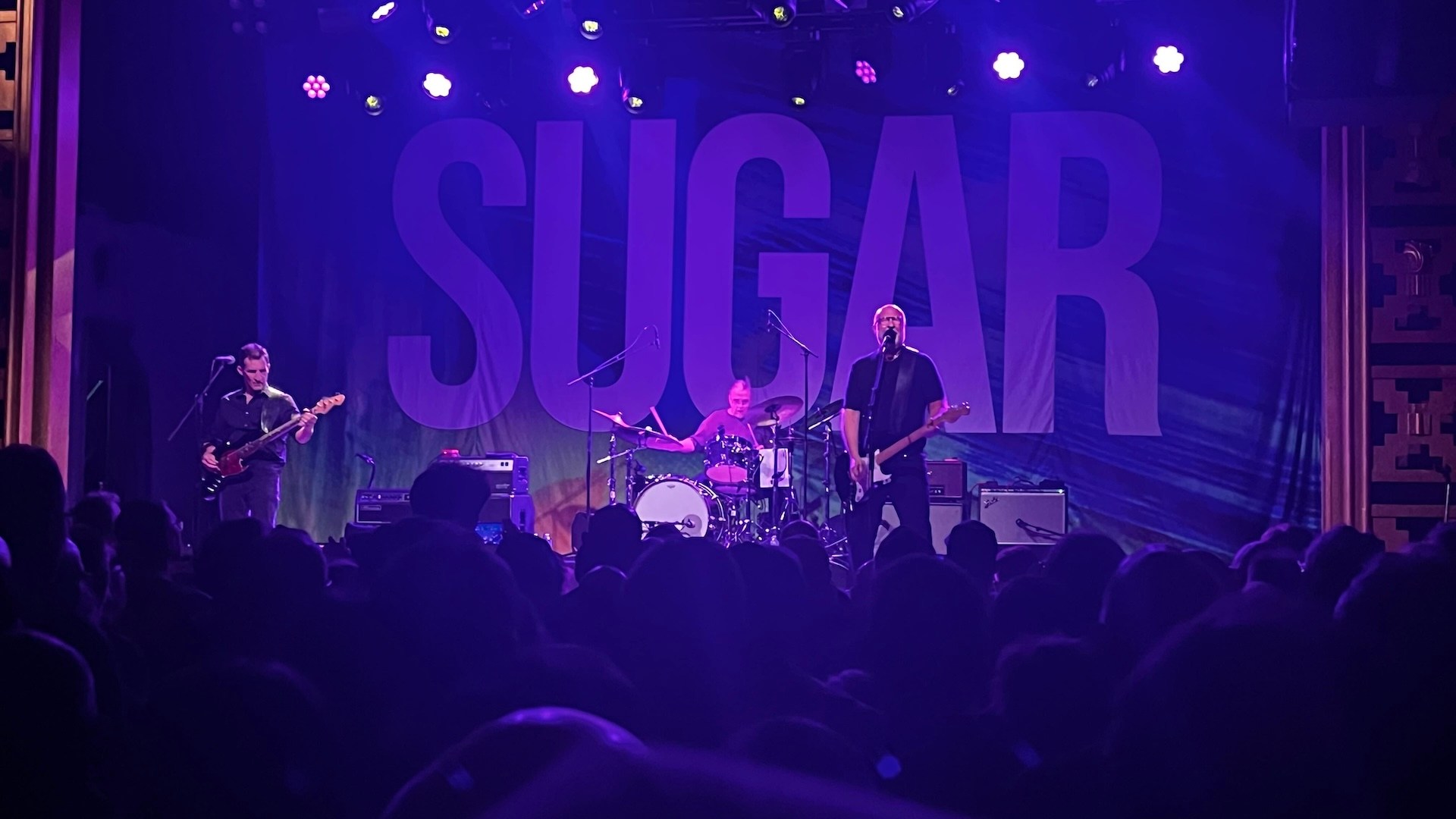
We begin at Webster Hall in New York City. I'm standing on the main floor with the rest of the general admission patrons. My best friend Howard is with me. He's been waiting nearly as many years as I have for what's about to transpire. So has everyone else in the room. Many of them are already drunk. Many more are still queued up in the line at the merch stand, which has run out of at least one line of T-shirts and will likely run out of others.
Howard and I are soaking in the pre-concert playlist playing over the loudspeakers, and waiting for the lights to go dark. I've put in my earplugs. I can't hear anything Howard says, but it doesn't matter. He's ready. I'm ready. Everyone is ready, because we're about to witness the resurrection of Sugar, one of the greatest bands of the 1990s. None of us believed this band would reunite. Never considered the possibility, really. Shit, prior to tonight I didn't even think the members of Sugar—guitarist/vocalist Bob Mould, bassist David Barbe, drummer Malcolm Travis—had considered the idea themselves. For Mould, the ringleader, Sugar wasn't even the most famous band he'd played in. The fact that they're here together on this opening night of the "Love You Even Still" tour, and that we're all here to witness it, feels like a happy fluke.
But this is no fluke at all. This is a reunion that required many years, plus a well-timed video birthday card, to become a reality. I have seen Mould on his own in concert more times than I can count, but I've never seen him take the stage live with Travis and Barbe. That's because I discovered Sugar's music a beat too late. They had already broken up before my roommate put on their second album, File Under: Easy Listening, in our college dorm room. Once I heard the opening chords to "Gee Angel," I knew right away that Sugar was my band. That they would always be my band. If I never got to see them in the flesh, so be it. The music had me forever. I knew it back in 1997, and I still know it today, 29 years later.
The lights at Webster Hall go down, and a roar from the adrenalized crowd fills up every empty space left in the room. Here the band comes, every member dressed in black and ready to get to work: Barbe, lean and youthful for a 63-year-old, assuming his place stage right; Travis climbing up onto the drum riser and taking his seat; and finally Mould, 66 years old and built like a truck, taking his spot stage left and plugging in. From there, it's 3-2-1 blastoff.
A dozen songs in, something happens. During the instrumental "Clownmaster," Travis, age 73, suddenly disappears from behind his kit. Where did he go? Did he just have a heart attack? Is this reunion over before the first show has even ended? Mould and Barbe continue playing as they gather around Travis's kit to assess the situation. Those two seem to know what's going on, but the rest of us do not. When Travis hops back onto his stool and gets back to keeping time, I'm left to wonder what happened and, a bit more darkly, what might happen next.
What happens next is more rock and roll. A dozen more songs, including a three-song encore featuring the aforementioned "Gee Angel," one of the highlights of the night. Howard and I are appropriately blown away. But I am definitely on edge for that back half of the show, because I worry for Travis. I'm no spring chicken. I know how your body can turn on you later in life, and I don't want that for Travis. Not now. Not after what he's been through to get here. Even after he makes it all the way to the end of the set and walks off the stage in one piece, I think about the tour ahead for his band. Will they make it to the end? Because these guys have a history of disappearing as quickly as they came, after all.
Sugar was not Bob Mould's first band. The man became a punk-rock legend as one of driving creative forces behind Minnesota's Hüsker Dü. Hüsker was a lo-fi indie band that, from its inception in 1979 to its definitive end in 1988, was among the first to pair punk's DIY sound with pop-music hooks (Joey Ramone, ever the crank, once said that Hüsker was just ripping his band off), which helped lay the groundwork for the grunge movement of the early 1990s. Hüsker Dü's music was joyous, agonized, and above all else very loud. There's no Nirvana without Hüsker Dü. In fact, many of your favorite artists wouldn't have existed without Hüsker Dü.
By the time the Seattle bands broke big, Hüsker Dü was already done. Their 1988 split was not an amicable one, and it left the founding members—Mould, drummer/vocalist Grant Hart, and bassist Greg Norton—unwilling to ever reconcile. Not even after the rock genre they helped pioneer had taken over the world.
Once Nirvana busted the door down with Nevermind in 1991, Mould seized on the opportunity by starting a new band. Unlike Hüsker Dü, where Mould and Hart shared songwriting and lead vocal duties and were always in tacit competition with one another, this new band would give Mould full control over nearly everything. He recruited Barbe (then of Mercyland) and Travis (Human Sexual Response) as his bandmates. He then christened the power trio Sugar, after seeing a sugar packet on a table at a diner and figuring that name was as good as any.
Recording sessions in Athens, Georgia, birthed 1992's Copper Blue, which took the Hüsker Dü formula and added a high-grade studio polish that Mould's original band had never had. The result was an undisputed masterpiece, and the best-selling album of Mould's career. On Copper Blue, Mould honed his sound to perfection: layers upon layers of distortion; the lead vocals mixed way down, almost as if they were just another layer of guitars, and a thick rhythm section undergirding all of it. "Beauty torn from violence," as music critic Greg Kot described it. Few debut albums sounded more confident than Copper Blue.
Or louder.
"The songs, especially on Copper Blue and [spinoff EP] Beaster, are a little more elongated: more guitar workouts, longer outros," Mould told me this past summer. "Maybe that was just part of the style of the early '90s when I was writing them." Maybe it was, but the results were timeless. Here was a band that could produce one sturdy, incredible track after another. A band that easily could have lasted forever.
It would last only three years.
"We exchanged some pretty stinky letters, and that set the tone for the next about 10 years. It wasn't very … how should I put it? It didn't really facilitate good communication for a long time.”
Malcolm Travis
After the success of Copper Blue, the three members of Sugar rushed to get a follow-up album done. This time, the process was far more taxing. In fact, for the record that would become 1995's File Under: Easy Listening, Mould ended up scrapping the first sessions entirely. Kurt Cobain's death earlier that year had blunted the vibe, both within Sugar and without. More importantly, the initial recordings for FU:EL, technically speaking, sounded like shit.
"Our first attempt was done in Atlanta," Travis told me. "Imagine one of those calling centers for T-Mobile or something, where they've got dozens and dozens and dozens of little cubicles spread out over a football field. Now imagine everything taken out and it's just an empty room. That's what it was. It was really a hard space to track in."
"We were putting headphones over the top of our headphones," Mould said. "David was doing a lot of the engineering. I'm trying to direct traffic and get the best results. Malcolm's out in a warehouse with runway protectors on. That's not an ideal situation to make a record in. My bad for all of that."
After those thorny sessions, Mould couldn't get the bass parts and the drum parts to line up correctly in post-production. So he had the band fly to a different studio in Austin to re-record everything, with Travis adding his drum tracks at the very end of the process.
"I was playing to fully formed tracks," Travis told me.
"Is it common to lay down the drum tracks last?" I asked him.
"Never. I've never done that before or since. And back then, the technology wasn't as advanced as it is now where you can just paste drop stuff in there. You had to pretty much play perfectly from A to Z. That was very stressful."
Meanwhile, Barbe—who originally attended the University of Georgia to become a journalist, only to change his mind once he bought a $2 ticket to see local Athens band REM play at a club—was burning out from the constant touring and recording. As a result, he made a choice that was unreasonably sane for a 1990s rock star.
"I had three small children at home and decided, 'I have to stop doing this,'" he told me. "I loved the music. I loved those guys, but for the benefit of my children, I needed to be at home. I couldn't spend my life like that."
Once FU:EL was released to predictable acclaim (though not quite as much as its predecessor), Barbe went to Mould and told him that he was done. He even told Mould to go ahead and hire a new bassist for Sugar if he wished. Instead, Mould chose to disband the group altogether. Travis was the last of the three to find out.
"I felt betrayed," Travis told me. "It was a pretty serious thing. They didn't break the news to me. I finally just went, 'This sucks.' We exchanged some pretty stinky letters, and that set the tone for the next about 10 years. It wasn't very … how should I put it? It didn't really facilitate good communication for a long time."
Mould, already a veteran of one truly horrific breakup (Hüsker Dü would never reunite; Hart would die of cancer in 2017), admitted to me that he could have handled the situation better.
"Breaking up bands is not my specialty, and not always fun. Does it leave scars? I think there was animus, and rightfully so," Mould said.
That animus quietly lingered. Fortunately, so did the songs. Within a span of just three years, Sugar had produced two excellent albums, a full collection of B-sides (titled Besides) that stood on its own, and the astonishingly heavy EP Beaster. Other bands would have needed decades to produce an output that could even approach that level of quality. Sugar did it in relatively no time at all, and then POOF! The band was gone before people like me had even realized they had been there.
"That record leaves a lot of blood on the floor. It's like, I don't know how long I want to bleed every night."
Bob Mould on Beaster
Travis filled the intervening years drumming where he could, waiting tables, and even working at Dell Computers for a stretch to help support his family. Barbe helped produce records for the likes of Son Volt and Drive-By Truckers while also heading up UGA's Music Business program, a job he still holds. As for Mould, he dabbled in electronica and even took a brief stint writing for World Championship Wrestling (where he experimented with doing steroids with the help of new friend Kevin Nash) to busy himself. All the while, he kept up his solo career, trying out different bandmates before eventually teaming up with Verbow bassist Jason Narducy and Superchunk drummer Jon Wurster to form a third, and seemingly ultimate, power trio that played solely under the name "Bob Mould." Mould did some of his finest studio work with Narducy and Wurster, while also playing Hüsker Dü and Sugar classics with the two while out on the road. In fact, it was that group which Mould took on tour in 2012 to celebrate the 20th anniversary of Copper Blue, which seemed to obviate the need for him to ever get the original Sugar back together.
But that wasn't true, and even Mould knew it.
Travis turned 70 in February of 2023. To commemorate the occasion, his wife emailed all of his friends, asking them to record birthday greetings for her to compile into a video birthday card. On the big day, she surprised her husband with a link to the final cut. Travis clicked on the link.
"It was just a bunch of people coming on and saying, 'Hey, Malcolm. Happy birthday,'" he told me. "Bringing up stuff that I couldn't remember. Great."
Then, roughly a dozen messages in, an old face popped up on Travis's screen: close-cropped hair, graying beard, thick eyeglasses. Bob Mould. The two had kept in sporadic touch, but not in any significant way. Seeing Mould now, wishing him a happy 70th birthday, laid Travis flat.
"I'm like, What? It really touched me. It was really great. I was really happy to see him in front of me."
Travis was so heartened by Mould's effort that he wondered, sitting in his Massachusetts home, if his old bandmate was surreptitiously hinting at a potential reconciliation, both personal and professional. The two men had spoken on and off in the intervening decades, but Travis's only real remaining tether to Sugar was Barbe, with whom he'd remained lifelong friends. So the drummer called up Barbe in an attempt to gauge the temperature.
Recounting that phone call, Barbe says, "Malcolm told me if a Sugar reunion is ever going to happen, it probably needed to happen sooner than later, while he was physically capable. I was like, 'You should write a letter to Bob and just tell him. If he wants to do this again, he'll know that you feel the same way.' Shockingly, other people don't always know how we feel if we don't share it with them."
So Travis drafted a lengthy email to Mould, ending it with this: "If there's ever any chance of Sugar doing a reunion, the time is now because the window is closing."
Mould, ever inscrutable, didn't reply at first. Travis told Barbe he hadn't heard back. Barbe replied, "Maybe Bob knows." Indeed, Mould had read the email. But rather than respond to Travis immediately, the punk icon spent his free time figuring out how and when a revamped Sugar could work. The potential money was enticing, although the vagaries of the 2020s concert economy made that far from guaranteed.
"To be honest," Mould told me, "I did not see a war that would be affecting all kinds of energy prices when we started laying stuff out."
But Mould knew people would be interested. More importantly, he knew that Barbe and Travis were interested. He sensed the passion was still there, and that they might even be able to get it down on tape. He spotted an opening over a year later when Barbe, in Mould's hometown of San Francisco while on tour with Drive-By Truckers, paid him a visit. The two hung out for a couple of hours, and only at the very end of their visit did Mould pop this question on his old bassist:
"Oh, by the way, 2026: What do you think?"
"I'm totally down," Barbe replied. "Let's do it."
"What do you think about Malcolm?" Mould asked.
"Malcolm would love to do this," Barbe replied. "But I think you should contact him personally."
It was then, 18 months after Travis had first emailed Mould about getting back together, that Mould finally replied in kind. He gave Travis a lengthy update on how he was doing, then ended his email, "There may be some interest in a Sugar reunion. I'm looking into it. That's all I can say for now, but don't share this with anybody."
Sometime thereafter, Mould sent both Travis and Barbe an email that asked: "Hey, could you guys go to Oakland one day this summer to record?" Both men said yes, and suddenly Sugar, unbeknownst to the rest of the universe, was about to play music again.
Mould sent Travis and Barbe three new songs he'd written. Travis practiced the tracks nonstop in his tiny basement studio. Barbe did the same back in Athens. When the three men convened in October of 2024 at Tiny Telephone studio in Oakland (an actual studio, not a hollowed-out cubicle farm), they laid down the new songs with the kind of crisp efficiency they'd brought to Copper Blue 30-plus years prior.
"Everybody quickly touched on where we'd left things," Mould told me. "Then it was just, let's get to work. Not a lot of litigating. Not a lot of this and that. Just, 'Here we are. People like these songs. Let's do our best and go play.' At this point in my life, I need to focus on the things I need to do, not the things I did."
"I knew," said Barbe of that session. "I knew that this was actually going to work and be cool."
Travis knew too. These songs were good enough to be released, and the three-piece was tight enough to take their act back out on the road. They just couldn't tell anyone yet.
"I had a hell of a time biting my tongue," Travis said. "I think I told my wife and maybe one of my kids. Even then, I got nervous they might spill it!"
They didn't. Travis kept his trap shut while Mould laid down a trail of digital breadcrumbs: a new Sugar Instagram account, an updated band logo … enough clues to tantalize, but nothing definitive. And then, in the fall of 2025, a new single dropped:
Sugar had come back gradually, and then all at once. The other two tracks the three men had recorded in Oakland were eventually released (none of them know if they'll record a full album or not later on), and so was a full tour schedule: three live shows at Webster Hall, then a handful of dates across Europe, then a North American tour, and then back to Europe for a final leg. It was a cathartic moment for everyone involved—a dream come true, even. But it was also an Oh shit, this is really happening moment. These guys hadn't played in front of a crowd in decades. Now they were about to tour the Western world. Barbe's wife warned him to get in shape. Travis, meanwhile, was also daunted.
"The bomb dropped," Travis told me. "'Hey, we're doing three shows in New York. Get your tickets now, or be sorry.' All the shows sold out! Then the pressure was on."
That pressure didn't feel evident at that opening Webster Hall show, the one Howard and I attended. Not for the first dozen songs, at least. Then Travis fell off his riser, and it wasn't just the crowd that was worried.
"We're playing," said Barbe, "and I heard the drum disappear out of the monitors. I thought something was wrong with the PA. Then I shot my head around and realized, 'Where's Malcolm?' I assumed the worst. If a person in their 70s is in an emotionally charged environment that's also hot and physically grueling, and they suddenly fall over, you start making a list in your brain of bad things that could be."
Travis mouthed to Barbe that he was fine. Mould gestured to Barbe to keep playing while their drummer got back into place. The whole episode couldn't have lasted more than a few seconds, but long enough to make you hold your breath. As for Travis, he just felt stupid.
"My drum seat collapsed," he said. "I was like, 'What? How humiliating!' I was feeling fine; it was just a mechanical mishap."
They finished that show, including two tracks from the hellacious Beaster, and then did a quick assessment of how the set went.
"People didn't throw stuff at us," Barbe told me. "So I guess it went great."
Mould himself felt overwhelmed the entire night. "It's just like, 'Oh my God, these songs, this crowd, David and Malcolm again!' It was flying off the handle. By the next day, I was like I gotta reel this in, and we've got to get right with these songs. It was first-night craziness."
Travis got a new drum seat for the following night's concert, and it held up all the way through the European leg (where, in Spain, they shared a bill with Alice Cooper), and then back stateside for a list of summer dates that included my hometown of Washington, D.C. No chance I would miss it.
I'm on the D.C. Metro, headed toward the city's waterfront district. Another friend of mine, Aaron, is meeting me down at The Anthem, a relatively new venue that holds up to four times as many attendees as Webster Hall did. Aaron is familiar with Sugar, but not a lifelong acolyte of the band. This will all be relatively new to him. I tell him to bring earplugs. I also warn him that I'll be singing along with every song. Maybe he should also bring some of those runway headphones that Travis had to use in Atlanta.
The crowd on the floor is sparse at first, giving the two of us a chance to get close to the stage, maybe five or 10 people away from the barrier. The floor grows denser with bodies as the lights go down. The band comes on, same as they did at the Webster Hall gig: dressed in all black, right to their designated marks on stage, and ready to kill. The pressure of opening night, and the pratfalls to go with it, are long past. These guys are fully road-tested again, and it shows. Travis has made it through every other show without major incident, and he'll remain happily upright for all of this one. Unlike back in New York, I'm not preoccupied with the eventfulness of this night. This time around, I can just focus on the music itself.
The band does likewise. There's Travis, eyes down and concentrating with all of his might as he lays down the beat. There's Barbe, with a perpetual shit-eating grin on his face as he takes lead vocals on the handful of B-sides he wrote and recorded with the band back in the 1990s. And there's Mould, the big dog, prowling the stage with his guitar like he's about to beat the shit out of you with it. I can tell that Mould, who has performed as a solo act more often than as part of a collective, is more than happy to be in a proper band again, to cede the spotlight both to Barbe and Travis so that his bandmates can soak up the moment. I can also tell that performing songs he hadn't played on stage in many years has forced Mould, who admits that he tends to just scream out lyrics while playing live, to sing on key.
This set is less frantic than the first night, but no less intense. In fact, at one point Mould—who tends to keep his stage banter to a minimum—chastises the crowd for not being loud enough. I have seen this man play live a zillion times, and I have never heard him do the I CAN'T HEAR YOU! bit with his fans. We all scream louder. The band rips through 17 songs before Mould steps to the mic and solemnly intones, "It's time." He means Beaster is coming. And now.
Beaster is just six songs long, but it needs no extra padding to be a masterpiece. It serves as both a primal howl and a glorious showcase of indelible hooks. Mould wrote and recorded it in a mad frenzy, to serve as the "evil twin" to Copper Blue. And the EP is evil, in all the best ways: lightning-fast guitar solos, abrupt shifts in tempo, Mould screaming, "I'm your Jesus Christ" until he can't breathe. Even Slayer would be taken aback by the heaviness on display. Here is a work so loud and intense, it may very well have taken years off of Mould's life to make it. That's one reason why he hasn't played its signature tracks live in many, many years.
"That record leaves a lot of blood on the floor," Mould said to me. "It's like, I don't know how long I want to bleed every night."
Tonight, he's willing to bleed for us. The three men kick off with the dreamy "Come Around" before the frantic rush of "Tilted," the greatest hard rock song of all time, fires out at us. After that, Travis lays down the opening beats of "JC Auto," the second greatest hard rock song of all time, and now Mould doesn't have to prompt the crowd to get louder. We're all loud. We're all pogo-ing. We're all screaming. Mould is screaming. The whole universe is screaming, as far as I know. After the show, Aaron will say to me, “I had no idea these guys rocked this hard." Now he does.
As for me, I got to experience those Beaster songs live for the first time at the Webster Hall show. But like the band, I was too caught up in the HOLY SHIT of it all to properly enjoy it. Not this time. Every time I've listened to these songs, every time I've screamed along with them while alone in my car, every time I've imagined seeing this band sandblast my face off by playing "Tilted" on stage: All of that was in anticipation of this moment, in this hall, with this crowd. It was worth it. I feel whole with the music now.
If this reunion was strictly about money, you'd never know it from how hard this band is working up there tonight. Bob Mould, Dave Barbe, Malcolm Travis: These are three men who are now old enough to understand, tangibly, how finite time is. The way they're playing right now, you know they have little intention of wasting it. Sugar could have remained a band only in memory. They could have been content to allow life to take them further apart from one another. But why live just to be content? Why not use the time you have left to see what you have left? None of these men knew the answer to that second question before this tour. Now they know, and so does the rest of the world. They're not the men they once were, but they haven't fallen off. Not a whit.
"Everything feels different because I'm not 30," Mould said to me. "This is an opportunity for us to be great. It's different and the same. It's like when you get together with old friends. Everybody's grown and changed but at your core, you're still the same people."