

In the 1957 drama The Three Faces of Eve, Joanne Woodward plays a woman with a split personality. By day, she is Eve White, an uptight housewife with a whisper of a voice, but sometimes, White is overtaken by Eve Black, a good-time gal in that mid-century American strain. "Honey, there are a lot of things you've never seen me do before," she purrs at the doctor. "That's no sign I don't do 'em."
The central tension of the film is both psychoanalytic and sociological, as Eve faces the Goldilocks problem of whether she should be a porridge that is too hot or too cold. Luckily for Eve, she discovers a new persona, Jane, who combines the extremes of both—the kind of woman you marry or you hire to teach elocution.
It was The Three Faces of Eve, and not any of the "Frat Pack" comedies of the 2000s, that sprang to mind as I revisited 2003's Old School, a movie I hadn't seen since for a good 20 years and which, in light of recent news, did not hold up. Old School revolves around Mitch (Luke Wilson), a man who comes home to see his live-in girlfriend (Juliette Lewis) hosting an orgy. He moves to a house by a college campus, where his two friends, married father Beanie (Vince Vaughn) and newlywed Frank (Will Ferrell), convince him to start a fraternity.
The three go back to streaking and drinking, one of them accidentally bedding a high schooler (dude, one time!), but nothing old can stay. Beanie eventually returns to his familial responsibilities, antagonizing the ref at a youth soccer game, while Frank, who has fully reverted to his rowdy, "Frank the Tank" college self, becomes the frat's new "godfather." Mitch? He's had his fun, so it is time for a foxy, age-appropriate girlfriend, single mom Nicole (Ellen Pompeo), and a more grown-up living arrangement.
One man is over-domesticated, straining at the limits of his suburban life; one is so unruly that his only choice, by film's end, is to reject adult responsibility entirely; and one is, well, the third, best face of Eve. Luke Wilson's character lives in that sweet spot of potentiality, monogamy without monotony, on the verge of a life looking more promising than the last one.
To borrow Britney's formulation, he's not a boy, not yet a stepdad.
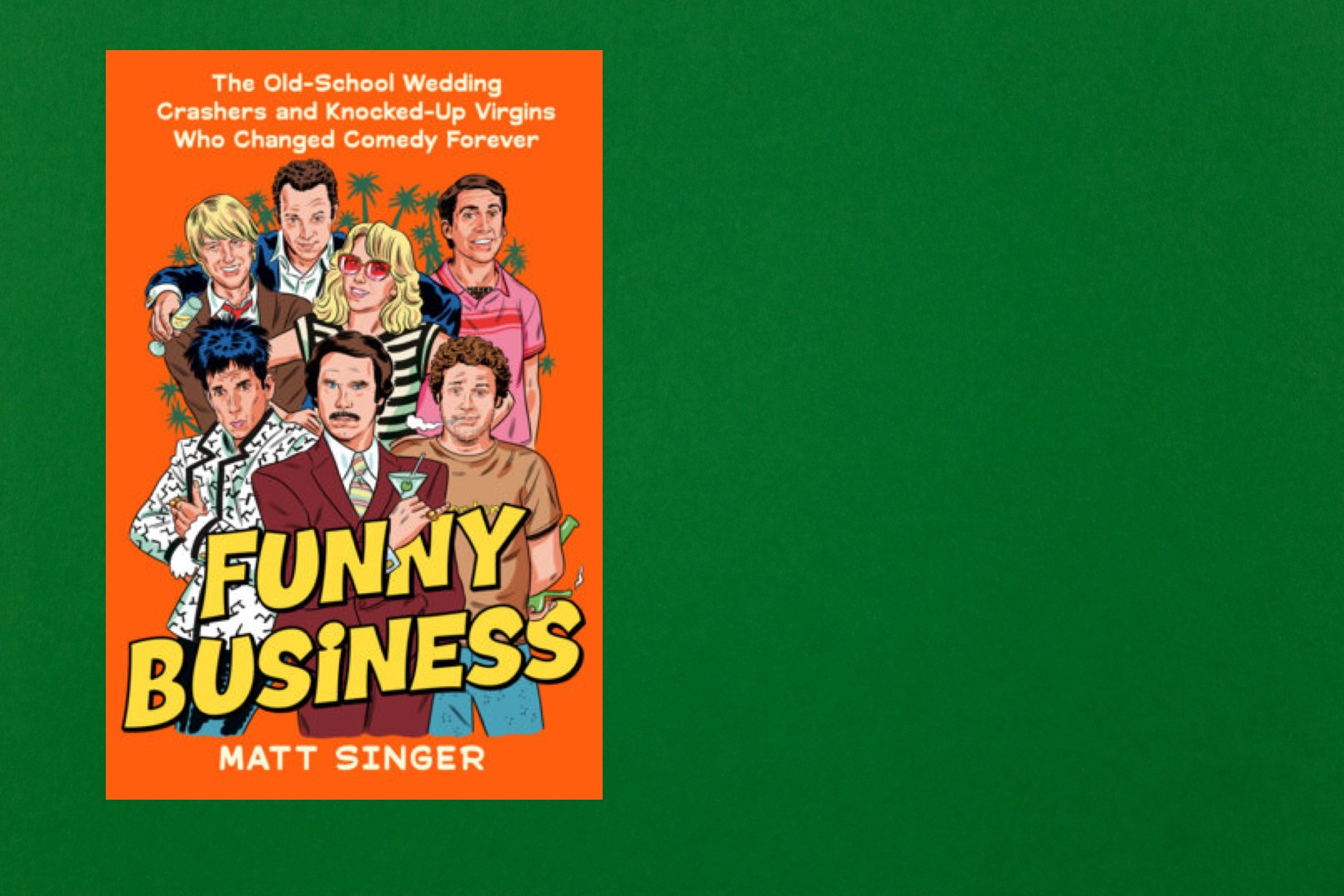
Old School is one of many movies discussed in Matt Singer's new book, Funny Business: The Old School Wedding Crashers and Knocked Up Virgins Who Changed Comedy Forever. In it, Singer tracks the meteoric rise and subsequent dissolution of the 2000s "Frat Pack," a term coined by Entertainment Weekly's Susan Wloszczyna in her coverage of the 2005 film Wedding Crashers. She started by talking about the film's stars, Vaughn and Owen Wilson, and built out the designation from there.
The "Frat Pack" would come to stand in for a broader network of talent, including writer-director Judd Apatow, director Todd Phillips, actor Steve Carell, writer-director Adam McKay, actor-writer Seth Rogen, and, perhaps the most hyphenate of all, actor-writer-director-producer Ben Stiller. To the extent that they accepted the moniker—they mostly resisted it, based on how juvenile and toxic it sounded, even at the time—they knew they collaborated well. They did not just act with or direct one another but offered uncredited support, eager to jump in with a cameo or a punched-up punchline. "[T]he whole Rat Pack–Frat Pack thing that came out is overblown," Vaughn told Wloszczyna in her fateful article. "It was really Ben Stiller giving opportunities to people."
Secondary members like Paul Rudd, Kristen Wiig, and director Paul Feig feature but not as prominently. Singer focuses on the figures with muscle behind them, those with box-office clout or production power, the number-1s on the call sheet.
Zoolander, The 40-Year-Old Virgin, Superbad, Bridesmaids, even The Cable Guy: These mid-budget, mainstream film comedies were ostensibly for grown-ups, by grown-ups, largely about men who needed to grow up. Raunchy, silly, but big of heart, these movies are the underachieving baby brothers of earlier boys-will-be-boys comedy films like Animal House (1978), Stripes (1981), and Revenge of the Nerds (1984), heavy-drinking stories light on sexual consent. Singer leans into the language of the schoolhouse, writing that if "M*A*S*H was basic bad taste, Animal House was advanced bad taste," and proceeds to deem the subjects of his book the "less-bad guys." These were the comedy super-fans who grew up reading MAD Magazine, alone, mostly, in their childhood bedrooms.
The characters in Frat Pack movies haven’t gone to war, and they don't have medical degrees, though some got a prescription for medicinal marijuana. Most of them are stumbling toward an answer to the question of what it means to be a husband, a father, and, even, a decent person, what it looks like to reconcile being one of the guys with being a good man.
But there is a wildness inside them too, one that refuses to be assimilated. That's where the comedy comes from—and, also, the darkness.
Singer—who is an editor and writer at Screencrush.com— approaches this decade-long genre cycle as an entertainment journalist first, critic second. For fans less familiar with the ins and outs of comedy production, the book explores how directors like Apatow and McKay left space for "alts" or improvisational takes, which quite often made it into the final cut:
As a first-time director without an entrenched idea of the "correct" way to make a movie, McKay developed his own approach, one that encouraged collaboration and experimentation. First, the cast would film the scripted dialogue a couple times word-for-word. Then they would keep rolling and let the actors try whatever they wanted—"alts" in the parlance of a McKay set.
Whatever didn't make it into the film could go into an extended cut, a blooper reel, or, in the case of Anchorman, a spin-off feature for the DVD called Wake Up, Ron Burgundy: The Lost Movie.
Funny Business is a trip down memory lane for anyone who remembers these movies well enough to be fond of them, but not so well as to cringe at their dated scenes and elements. Singer has filled his account with endearing anecdotes, including one about Rudd and Leslie Mann, a.k.a. Mrs. Judd Apatow, on the set of Knocked Up. Their on-screen argument, in some part inspired by Apatow and Mann's marriage, became so heated that Rudd was concerned he had offended her. When he approached later to apologize, Mann cheerfully reassured him, "I don't hate you, my god. I hate Judd!" (Mann and Apatow celebrated their 29th wedding anniversary this past summer.)
The first two or so acts of this pop history are dominated by stories like these. Charming, yes, to a fault. These soundbites feel authorized, talk-show-ready, mostly because Singer's secondary sources are legacy media ones: Vanity Fair, Hollywood Reporter, and Entertainment Weekly, along with celebrity-friendly podcasts from Conan O'Brien and Marc Maron. Todd Phillips, who began his career by producing a documentary on fraternities too controversial for HBO to air, told Rolling Stone, "My whole life, even now, I'm attracted to mayhem." But would a person truly attracted to mayhem phrase it that way, in this outlet?
This is, perhaps, the crux of the Frat Pack movie: the illusion of chaos and havoc, capped off with the security of a happy ending for characters and studio alike. The descriptions of these actors—Will Ferrell? Surprisingly normal! Owen Wilson? Wasn't sure he would be a star!—outnumber more candid glimpses of the men behind the movies. Documented breakdowns and cancellations are mentioned, but only those on public record. Singer's previous book, on how Siskel and Ebert "changed movies forever," doesn't suffer as much from this problem, possibly because the volume's two subjects are deceased, or because the men themselves were unapologetically weird writer-types who never went on press tours to publicize multi-million-dollar studio endeavors.
Tantalizing flickers of Ben Stiller's prickliness, for example, still come through, as when Singer describes the actor as "ambivalent" toward his post-There's Something About Mary fame. "I hope we'll return to good old solid funny situations and characters," he told a reporter, "And not having to shock people. It's gotten out of control, and it's not funny."
It takes until the book's final act for Funny Business to give readers something like the big, juicy picture. When the cracks start to show—the decline of the "Frat Pack" genre, various fallings-out and cultural shifts—these comedies come into focus as cultural objects, and Singer's voice becomes more direct and colorful.
So, what happened to the "Frat Pack," a group which, if you ask the people in it, never existed in the first place? Singer locates local and global reasons for the disintegration: For one, actors like Seth Rogen and Jonah Hill aging out of the roles, Hill already being 24 when he played a high schooler in Superbad. Actors' asking prices became too high, which made these once affordable theatrical comedies into tentpole releases without the lucrative merchandising tie-ins.
And, as Singer lays it out, the mostly digital release of The Interview, a silly but controversial comedy imagining the murder of Kim Jong-Il, signaled the beginning of the end of comedies in theaters.
"The wave of movies that inundated theaters in the mid-2000s," he writes, "didn’t shut off like a faucet; more like a hose that gradually lost water pressure." He proceeds to accuse streaming generally and Netflix specifically, along with the rise of better, more accessible home entertainment technologies, of weakening theatrical comedy. It's the age-old question, one that COVID would pose at an even louder volume, that Singer pinpoints: "Why bother when you can watch something on Netflix without leaving your house?"
It is in the winding down of the genre that Singer moves into critic mode. He lavishes attention on movies like This is 40 ("rambling, episodic ... could be described as a mess") and This is the End, a post-apocalyptic comedy he interprets as a tender, filthy farewell to the Frat Pack genre. Singer also brings in the increasingly bleak, acrid humor of the Hangover trilogy, homing in on Stu's (Ed Helms) prescient line in the franchise's third installment: "Someone needs to burn this place to the ground. I told myself I would never come back."
These close readings of the films and their inner workings, together with Singer's opinionated commentary, are a delight. The Cable Guy is one of the only early films subjected to such sharp analysis. Singer's appendix, on the "Buried Treasures" of this decade of filmmaking, is an end-of-volume gift, a fun resource for comedy nerds looking to watch beyond the Frat Pack canon.
That the Frat Pack has been largely relegated to television, replaced, over time, by whatever is the next hot thing—toy IP? AI slop?—is treated as a mournful development. And while Singer rightfully emphasizes the distinct pleasures of watching comedy with others, even (especially) with strangers, it isn't all bad. Television has allowed for a kind of experimentation and genre-blending that it is hard to imagine 2000s studio comedies embracing.
So, any fan of weird or tonally unstable prestige programming has many of these guys to thank. Would we have PEN 15, Fleabag, or Broad City if Apatow had not championed Wiig and Annie Mumolo with Bridesmaids and Lena Dunham with Girls? Would there be a pitch-black workplace satire like Severance if Stiller hadn't first directed the similarly dire The Cable Guy? Where would we be if these professional man-children hadn't knocked up America with their brand of R-rated humor?
For Singer's purposes, Frat Pack movies are first and foremost about the power of male friendship, on-screen and off. To that end, the book begins with Stiller and Apatow chatting in line to watch Elvis Costello on MTV's Unplugged. "That's where two future giants of American comedy met by chance for the first time," Singer writes, comparing it to the start of a train of dominos falling, setting history in motion.
But, as Jerry Maguire's baddie agent sneers, "It's not show friends, it's show business." Singer's meet-cute opener sets up a reasonable through-line for this genre cycle—good friends make good movies—but institutional affiliations and connections go under-examined. Such a personality-driven account neglects, for example, that Stiller and Apatow were represented by the same agency at the time (United Talent Agency), not to mention moving in similar circles, knowing in common, for example, Adam Sandler, who was Apatow's roommate and a Saturday Night Live graduate like Stiller.
Ultimately, what holds together this band of goofy alphas and unabashed betas, real and fictional, is the status of "less-bad." We see this in a sequence from the final act of Wedding Crashers, in which eponymous crasher John (Wilson) finally meets his inspiration, pick-up guru Chazz Reinhold (Will Ferrell). The comfortably middle-aged Chazz greets his protégé in a Hugh Hefner–style silk robe, hollers upstairs to his mother for meatloaf, and brags that he's been crashing funerals to pick up women. "Yeah, I'll throw in a wedding every now and then, but funerals are insane," he brags. "The chicks are so horny, it's not even fair. It's like fishing with dynamite."
John demurs. "I'm not judging you, 'cause I think you're an innovator," he says. "But there’s no way I'm ready for that." (He goes anyway; he isn't ready.)
But, just as John looks at Chazz and sees his own future—a pathetic loser, preying on vulnerable women—it's hard to reflect on these films from our contemporary mess of Jane Does, incels, and manosphere podcasts. It cannot be enough to be a "less-bad" guy, can it? To let your friend trick the unsuspecting bereaved, even if you yourself opt out, choosing to cuddle at home with your movie-star-hot wife? The Seth Rogens and Steve Carells of these films performatively surrender their patriarchal privileges, all in good fun, but the worst forms of masculinity live in these movies too, and those are the ones occupying center stage now.
These movies might have changed comedy forever, but too much has remained the same. But humor is a powerful weapon, so, with our nostalgia satisfied, we might look ahead—to the next project, to the next talent, to the punchline that might leave a mark.