
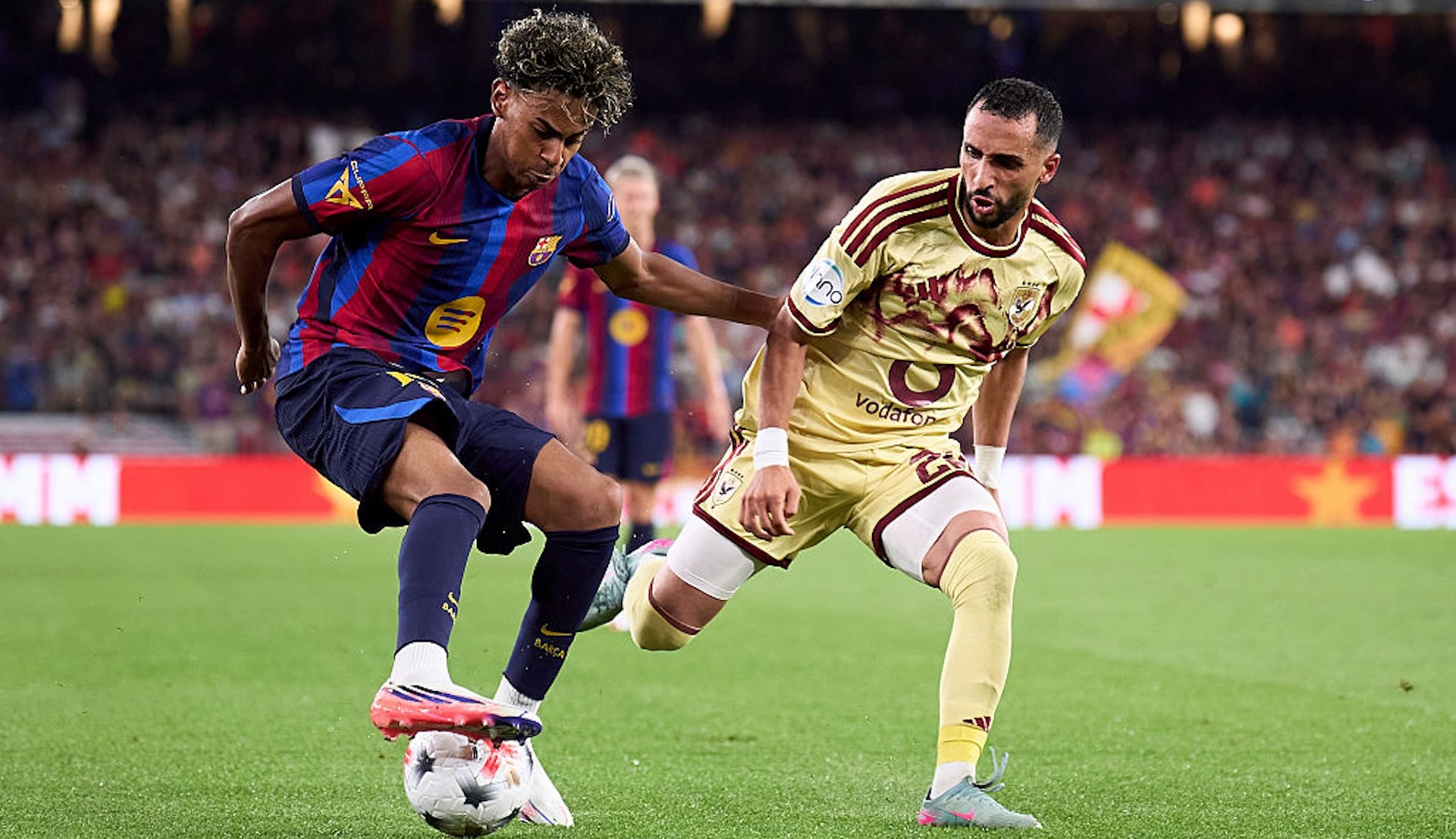
The suspended rabona, the showy drag with the left foot, the ricochet off the defender, the bobble of instinctive control on the byline with the right, then back onto the left for a quick push with the outstep into the goalmouth, where a teammate applies the finishing touch.
Lamine Yamal made it look easy last week 😤From the setup to the execution, Thierry Henry breaks down every detail of Lamine Yamal's outrageous fake rabona 🤯And @Carra23 and @MicahRichards prove how difficult a skill it is 😅
— CBS Sports Golazo (@cbssportsgolazo-m.bsky.social) 2026-10-20T18:56:18Z
Even a few weeks later, the rabona-croqueta that Lamine Yamal improvised in Barcelona’s recent Champions League win over Galatasaray astonishes with its ingenuity. Did he intend the move to come off exactly as it did? We don’t know. Does it matter? It does not.
As soccer has become larded up with familiar storylines—Vinicius Jr’s drop in form, the grim inevitability of haramball’s triumph in Europe’s major leagues, the incurable sickness at the heart of Manchester United, the institutional sham that is Manchester City, and finally to the latest in “transparency” from Gianni Infantino’s FIFA—Yamal’s inspired marriage of two distinct moments of skill has come to appear more and more important to the future of soccer, as a kind of corrective to the beautiful game’s metastasizing ugliness. A sport that’s increasingly “tricky” in the Nixonian sense—in which chicanery and cynicism, both on and off the field, are now the order of the day—has never needed a positive vision of the trick more.
Weird and brilliant inventions like Yamal’s footballing cronut are more than simply grist for the clips mill; they rehabilitate the very idea of trickery in a sport where that word increasingly stands for the selfish maneuvering of the suits. In place of the authorities’ gimmicks, systems, deceptions, and hypocrisies, players like Yamal offer spins, nutmegs, dragovers, and dummies. They reinvest the trick with its original vocation, which is to provoke joy and wonder in the spectator, rather than the disgust and betrayal that have become the standard fan response to so many of the “innovations” cooked up by the ghouls in soccer’s laboratories of power.
This is, in many ways, the golden era of the trick—or perhaps it merely seems that way because, thanks to ref cams, supercuts, tactical explainers, and instant highlights, vision of professional footballers’ insane levels of skill and speed has never been more complete or illuminating. Consider, beyond Yamal’s Champions League stunner, some of the absurd moments of footwork and finishing that top flight soccer has furnished us with over the past few weeks: Charalampos Kostoulas’s delightful backheel chop to tee up Yasin Ayari against Crystal Palace, Désiré Doué’s rattle of taps to set himself up for the first goal against Barcelona in the Champions League, Erling Haaland’s decelerated shin slide to time his finish against Leipzig. Even the little combo that Yamal himself put together for the first goal in Barcelona’s recent thrashing of Real Betis—a dragover followed by a short pass to himself behind his back to create space for a left-footed curler—was its own tidy miracle of unhurried wit.
As the recent flurry of slop remixes of Mesut Özil’s famous goal against Ludogorets demonstrated, the soccer trick, at its best, is so transcendentally beautiful that not even AI can fuck it up. The trick is the antithesis of AI: random, unpredictable, and utterly irreducible to the dead law of the pattern. This is why it is always wrong to claim that players operating at a higher level of skill are producing “PlayStation football:” no console, no computer, has the speed and originality of thought to do what Yamal did a few weeks back, or Özil did a decade ago.
Against the backdrop of modern, optimized soccer, the trick has undergone a subtle but important shift in cultural value. It has transformed from an indulgence into a necessity. This isn’t to say that earlier iterations of the footballing trick weren’t useful or efficient. The Cruyff turn, the elastico, the papinade, and Zidane’s roulette, to take a few important historical examples, were all brilliantly effective and aesthetic ways of opening up space and opportunity on the field of play. The same is true, of course, of the two moves that Yamal rolled into one, the rabona and the post-Iniesta croqueta.
But for decades, the idea of the “trick” carried a stain of gimmickry. In contrast to the traditional non-sporting understanding of the gimmick—as a device that, while still fundamentally scammy, at least saved on labor, capital, and time—the soccer trick was largely seen as something both useless and wasteful, a kind of sporting anti-economy. In the annals of soccer history the trick is associated at least as much, and possibly even more, with René Higuita’s scorpion kick, the fruitless shuffling of El-Hadji Diouf and Gervinho, early Cristiano’s neverending stepovers, and the Kerlon seal dribble, as it is with anything aristocrats of the game like Cruyff and Zidane pioneered. Any showboater attempting a bit of Kerlon-grade razzle-dazzle today risks becoming the subject of almost instant ridicule: Rayan Cherki’s kick-ups in last season’s Carabao Cup final against Arsenal helped solidify the narrative that he’s a player of great skill who lacks maturity and judgment, while Antony’s furiously unproductive trickery—most notoriously, his signature “spin”—essentially saw him laughed out of the English Premier League.
In contrast to these earlier renderings of the trick—all excess, ego, and display for display’s sake—the modern trick is both decorative and useful, ornamental and productive. If the old trick was Ronaldo roadrunnering over the top of the ball in acres of space for no reason, the new trick is Yamal unleashing his full arsenal of stop-starts, body feints, shoulder drops, and hip shifts—sometimes all in one go—to break through a wall of markers. Just imagine the thrill that must come from proximity to this style of genius, even for the defenders on the wrong side of video history. You spend the week at training, you sit through tactical sessions, you study the footage, you know your opponent’s every move, you maintain shape and discipline once the match gets under way, you shut the main attacking threat down, then bang: In an exorcizing blur Lamine Yamal conjures some bullshit turn-shuffle-trivela trifecta with only five square inches of space at his disposal and before you know it, he’s released an unmarked teammate through on goal and made you look like the idiot of the year.
The popularity of soccer’s tricksters—Yamal, Olise, Doku, Kvaratskhelia—has arguably never been higher. That’s in part, I sense, because the modern game, with its emphasis on blocks, channels, zones, and processes, is designed to strip players of their virtuosity and force them into systems whose success ultimately depends on the subordination of individual expression to collective discipline. Paradoxically, this has made the trick more, not less, important. When every team is fanatically committed to closing down space and winning through attritional defense and spoiling tactics, as seems to be the case in modern soccer, moments of individual rebellion—all those jinks, hops, spins, and flicks—become an essential “cheat” to prise the game open and make things happen.
The trick is everything beyond coaching, beyond control, beyond discipline. Its power comes from its irresponsibility. On one side: system football, set pieces, the “dark arts.” On the other: the scorpion kick, the flip-flap, the panenka. Without the saving grace and impudence of the trick, soccer today would verge on the unwatchable. It would just be 20 outfielders passing the ball from side to side for 90 minutes before Harry Kane scores in stoppage time; in other words, it would be like watching England play at this summer’s World Cup, which is not something any of us should ever willingly subject ourselves to again. Not since gargoyles and flying buttresses were going up all over France has ornamentation been so vital to the cultural future of Europe.
If the trick has become a way to “cheat the system” in a game that’s increasingly about structure and statistical efficiency, its dupery also offers a gleeful contrast to everything else that’s going on in the sport. Guile, disguise, and deception are, of course, everywhere in modern soccer, but they’re usually deployed off the field, as administrators and self-serving club officials conspire to rig the game for the benefit of a wealthy few. There are now two paths for the trick, two ways of cheating the system. As fans, we’re wearily accustomed to a world where FIFA markets a plan to sell the World Cup off to private investors as an improvement to “grow the game,” where negligent owners “exit” clubs while continuing to leech off them indefinitely, where there are always magic financial “levers” available to pull whenever a balance sheet starts to Titanic into reality, where regulation is forever a game of loopholes.
As a commercial enterprise, soccer has become stagnant, bloated, and corrupt, and increasingly the sport feels like a kind of protracted joke designed to make a fool of the un-moneyed fan. But players like Yamal still have the talent to surprise and delight. They return cunning and deceit to their rightful place, which is on the pitch. The trick has become a ray of improbable hope in a murky world—and the perfect antidote to a sport that’s in danger of losing its soul.