
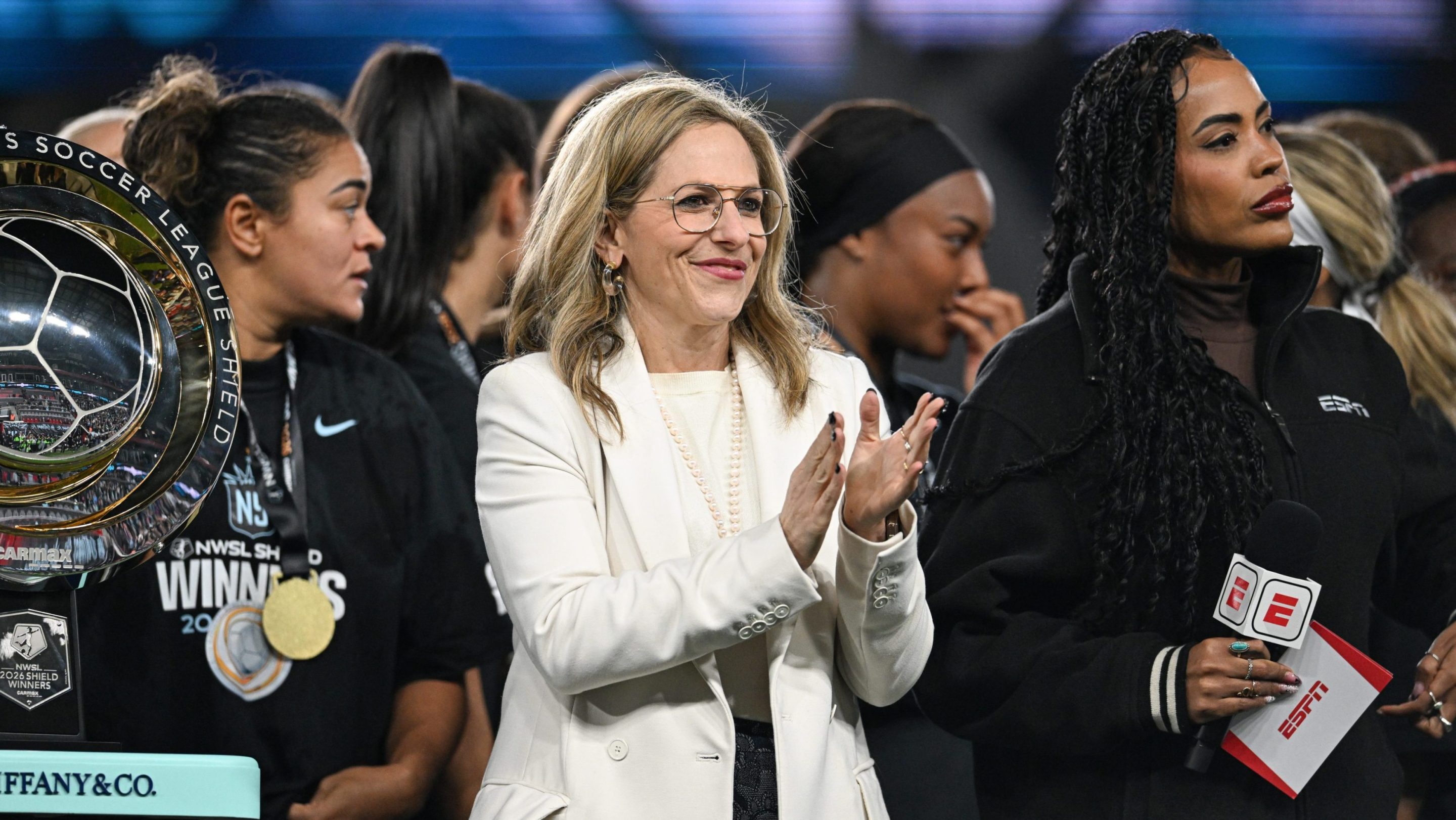
WASHINGTON, D.C. — Thrice a year, the media gets the chance to speak with NWSL commissioner Jessica Berman. And as the league has grown, so have the pomp and circumstance around the event. For this year’s edition, famed soccer announcer Andrés Cantor introduced the commissioner to the stage.
Many questions were asked of Jessica Berman, and very few of them—especially the thornier ones—were really answered.
Berman’s speech glided through the NWSL’s wins in attendance and viewership, and she shared lofty goals for the years ahead while also giving opaque answers (or sometimes complete non-answers) on issues like field quality, anti-trans activists coming to games, and one team possibly relocating. Each answer sounded like it was crafted from the same girl-boss leadership academy that produced outgoing WNBA commissioner Cathy Engelbert.
Stadium Woes
An ongoing concern in this year’s playoffs was just knowing where teams would play. Gotham and Washington advanced through the quarterfinals, eliminating the worst of the scheduling conflicts or 9 a.m. local time kickoff times, but they still had issues of their own.
Seattle’s Laura Harvey called Gotham’s pitch "shit" after her squad’s quarterfinals loss. She added that the league knew about it, having previously fined Gotham $10,000 for the field’s poor conditions in the final game of the regular season. The team would ultimately relocate its semifinal match to avoid more field issues, as fellow stadium tenant the New York Red Bulls had a friendly scheduled for the night before.
The Spirit, meanwhile, faced a conflict between their semifinal match and the Secretaries’ Cup, the annual football match between the U.S. Coast Guard Academy and the U.S. Merchant Marine Academy. The team reached an agreement with Lafayette Credit Union to underwrite the cost of moving the Secretaries’ Cup game to later in the day. But the tradeoff meant playing on a pitch with both soccer and football lines, like a high school multi-purpose field.
So it’s perfectly understandable that the first question of the day came from ESPN’s Jeff Kassouf, asking what could be done to prevent scheduling snafus in the future. Berman said the league was prepared to handle the schedule issues thanks to months of planning—despite the haphazard vibes behind last week’s venue shuffle. The addition of more team-controlled venues will also help. Yet long-term, Berman had little to offer beyond her belief that the league needed more time.
“I think we should acknowledge that solving infrastructure problems for many leagues takes 50 to 70 years,” Berman told the media, without naming names. "We've been at this for four. I'm incredibly proud of the progress we made, and it's clear we have more work to do.”
A Team in Limbo
As soccer media members traveled to D.C. for the final, Racing Louisville's ownership announced their intention to sell the team. Earlier this year, sources told Kassouf that the club was seeking a partial sale. Over the summer, owner John Neace told Louisville business leaders the team would be “forced to do something” if attendance didn't go up.
Louisville got an expansion team in 2019, back when expansion fees topped out at $1 million. At the moment, the plan for the team is to play the 2027 season in Louisville, but sources told Kassouf that the owners of MLS’s F.C. Cincinnati are expected to take ownership.
Berman said she didn't have any updates to provide on Racing Louisville. But when the floor was opened to questions from those present via Zoom, one reporter asked about the approval process that would happen if a new owner wanted to move the club.
“That decision, like any team sale, like any expansion decision, is one that has to go to our board of governors for approval,” Berman responded. “There are specific recognitions that NWSL teams are community assets that we want to encourage and incentivize our owners to continue to invest in, and so any consideration of relocation would have to go through our normal process.”
For people who’ve never worked for McKinsey, she means that relocation would be a last resort.
A Disconnect With Supporters
Last month, anti-trans agitators from XX-XY tried to unfurl a “Save Women’s Sports” banner in the middle of the Portland Thorns supporters section. Fans moved quickly to cover the banner with trans flags instead. In Seattle, right-wing Pierce County Sheriff Keith Swank said he’d organize a similar protest at a Reign game. He did not show up, and the few agitators who did were quickly flanked by supporters holding trans flags.
The concerns about agitators showing up at games aren't going away. Washington state voters approved a new law banning transgender athletes from playing girls' sports. Oregon conservatives are gearing up to try a ballot measure of their own. In past press conferences, Berman has punted on answering specific questions about trans inclusion and player safety from anti-trans harassment.
“I feel like this is the third year in a row where I've asked some version of this question,” Meg Linehan of the Athletic asked. “The league wants to live by its values, but how do you head off these potential conflicts without putting yourself into a political conversation while also drawing a line in the sand?”
After lauding the supporter groups as the “lifeblood of the league” Berman, once again, opted to punt, giving an answer that mostly reiterated the league's fan code of conduct. When asked specifically if the league would decide how to handle these intrusions, she served the following word salad:
"There is a legal policy in place that creates an umbrella of minimum standards that we expect that is our responsibility to endorse, and then we leave it up to the individual clubs to decide what makes sense in their local market because there are unique attributes of particular communities that we may not be aware of. And so we leave space for the clubs to help us to understand those unique attributes of a particular community and make sure that when our policies are being applied locally, they're being done appropriately."
She did not go into more detail and, as often happens in such large press conferences, did not take any follow-up questions.
After Linehan published her piece on the league’s inaction, XX-XY's Jennifer Sey shared on her Substack page that she will be attending the championship game.
Questions Not Asked
The growth of the NWSL meant there were more reporters attending the press conference this year than ever before. This also meant Berman could avoid certain reporters or questions more easily. I was never called upon. So here is a list of questions that I and others were not able to ask:
- I’d intended to ask Berman about the leagues eight complaints of sexual harassment, sexual misconduct, and retaliation over a six-month period. A league source later told The Athletic that some of those reports were unsubstantiated. How were the others resolved and did those investigations result in disciplinary actions?
- André Carlisle, a longtime Washington Spirit reporter, had hoped to follow up on Berman’s answer to Linehan and ask, even putting politics aside, what the league felt was their responsibility to supporters’ safety.
- Defector Media reporter Abigail Segel was prepared to ask about new Columbus NWSL owners the Haslam Sport group, whose Cleveland Browns continue to employ Deshaun Watson. She intended to ask if Berman would have confidence in a club owned by the Haslams responding appropriately to a report of abuse.
- No questions were asked about the league’s dissolved broadcast partnership with Victory+ or about their partnership with Alex Cooper and her defunct energy drink.
Berman might not have had time for all of our questions. But she did have time on Thursday night to take the stage for a live recording of The Women’s Game podcast, hosted by NWSL legend Sam Mewis.
Berman was warmly received by the sold-out crowd. The low-ceilinged nightclub was a sharp contrast to the airy, historic Navy Yard landmark that had hosted her earlier press conference. Whether it was the long day, the gracious hosts in Roger Bennett and Mewis, or the disco lights on her introduction, when her interview began, the corporate curtain fell.
When Bennett asked how Berman keeps her enthusiasm going through these long days at the season’s end, she referred to the famous Billie Jean King quote about pressure being a privilege, but then she went for a Hamilton reference. “So you know the song that goes, ‘Why does it feel like I'm running out of time?’ That's how I feel every single day. That is my soundtrack in my mind. I have just a tremendous amount of urgency, and I feel like our only finite commodity in life is time. So I just want to get a lot of shit done—Sorry!”
She laughed off the swear with Bennett, who offered a question about what the league is doing to attract more players like Trinity Rodman. Here, Berman’s answer wandered back closer to her usual corporate cadence.
“The market will hold us accountable, and so we have a variety of different metrics that we analyze on an annual basis to determine whether the competition on the field and the talent in the league is the best in the world,” she said. And as Berman began listing those metrics, someone in the audience shouted “Raise the cap!” “We can talk about that!” Berman replied with excitement. But for the next 10 minutes of her time on stage, she didn't talk about it. Another question left unanswered.