

Before the NWSL playoffs started, I predicted, like many, that San Diego would go all the way. The second-seeded Wave were so solid, so well-balanced, and with a possession-based style that steamrolled team after team. Making it past the faltering, Mina Tanaka–less Utah Royals in the quarterfinals didn't feel anything close to a question. Where San Diego had earned 25 points in the final 10 matches of the regular season, Utah earned just 11.
I've never been so happy to be wrong. In delivering a 1-0 upset in San Diego last Friday, Utah provided a postseason performance that left me, a neutral, pumping with joyful adrenaline.
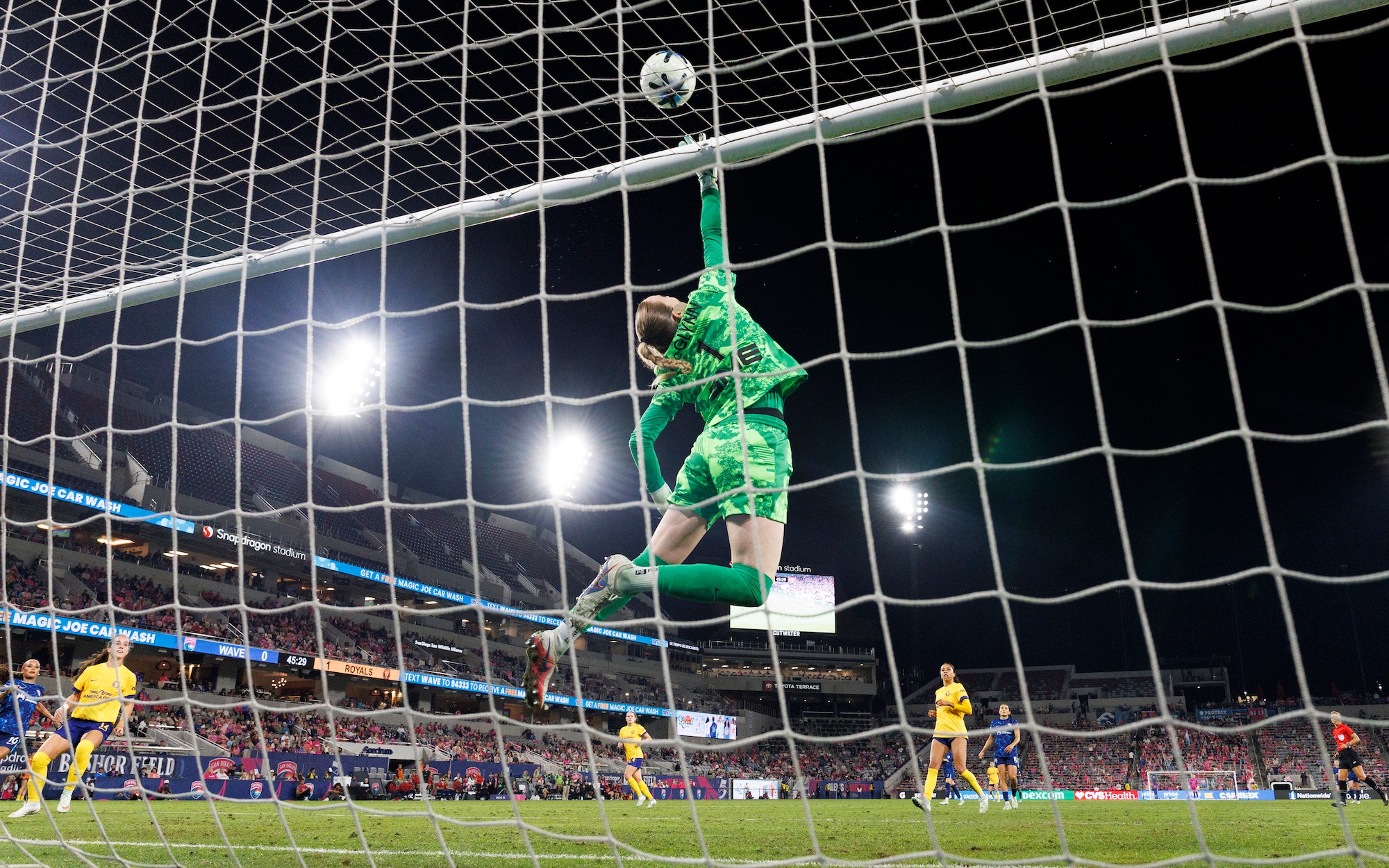
As expected, San Diego dominated in nearly every way: shots, possession, touches in the final third. But the only stat that matters is goals scored, and Utah goalkeeper Mandy McGlynn had something to say about this.
San Diego is full of sharpshooters, and they were playing genuinely well, especially before Kiana Palacios put Utah on the board in the 30th minute. It's just that McGlynn was playing better. Three of the four saves she put up were just as astonishing as the kind of shots that leave your jaw on the floor—reflexive, how-the hell-did-she-get-there-fast-enough blocks that defy nature.
In the dizzying final minutes, she also made strong claims on aerial balls, sucking the air out of hopeful Wave attacks again and again.
"[I was] trying to be Superman," she told the broadcast after the whistle blew. It would be a comically obnoxious thing for an athlete to say out loud had she not just had a performance that looked, undeniably, like Superman had put on a Mandy McGlynn mask and some goalie gloves.
Maybe it shouldn't have been a surprise that Utah's keeper would have an awe-inspiring night. The last time McGlynn took on a higher-ranked opponent in a playoff match hosted at the San Diego State University stadium was the 2023 championship, when her Gotham side defeated OL Reign, 2-1. In that game, she made the critical decision to foul Elyse Bennett to prevent a last-minute equalizer, taking a red card in the process. The memory of this match served her well on Friday. "Last time I was on this field in the playoffs, we won it," she said. "And that's the kind of vibe I was bringing."
For all the inconsistency McGlynn had this season—which had cost her some USWNT call-ups—she found another gear on Friday.
And it wasn't just McGlynn who put on a clinic. All over the pitch, Utah's fearless aggression was in full force. Midfielders Madison Hammond and Ana Tejada did the exhausting work of box-to-box coverage to interrupt San Diego's press and make the most of Wave No. 6 Kimmi Ascanio's absence. The team's attack was varied, reminding San Diego that they could do damage anytime possession turned over.
And so, for 30 minutes and then 60 more, the Royals defended their hearts out, and in doing so knocked out the best team in the league. "Why the fuck not us?" McGlynn shouted in her team's huddle after the game.
The Royals would have to wait until Sunday to determine if they’d be traveling to Washington, D.C. or Oregon for the semifinals. But that suspense was broken quickly, even before the first half of the Portland Thorns' visit to the Spirit ended.
For all the surprise of Utah's win over San Diego, Washington trampling Portland was about the most predictable thing that could have happened. Combine an attack of Trinity Rodman, Leicy Santos, and league newcomer Clara Luvanga with Portland's pitiful defense, and what do you get? A 4-1 scoreline, naturally. The only question was if Portland's attack could muster up some protest, but not even Sophia Wilson and Pietra Tordin could pull their team out of the muck.
The first of Washington's onslaught started with Rodman stealing the ball from Carolyn Calzada at the sideline, dribbling toward net, and passing it off to a wide open, ready-to-pounce Mélissa Bethi. Luvanga blew past Portland's back line multiple times, to no avail, before she decided in the 34th minute to simply strip the ball from keeper Mackenzie Arnold's feet and tap it home. In the next minute, she turned a short progressive pass into an all-out sprint up the sideline and, with a simple short cross past multiple defenders, found Rodman, who found the net.
The three-goal deficit was so deserved and so deep that Portland manager Robert Vilahamn made two subs before the halftime whistle. Tordin managed to get one on the board for Portland in the 51st minute, but it couldn't have mattered less. Seven minutes later, Luvanga yet again assisted Rodman for the Spirit's fourth of the afternoon.
After the game, Thorns winger Morgan Weaver said she was "a little embarrassed." I would be too.
It wasn't even the goals that were the most indelible images from the Spirit's win. Twice, Luvanga passed the ball past Portland defender Jayden Perry and then ran around her to receive it herself. Two self-passes in one game is a warning shot from a striker on a tear if I've ever seen one.
Washington endured a bumpy back half of the season before finishing third. They showcased their potential in an impressive 1-0 win against Gotham in October, but they also dropped points to teams up and down the table. Stumbling into the playoffs on a loss to Kansas City in which Hal Hershfelt tore her ACL didn't inspire a lot of confidence. And yet, Portland's defense is so bad that the Thorns were probably the best team for the Spirit to play to get their legs under them for the rest of the postseason. With the win, Washington's defense can feel good about overcoming Wilson and company, and the attack put on a confidence-building clinic against defenders that aren't much better than training dummies.
When Washington and Utah play each other in the semifinals on Saturday, it'll be a clash between a vibrant attack and a daring underdog whose keeper becomes a monster in the playoffs—hopefully. For all the potential the match has, it's not quite an unstoppable force vs. immovable wall situation. Both teams are prone to inconsistency; both teams' quarterfinal performances represented them operating at their highest ability. Single-elimination knockout tournaments challenge entire squads to peak in synchrony, and stay in that flow state through multiple rounds.
On paper, Washington should crush Utah. But on paper, San Diego should also have crushed Utah. The match, as they say, is played on grass, and to make matters better for the Spirit, that grass will be their home pitch (albeit with lines from the other kind of football, too), thanks to savvy moves by Washington's front office. The Spirit have every opportunity to win a final berth, which they would host, but the Royals will aspire to play spoiler. After their showing against the Wave, "Why the fuck not us?" indeed.