

A Weird Star is a classic place-setter in fiction. Put a Weird Star in the sky, even if it never has anything to do with the plot, and you know we're somewhere different and alien. Anything that's clearly not our Sun, and you're cooking with gas. Maybe it's a binary system, and there's two suns. Maybe it's large and looming. Maybe it's even flickering, like Jack Vance used to excellent effect. But rarely do authors fuck around with color. A star is white, or red if it's going out soon, or, if the planet is question is truly fucked, the star is blue because that's the hottest color there is. Those are the colors of stars, we figured. Not even sci-fi authors could conceive of a mechanism to get some new tints in there.
As is often the case, the real universe turns out to be stranger than imagination. Stars, under the right circumstances, can appear to observers on their orbiting planets in a wide spectrum of colors, from hot pink to the green of cucumber lime Gatorade. "Imagine standing on a planet and looking up at a green star," said Mark Hollands, an astrophysicist at the University of Warwick and lead author on the study. I'm imagining it, Mark! It rocks!
The paper, published last week in RAS Techniques and Instruments, doesn't rely on having found some new stars lit up like Christmas lights. Instead, it's a breakthrough in modeling. Traditionally, stars are modeled as putting out black-body radiation. Black bodies are mathematical conveniences, idealized objects: perfectly opaque and non-reflective, and emitting light in all wavelengths. Black bodies do not actually exist, but stars are close enough to that the models work for most purposes, which is the important thing. In black-body radiation, light will only ever vary depending on the temperature of the object, going from red to white to blue as the object gets hotter. Play around with the burners on your stove to grasp this immediately.
Black-body modeling works for stars because their photosphere, or visible layer, is not usually dense enough to introduce any meaningful variables into the spectrum of light they admit. Usually. Main-sequence stars like our Sun, at the end of their lifespans, stop fusing hydrogen in their cores. Without that source of outward pressure their cores collapse, leaving something much denser: a white dwarf. Before that, though, the star will go red giant, expand, and begin consuming their inner planets. In five billion years or so, the Sun will gobble down Mercury and Venus and maybe or maybe not Earth, and then it will settle as a white dwarf.
Now, suddenly, you have a very dense star that has wolfed down all sorts of heavier elements. Those elements, according to the Warwick group's model, will interact with the star's helium in interesting ways, and absorb specific wavelengths of light coming out of the star—making black-body models inaccurate for determining their actual appearance.
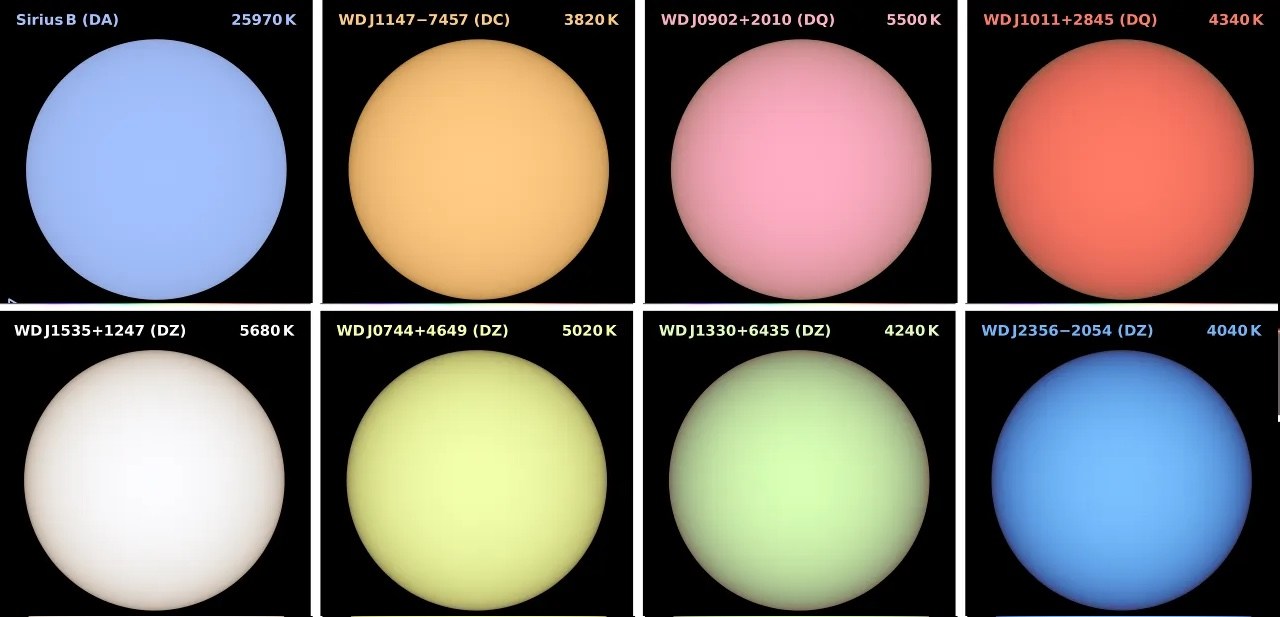
The Warwick model offers up the star WD J1330+6435, located about 280 light years away and first catalogued in 2021. We can see, from its spectral lines, that WD J1330+6435 is a white dwarf star that has accreted lithium, sodium, potassium, and calcium in its atmosphere, by swallowing up some nearby planets (or debris disks, if conditions hadn't allowed full-blown planets to form). What would a white dwarf's full-spectrum light, minus those wavelengths absorbed by those specific elements, look like if we could view it from in-system? A pale, luminous green, the researchers say, like this:
They found other weirdo stars. WD J1011+2845, thanks to an abundance of carbon near its surface, would appear a salmon pink. I bet that's a relaxing solar system to live in.
But overall, the researchers found that most white dwarfs are just that—white. Twenty-nine of every 30 stars in the group's sample showed no unusual coloring. This is possibly for the best. A pop of color is most effective when deployed sparingly. The universe does not dress like Matthew Lesko.
And will our own Sun, in its last days, greedily suck down Mercury's iron and nickel, Venus's silicon and aluminum, and to survivors in our outer solar system flush a bright, uncanny hue to announce its death throes? It's entirely possible. What a gorgeous universe we've got here.