
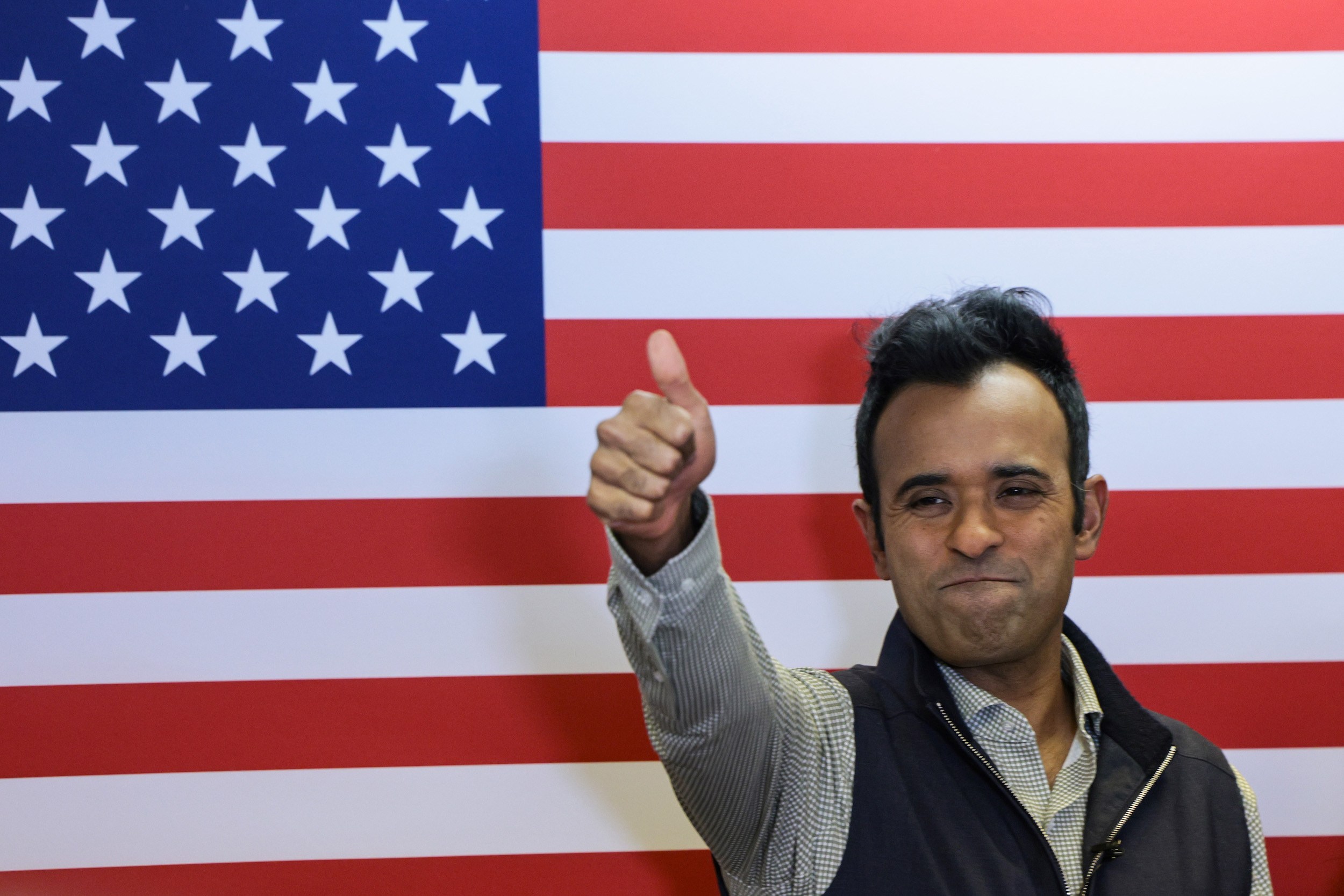
Aspiring politician Vivek Ramaswamy broke his lifelong vegetarianism Tuesday night, eating a fat one in the Ohio gubernatorial race where he ran as a Republican against Democratic candidate Amy Acton. It's certainly a vexed time to try and court a right-wing audience as a Hindu and Indian-American candidate. Let's wind back the clock and see how that strategy worked out for him over the past few years.
Recall the promising origins of Ramaswamy's political consciousness: biotech executive abruptly turned critic of the "modern woke-industrial complex." With the release of his 2021 book Woke, Inc. and his unfortunate slide into public view, he offered the country a strain of sleazy, technocratic Trumpism. Even as he opposed the scourge of identity politics, he seemed not to realize that he himself would soon be subject to them. From the start of his national prominence, Ramaswamy has tried to make his Hinduism more palatable and relatable to his fellow travelers. This was a throughline of his 2024 presidential campaign as a Republican. "The lessons learned being Hindu were similar and in many ways overlapping with Judeo-Christian values like sacrifice, performing your duty without attachment to the results and believing that your work on this Earth is not being done by you, but through you,” he said in a 2023 interview with the Associated Press. The article, paraphrasing Ramaswamy's views, noted his belief that "Hindu values seem to resonate with Christian and Jewish audiences."
Shockingly, Ramaswamy's political instincts might have led him astray on that front. He suspended his presidential campaign in January 2024. In May of that year, after a Republican candidate debate, Ramaswamy hosted conservative commentator Ann Coulter on his own podcast, where she expressed a view that was undoubtedly prevalent among his hypothetical voter base. Ramaswamy voluntarily promoted that episode by saying that Coulter "told me flat-out to my face that she couldn’t vote for me 'because you’re an Indian,' even though she agreed with me more than most other candidates. I disagree with her but respect she had the guts to speak her mind. It was a riveting hour. The TRUTH podcast is back." Here, he adopted his signature pose: groveling to people who plainly hate anyone who looks like him, under the pretense of accepting their tough ideological disagreements. He would later face similar attacks from Coulter's millennial and Zoomer spiritual successors, Laura Loomer (who criticized him for opening America's borders to "third-world invaders") and Nick Fuentes (who said he'd rather see a Democrat win than Ramaswamy).
After Donald Trump's victory in the 2024 presidential election, Ramaswamy was tapped to help Elon Musk run DOGE, their sociopathic government autolysis program. Infighting kept him out of the job. By Trump's inauguration, Ramaswamy was ejected from DOGE, reportedly for partaking in a furious online debate on the subject of H-1B visas, an intra-MAGA civil war that pitted capitalism uber alles against blood-and-soil nationalism. Perhaps the mere existence of such a debate, about whether Indian immigrants should be allowed to work in the U.S., would have caused a savvier Indian-American political operative to reconsider his political trajectory, as well as his life choices. Not Vivek Ramaswamy, who might have thought he could win over this base with his ideas and, er, charisma. One of his many sins was letting his (always obvious) immigrant exceptionalism seep into his public comments. Ramaswamy, who employed H-1B workers in his own biotech company, criticized American culture for "venerat[ing] mediocrity over excellence," which, in his view, forced companies to reach overseas for talent. Conservatives also dredged up his old promises to gut the H-1B program, so he was framed as a hypocrite, too.
After flaming out of DOGE, Ramaswamy set his sights on becoming Ohio's governor. At an October 2025 event hosted by Turning Point USA, the Hindu candidate was challenged by Christian students at Montana State University. One student asked him why he chose to “masquerade as a Christian.” Another questioned his polytheism. "Do you believe in the Holy Trinity, the Father, the Son and the Holy Spirit?" Ramaswamy then asked the student, who agreed. "And that doesn’t make you a polytheist, does it?" Got 'em.
Those critics were the polite ones. By the end of 2025, having belatedly noticed his new bedfellows, Ramaswamy was complaining in the New York Times Opinion section about racist groypers. Here's an excerpt from his op-ed, which strained to present his vision of America as a "colorblind meritocracy" troubled by only temporarily racist young conservatives, confusing a foundational feature for a passing fad:
Older Republicans who may doubt the rising prevalence of the blood-and-soil view should think again. My social media feeds are littered with hundreds of slurs, most from accounts that I don’t recognize, about “pajeets” and “street shitters” and calls to deport me “back to India” (I was born and raised in Cincinnati and have never resided outside the U.S.)
Antisemitic statements are now normalized online, and it’s not limited to the internet either. Rod Dreher, a conservative writer, recently described a trip to Washington, D.C., where he estimated that a sizable minority of Republican Gen Z staffers are fans of Nick Fuentes.
This new online-right movement doesn’t represent the views of most real-world Republican voters — take it from a son of Indian immigrants who dominates polling in Ohio’s G.O.P. primary for governor. But as one of the most vocal opponents of left-wing identity politics, I now see real reluctance from my former anti-woke peers to criticize the new identity politics on the right.
Nevertheless, Ramaswamy persisted. In another column this past January, this time for the Wall Street Journal, he resolved to become a social media "teetotaler" in 2026, deleting his apps and handing off his accounts to staffers. On to the 2026 Republican primary. The groypers were just lurking in the comment sections, and weren't actually seeking public office, right?
Over the course of the Ohio primary, Ramaswamy's Republican primary opponent Casey Putsch did the following: posted a video of himself firing a rifle and inviting Ramaswamy to play "Cowboys vs. Indians," clarifying, "Don't worry, it's feather, not dot"; told the National Rifle Association that there was "nothing remotely American" about Ramaswamy; and referred to him as an "Indian anchor baby." Backed by Trump, Ramaswamy still coasted to victory in the primary.
Down the stretch, Ramaswamy obscured his background as much as possible—no anodyne Happy Diwali tweet this year, and no public comment on the attempted Hindu temple mass shooting in Illinois, perhaps because his base resembles attempted Hindu temple mass shooters. Despite all that, and after running the most vile attack ad in the recent history of American politics, Ramaswamy lost to Acton in Tuesday's election, by a nearly 8 percent margin at time of writing. I look forward to seeing how the vote split along demographic categories, but I have my suspicions. Over the course of my and Ramaswamy's lifetime, the American right wing has gone from vaguely hating Indians because they believed they were Arab Muslims who did 9/11, to virulently hating Indians for a suite of distressingly specific arguments about labor, genetics, and assimilation. Their racism has become more fine-grained and evil. Surely this was the perfect time for an Indian American to court this exact group of people. Can't believe that shit didn't work out for him.