
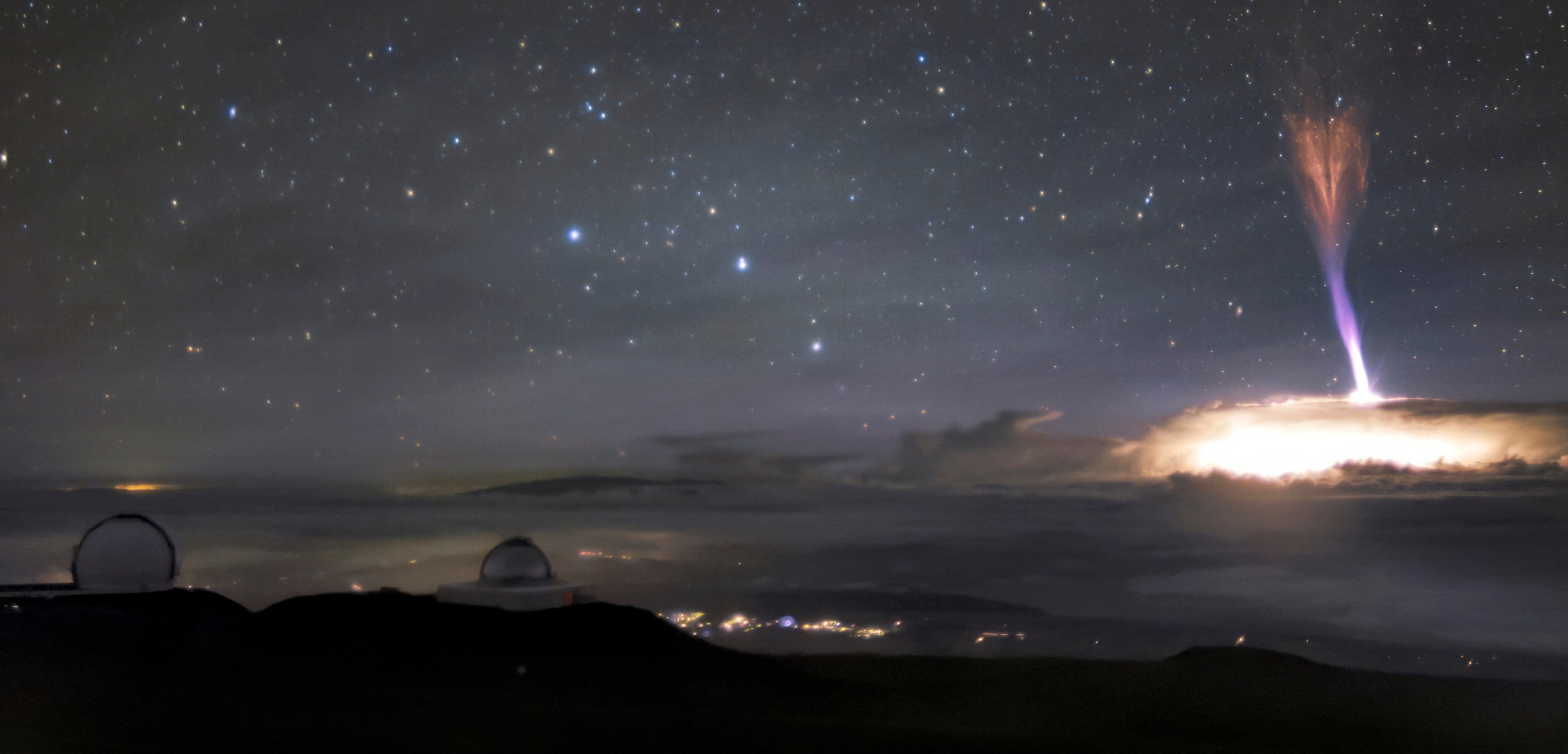

The technical term for them is Transient Luminous Events, and it's a good term. Transient, because they last just a few milliseconds. Luminous, because they light up the sky, but also because they invoke the radiant immanence of an old-testament manifestation. Events because—well, imagine you saw this. You would agree this was an Event.
The most commonly observed TLE is a red sprite, an enormous electrical discharge shooting upward from thunderstorm clouds, usually a blood-red color due the excitation of nitrogen atoms. Below is one of the finest images of sprites ever recorded, by nature photographer Florian Riou last month:
Unlike cloud-to-ground lightning, which takes place within a few kilometers of the Earth, red sprites occur in the upper mesosphere, as much as 80 or 90 km up. And they are huge. Their size and their height means that to be seen from a ground, they have to be seen from a distance. In his behind-the-scenes video of how he got the photo, Riou explains that he was stationed in the hills outside the Corsican village of Calvi, which appears in the foreground of his shot. But the actual sprites were above a thunderstorm on the Catalonian coast, about 600 km away.
(The same sprites, or at least sprites from the same storm, were also photographed from the Cote D'Azur by photographer Christophe Suarez.)
It is no wonder then, given the scale of them, that many of the images we have of TLEs are taken from space, like this gigantic jet (technical term; related phenomenon) captured last year above the Texas/Mexico border by an astronaut on the International Space Station:
Sprites are still a relatively newly observed phenomenon. The first recorded description of them is from 1886. In the 1920s, physicist Charles Wilson modeled how they might occur during a sufficiently large lightning strike. Rest assured that I don't understand it at all, but it does involve the very metal term, "electron avalanche," and it is a cold plasma so it would not flash-fry you like regular lightning would. Still theoretical at that point, red sprites were increasingly reported by airline pilots, though dismissed as implausible by meteorologists. There was a whole lot of arguing until, they were finally captured on video, entirely accidentally, in 1989. (Just a few years ago, we discovered that similar stuff is going down in Jupiter's atmosphere as well.)
Imagine it! For the totality of human history minus the last 37 years, had you been lucky enough to see one of these events, you would have been disbelieved, ridiculed as a fool or lunatic, or perhaps venerated as a seer. Perhaps the split-second vision of the flayed body of some mad dead god hovering in the skies would have driven you insane.
TLEs come in many varieties, with more or less descriptive names (deep breath): sprites, sprite halos, gigantic jets, blue jets, blue starters, trolls, ghosts, pixies, gnomes, ELVES (Emission of Light and Very low frequency perturbations due to Electromagnetic pulse sourceS), and of course, sprelves. Even today, the mechanisms behind them all aren't fully understood. I think that's beautiful, that our busy, living planet is still, billions of years on, doing things—even large, blindingly bright things—that can awe us with both novelty and mystery. We may not know precisely how everything around here works, but it's all very beautiful.