

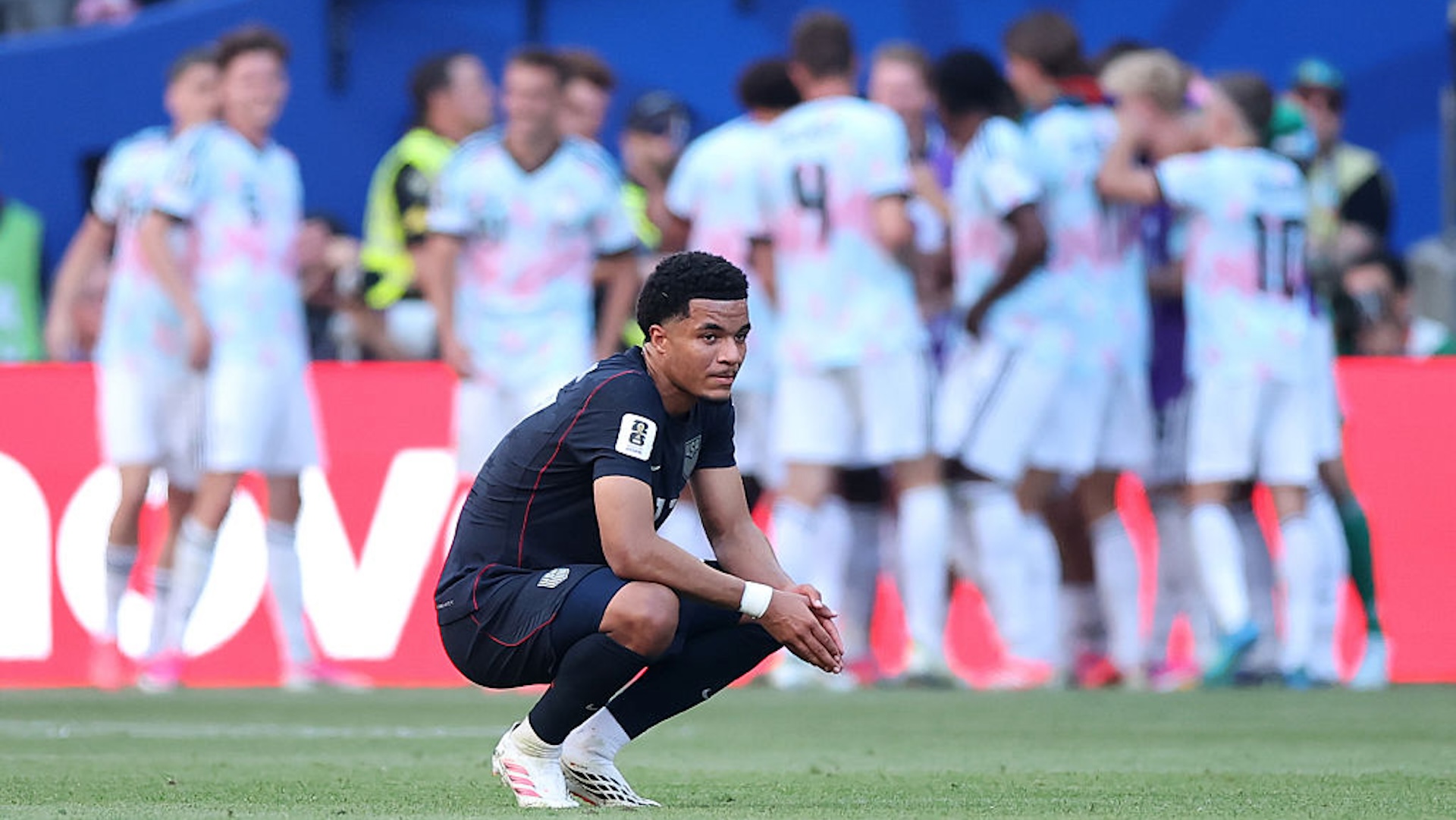
It is difficult to pin down an international team's true quality and character based on the results of one brief tournament. The games are too few, and the environment too variable, to come to any definitive conclusions. But the games are revealing nonetheless, and any team that plays enough of them will have their specific strengths and shortcomings put on display, some more immutable than others. The teams that tend to thrive in the World Cup are the ones most capable of shrinking the distance between the best and worst versions of themselves, such that the arrival of either is not overly surprising or destabilizing. On Monday, Belgium reached through the swagger and confidence that the USMNT had spent four games building, and drew out a fragility that lurked deep within. Unprepared to face the worst version of themselves, the Americans crumbled.
It is not often that the complete story of a soccer game can be told by its goals alone, but it is true of this game. Each of the four goals Belgium scored in its 4-1 victory can be held up as a tidy encapsulation of the USMNT's dispiriting performance. The first: a tap-in that was created by Nicholas Raskin being allowed to control a loose ball and dribble through the American box while four USMNT defenders stood by and watched. The second: a header at the back post in which two defenders on the ball failed to stop the cross and two defenders on the post were out-muscled by the goalscorer. The third: a completely fucking humiliating sequence in which Matt Freese got marooned outside his box, kicked the ground instead of the ball, and watched helplessly as the Belgians poked it into an empty net. The fourth: Chris Richards gifting the ball to Romelu Lukaku in his own box and watching the big Belgian stomp his way to a goal.
All of these goals were the result of the type of defensive disorganization and brittleness that you most often encounter in total mismatches. The USMNT looked like Wolverhampton Wanderers out there, suffering through a November game against Manchester City. Not even the surge in energy brought by Malik Tillman's free-kick goal, which leveled the game at 1-1 in the 31st minute, was enough to shake his teammates out of their stupor. Belgium's second goal was scored two minutes later, and it was clear then that the USMNT was in quicksand.
It turns out that 3-2 loss to Türkiye in the group stage wasn't as meaningless as many Americans had hoped, and that this team was simply incapable of defending against quality opponents. The Belgians, to their credit, identified the USMNT's keeper and back line as its biggest weaknesses, and deployed a game plan designed to press on those weaknesses as often as possible. The Red Devils nullified the ferocity of the USMNT's always-pressing forwards and midfielders by playing direct and getting the ball into the American half of the field as quickly as possible, where they could then set up and start torturing defenders. It's easy to forget that 38-year-old Tim Ream is a key piece of the USMNT defense when Tyler Adams is winning the ball 40 yards up the field, but his presence becomes nausea-inducing as soon as he's forced into a footrace for a long ball with an opposing forward.
Let us not lay all the blame for this performance on the USMNT's defenders, though, because the Americans were just as pathetic with the ball as they were without it. One thing that Mauricio Pochettino understands is that if you can convince players with real technical quality to spend the whole game running and pressing like psychos, then the positive results of all that running and pressing will pay off twofold once the ball is won back, because the energy and confidence boost that comes from regaining possession in a dangerous area will flow right into nifty dribbles and slick passing moves. For four games at the World Cup, the USMNT looked like the perfect roster to utilize Pochettino's system—athletic, fast, skilled enough to make quick and creative use of the ball—but in the fifth game the Belgians showed how Pochettino's philosophy could be turned against itself.
When all that running and pressing leads to nothing because the opponent is passing around, over, and through it, all the momentum-building properties of the system can turn inward, creating an anxiety engine. From kickoff, the USMNT looked frustrated and exhausted, as if they were playing in the 112th minute of extra time, and their confidence was clearly shaken. I lost count of how many times they were beaten to the second ball, how many passes were played directly to an opponent, how often an American player got on the ball and simply dribbled it directly into an opponent's legs. Christian Pulisic lost possession 11 times in the first half alone.
Because of the weight of the World Cup, it is impossible for any team's exit from the tournament not to turn into a referendum on the direction of the national team. It is tempting to declare this result a historic disaster, not just because of how sickening the performance was, but because of how quickly it transported everyone who watched it back to the bad old days of 2014. I honestly felt crazy watching it unfold. I had just seen this team, across multiple games against a variety of opponents, play the kind of competent, self-assured, skillful soccer that I had never previously associated with the USMNT, and then suddenly there I was again, watching the team struggle through a knockout game it had no business being in, pathetically muttering, "OK nice, here we go" every time they managed to string three passes together.
So what the hell is this team? How good or bad is it, really? What stage of disaster does U.S. Soccer now find itself in? Those are questions you will have to answer for yourself, my friend, as we all will. I will attempt to provide some solace, though. Perhaps it is comforting to realize that the era of meaningful growth is behind the USMNT, and that the American soccer project has more or less found itself where it belongs. This is a country that can play some real soccer, can wow its fans under the right circumstances, but will ultimately stall out against the established powers. There are worse places to be, and unless the American Kylian Mbappé is somewhere on the horizon, we should probably just get comfortable here.