

CHESTER, Penn. — For decades, the U.S. Women's National Team stood at the top of the mountain, where the air is thinnest. They defended their position with ferocity. They didn't win every major tournament, but they won most of them, and were contenders in all. Their identity on the pitch, more than anything, was being the best.
That changed with the 2023 World Cup, when the two-time defending champions flamed out in the round of 16 after barely surviving the group stage. Spain went on to win the tournament, and deserved to. That result, combined with Spaniard-heavy Barcelona's simultaneous surge on the European stage, made it clear that La Roja had pushed the USWNT off the side of the mountain and taken their place at the summit.
The USWNT might have won the 2024 Olympics, but anyone with eyes that see will tell you that Spain remains the better team. The USWNT are under no illusions about this. "All of these things that we're teaching are for this opponent," head coach Emma Hayes told her players Saturday after losing to Spain, 2-0, in the first of two friendlies. "And the reason I say that is because that's our barometer of success."
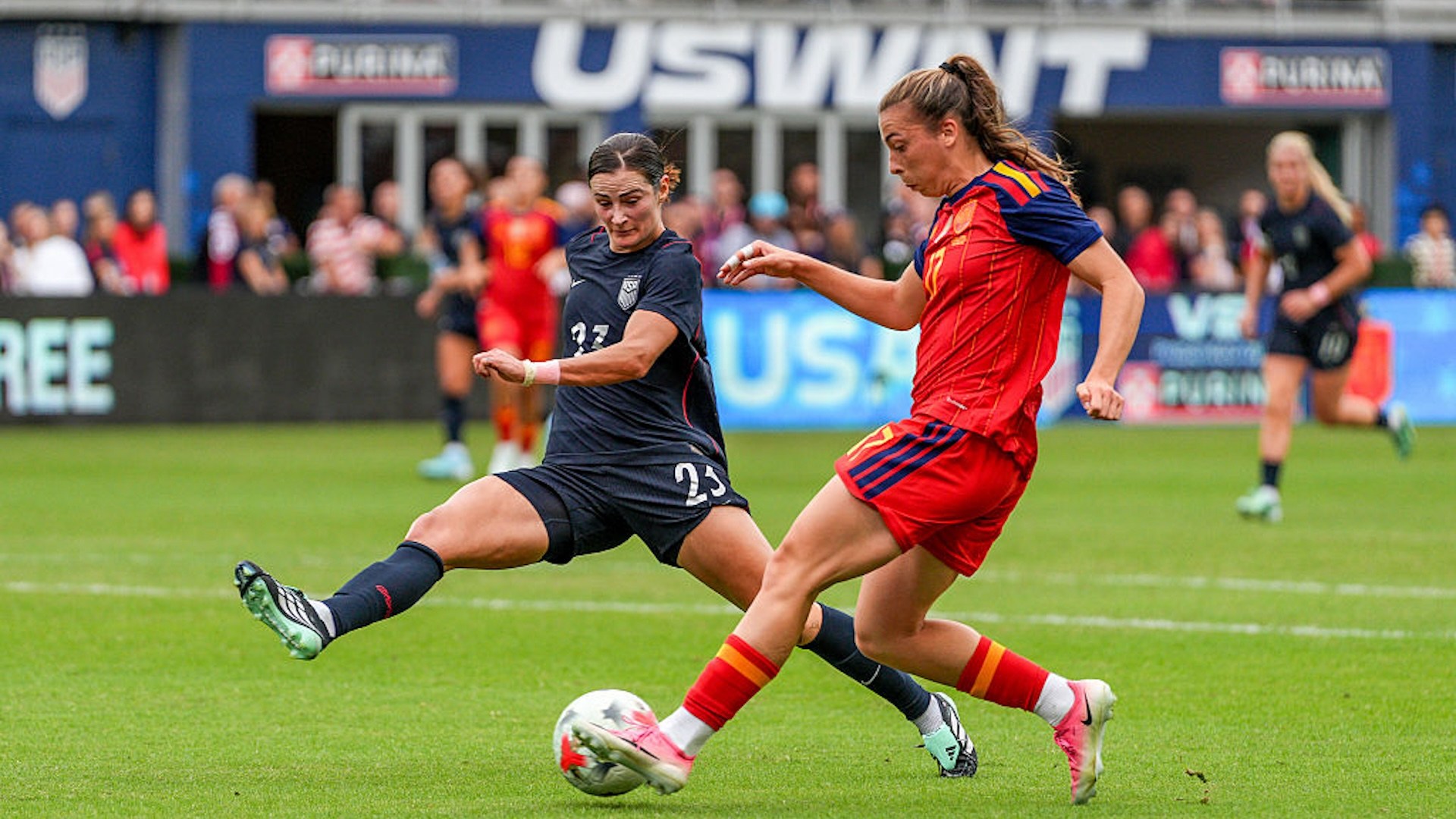
These friendlies, the second of which was played on Tuesday night, were a chance for the USWNT to see how they measure up now, in the third year of Spain's reign over the international scene. Neither team sent full-strength rosters, and friendlies are decidedly different from matches with stakes, but there are lessons to be learned from any matchup against a premier opponent, no matter the circumstances. Saturday’s 2-0 loss, followed by a 2-2 comeback draw on Tuesday, shows the USWNT still has a ways to go. If a draw feels like a win, you're still the underdog.
In the first game, in Washington, D.C., Spain had the run of the middle of the park, where the USWNT's stagnant midfield wasn't much use on either side of the ball. Two early defensive collapses invited goals from Patri Guijarro and Eva Navarro, and from there Spain was happy to sit back and defend. The Americans generated some good chances, mostly from the wings, and things improved with several zoomy second-half subs, but no one managed to get one on the board. It was a deflating loss that asserted Spain's stature.
The U.S. started the second match with some measure of confidence. Most of the attacking action came on the left side through Gisele Thompson and Ashley Sanchez, both of whom earned starts after impressive shifts as substitutes in the first match. But as much as the U.S. maintained most of the possession, the cutting edge to make it count was missing.
Part of this, I think, was due to Sanchez's positioning. She attributes her renaissance of form with the North Carolina Courage this year to changing her position to winger. Often when the Courage are attacking, or trying to win possession in the middle of the pitch, Sanchez stays so far wide that she's beyond the scope of the camera. In that position, all it takes is a teammate to launch a quick ball through the back line to set her on her way. But for the USWNT, Hayes wanted Sanchez to be more active on defense. This meant she spent most of the first half pulled farther into the action, leaving her favored wide spaces deserted and, therefore, unusable as an outlet for her teammates. On the occasion there was a USWNT player attacking from the flank, it was more often Thompson. The fullback was charged with being in the attacking spaces where Sanchez likes to be, while also having to get back and cover on defense. In this system, Sanchez's strengths weren't leveraged, and Thompson was stretched thinner than was necessary.
Attack for long enough against a team as good as Spain, and they're bound to bite back sooner rather than later. After weathering the American storm for 27 minutes, they strung together a patient attack that ended up with a wide-open Alexia Putellas making a tap-in. Spain didn't need the kind of masterstroke Patri delivered in the first match to open the scoring. They just needed a calm moment to confuse the USWNT's zonal defense enough that the two-time Ballon d’Or winner could get in front of the net with the ball at her feet.
The five minutes after a goal is scored are often ripe time for another. Phallon Tullis-Joyce learned this the hard way in Chester. The keeper, whose skills with the ball at her feet have always been her greatest weakness, made a low and slow pass up the middle of the pitch directly to an alert Alexia. The Spanish captain quickly found Salma Paralluelo on top of the box, who fired her shot off the bottom of the crossbar and into the net.
The rest of the first half saw the U.S. just trying to make it through without losing more ground. The team's attacking remained sloppy, and its defending was tentative. But make it through they did, enough for Hayes to make a critical tactical change at halftime. She flipped the lineup from a typical 4-3-3 to a 3-5-2, which spread Spain thinner and encouraged more oomph in the attack.
Just a few minutes into the second half, Lindsey Heaps launched a transitional attack by releasing a ball up to a hungry Sophia Wilson, who shrugged off a challenge by Irene Paredes near the center circle and was off to the races. Wilson had both Thompson and Sanchez joining her sprint, so she sent a ball down toward the both of them. Thompson, who had a marker, dummied to let the ball go by to Sanchez, who was wide open. Soon, Sanchez was right where she wanted to be: on the left side of the box with the ball at her feet, faced up with a scared defender. That defender was Ona Batlle, who gave Sanchez daylight, and we all know what happens when Sanchez sees daylight: a little shimmy and a lightning-quick shot with her right foot, curling into the far post. It took three halves for the USWNT to get on the board against Spain, but Sanchez made sure the Americans avoided total embarrassment.
The match might have had meaningful implications, but it was technically a friendly, which is why both sides were allowed a whopping eight substitutions. Hayes made five of them at the 60th minute, and three in the 80th. All were vital. Mal Swanson and Michelle Cooper went in for Rose Lavelle and Trinity Rodman, which opened up the right side to be just as lethal as the left. Other notable introductions were Jaelin Howell and Kate Del Fava, who were both called into camp as injury-replacement players.
It was Del Fava's first cap, and she made it count. In the 86th minute, the Utah Royals center back did her best impression of Tierna Davidson—whom she'd replaced—when she sent a gorgeous arcing diagonal ball up past Cooper. Cooper did what she does best and dribbled it toward the goal, then held it up until help arrived in the form of Swanson. Swanson lifted Cooper's pass into the air and rocketed it into the net on the volley. It was her first goal since scoring the game-winner in the 2024 Olympic final, and since giving birth in November.
The U.S.'s legion of subs were clearly hungry to finish the job, and the home crowd willed them on. "I didn't drive all the way to Chester, Pennsylvania for a tie," a fan behind me growled. Del Fava made a critical block to prevent a loss, but Spanish goalie Misa Rodríguez was similarly determined, blocking a great shot from Lily Yohannes soon after. It turns out, we had traveled all the way to Chester for a tie.
The series did give some real reason for hope. Hayes has built a deep squad, and she showed good judgement in letting club form sway recent roster decisions—that's how Sanchez and Del Fava made it in. The team is clearly driven, and has spades of individual talent. Tying Spain, even its C roster, will do a lot to bring confidence.
But it shouldn't take a comeback to get a result, and that result, according to the USWNT's high standards, shouldn't be a draw. So often, Hayes's preferred starting core ushers in a deficit, and only gritty, fearless performances by more mobile substitutes can undo the damage. This happens on a larger scale, too. This year, the team dropped games in friendly series against Japan and Brazil before retooled lineups in the next games earned wins. That’s all fine for friendlies; losses are effective teachers. But the World Cup is a single-elimination tournament, and there won’t be that kind of time for players and coaches to make mistakes.
After the halftime whistle blew, as the team stared down a 2-0 deficit yet again, the stadium speakers started blaring "The Middle" by Jimmy Eat World. It just takes some time / Little girl, you’re in the middle of the ride. Hayes has been right to insist that development takes time, but that time's almost up. This camp marks the end of the middle phase of the World Cup cycle. The USWNT's next match, against El Salvador on Nov. 27, is a World Cup qualifier.