

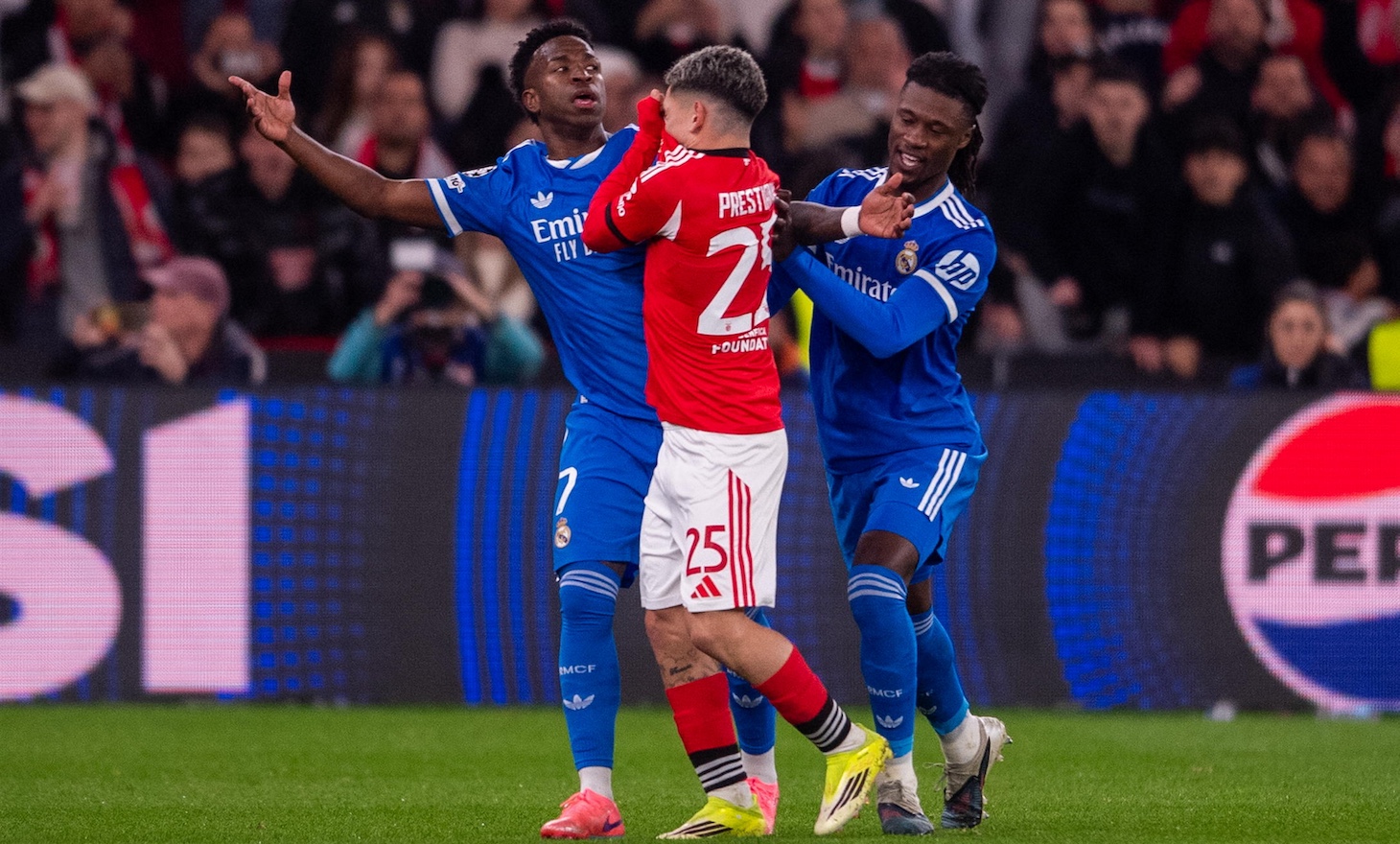
Just over midway through Tuesday's Champions League playoff between Benfica and Real Madrid, Vinícius struck one of the most beautiful goals of his career. In response to the strike, and to Vinícius's totally normal celebration of it, the incensed Lisbon crowd sent boos, water bottles, and other projectiles raining down on the Brazilian forward and his teammates. Ginned up by the atmosphere, Benfica's Argentine winger Gianluca Prestianni ran over to confront the goalscorer and exchanged some heated words, most all of them obscured by the jersey Prestianni hiked up over his nose and mouth. Vinícius said Prestianni called him a "mono," "monkey" in Spanish. Prestianni denied this, claiming Vinícius misunderstood him.
The general scenario presented above is depressingly common in soccer, and has been for as far back as you'd like to look. Instances like this are surely less frequent today than in prior times, which to me only calls to mind Malcolm X's bit about knives. To hear certain people tell it, the word "monkey" must possess some downright mystical attributes—always being heard, but somehow never actually being said. Prestianni is only the latest victim of those devilishly deceptive sounds, though Vinícius himself is no stranger to this particular rodeo. Maybe the most direct path to proving once and for all that racism actually has already been eradicated from the sport is to fit all black players with hearing aids.
It is indeed true that stadiums are loud, shirts dampen sound, and language is tricky. If Prestianni is being honest and Vinícius really did just mishear a word, it wouldn't be the first time that what at first blush seemed like a clear case of racism turned out to be something of a misunderstanding. It is also true that black soccer players have been called "monkeys" in the middle of matches since time immemorial, and every bit of evidence we've seen so far supports Vinícius's version of events, above all the sharp and immediate reaction of Vini to whatever it was Prestianni said and the fact that Kylian Mbappé said he himself heard Prestianni say it several times. (Judging from the context, it seems that Mbappé realized Prestianni was throwing around "monkey" before even Vinícius did, which would explain his forcefulness in castigating the Argentine before Vini went to the referee.)
Even in the most generous reading of Prestianni's behavior, everything around the situation shows how soccer is rotten with racism. Firstly, there's no fan of European soccer in 2026 could credibly claim that a white player calling a black player a "monkey" would qualify as inconceivable. This flavor of racism is so endemic—the word "monkey" itself, the tell-tale "ooh ooh ooh" noise, the apish gestures, the odd banana tossed from the stands—that it's never a surprise to come across it. At this point basically every single fan base has been on either side of a racism controversy, and, ever so coincidentally, those fan bases' responses tend to be determined entirely by rooting interest.
The simple fact that Prestianni's alleged behavior, even if ultimately proven unfounded, isn't considered so heinous as to be unbelievable in the literal sense says plenty about the sport's culture. Lest anyone think I'm exaggerating, here is a clip from Tuesday's game of a pair of Benfica fans pantomiming monkeys at the Real Madrid players, to zero admonishment from anyone:
Ao mesmo tempo: pic.twitter.com/ywLSD8Tqbz
— Allan Sampaio (@shk_al__) February 17, 2026
For as reprehensible as the acts inside the Stadium of Light were themselves, the problems were only compounded by the response after the match. When asked about the incident after the game, Benfica manager José Mourinho said that he'd spoken to both players, and that he didn't want to get drawn into whether one of the parties involved was lying, only to immediately then launch into the same, tired diatribe against "provocation" that is always trotted out when someone wants to justify racism against Vinícius.
"It’s not that I want to say Vinicius is a liar and mine is an incredible kid," Mourinho said. "It happens in so many stadiums, and it’s always the same thing… Something’s not working. Vinicius scored a fantastic goal. Why didn’t he celebrate like Eusebio, Pele, or Di Stefano? Why didn’t he? The game was over with that play." In addition to openly blaming Vinícius for inciting his own abuse with a bog-standard celebration, Mourinho went on to say that, because Benfica's most legendary player is Eusébio, a Mozambique-born Portuguese international who starred for the club during the 1960s and '70s, Benfica cannot be considered a racist club. As if that were at all the question at hand. As if Eusébio's ghost resides inside the shield of every Benfica jersey and would leap into the throat of anyone wearing it and gag them before a racist comment could escape.
That Mourinho—one of the most iconic figures in the sport's history, often hailed as a kind, caring, notably non-racist human being by the dozens of black players who've worked with him and seen the real heart of the man behind the public bravado—would spout such legitimizing bullshit is a real bummer, and an abdication of the duties of his status. But even worse were the statements of Benfica as a club. First the club's official Twitter account reposted Prestianni's denial, wherein he makes himself out to be the real victim of the Real Madrid players' "threats," with the message "Together, at your side." Then, ratcheting things up to a whole new level, the club tweeted a video of the incident, which they claimed directly disproves the statements of various Madrid player who said they themselves heard Prestianni say "monkey":
Como demonstram as imagens, dada a distância, os jogadores do Real Madrid não podem ter ouvido o que andam a dizer que ouviram. pic.twitter.com/7JF9AVuhEM
— SL Benfica (@SLBenfica) February 18, 2026
Seriously, what are we doing here? Taken on its own terms, this statement makes no sense. The attached video, which purports to show that no Madrid player was close enough to Prestianni to hear what he said to Vinícius ... shows multiple Madrid players pretty damn close to Prestianni! More troublingly, saying that a black person is lying about a reported instance of racism is about as grave an accusation as there is. To do so with any semblance of a conscience would require irrefutable evidence and also extreme tact. Doing it the way Benfica did, passive-aggressively and with nothing even resembling proof, is not the behavior of a club that takes this stuff seriously.
Thankfully, the response to Tuesday's scenes wasn't uniformly despicable, though even the good stuff was telling in the same way as the bad. Vini's teammate Kylian Mbappé spoke clearly, forcefully, and with real sophistication about why what happened was wrong. CBS Sports' always excellent Champions League panel also met the moment with the gravitas it deserved. Thierry Henry was as eloquent as always, speaking about how sick racism in the sport he loves makes him and how craven he finds all the cheap talk from governing bodies and club presidents and famous managers about their commitment to stopping racism, when those same mouths are zipped tight when racism is actually put in front of their faces. But almost even more than the words from Henry and fellow panelist Micah Richards, I'm struck by their body language in clips like this from yesterday:
"People did fight, way before my time, for us to be able to perform... and to be in 2026 talking about the same thing, it's tiring.
— CBS Sports Golazo ⚽️ (@CBSSportsGolazo) February 18, 2026
Thierry Henry and @MicahRichards share their experiences and frustrations about how far football still has to go to fight racism 👇 pic.twitter.com/oS5teP3mqT
You can see in their bowed heads, slouched postures, and listless voices the psychological and physical weight black people in soccer so often feel when confronting yet another example of how their dignity is always only ever contextual. It's been like this for so long now. Even if things have gotten a little better, it's nowhere near good enough. And, again, none of that is affected one iota whether or not Prestianni did or did not say "monkey."
Let's go back to that hypothetical, backbreakingly generous reading of Tuesday's incident, where Prestianni is innocent. (Though let's not forget that, according to Real player Aurélien Tchouaméni, Prestianni's exculpatory case was that he said "faggot," not "monkey," itself telling of the kinds of bigotries the sport's culture abides.) It's not difficult to imagine an alternative way of handling this that would've spoken to the world with a much better understanding of the gravity of racism. Once Vinícius reported what he believed he'd heard to the referee, it could've triggered a protocol that immediately demanded Prestianni be substituted out of the game, without costing Benfica one of its allotted subs. If the refs then could find no direct evidence of Vinícius's allegation, the match would've continued. Asked about it after the game, Mourinho could've said that he'd spoken to both players, respected their positions, and wouldn't be weighing in as to the truth of the matter until it could first be fully investigated. Prestianni himself could've appeared before the media and answered questions about the incident, explaining what exactly he said and how it wasn't what Vini thought it was. In addition, the head referee could've spoken to the media as well, giving his accounting of events.
Benfica could've put out a statement echoing Mourinho's, that the club was going to await the results of the investigation, adding that Benfica has no tolerance for racism. TV pundits could've sifted through the evidence, said that Vinícius's allegation was by all indications credible, but because the system of sussing these things out was so rigorous, everyone could hold off on any firm determinations of guilt, content in the knowledge that the right thing would ultimately be done. Then, if the investigation proved that Prestianni didn't do anything wrong, both his and Vinícius's dignity could've been preserved and everyone could move on.
Our world is much worse than that one. One of the most famous coaches in history is saying that dancing after scoring a goal is basically asking for racist abuse. One of the most storied clubs in European soccer is calling black people liars—not that they could be genuinely mistaken, but that they are lying. Fans of clubs all around the world are determining whether or not they believe Vini based on how recently Real Madrid beat them in a game. Black people are insulted, doubted, blamed, saddened, tired, and, maybe most of all, unsurprised. Racism isn't soccer's problem alone, as it is at heart societal. Soccer can help guide society, but more often it simply reflects. Nobody should like what they're seeing in that mirror. But, based on incidents like Tuesday's, nobody should expect to see anything different any time soon.