

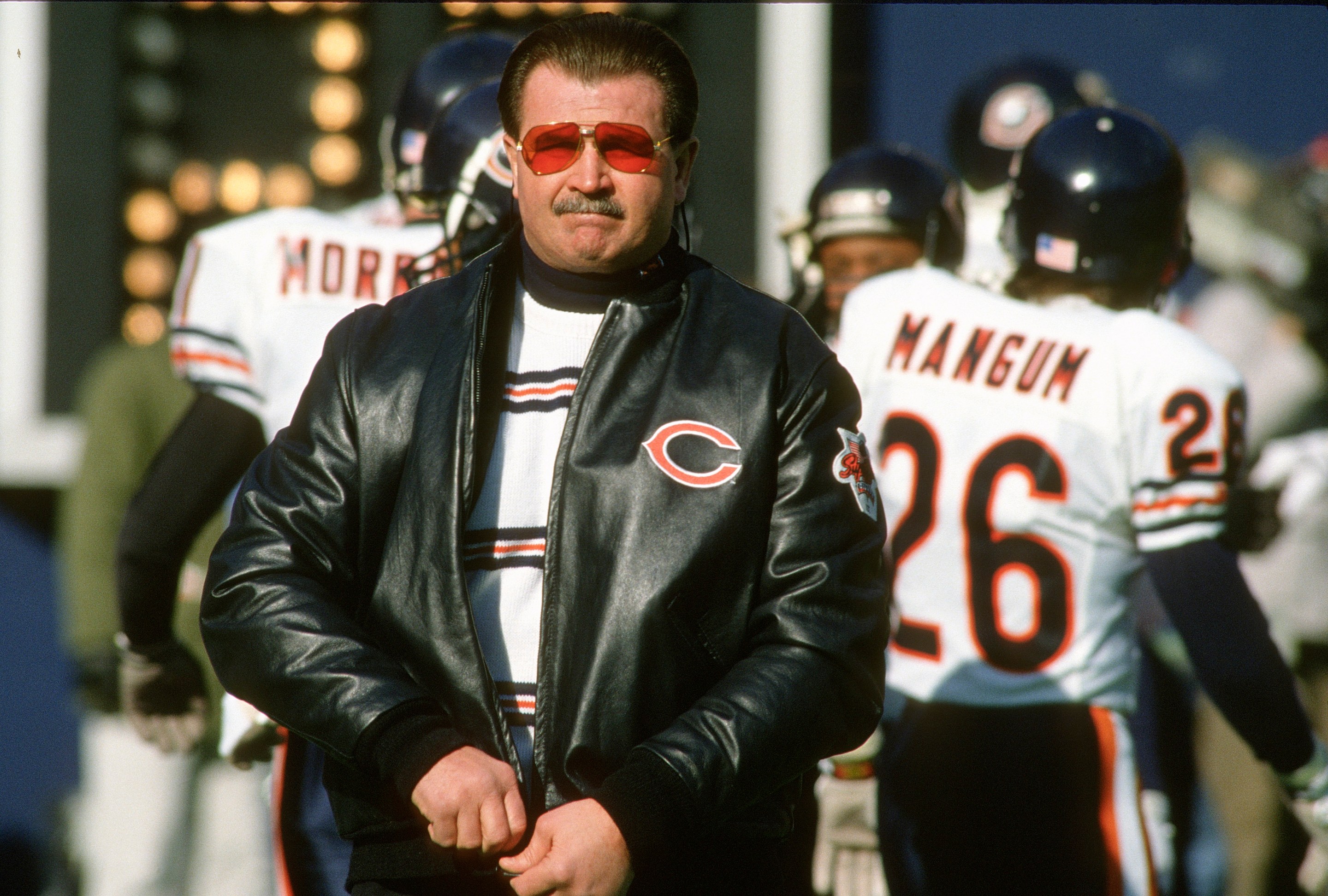
The relationship between sports and the place where those games are played is largely a matter of fans developing a strong but mostly manageable addiction to their own pheromones. Ritual and iconography matter more than the actual results when the results don't meet the need; the first two are stable and reliable in a way the third will never be. It has always been thus.
And so Mike Ditka, whose death at age 86 was announced by his family Friday morning, was and remains still Chicago in ways that no other figure in any other city could manage. Ditka explained Chicago's view of itself from head to toe, vocal inflections to hand gestures, minor local biases to general worldview. Chicago is Ditka just as Ditka was Chicago, and that self-reverential truth will remain true even after he's gone.
Ditka was quite literally the face of the Bears from the moment he left the University of Pittsburgh to seek his fortune in football 65 years ago. His helmet with the white single-bar facemask and his gashed-up face behind it was the image of choice in their 1963 championship, the one that interrupted the Decade of Lombardi. Ditka's contractual intransigence in the face of the team's iconic (and iconically vice-gripped) owner, George Halas, reinforced that status despite the six-year endgame in Philadelphia and then Dallas that completed his playing career. Even Ditka's Super Bowl championship with Dallas in 1971 felt a bit odd, in that Why is that Chicago guy celebrating next to Roger Staubach? kind of way. He sent himself into exile rather than take what Halas was offering, but Ditka never really left.
And when Ditka came back to Chicago to coach that bereft team a decade after his retirement as a player, he did so at the desperate behest of Halas himself. That concession was proof that some powers transcend even proof of purchase. Ditka embodied that power in more enduring ways than even the era's other face of the Bears, Dick Butkus, though it seems instructive that the two icons of choice on this team are heavy on the consonant "K." This is a city that prefers icons whose names must be spat out at speed rather than eased into. Ditka's surname became one that Chicagoans like to say just for the satisfaction of saying it, whether they carefully pronounced all five letters or shortened it for reasons of stylistic laziness to "Di-ka." It stands for the fist that never fails to find a face, for a sort of hard and overwhelming will. Again, it's circular: The name is ancillary to the profile, and the profile is ancillary to the image. The Bears were Ditka, and because Chicago was the Bears, Ditka was Chicago.
Ditka doubled down and coached the city's only Super Bowl champion in 1985, thanks mostly to a defense that actually recalled Butkus's historical influence more than Ditka's. But Butkus wasn't on the sidelines with that defense and Ditka was, and proximity is easy to mistake for creation. Then Ditka was commercials and restaurants and Halloween costumes and an enduring Saturday Night Live proto-meme; he was one-sided fights with quarterback Jim McMahon and defensive coordinator Buddy Ryan, two of the other principal figures of that title, and opting to let Refrigerator Perry to score a touchdown that belonged by rights and reputation to Walter Payton. He defended the concept of Ditka by simply becoming more and more Ditkaesque, and while that stopped working in some ways, it remained highly effective in other, vibe-intensive ones. When Ditka flamed out in New Orleans after being fired by the Bears in 1992, the fault was declared to be with New Orleans, for not being able to spiritually align with the essence of Ditka. That the Saints were the fourth-worst team in football from their inception to the moment Ditka was hired, and that every major decision he made there made them worse, was just details.
If you are of an age that you either barely remember any of this or weren't alive when it happened, consider the very limited number of Ditka's peers in the cohort of sports figures who came to represent something simultaneously essential and caricatured about the places where they worked. There's Magic Johnson in Los Angeles, Jerry Jones in Dallas, Larry Bird or Bill Belichick in Boston, Nick Saban in Tuscaloosa, Jean Béliveau in Montreal; add your own in the comments below if you want, we promise not to look. Ditka beats them all because, even after being traded as a player and fired as a coach, he returned to Chicago. He returned because it was the town that defined him, and that he defined; he brought it with him wherever he went, but when the transference is this total, why bother to leave? The most dismissive you can be here is to say that Ditka showed Chicago the Chicago that Chicago had always fancied itself to be: tough, stubborn, successful, not just unashamed of its appetites but proud of them. Maybe Magic does that for L.A., but he never tested that theory by leaving.
But that's a debate for people you would understandably leave your own birthday party to avoid. Chicago is Ditka and Ditka is Chicago, and there is no need to change the verb tense just because the man has died. Maybe in three or four generations his place might fade, but then in three or four generations we might be killing and eating each other to stay alive, or because it's the most reliable employment left. It is unwise to look 60 years ahead and expect anything, but for the past six decades, Mike Ditka wore his town like a sweater vest, and he wears it still in the absence of any potential rival.
Michael Jordan was Chicago, too, but he belonged to the nation at a time when brands could be made universal with the right marketing. Ditka stayed closer to the home he chose. He belonged to the city completely, and that will survive his death by a considerable stretch of time.