It's almost time for the World Cup. Before the tournament, we'll be previewing each of the top 15 teams by FIFA rankings that made the tournament. Why the top 15? Because that's how many we needed to do in order for the USMNT to make the cut. You can read all of our previews here.
From a distance, it might be tempting to fit Morocco's recent rocket-ship rise up the global soccer hierarchy into the familiar story of the golden generation. To be fair, when a smaller and/or relatively unheralded country experiences this kind of ascent, it often is indeed thanks to the efforts of an especially fecund generation whose players reach maturity around the same time and take the country places it has never been before. But though Morocco's leap has been quick and massive—after missing the first five World Cups of this millennium, the Atlas Lions qualified in 2018 for the first time in 20 years, then made it to the semifinals four years later, and now enter this one with legitimate hopes of matching and maybe even surpassing that feat—the story here does not in fact mirror that of, say, Belgium. There's no single, solid core of similarly aged players responsible for this rise. And that might be the most important message they could send this summer: that Morocco is not only here, but here for good.
Especially in light of the general roster consistency of most other contending teams, you'll be surprised to learn how much turnover there has been for Morocco over the past four years. Of the lineup that fought admirably but ultimately fell to France in the semis of the last World Cup, only four of those 11 players are likely to start Morocco's first game against Brazil this time around. Not only that, but six of the semifinal starters aren't even in the squad Morocco is taking to the U.S. In total, just 10 of the 26 members of the 2026 team are holdovers from 2022. What's most remarkable is that these Atlas Lions are actually even more talented than the ones who pulled off the deepest run an African team has ever seen.
What all of this turnover proves is that Morocco's recent success is no fluke. As is often the case, those successes only beget more success. Like many of their African and Arab peers, Morocco's national team is largely indebted to its diaspora. Most of the players were raised in Europe but chose to represent their ancestral country, in several cases actively picking Morocco over the European teams they'd previously represented at the youth international level. Obviously things like familial ties and ethnic pride play a big role in the recruitment of foreign-born players to their lineal homelands, but so do more immediate things like sporting ambition and the desire to play in a World Cup no matter who it is for. In that way, wins today create more wins tomorrow. By promising diasporic kids not only a chance to play at the World Cup, but the opportunity to legitimately challenge once there, Morocco has an even easier time bringing into the fold real-deal talents honed in Europe's most prestigious leagues. This dynamic is what has helped Morocco follow up its best-ever World Cup performance with a reloaded squad that can aspire to do even better.
As endearing as it is to see a diaspora-laden African team showing out on the world stage, I think it is also important that the success achieved by the European-raised national teamers trickles down to help the less privileged people who actually live there. Morocco appears to be on solid ground there, too. The Moroccan federation has invested billions in recent years on both the men's and women's side of the game, looking to ensure that it's not only its emigrant talents that are able to cultivate their skills. There is a flip side to this story, though, seen in widespread protests last year when Moroccans took to the streets to decry the country's economic priorities, which have privileged spending tons on stadiums and tourist infrastructure to prepare for its cohosting role for the 2030 World Cup, while neglecting the needs of the people themselves. As ever, soccer resists pat narratives about good guys and bad guys, which the Morocco team itself embodies in more ways than one.
Who Is Their Main Guy?
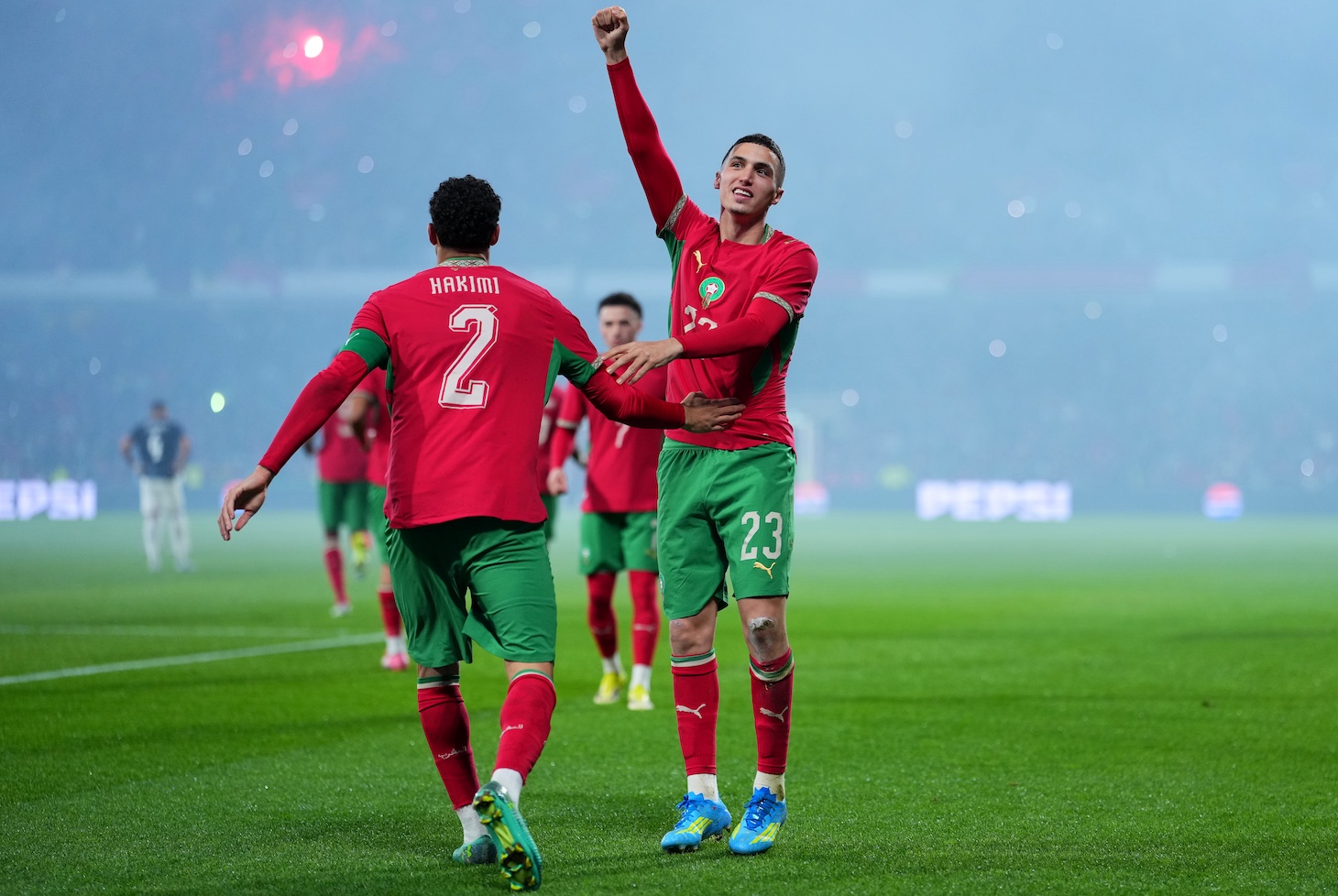
Achraf Hakimi is a sensational player. At club level at Paris Saint-Germain, he, alongside Nuno Mendes, forms the kind of terrifying full-back tandem at that you usually only see in old Brazil national team highlights. The world's best club team, the back-to-back reigning European champion, is in an important sense defined by the impossibly broad skill sets of its two outside backs. Hakimi, though not quite as good overall as Mendes, instantiates that absurd breadth more than anyone.
A mere positional term like "right back" can't come close to encapsulating Hakimi's game. That's because he legitimately can do it all. He is a totally solid defender, is a nuclear bomb when he flies up the flank as a winger, has the vision and touch of a born midfielder when he steps into interior zones, and is even a serious threat to score and assist when he gets around the penalty box. The defining aspect of the budding PSG dynasty is positional fluidity. Other than the keeper and two center backs, every other Parisian on the pitch is expected to rotate into any and every position on the field depending on the movements of their teammates, creating an ever-changing whirligig that defense have trouble even following, let along stopping. I'd argue that no other PSG player better demonstrates this fluidity than Hakimi, who genuinely pops up everywhere.
For Morocco, Hakimi isn't tasked with playing quite so adventurously. Together with Abde Ezzalzouli on the other flank, Hakimi is mostly expected to make the pitch wide by camping out on the wing and waiting for a switch of play, where he can then flex his most unbalancing skill: his ferocious ball-carrying. Morocco plays a delightfully attractive offensive style—a major transformation from last World Cup, where they were first and foremost defensive—that is itself full of movement and combination plays for pretty much everyone other than Hakimi and Ezzalzouli. Nevertheless, this style is designed to manufacture space for those two wide men, who therefore serve as the team's most incisive players. That fact, together with his overall world-class talent, is why Hakimi is the best and most important player for Morocco.
However, before you go looking to buy a jersey of the star player on what could very well again prove the most heartwarming team of the tournament, it's worth noting that Hakimi will soon face trial in France for rape, stemming from an incident in 2023. Like I said, "good" soccer stories aren't always only that.
Who Is Their Main Scoring Guy?
Ismael Saibari is to Morocco what Hakimi is to PSG. Where Hakimi's perma-motion instantiates the positional fluidity of his club team, Saibari does that for the different sort of fluidity of the national team.
Morocco is in some ways a team of attacking midfielders. With their nominal 4-3-3 formation, the Atlas Lions like to cram the pitch with no less than three No. 10s: Azzedine Ounahi, the most advanced of the two No. 8s; Brahim Díaz, who starts on the right wing but is almost always found centrally; and Saibari, who plays in lieu of a traditional striker. Whereas PSG's movement tends to maintain the same overall shape, just with different players rotating into the various positions on the field, Morocco's movement is more about bunching teammates together in close proximity to each other, knowing that their skills in tight spaces will see them dribble and combine their way out of the surrounding thicket of defenders, at which point they can either blaze off into the open spaces themselves or hit a cross-field pass out to Hakimi or Ezzalzouli. It's Saibari's movement off of the front line into the midfield or out to the wings that is key.
The term "false 9" is wildly overused. It tends to get thrown around whenever someone who isn't known as a center forward plays center forward, even when the things they do in that position are exactly the same kinds of things a normal No. 9 does. Saibari, though, is closer to a true false 9. What makes a false 9 "false" is how they do not usually appear in the space you find your typical 9s, all butted up against the opposing central defenders jockeying for position. That is precisely what defines Saibari's role when he plays striker for Morocco. Rather than standing out by the central defenders, when Morocco has the ball Saibari is almost always found in the pockets of space between the defensive and midfield lines, trying to form those bunched-up overloads with his fellow 10s that they are so adept at dominating.
This scenario is often confusing for opposing defenders. Do they track his movement and head up the pitch to stick to him? If they do, then Ezzalzouli will start to drift in from his position on the left wing, angling himself in preparation for a ball over the top into that unprotected central area. Do they let Saibari go free and stay back to maintain the defensive line's integrity? If they do, then Saibari can receive passes and turn toward goal with ease, and a Saibari with space, a head of steam, and passing options around him is a terrifying sight. What's more, unlike many false 9s, Saibari is a powerful runner who is a real threat when he decides to makes runs in behind the backlines that his previous movements have often dragged out of shape. Saibari really is the cornerstone of what makes Morocco's attack so very dangerous.
And as Saibari has shown over the last couple years, he is plenty dangerous in his own right. After a few years as a rotation piece for Dutch giant PSV, Saibari really erupted onto the scene when he earned a starting spot in the 2024-25 season. He put together 11 goals and 11 assists in the league that season, demonstrating just how attacking he is as an attacking midfielder. The Spain-born, Belgium-raised player maintained those numbers this past season, hitting for 15 goals and 8 assists in a PSV team that demolished all comers in domestic play. The latest reports say that Bayern Munich is trying to secure his signing before the World Cup starts, which is wise. If Saibari plays the way he can this summer, both the price and the number of suitors are only going to go up.
Who Is Most Likely To Break Out?
I would love to write about Abde Ezzalzouli here, one of my favorite players in La Liga due to his dribbling ferocity and his newly honed eye for goal. Ezzalzouli was all set to play a crucial role for Morocco in this tournament, until he picked up an injury on Sunday in Morocco's last warm-up friendly. Early reports say he sprained a ligament in his knee and will be out for the whole World Cup. A huge bummer for him, and a huge blow for Morocco.
Luckily, Morocco is not short of attacking replacements—so much so that it's hard to predict who manager Mohamed Ouahbi will turn to in Ezzalzouli's absence. They could bring in a tradition striker like Ayoub El Kaabi or Ayoube Amaimouni and move Saibari out wide, or they could turn to veteran forward Soufiane Rahimi to try and replicate Ezzalzouli's role. But if Ouahbi is most interested in maximizing the talent out on the pitch, I think he'll turn to Bilal El Khannouss.
El Khannouss isn't the same kind of vertical attacker as Ezzalzouli, but he is a monster talent in his own right. No matter where you put him, be it in the middle or on either wing, the 22-year-old attacking midfielder is a lock to provide you with elegant dribbles and heat-seeking passes. It's his vision for seeing impossible passing windows and his technical ability to squeeze the ball through them that are his most stand-out traits. Even at his young age, he is probably Morocco's most outstanding creative passer. That world-class ball-striking of his also makes him a dangerous shooter, and he can rip them off with either foot.
Again, Morocco is definitely going to miss Ezzalzouli, a key structural piece whose particular skill set has no direct replacement. But any injury is also an opportunity, and El Khannouss is more than talented enough to seize the chance and run with it.
Who Is Most Likely To Eat Shit?
Brahim Díaz is the crown jewel of Morocco's diaspora virtuous circle. A purported star-in-the-making since he was in his middle teens, Díaz has at various times in his career been one of the most sought after attackers of his generation. A bidding war when he was 16 took him to Manchester City, and a second a couple years later brought him to Real Madrid, where, after a couple good loan seasons at AC Milan, he has found his place as a very valuable back-up attacker.
Now, while being a valuable back-up for Real Madrid is nothing to scoff at, it also isn't the kind of thing that makes you a lock for the Spain national team, which is perpetually overflowing with talent at Díaz's exact position. Born in Spain to a Spanish mother and a Moroccan father, Díaz had been a mainstay for Spain at the youth levels, and surely only ever had eyes for playing with his country of birth. But because of the aforementioned overflow of players at his position, Díaz found it difficult to crack the Spain roster. His only Spain cap came in a semi-official friendly in 2021 when COVID-19 restrictions forced La Roja to field a youth team in a senior match.
Díaz's international situation came to a head ahead of the 2022 World Cup. At that point he was in the middle of his best season as a pro at Milan, and had legitimate hopes to make the trip to Qatar with Spain. Part of the strength of his candidacy for the roster was to ensure the then-22-year-old would be cap-tied with Spain, since already there were rumors that he might be interested in representing Morocco instead. Ultimately, however, Díaz was left off the roster. In response to that snub, Díaz decided to cut ties with the Spain setup and go about switching his international allegiance to Morocco.
Though to my understanding Morocco's relationship to its diaspora national team players isn't particularly fraught, Díaz's case was a little different. Most foreign-born Moroccan internationals had been courted over in their teen years, which firmed up the credibility of their commitment to the country. Díaz, in contrast, had held out until just about the last possible moment, showing an undeniable preference for Spain that he'd only changed after Spain had all but discarded him. Not only that, but Díaz was, alongside Hakimi, the highest profile Moroccan on the team when he officially joined in 2024. All of that heaped the pressure on him to deliver as the team's new big star.
Díaz was well on his way toward making good on those expectations during the 2025 Africa Cup of Nations, when Morocco, as hosts and tournament favorites, made it to the final. Along the path there, Díaz had been Morocco's best player and the tournament's the highest scorer. But the final itself, against Senegal, was pure chaos, with Díaz at the heart of it.
To make a long story shortish, VAR awarded Morocco a stoppage-time penalty for a foul on Díaz. Senegal's players and manager lost their minds in indignation, due to that call, other referee decisions, and the general air all tournament long that the powers that be had put the thumb on the scales in Morocco's favor. In response, most of Senegal's team walked off the pitch in protest. Rather than disqualify Senegal right then and there as he should have, the ref just let the matter sit in limbo. Eventually Sadio Mané was able to talk some sense back into his teammates and got everyone back on the pitch to play out the game. After about 20 minutes of bedlam, Díaz finally stepped up to take what was essentially a game- and trophy-winning penalty. Díaz proceeded to hit one of the limpest panenkas you'll ever see, which was easily saved.
Díaz was distraught after his missed penalty and had to be subbed out of the game in extra time as he was clearly still shell-shocked. Senegal went on to win. In front of his new home fans, Díaz had humiliated himself and let the entire country down.
When the African federation made the atrocious decision to reverse the match's outcome after the fact by disqualifying Senegal for leaving the pitch (the decision to DQ them was right, but it had to be made in the moment; doing so after the game had been allowed to resume is heinous), Díaz was given a bit of respite since Morocco is, at present, "officially" considered winners. (It's highly likely that decision will be overturned on appeal, however.) Still, I have to imagine that Moroccan fans still regard Díaz a bit skeptically, and Díaz himself too will probably feel some jitters at the World Cup, not wanting collapse under the pressure for a second time. Should he fail in spectacular fashion again this summer, things could get ugly.
How Can They Win It All?
In my opinion, this Morocco team is far better than the one from 2022. They have more talent, more experience, and more depth. Though generally more attack-minded than in Qatar, these Atlas Lions are versatile, and have the ability and know-how to play any sort of game. Everything is here for a deep run.
However, I think that Morocco was better equipped to go really far at the World Cup last time than this time. Partially it's a matter of expectations and surprise. Where Morocco could play totally free in 2022, unburdened by any pressure and strengthened by opponents necessarily considering them an easy out, this time around Morocco has a reputation to live up to and will be taken very seriously by every other team. In addition, it's easier to win the kinds of squeakers you're likely to be in in the knockout rounds when you are a defensive behemoth like in 2022, rather than as a more attacking side. So while I do expect Morocco to do well, and would not be totally shocked to see them again in the semifinals, I think getting there or beyond this summer will be an even greater challenge.