

In honor of Monday night's Vikings debacle, some members of the Defector staff share their memories of terrible quarterbacking.
Dan Pastorini, Oakland Raiders vs. Houston Oilers, Oct. 9, 1972
Dan Pastorini was a highly regarded but still inexperienced Houston Oiler in 1972, before any of your parents were born, and 30 years before the franchise stopped being either Houston or Oilers. But Pastorini had the bad luck of being drafted by a team that was bad and about to become much worse. He won one of his first 22 starts across his second and third seasons, to give you an idea of how horrendous the Oilers were.
Pastorini was facing the very accomplished Oakland Raiders (equally defunct) in Week 5 and got backhanded, 34-0, which wasn't surprising. What was surprising were the collapsed pockets and his final numbers: 3-for-21, 31 yards, and more completions to Raiders than Oilers. He eventually became a quality quarterback of the era, enough to be traded to the Raiders eight years later—where he played only five games before breaking his leg and receiving boos as he was carted off the field because, well, Raider fans. At least he's famous for being treated worse by his own fans than almost any other North American athlete ever.
– Ray Ratto
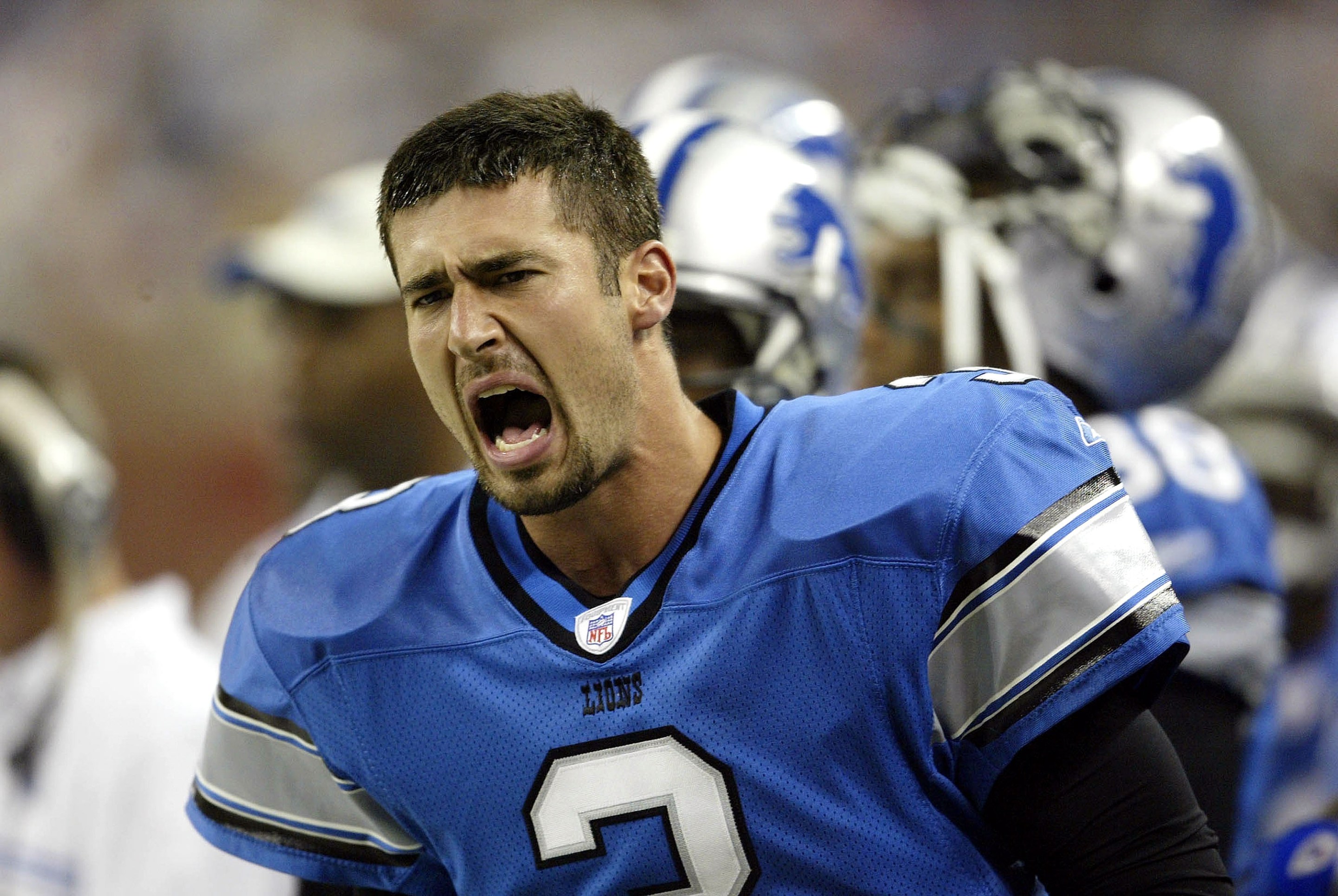
Joey Harrington, Washington vs. Detroit Lions, Nov. 7, 2004
The bad quarterbacks of today have it harder than the ones of yesteryear. Make a boneheaded turnover in a game in 2026, and within seconds, every football fan with a phone in their hand can watch infinite replays of just how badly you screwed up, as jokers worldwide try to one-up each other with clever burns. The true extent of a QB’s ineptitude felt perhaps just a little more secluded back in the day, in that you had to be a committed local fan to be able to survey the entire scope of the wreckage. Nevertheless, when I think “bad quarterback,” there is only one name that leaps to mind immediately—a guy so ineffective for such a long stretch that he will forever be the floor with which I judge all others. That man is Joey Harrington.
Drafted by the Lions third overall in 2002, the former Oregon Duck admittedly had the misfortune of going to a team that didn’t yet realize offensive line is an important position in football. But over the course of four seasons he was allowed chance after chance to prove he wasn’t a bust, and the best he could do was lift the Lions from last in the NFC North to second-last, going 18-37 overall. The platonic ideal of a Joey Harrington play was an incompletion four yards downfield on third-and-9. In only one year did he throw more touchdowns than picks. And while we were not a Lions-going family when I was growing up, an outing to a game against Washington holds a special place in my memory. The final score was a 17-10 Lions loss, but that grossly distorts the action on the field. When we left, my dad swore that he would never spend money on the Lions again until they had at least a .500 season, which they eventually accomplished seven years later. I suppose in that way, experiencing Joey Harrington together was a net positive for my family.
In a game where Harrington threw the ball 52 times, let me just list the results of the Lions’ drives, chronologically: Punt, punt, punt, punt, punt, punt, field goal. Punt, blocked punt returned for a TD, punt, punt, interception, and then finally the end zone on a one-yard pass with two minutes remaining. Imagine being a 9-year-old in a section of increasingly intoxicated adults fruitlessly screaming for the backup, Mike McMahon, as you watch literally nothing take place in front of you. Anything better than that is now good football, to me.
– Lauren Theisen
Josh Freeman, Minnesota Vikings vs. New York Giants, Oct. 21, 2013
The facts are not promising on their face. The Vikings were 1-4 and preparing to bring down the curtain on the Christian Ponder administration. The Giants were 0-6 and at the beginning of the excruciatingly protracted Eli Manning endgame. This was 2013, which would become Manning’s first losing season as a full-time starter, the first of five he’d oversee across the next six seasons—a fact I mention here only because it is still quite upsetting to me. Manning was about as bad as he’d ever get that year. He had thrown 15 picks across those six losses and would lead the NFL in interceptions that year with 27. This is notable only because he was by far the superior quarterback in the game.
And you really have to give Josh Freeman a lot of credit for that. The Vikings had signed Freeman during their bye week, after he’d been released by the Tampa Bay Buccaneers. He came into this game on a pleasant October Monday night with a little under two weeks of preparation, and he ran a limited play sheet just about as badly as it could have been run. Freeman was under pressure constantly, and the Giants bottled up Adrian Peterson effectively enough that Freeman wound up having to throw the ball a lot.
The result was, among other things, one of the most brutal live sports experiences of my lifetime. Freeman had it far worse. He was knocked down a dozen times and completed just 20 of 53 passes. After the game, the Vikings allowed that he might (or might not have, they didn’t seem that concerned either way) played most of the second half with a concussion. During that second half, Freeman attempted 37 passes and completed just 13. That he threw just one interception seems surprising in retrospect, but in my memory this was more the result of him throwing passes that no one, on either team, had much of a chance of catching.
The teen fans sitting next to me arrived drunk, in the sort of way that you only really see at NFL games, juddering down to their seats with the body language of those inflatable guys that whip around outside car dealerships. One of them took out a big sign reading “Eli Is Eli-te,” yelled it a few times, and then had the sign snatched out of his hands by a security guard. He disappeared for more than a quarter, during which time his buddy fell asleep on my shoulder and was then physically removed by security. When the "Eli Is Eli-te" guy returned, he seemed not to notice. They did not return for the second half.
I stayed for the whole thing: the Marcus Sherels punt return touchdown that was the Vikings’ only offense, a Peyton Hillis rushing touchdown for the Giants (he rushed 18 times for 36 yards), and two-dozen second-half incompletions by someone who should not have been playing for every conceivable reason. With that in mind, it is hard to argue that these young dipshits—people so loaded they moved as if being puppeted and incapable of just sitting in a stadium seat without incident—made worse decisions than me that night.
– David Roth
Jameis Winston, Tennessee Titans vs. Tampa Bay Buccaneers, Sept. 13, 2015
Picture this: It’s the first week of January 2014, and I’ve just watched my alma mater Florida State win its third national championship after a dominant, undefeated regular season. In that moment, you could not convince me that I was not watching the best collection of college players since the 2001 Miami Hurricanes, starting with quarterback Jameis Winston. Winston was a lot of terrible things, even back then, but he was the next football superstar, sure to dominate in the NFL the way he had in his first year at FSU. A year and some stolen crab legs later, I watched him—in the inaugural playoff season—get embarrassed by Marcus Mariota’s Oregon squad, including one of the all-time fumbles ever put to film.
Winston and Mariota, at one point in time, were seen as the yin and yang of great college prospects. Mariota was the nice, gentlemanly star to Winston’s goofy and possibly criminal galoot. They were the two top players of the 2015 NFL Draft, and there was a lot of consternation over who would succeed and who would bust.
Fortunately, they ended up on teams that would play one another on Week 1 of that NFL season: Winston on the Buccaneers and Mariota on the Titans. Unfortunately for FSU cultists everywhere, this game was an upsetting sign of what Winston's NFL tenure held in store. His stats read 16-of-33 for 210 yards with two TDs and two INTs, but that doesn’t do justice to just how badly Winston played and got outplayed by his media-created rival, who looked like Steve Young by comparison. His two interceptions were two of the goofiest fucking turnovers one can make, including his very first pass of his NFL career, which became a pick-six in the other direction. He also suffered four sacks, including one where he tripped on his own offensive lineman’s foot.
Winston plays football as if he’s Clifford the Big Red Dog, trying desperately to avoid all the tiny people that might be underneath his paws. He plays football like he’s Dick Van Dyke tripping over all the furniture. He could’ve been Peter Sellers in another life, maybe. How this man found a way to put up a whole year of Heisman-level football in his first real try as a college QB, and then never do it again, is astounding to me. I can’t for the life of me figure it out.
– Israel Daramola
Nathan Peterman, Buffalo Bills vs. Los Angeles Chargers, Nov. 19, 2017
You know the Legend of Peterman. Five interceptions in the first half. A 0.6 QBR (not the worst game of his career!). The rookie fifth-round pick iconically and instantly became shorthand for an overmatched second-stringer being thrown to the wolves. Everything anyone can say about that game is true, and cruel, and crueler for being true.
I have a soft spot in my heart for Peterman’s start, because I think it most closely resembles what would happen if you put me in an NFL game, perhaps via some sadistic genie deliberately misconstruing my wish to be a pro athlete. Oh, I don’t claim I’d have been anywhere near as competent as that. He completed six passes, after all, and I’d have completed none, and also I would have literally died. But my first few snaps might have each looked like his second and third picks, where Peterman faces the slightest bit of pressure and immediately shits his pants and chucks up a ball and hopes for the best. Perhaps, once the Chargers decided they didn’t even need to blitz me and were better off letting me put the ball in the air, I would have thrown (soft and non-spiraling) balls that looked like Peterman’s fourth and fifth picks, where his panic-induced tunnel vision led him to completely overlook a lurking safety.
Peterman’s terrible, horrible, no good, very bad first pro start is actually a stirring tribute to the talent level in the NFL. He was in point of fact one of the hundred or so best quarterbacks on the entire planet at the time, just by dint of being on a roster; by any reasonable measure except that of the NFL, he was elite. He was! And the NFL ran him over. It was too fast, and its defenders were too smart and too strong. A decorated college quarterback was made to look like a small child by a quality NFL defense. Think about Peterman’s game next time you’re frustrated by your quarterback missing a so-called easy throw: The skill level on display from even an average NFL QB is basically unfathomable.
And Peterman eventually proved his own chops—he was not innately a walking interception. With time and reps, the game slowed down for him, and he had a long (by NFL standards) and lucrative eight year-career as a backup/practice squadder. Which makes his five-INT game all the more astounding. We may never see another like it.
– Barry Petchesky