
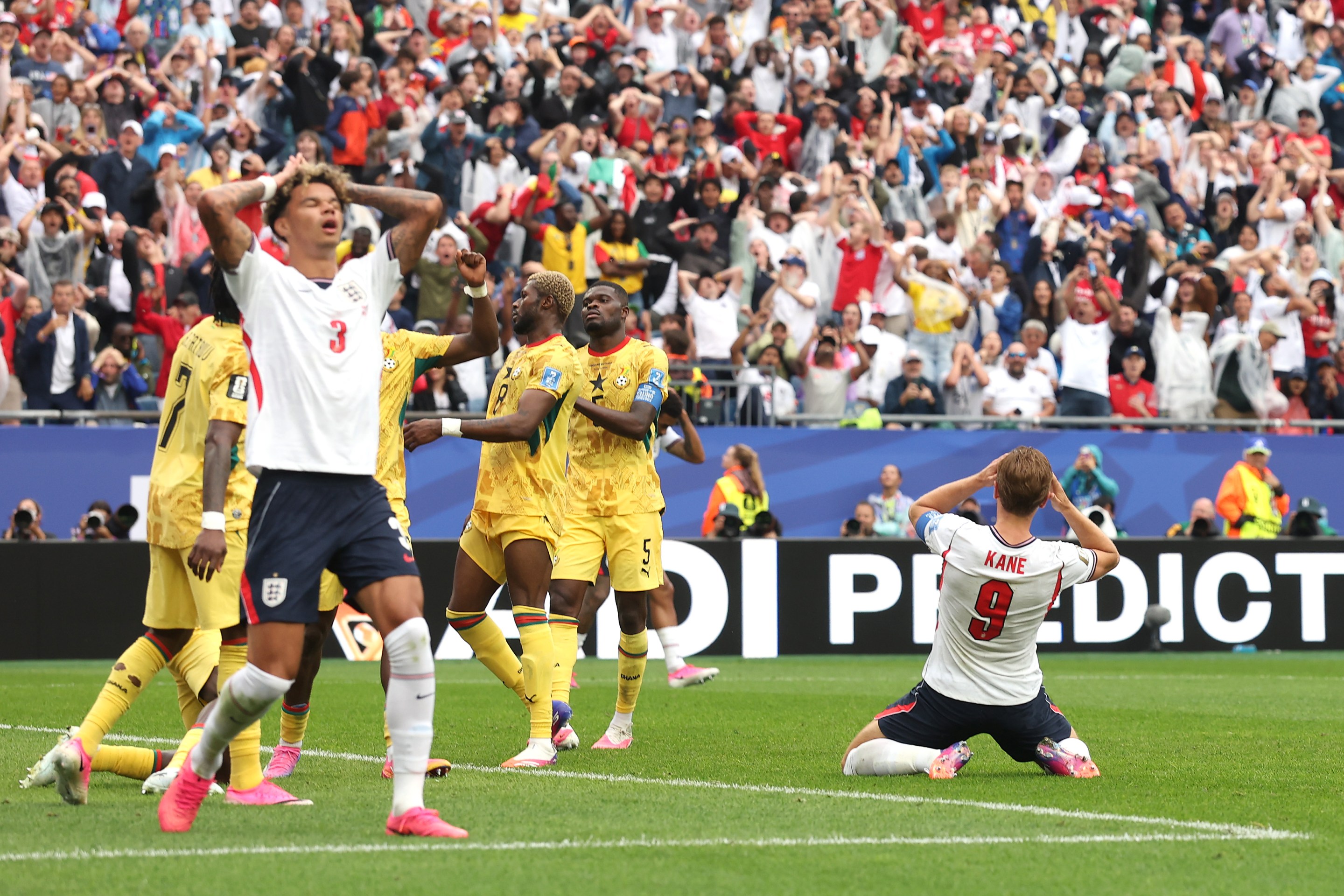
It is easy to miss the Match Momentum graphic the Fox network stamps onto its World Cup broadcasts. The graph pops up only on rare occasion, wedged into the bottom-left corner, less than a third of the height and width of the screen. Often it appears only so briefly that the commentators never make a point to draw attention to it, or to try to explain what is happening within it. If advanced statistics have historically been created 1) to produce better metrics for match analysis and 2) for advertising, the Match Momentum graphic poses a new, intriguing third option: an advanced statistic simply for the sake of it.
The "what" of Match Momentum is easier to grasp than the "why." It is a statistic provided by Stats Perform/Opta, a sports data and AI (presumably in the machine-learning sense) company, that provided a full explainer. The graphs can also be found on the stats pages of the BBC and FlashScore, presumably using Opta's model, though the BBC and the Fox broadcast, diverging from modern broadcast conventions, do not come along with a helpful plug for their source.
In summary, Match Momentum takes the highest-danger chance from each team up until that point—presumably due to soccer's low scoring nature this is quantified by possession value, another one of Opta's advanced statistics, rather than shot volume—and then weights it for recency, before taking the difference between each team to determine momentum, or, rather, Momentum, unit undefined. The end result is a graph with time on the x-axis and no scale on the y-axis, a less descriptive version of HockeyViz's Shot Pressure graphs, which demonstrate the contours of a game by tracking shot volume. It's how you wind up with a nebulous explainer, courtesy of the BBC, that looks like this:
While statistics like Expected Goals (xG) attempt to quantify some qualities usually relegated to the eye test, Match Momentum lacks the tools for such precision. At best it can only reconstruct in graph form what it felt like to watch the match. Big events are good times for gimmicks without too much practical usage. The most amusing tend toward 3D recreations of games or matches, like the BBC's Sport 3D feature, which is reminiscent of Major League Baseball's Gameday 3D or the Australian Open's Virtual Slam: a way of watching the game without watching the game, presumably for the specific niche of true sickos without access to a stream or television who still want to watch, even in the form of some nondescript figures wiggling about.
Like those various 3D simulations, Match Momentum can be viewed as an emotional, rather than quantitative, summary for spectators who could not watch the match live, a way to reverse-engineer watching the game without actually watching. That would provide some utility, and the BBC's introductory article explicitly treats as Match Momentum's target audience people who could otherwise only see the match's final score.
For the spectator currently watching the World Cup matches—say, watching the broadcast and seeing the visuals displayed live—Match Momentum cannot convey any information beyond what the spectator has already seen. Perhaps in soccer, in which a dearth of scoring events can obfuscate the quality of the action on the field, having confirmation of the eye test is a more difficult enterprise than in other sports. Shot volume works as a good shorthand in hockey; not necessarily so much in soccer. In that way, having proof that what you felt was what actually happened can be valuable. See, for example, the following fan implementation to analyze the effect of hydration breaks; as a wise man once said, soccer is all about momentum.
So that is one explanation to the why. As a retrospective stat, Match Momentum can confirm the eye test and provide some numerical justification for something people have always felt while watching. The flip side is just that: Like the most useless advanced statistics, Match Momentum is redundant, recreating a process that the human mind does perfectly well on its own. So why invent it?
Generally, the answer to this question is advertisement. Broadcasts display advanced statistics for the same reason they talk about a Toyota Rav4th Inning. But Match Momentum is conspicuously absent the visible sponsorship that these graphics usually come with. Where is Amazon Web Services? Where is Google Cloud? Where is FanDuel? Perhaps a better question is not why someone felt the imperative to invent Match Momentum, but what they are trying to advertise.
Advanced statistics were products of artificial intelligence long before marketing sleight of hand turned "AI" into a homogenized, purposefully vague term implying technological black boxes whose functions and flaws the consumer needn't know or understand. The marketing of AI insists not upon its utility but rather on its cultural ubiquity: Everyone is already using "it," "it" exists, "it" is already here. If there is a hallmark of modern AI advertising, it is its definitional imprecision; it can be frustrating, then, to see an article on AI "sneaking" into the World Cup fall into the same trap, by conflating teams' access to AI models (i.e. advanced stats, something they have always had access to) with wearing Google Gemini across their chests.
Advanced statistics are at their best when they are motivated by curiosity about a sport and a desire to better understand some part of it, and are then distributed for public use. Opta has publicly available statistics, but as a company, its primary interest would be to provide data to an entire slew of customers, including broadcasters, sports leagues, and sportsbooks. In that view, useful or not, Match Momentum is the advertisement; it doesn't need much purpose other than existing.
This is not to handwave away all of Opta's works or insights, or to even read it as an intentionally insidious action. But as the production of sports analysis is being swallowed into the same industry and lexicon as modern AI companies, the resultant statistics mirror that same form. It is at its most obvious when the end product is telling you something you can see with your own human eyes, or consider with your own human brain. There is no need to care overly much about utility or insights or purpose; that Match Momentum exists in the first place justifies its need to exist.