

In the grim darkness of the far future, 40,000 years from now, an immortal corpse-Emperor sits atop his Golden Throne on Earth, watching over the trillions upon trillions of human beings scattered across the galaxy. For ten thousand years, the Emperor hasn’t spoken or moved from that Golden Throne, and those masses of humans are ruled by the Imperium of Man in the Emperor’s name. Their often short existences are spent within the Imperium’s authoritarian systems that value ignorance over knowledge and stasis over change. Human life is cheap, and the Imperium spends it freely on neverending wars with a variety of aliens and the forces of Chaos, which inhabit an alternate dimension known as the Warp.
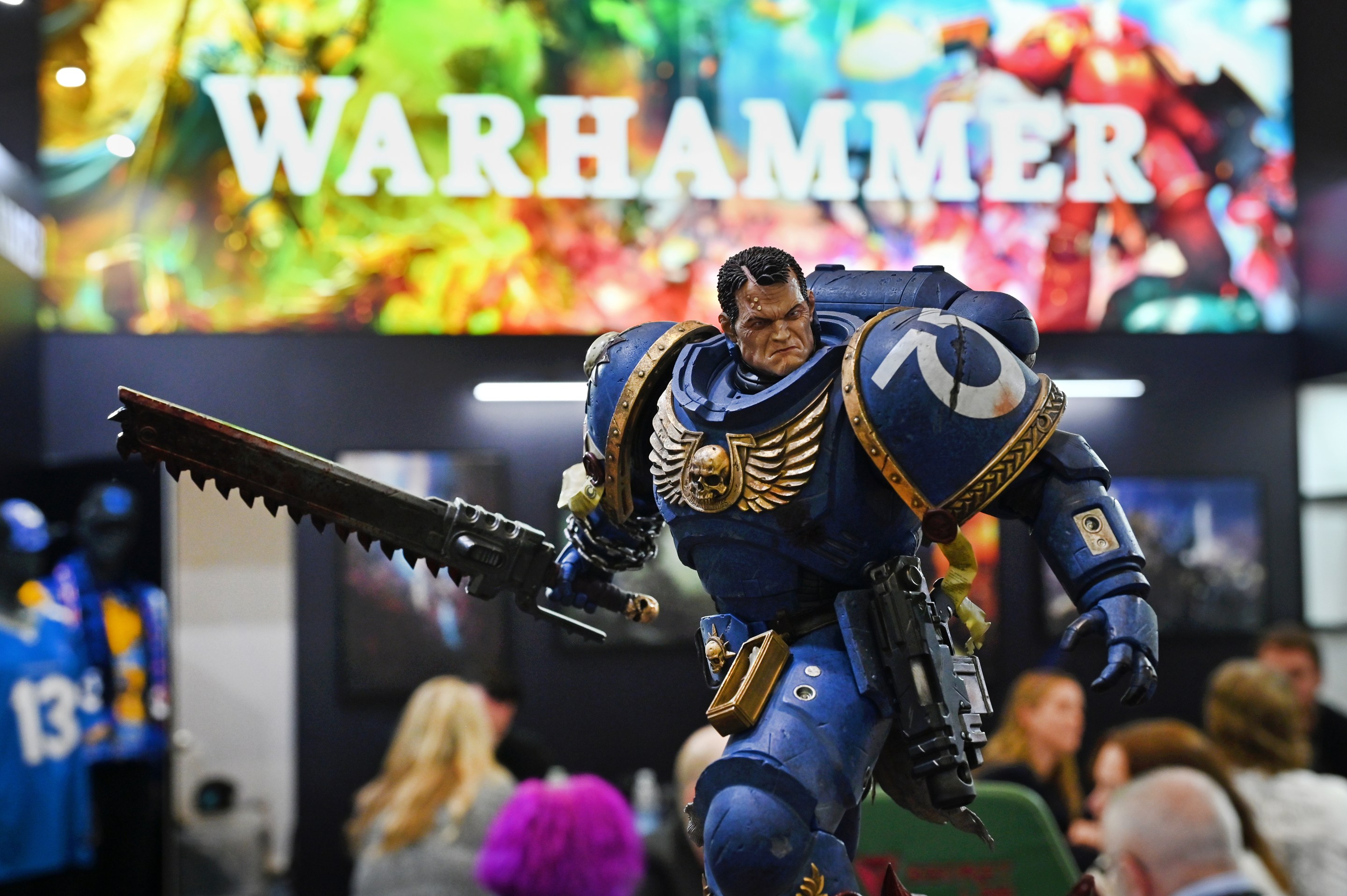
Earth—Terra—is a hellscape, a city-planet packed with so many people that an accurate count is impossible, its oceans long since boiled away and its original surface buried beneath millennia of haphazard construction. The Imperium is a creaking, ramshackle realm where cruelty, hierarchy, and suppression are facts of life. Its greatest warriors, the Space Marines, are genetically altered monstrosities, created through processes that kill more than they successfully manufacture. Technology is controlled by closed-minded zealots who fear nothing more than innovation. Of course, the Imperium has an Inquisition, which roots out heresy of all kinds, and an official church (the Ecclesiarchy) dedicated to unquestioning worship of the Emperor.
The aliens—xenos, in the parlance of the universe—are no better. The Orks live only for fighting; the elf-like Aeldari care little for lesser beings; their dark elf Drukharii cousins subsist on torture and pain; the Necrons are living-metal horrors who traded mortal life for soulless immortality tens of millions of years ago; the insectoid Tyranids, controlled by a hive mind, exist solely to consume every bit of biomass in their path; and even the T’au, the newest addition to the galaxy, who value the Greater Good above all, aren’t to be trusted.
And then there’s Chaos with its four great gods of the Warp, each representing some aspect of our darkest natures: Khorne, for whom bloodletting is the only sacred act; Tzeentch, who embodies the omnipresent forces of change; Slaanesh, the androgynous deity of pleasure and sensation; and Nurgle, lord of plague and decay, who asks his worshippers to embrace inevitable entropy and the end of all things.
If that sounds bleak, it should. The tagline of Warhammer 40K is where the genre known as “grimdark” gets its name. Definitions vary, but grimdark generally describes work that contains immense amounts of blood and gore, characters driven not by virtue but by the will to survive, and a general sense of the volume being turned up to 11. Massive battles involving millions of combatants, evil sorcerers whose power comes from the sacrifice of thousands of living captives, superhuman demigods fighting demons: It’s all there.
Despite all that, or perhaps because of it, Warhammer 40K is one of the fastest-growing multimedia franchises on the planet. Its parent company Games Workshop is valued at more than £5 billion, posted record revenue and profits in its last fiscal year, is one of the best-performing stocks in the United Kingdom in this millennium, and generated more revenue than the UK’s entire fishing industry at the latter’s recent nadir. What began four decades ago as a line of paintable models for a miniature wargame with a little bit of lore scattered across its rulebooks has become a sprawling universe with dozens of video games, hundreds of novels, animated series, and—if Amazon can find a way to not screw it up—an upcoming live-action series featuring long-time fan Henry Cavill. Despite its cartoonish visual language and lack of subtlety, many of these entries in the Warhammer 40K are pretty dang good.
More importantly, they’re fun.
Ten years ago, it seemed like multimedia franchises were the future of entertainment. DC was finding its footing with its churning output of series on the CW Network and a steady stream of movies of varying quality. Assassin’s Creed got a movie; so did Warcraft. Nobody bought in harder than Disney. The addition of Star Wars to its Marvel properties promised an endless round of movies, TV series, novels, comic tie-ins, video games, and, not least, toys. Franchises were minting money, raising shareholder expectations, and serving a vast and growing fanbase.
Now, that model appears to be in serious decline. Except for a couple of Disney+ series that made few waves in the broader world, the Marvel Cinematic Universe seems to be rudderless, coasting forward on the momentum of assumed future earnings. The MCU is giving us homework before the release of Avengers: Doomsday, for crying out loud! Maybe James Gunn will rescue DC: His Suicide Squad and its Peacemaker spinoff were surprisingly fun, thanks mostly to John Cena. The extraordinary Andor aside, Star Wars has succeeded in killing almost everything that threatened to be interesting about its fictional setting. The Mandalorian and Grogu felt like it was slapped together from spare parts, a soulless, poorly constructed morass of action scenes between Pedro Pascal’s phoned-in dialogue. Now they’re talking about making another Skywalker saga. Who, exactly, is asking for that?
Enter Warhammer 40K. While I don’t pretend to be an expert on Games Workshop’s economic value, its future plans, or the depths of the fandom, there are a few obvious points that help to explain why this franchise is booming at a time when others are struggling with oversaturation, underwhelming products, and a general sense that their time has come and gone.
The people leading the charge creatively for the Warhammer 40K universe, particularly for the hundreds of novels (with more coming all the time), are shockingly good at what they do: They know what business they’re in, what the strengths and weaknesses of the franchise are, and what they’re trying to accomplish. While there are big, overarching epic stories that provide the basic grounding for the setting, individual authors are granted substantial freedom to tell a wide variety of tales, featuring a dizzyingly diverse array of characters. In some entries, heroic Space Marines battle against the encroaching forces of Chaos with the fate of the galaxy on the line; in others, a detective on a backwater world struggles to run down a vicious criminal who may or may not be a heretic. Ork warlords seek out bigger and better fights and dour inquisitors follow the trail of sorcerous cultists and plotters across the stars. When everything in the galaxy is big and loud and maybe just a bit too much, that necessitates smaller, more intimate stories that try to grapple with human-scale themes.
Not all of these novels are great, but few are downright bad, and the top-tier entries are as good as any genre fiction being published today. Dan Abnett has been the workhorse of Warhammer 40K fiction for more than 25 years, creating the terminology and basic concepts upon which the setting has been built: If you’re familiar with the old Star Wars Expanded Universe, he’s like a more prolific Timothy Zahn. Abnett’s recent novel Hive is a frankly stunning portrait of a single densely populated “hive city” of billions of impoverished inhabitants, tearing itself apart from the inside and too consumed with its own conflicts to even investigate a looming menace approaching from the larger galaxy. Robert Rath’s The Infinite and the Divine is a millennia-spanning tale of two immortal rivals who can’t stand each other, alternating between philosophical musings on the nature of time and madcap hijinks with equally entertaining facility. They’re both great, and not in the restricted sense of “great for genre fiction.”
Everybody knows that the point of the novels, and the animations, and the video games, is to pull consumers into a state of mind where they’ll buy the little resin models that they may or may not ever get around to painting. The models still account for the vast bulk of Games Workshop’s overall revenue, licensing for a much smaller but not insignificant chunk, the novels and other media least of all. They’re not exactly loss-leaders, but something more like long-term investments in creating the consumers who will one day open their wallets to buy wildly expensive bits of plastic. My unpainted stash far outnumbers my completed models, and I’m hardly atypical in that regard. It was the media that made me buy them.
This means that the success of the franchise as a whole doesn’t rest on an individual novel or animation, a simple fact that creates a great deal of space for authors and creators to simply try interesting stuff. Can you write a compelling story from the perspective of an Ork warlord whose internal monologue sounds like a football hooligan with late-stage CTE? In 40K, we can find out: Yes, it does work, and the result is an absurdly fun read. I cannot imagine a world in which the powers-that-be at Disney allow their creators to inscribe that kind of perspective in the Holy Writ of Star Wars canon. If a character from the media becomes popular, Games Workshop can make models for them; conversely, if there’s a popular model, they can give the character to one of their talented stable of authors, and see what they do with it.
There’s a flexibility to the approach that Games Workshop has taken with 40K that seems absolutely foreign to someone coming from Star Wars or Marvel. Almost 20 years ago, Games Workshop released the first in what was intended to be a roughly ten-part series of novels covering an ancient conflict known as the Horus Heresy. When the first entries turned into wildly popular bestsellers, the series expanded to a sprawling 64 books over 18 years and spawned a separate line of miniatures, game supplements, and alternative media that are now among the company’s most popular products. Those 64 books served as an incubator for authors whose work has become foundational to the setting, like Chris Wraight and Aaron Dembski-Bowden, the latter of whom is now the Head of Narrative for Media and Licensing. In other words, they had an idea, ran with it, and in the process found the people who were suited to bringing 40K to new heights.
Stop and consider that for a moment. Instead of starting with the overarching story and shoehorning individual creators into roles for which they weren’t well suited—ahem, Lord and Miller’s Solo—they gave authors relative freedom within a universe that allowed them to play and experiment. The themes are consistent: human fallibility, the lack of anything we might consider a true good guy, the omnipresence of conflict, and the Imperium’s slow-motion decline. What forms those themes take, how they interact with individual characters and stories, is very much up for grabs.
The corollary is that while 40K pays attention to what its fans want and tries to give it to them—after all, that’s where the money is—those creators also aren’t afraid of the fanbase in the way that Star Wars has repeatedly proven to be. The setting is in many ways surprisingly progressive: Female characters are present in positions of power, gender nonconforming individuals pop up with some regularity, and a deep mistrust of arbitrary authority is baked into 40K's DNA. The chuds might bitch and moan, but the setting recently retconned its all-male Custodes (the corpse-Emperor’s demigod bodyguards) into a mixed-gender force, and nobody seems particularly fearful of losing said chuds. If you don’t like female Custodes, read something else, or don’t. We’ll survive.
That attitude seems particularly well-suited to an age of fandom: Make cool stuff and trust that people will find it, and if the fanbase churns, well, that’s what we should expect. Fans come and go. Some asshole making a YouTube video about how 40K has GONE WOKE and HE IS DONE isn’t the end of the world, and it doesn’t necessitate a sudden about-face in the creative direction of the franchise.
That gives both creators and fans freedom to imagine, freedom to explore, and freedom to make. Make your own Space Marine chapter, with your own color scheme and lore. If you prefer, tell the story of the guy picking up after the Space Marines leave the battlefield: In 40K, that perspective is every bit as valid as that of the superhuman warriors said garbageman serves. The galaxy is big enough for all of it, and there will always be room for more.
So if you have any interest in science fiction or science fantasy, you don’t mind some blood and guts, and you’re looking for high-quality escapism, give 40K a try. You might not find what you’re looking for on your first read, but if you sift a bit and ask around, you’ll probably find something that keeps you entertained. It might make you think a little bit about what we owe to the powers that rule us, the nature of belief and devotion, and what it means to be human. More than anything else, however, I can pretty much guarantee that you’ll have a good time.