
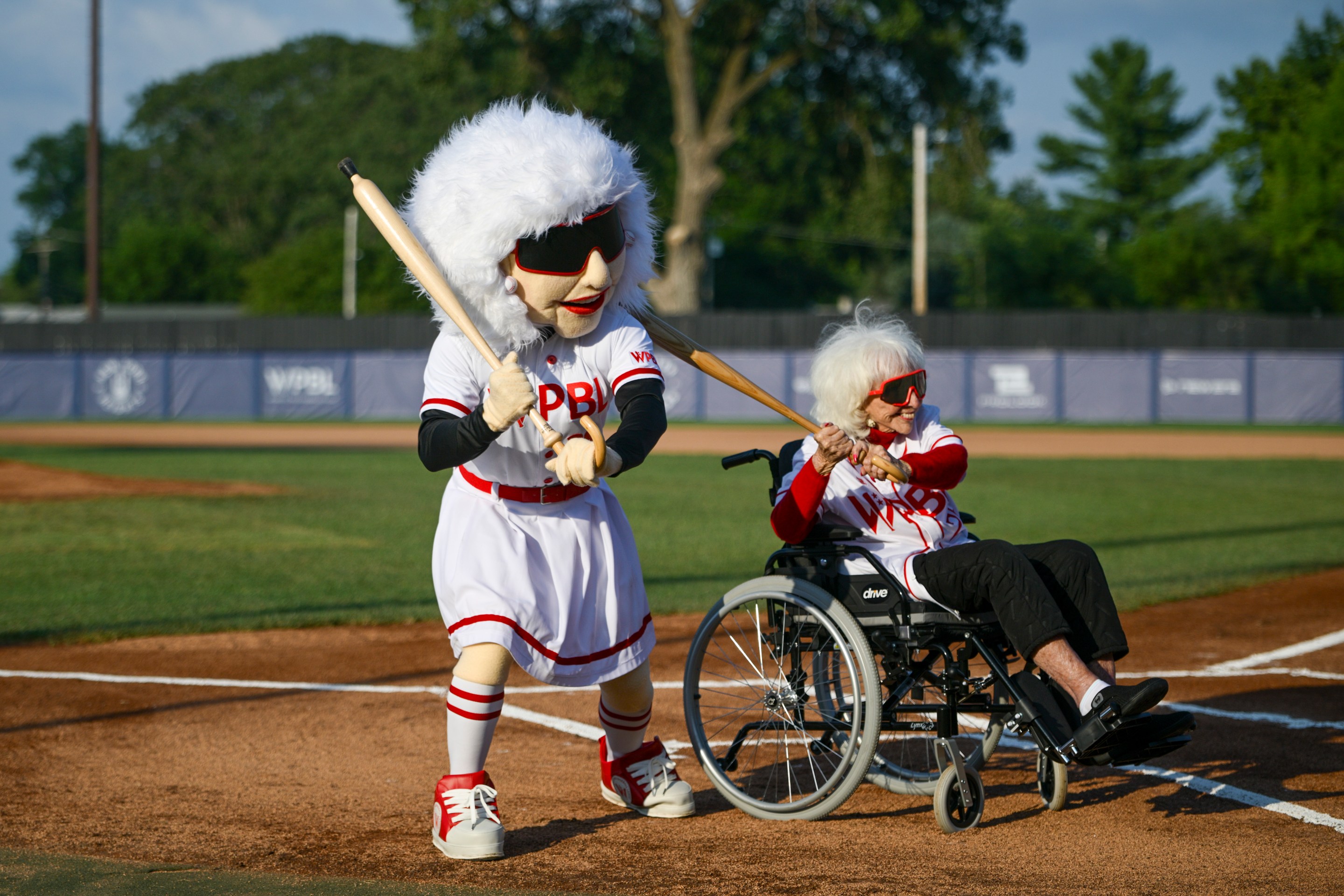
You may think you've experienced joy before, but you had previously never seen a mascot version of a 99-year-old woman with a cane dancing and cartwheeling around a baseball field in Springfield, Ill., which ushered in the inaugural weekend of the first professional women’s baseball league in nearly 30 years. I have never been happier than I was witnessing that moment. Our lives are all downhill from here.
That mascot is modeled after Maybelle Blair, a former pitcher for the All-American Girls Professional Baseball League, honorary chair for the new Women's Pro Baseball League advisory board, and wearer of iconic sunglasses. As was mentioned several times on the broadcasts of the WPBL's first two games, she broke four ribs and still made sure she was in Springfield for the occasion. Because I risk writing 1,000 words about everything I love about Maybelle Blair, I will put it succinctly: She is cool as fuck.
The mascot Blair is not dressed in the human Blair's sensible slacks, nor the WPBL's uniform. Instead, mascot Maybelle wears the skirted uniform of the AAGPBL that many will recognize from A League of Their Own. The AAGPBL was everywhere during the new league's opening weekend. Springfield, the location for all of its games this season, was chosen specifically to reference the historic league. Former players came to watch. Fans wore Rockford Peaches merchandise and shirts that read "There's no crying in baseball." And commentators made reference to the famous "dirt in the skirt" line from the movie when talking about sliding. But the women of the WPBL wear pants, and they don't have to perform a rigid version of femininity. That's a big deal, even now.
From elderly women to young girls, commentators asked fan after fan what it meant to see such a historic moment where women played baseball professionally for the first time in nearly 70 years. (This is actually the first time in nearly 30 years, but the WPBL broadcast and marketing has left the short-lived leagues of the '90s out of their narrative.) While no one else, to my knowledge, made the journey with four broken ribs, fans had come from across the country to see that history be made.
The love for the game and the admiration for the women playing it was beautiful, but by the time I heard a commentator announce that each foul ball into the stands was "an opportunity to catch history," I got the point. Once they started advertising all the historic memorabilia that would be auctioned off after opening weekend, I really got the point.
Eventually, all this talk of history overshadows the chance to make it. We can go on and on about how important this league is, but it also exists on shaky ground, lacking the formal pathways of development that exist for other women's sports. Especially with no minor league, and no women’s college baseball, how can you be so sure that you're creating something transformative for women when you haven’t truly made the pathways for women to get there? Right now, many of the WPBL players either are switching back to baseball after years of softball, or they were playing in exhibition leagues like Banana Ball. Hopefully, this league inspires new methods of development, but this is not a given.
Some of the lack of development was clear in bobbled catches and relatively frequent defensive misplays. Yet for every fielding error, there was a moment like Gabrielle Haas’s diving catch in center field, or Sabrina Robinson falling into a split to catch a throw to first, or Denae Benites’s home run for New York, or even when the Los Angeles combo of Mo’ne Davis and Ashton Lansdell scored the league's first pair of runs on Maggie Foxx's base hit. The WPBL doesn’t need the boost of historic appeal when the play gets exciting. Moreover, the league doesn't need to use the past to differentiate itself, because it offers a different style of play than MLB. There are more two-way players, fewer home runs, and more focus on baserunning.
And if you do want history, the women playing now have already made it. Davis pitched a shutout in the 2014 Little League World Series. Kelsie Whitmore, the No. 1 pick in the draft, was the first woman to start in the Atlantic League (unfortunately, it was for the Staten Island Ferryhawks). Rakyung Kim, pitcher for the New York Heights, was the first woman to hit a home run in the Korean men’s college league. Ayami Sato, pitcher for the Los Angeles Queens, has a curveball with a spin rate of 2,583 rpm, faster than many MLB pitchers. Many more WPBL players were the first women on their high school or college teams.
But as much as I was bothered by the over-the-top references to how historic the new league is, I can't help but extend some forgiveness now that I’m sitting down to write about it. I became a baseball fan because of A League of Their Own. I watch it every year on my birthday, and I know the AAGPBL anthem by heart. Despite how cheesy the opening ceremonies were, how obviously designed to tug at my heartstrings with the platitudes about passing a torch and little girls looking for a place on the field, I still teared up. When the former AAGPBL players took the field, it was like I was 10 again, watching the movie for the very first time. I was once again the little girl who wanted to play baseball but didn't see a place for herself outside of her backyard. I was the girl who had been waiting for this league. But it's here now, so it's time to leave that wait in the past and appreciate the WPBL in its own right.