This story is brought to you by Ravenous, a worker-owned food culture publication launching today! Together, they’re putting the bite back into food journalism with incisive reporting like this story you’re about to read, plus all the cultural criticism, silly blogs, and reporting you can eat—all without the influence of big-money investors or generative AI (yuck). If that sounds delicious to you, please consider a paid subscription. They're offering a special discount only for Defector readers today. Or, if you hate food and just want to support worker-owned media, you can drop a few bucks in their tip jar here.
If I were to ask you to close your eyes and conjure a mental image of a sports bar, perhaps you’d envision a space with tons of televisions on the wall, each playing a different baseball game or soccer match while clumps of dudes yell at each other about those aforementioned sports. Maybe your mind’s eye sees sweaty bottles of beer, neon signs, and dartboards, all soundtracked by dad rock and the low rumble of bar chatter.
For a very long time, this perception would have accurately described 99 percent of the country’s sports bars, filled mostly with grown men who found a safehouse to wear the jerseys of the players they idolize. In some senses, homogeneity was the name of the game: As chains like Hooters and Beef ‘O’ Brady’s proliferated across the country, they sought to cultivate an easily replicable vibe, one that could make any piece of strip-mall real estate feel like a homey, convivial place to catch a game while enjoying a brew or two and a basket of Buffalo wings.
But sports-watching has evolved, and these old-school bars are starting to feel like stodgy relics of an irrelevant lifestyle, especially as alcohol consumption declines across the board and fewer bars have the need for TVs with patrons glued to their iPhones and Androids. More and more fans are choosing to watch the biggest games in sports in the comfort of their own (or their friend’s) home, finding VPNs and other work-arounds while discovering streams to out-of-market games once only available at bars. The problematic rise of third-party food delivery, like DoorDash, provides another reason to stay in. But the sports bar isn’t totally dying, it’s just evolving into two distinct types of establishments that are decidedly different yet no less sports-obsessed: the women’s sports bar and the betting lounge. And though it may seem as if these two distinct types of sports bars—the women’s sports bar and the gambling lounge—exist on totally different planets, they’re products of the exact same social environment.
Let’s first delve into a little history: While (mostly white) men long gathered around a neighborhood bar’s radio to listen to baseball games, most agree that the story of the American sports bar, at least as it exists now, begins in 1979. Former NFL lineman Dennis Harrah opened his bar Legends in Long Beach, Calif., watering hole that pioneered the concept by being the first to offer live satellite feeds of sports games and matches from across the globe. Harrah decked out the dimly lit, wood-walled space with jerseys, boxing gloves owned by Muhammad Ali, and more sports memorabilia, and created a format that was later copied by thousands of sports bar proprietors across the country.
Over the years, sports bars developed a reputation as distinctly male-forward spaces, where “breastaurants,” like Hooters and Twin Peaks, which both grew into national chains with hundreds of locations across the United States, cultivated misogynist atmospheres where locker room chatter wasn’t scrutinized unless you cheered for the wrong team. (In 2025 and 2026, respectively, both chains filed for bankruptcy.) But even beyond those two examples, the traditional sports bar has never been perceived as especially friendly to women—or to women’s sports. Outside of the Olympics or the occasional FIFA Women’s World Cup final, it was exceedingly rare to see women’s sports on any of a sports bar’s many televisions.
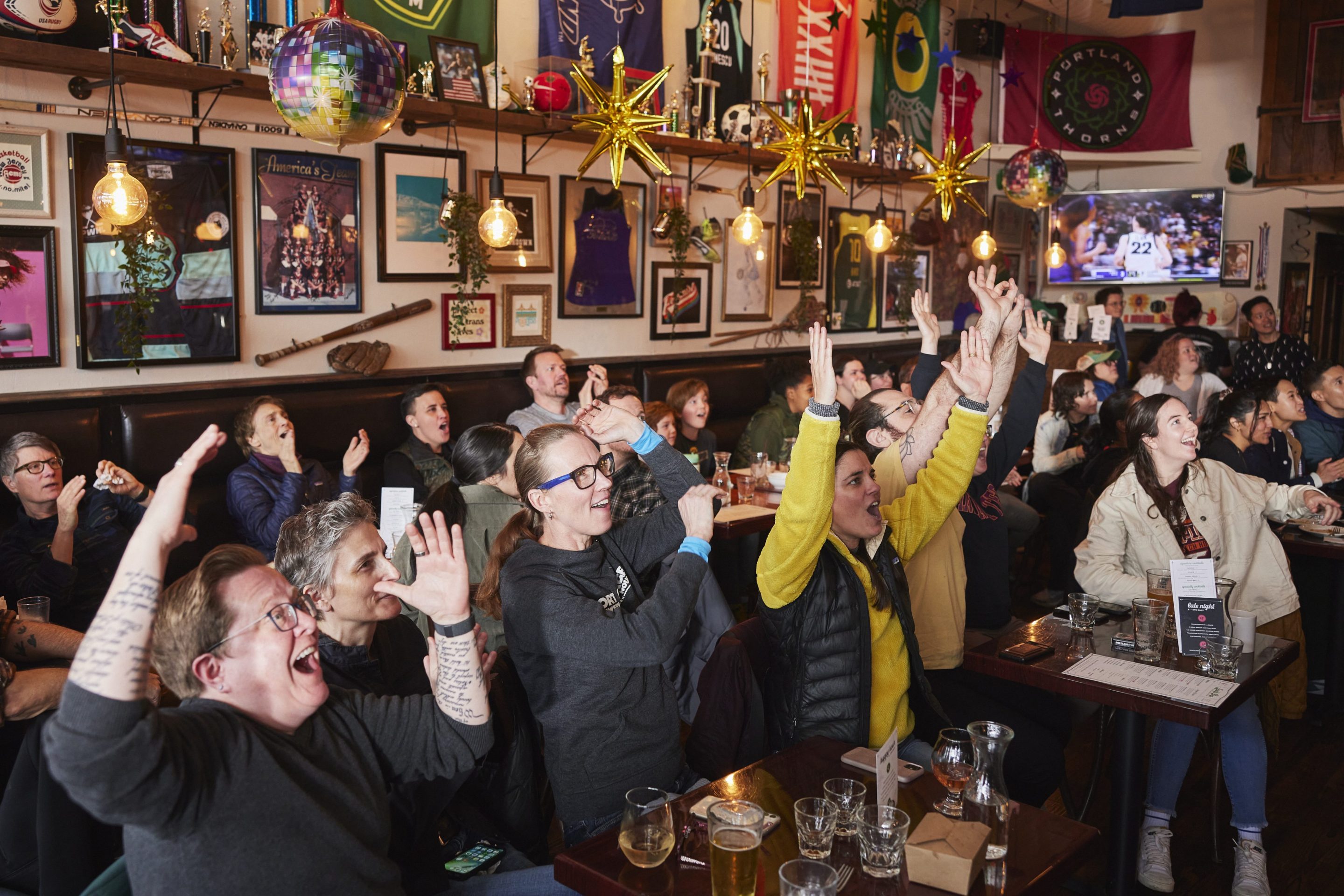
Jenny Nguyen has been trying to change that reality, one NWSL and PWHL game at a time. In 2022, she opened The Sports Bra, a bar and restaurant that would exclusively show women’s sports in her home base of Portland, Ore. It was an immediate hit, due in large part to the ways in which traditional sports bars had flatly ignored wide swaths of sports-watchers—women, queer women, and people of color—who were desperate for a place to go watch sports with their fellow fans.
As vice president of marketing and operations Deborah Pleva notes, there were 90,000 sports bars across the country when The Sports Bra opened, and exactly zero of them were dedicated to women’s sports. The idea that women’s sports fans would flock to their own sports bar was the definition of an unproven concept, and as such, Nguyen struggled at first to find investors.
“Jenny often jokes that because we opened on April 1, if it didn’t work out, we could just say it was an April Fool’s joke,” Pleva says. “But on our first day, we had lines around the block of people waiting to get in. This is such an untapped and overlooked market.”
The timing really couldn’t have been better. Interest in women’s sports has skyrocketed in recent years as increased media coverage of leagues like the WNBA have created a new generation of superstars, including Caitlin Clark and Paige Bueckers. But in 2022, the Bra’s staff still struggled to find enough televised women’s games to show while the doors were opened. According to Pleva, prior to 2022, only about 4 percent of televised sports were played by women. That figure has since risen to 15 percent in just a few years as viewership soars and networks like ESPN and Paramount invest in the broadcast rights necessary to air these games.
Besides actually airing women’s games—with sound—Pleva attributes much of the Bra’s success to its deliberately cultivated atmosphere of inclusivity. The walls are covered in pride flags of all kinds, and banners emblazoned with “Black Lives Matter.” Food offerings include typical bar fare like wings and burgers. But there are non-alcoholic drinks options as well as a kids’ menu, along with plenty of options for vegans and other folks with dietary restrictions. Every bathroom also comes equipped with changing tables to accommodate parents, and all staffers are extensively trained in inclusivity—they’re not afraid to jump in and de-escalate any uncomfortable situations that may arise. Everyone is welcome, except for those who would make anyone else feel unwelcome.
Women’s sports are intrinsically connected to queer fandom, which is why Pleva and the rest of the staff at the Bra are so insistent on making it a welcoming space. In 2014, the WNBA became the first American professional sports league to market directly to the LGBTQ+ community, inspiring a broader culture of inclusion in women’s sports. "We're the pioneers,” said college and pro basketball legend Brittney Griner when the first WNBA Pride campaign launched. “We're showing our league is strong and we're branching out into different communities. We need more LGBT role models.”
“Early adopters at the Bra were definitely members of the LGBT community who were die-hard sports fans, but we’re not a lesbian bar,” Pleva says. “We’re a women’s sports bar, and it just so happens that a lot of lesbians love women’s sports. But they’re not the only ones. There are people of all kinds who appreciate the high level of play and the incredible sense of community that exists around these teams.”
The Sports Bra has been such a hit, in fact, that it’s currently in expansion mode—even in an economic climate that is proving difficult for bars of all kinds. In June 2025, Nguyen announced that she would open four new locations of the Bra across the country, with new outposts in the works in Boston, Indianapolis, St. Louis, and Las Vegas. A fifth location, in Portland, Maine, was announced in 2026, and the company is actively seeking more franchisees who are looking to build their own versions of the Bra.
“Our environment is really special, and we want people to know that if there’s a Bra nearby, there is a place where they can go and be safe and comfortable,” Pleva says. She adds that based on construction timelines that St. Louis will probably open first. And though the city lacks WNBA, NWSL, and PWHL teams, Pleva says that St. Louis, “more than ever, needs a place to come together as a community of fans because they don’t have that stadium. They don’t have a home court.”
The runaway success of The Sports Bra has inspired a mini-boom in bars focused on women’s sports. In 2025, the number of these bars across the country was expected to quadruple, with spots like Phoenix’s Title 9 Sports Grill and the 1972 Women’s Sports Pub in Austin, Texas. “We created a proof of concept,” Pleva says. “That you could build a bar focused exclusively on women’s sports, and people would come.”
In what feels like a parallel universe to the inclusive, queer-friendly environment that The Sports Bra and its contemporaries are building, another major force is shaping the future of the sports bar: gambling. Thanks to the United States Supreme Court’s 2018 ruling in Murphy v. NCAA, which struck down the federal ban on sports betting, the industry has boomed. In 2025, legal sportsbooks like DraftKings, FanDuel, and BetMGM raked in a record $16.9 billion, an 11 percent increase over 2024 revenues.
There has always been, on some level, a link between the neighborhood sports bar and sports gambling, long before these bets were legalized. “Back in the day, if you needed a bookie to take your bets, going into a sports bar and discreetly asking the bartender or patrons was a pretty good place to start,” says Danny Funt, a journalist covering the betting industry and the author of Everybody Loses: The Tumultuous Rise of American Sports Gambling. “I’ve heard so many stories from people who started just like that.”
Now, though, in the era of legal gambling, there’s no need to seek out a bookie who may or may not break your legs if you get in over your head betting on baseball. Instead, there is this slew of companies (many partnering with your favorite sports leagues) looking to take your bets directly from the comfort of your own phone (and offering free money to bet with!). But if you do want to get together and socialize with your fellow bettors while watching the game, DraftKings and its ilk are all too happy to oblige, with a new take on the sports bar that places gambling right at the front and center.
“One of the main draws of gambling is that it can turn any game into a game that you really care about, and are heavily invested in,” Funt says. “If you’re at a sports bar in the middle of the week and there’s a bunch of mid-level college basketball games on, you might not care too much. But if you bet on one of those games, you’re going to be locked in, and watching it is going to be a lot more fun.”
Part of making these gambling lounges comfortable places to bet and watch sports is making them feel much like any other sports bar. Inside the DraftKings Sportsbook at Chicago’s Wrigley Field, Buffalo wings, beer, and pizza from hospitality behemoth Levy are served to the hordes of bettors who show up to watch baseball—and pretty much any other sport you can think of—on the Sportsbook’s enormous television screens. A scrolling ticker underneath the screens supplies a variety of handy sports info and statistics that may or may not entice gamblers—data like on-base plug slugging percentage and injury reports. Bettors can also step up to the plate and place wagers at any point during a game.
Baseball has a complicated history with betting, from the Black Sox scandal to Pete Rose, and that history endures today. In February, two Cleveland Guardians pitchers pleaded not guilty in a pitch-rigging case that involved colluding with bettors through a convoluted series of code words. Even though DraftKings Sportsbook is MLB’s official daily gaming partner and stands on the same parcel as Wrigley, the league has insisted on some distance. The facility’s branding insists that the sportsbook is “at” the Friendly Confines and not “in.” DraftKings has also opened a second location in Connecticut.
Drinking, too, has long gone hand-in-hand with both gambling and watching sports, making the three natural bedfellows. Much like the free drinks given to encourage gamblers at the blackjack table, new research indicates that an increased interest in sports betting may encourage alcohol consumption in bettors, especially young men. This is good news for both sports bars, who make their money by selling alcohol, and sports leagues, who have a vested interest in getting people to watch as many games as they can, whatever their motivations.
As any sports fan can attest, the advent of sports betting has infiltrated every level of sports-watching, and it’s hard to think anything other than that the future of sports is deeply intertwined with the future of gambling, and that includes women’s sports. In November 2025, a new sports betting platform called Rival announced that it would debut in multiple markets in 2026, with an exclusive focus on women’s sports.
“We believe betting is participation,” the company wrote in an Instagram post. “A way to invest in women’s sports. To signal value. To show up with a like-minded community.” It also claims that as many as 40 percent of new sportsbook accounts belong to women, and that it will cater to this growing audience by providing an atmosphere centered around “community, respect and love.” That mission sounds distinctly similar to what The Sports Bra has proven it can offer to women’s sports fans, though it’s unclear exactly how an online betting platform could offer that same feeling of belonging and inclusivity.
And while gathering around to root for a common goal is fandom in its purest form, introducing gambling into the mix has been associated with a wide range of legitimate social ills, from gambling addiction to the increased prevalence of harassment against athletes and coaches from angry bettors. Many experts have serious concerns about the proliferation of gambling in our culture, especially as sports betting catches on with young people, particularly young men. But there is no denying that it currently occupies an outsized place in American culture, and is playing a major role in the future of the American sports bar.
Teams, too, are getting in on the action, and recognizing that sports bars are more than just places to drink and watch the game. Watch any hometown team’s TV feed and announcers won’t be shy in reminding fans about watch parties held at official team bars, complete with promotional giveaways supplied by the team. These lists are particularly valuable to travelers searching for a friendly place to wear their jerseys away from home, or newcomers to a city in search of a new place to meet their fellow fans.
As the traditional sports bar became less interesting to fans, whether because they were drinking less, or didn’t feel welcome, or just felt more comfortable watching the game at home, this new generation of establishments is getting people off their couches by broadening the experience. That shift is happening at the same time as the “loneliness epidemic” looms, in which more and more American adults report feelings of isolation amid the shift to online socialization. This increased isolation can be connected to the disappearance of the third space, or places where people can socialize with their peers in environments outside of their home and their work. Now that we’re all spending so much time at home staring at our phones, we’re desperate for places to connect with others without engaging in the complicated politics of a group chat.
And regardless of what it is that connects us, the excitement of sharing in the thrill of victory or the agony of defeat in a public setting with like-minded people shouldn’t be taken for granted. But it is worth noting that while women’s sports bars are doing it to build community, gambling lounges exist to profit from and exploit those who seek reverie there. In disguising itself as any other sports bar, the gambling lounge is engaging in a little cultural stolen valor.
As this new generation of sports bar re-emerges as a one-stop shop for social interaction in this increasingly fragmented society, the distinction between these two types of watering hole is both crucial, and a reflection of the broader forces at play in our culture. There’s always some folks trying to make the world a better place, and they’re always working in opposition to those who are looking to make a quick buck.