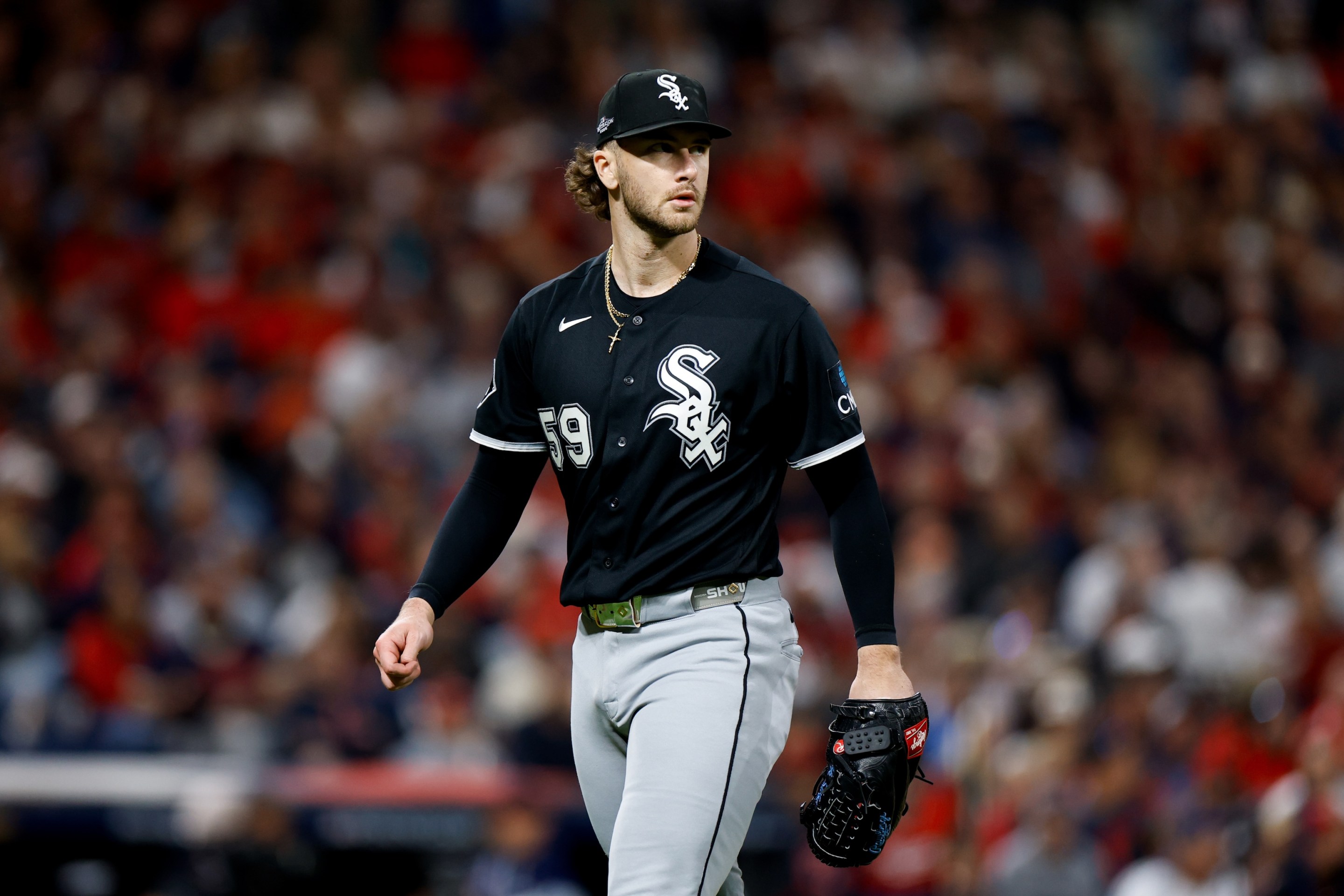
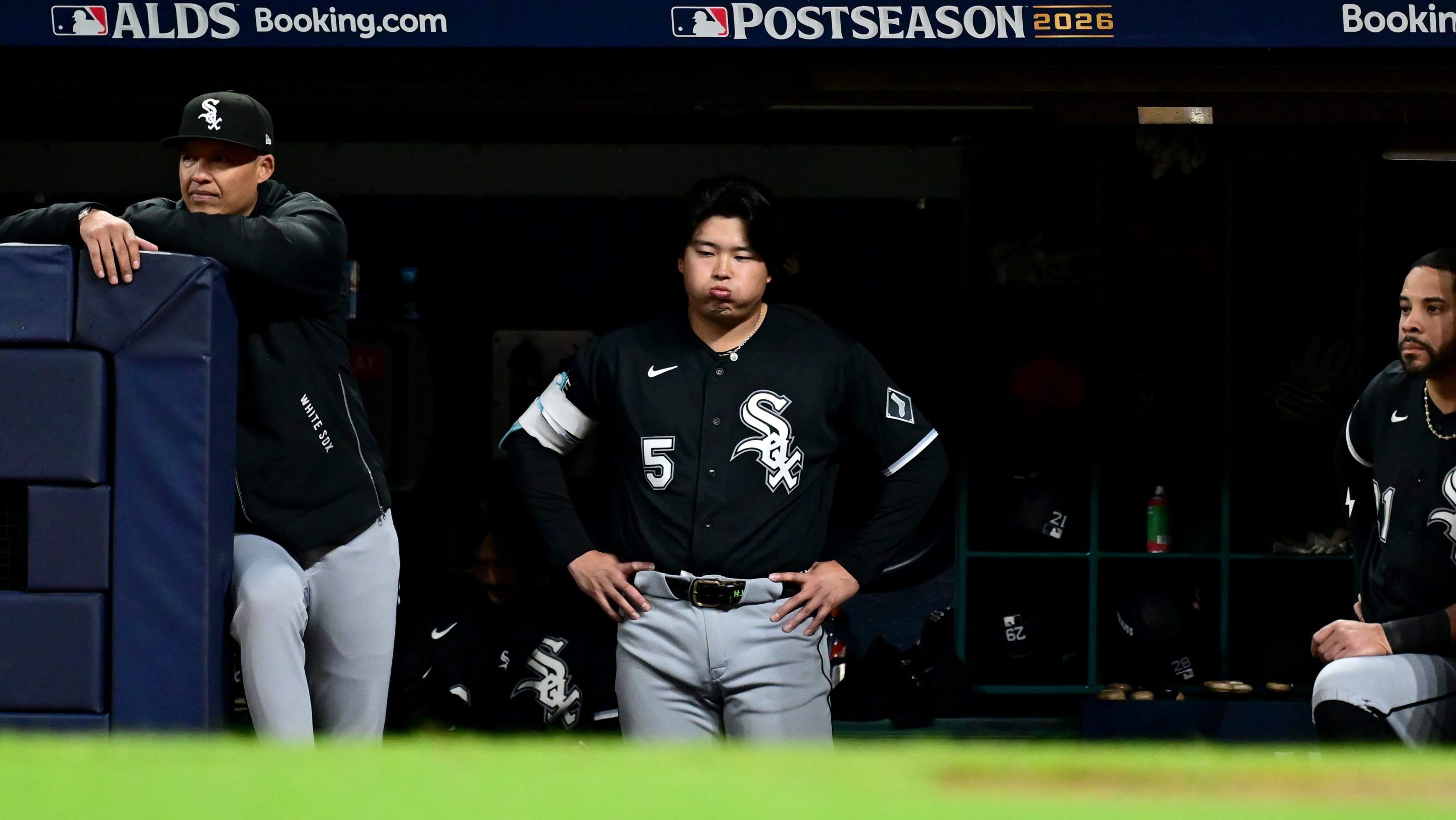
The Chicago White Sox had been given oodles of credit for overcoming the three worst years in their history (throwing the 1919 World Series aside). And when they plowed remorselessly and successfully through their first four postseason games this fall, you could sense that magic was being conjured in the least explicable way. They'd been kissed on the forehead by the same gods that had pummeled them repeatedly. They were going to be a team of destiny, whether or not they liked or understood it.
But these White Sox are made of sterner stuff than that, and the thing that made them charming—their return from bulk failure to national quasi-relevance—was turned on its head Saturday in spectacular style. They had, in short, boiled down their 2023, 2024, and 2025 seasons into one evening's work, an homage to their own abjectness condensed into two hours and 36 minutes. Last night was just a montage of them getting their steps in, almost all of it walking to and from their own dugout.
There's no point in being clever about this either. In the game that they needed to win to advance to the American League Championship Series and make all their suffering worthwhile, they struck out 21 times. Twenty-one. In nine innings. They were allotted 27 outs and did the least they could possibly do with those outs nearly 78 percent of the time. Nobody has ever done that before in a nine-inning game in the 156-year history of the game as counted by those psychos at Baseball Reference—regular season or playoffs. In the game that could have made them the most improbable underdog in the history of dogs, they went out like, well, dogs.
And this wasn't an anomaly caused solely by overpowering Cleveland pitching—oh, yes, we should mention that they were playing the Cleveland Guardians in the deciding game of the 2026 American League Division Series, and that the Guardians won, 2-0, on a fourth-inning home run by José Ramírez. The Guardians were on the field when the White Sox happened, so we suppose some notice must be paid.
But we digress, as frankly we should. Twenty-one strikeouts in a nine-inning postseason game broke the record of 19, last achieved by ... the 2026 White Sox, just three nights earlier in Game 3. And twenty-one strikeouts broke the all-time record of 20 in any nine-inning game last achieved by ... the 2026 White Sox on Opening Day. In other words, you have no right to be surprised by last night. This is who they are. This is what they do.
Yet, you are stupefied nonetheless because you might have watched this game and marveled at the collective inertia on display. Munetaka Murakami, the cleanup hitter, struck out four times. So did five-hitter Andrew Benintendi. Two-hitter Kyle Teel and seven-hitter Chase Meidroth struck out three times each, as did the nine-hole combo of Brenton Doyle and Randal Grichuk. The only Chicagoan not to strike out at all was leadoff hitter Sam Antonacci, and he is likely to be released this week for not understanding the gig.
They had one inning in which they could have made this a game, the sixth, when Colson Montgomery was hit with a pitch, went to second on a two-out line single by Teel, and then third on a walk to Miguel Vargas. All of this was off starter Gavin Williams, who had struck out 12 White Sox two days after closing Game 4, for Christ's sake. So Cleveland manager Stephen Vogt did the only thing he needed to do all night—walk to the mound (rather than the White Sox dugout, as everyone else had been doing) and send for reliever Erik Sabrowski, who described his performance thusly: "I think I threw the plan out the window and said f--- it. I'm going to throw you fastballs." He did. Five of them. The last one was a foul tip into the glove of catcher Patrick Bailey, the last of the three foul balls managed by Murakami as his entire evening's output of contact.
But, as we said, this was not just him but a team-wide pathology, which culminated in one of the cleanest scorecards you will ever keep (h/t Comrade McKinney and her Sit And Score Stupid Initiative, a.k.a SASSI), thus begging the question, "How the hell did they get here in the first place?" Well, their offense over the prior six months was single-mindedly dedicated to the three true outcomes—homer, strikeout, walk—with a bunch of players who largely weren't around for the 323 losses the franchise had absorbed in the prior three years. Those seasons (61-101, 41-121 and 60-101) defined this one more than anything else because people needed a context for this White Sox team, and this was the handiest item in the catalog—that they used to suck persistently, performatively, and preposterously.
And a hundred losses is a thing in baseball, a number that provides its own context. You lose a hundred, and you're going to be bad for awhile because you've been bad for awhile. Of the 176 teams ever to lose that many games, less than 20 had winning seasons the next year, including two folding operations (including you know who), two changing cities, and one changing leagues.
The White Sox did that one better, winning more games than they lost and reaching the postseason a year after those C-note failures. The 2024 Royals did it, the 2020 Marlins did it (albeit in the 60-game COVID season with an expanded playoff format), and the 1890 Louisville Colonels of the American Association did it, back when there was only a World Series of sorts. They played the National League champion Brooklyn Bridegrooms in a hastily assembled series, and the two teams actually managed to split seven games, tying once. They promised to play the tiebreaker the following spring, didn't for reasons only known to your great-great-great grandfather and Queen Victoria, and the Colonels as a concept died eight years later, as must we all.
The point is, the White Sox accomplished something genuinely remarkable in 2026, and that was to stop stinking long enough to have a chance at their fifth honest World Series. Presumably you glass-half-full snivelers will make that your satisfying sendoff for their season while trying to imagine the Cleveland-Tampa Bay ALCS you never thought you'd have, or want.
But for the rest of us, it will be how they went out—blowing a 2-0 series lead (hey, it happens) by somehow striking out in 52 of their final 100 at-bats (which doesn't), a record for sub-futility that will linger through the hard months of non-negotiations and the non-season that awaits us all. And maybe that's how we should consider the White Sox in the end—not as the guy who who made a hundred grand at the casino by 9 p.m. and then gave it all back along with 50 grand more by midnight, but as a metaphor for the upcoming baseball season, where nobody gets an at-bat at all. It's better than folding the franchise, but not by all that much.