

It's unlikely that you spend much time thinking about the New Orleans Pelicans. However, as a New Orleans resident for whom ball is life, I am rather fixated on them. This team is far stranger than you may have previously understood. They suck in a singular way, and I’ve convinced myself to love them for it. No one else is doing it quite like this.
Any attention that was paid to the Pelicans by the broader NBA community last season was a result of one of the strangest trades in NBA history. This, you probably are familiar with: During the 2025 NBA draft, freshly installed Pelicans executives Joe Dumars and Troy Weaver traded an unprotected 2026 first-round pick in order to move up 10 slots and take Derik Queen at No. 13. The Pels could have picked Queen at No. 7, which would have aligned with the organization’s internal valuation of him, but instead they decided to give up an extremely valuable future pick for a smiley, versatile big man who absolutely cannot play defense. The pick they gave up almost became a top-three selection for the Indiana Pacers in a consensus three-player draft in 2026, but thanks to some ping-pong balls, it instead became the eighth pick and remained with the Atlanta Hawks. So who’s laughing now?
The Weaver-Dumars partnership is a particularly thrilling thread of this team’s current construction. Dumars—who last held an operations job for an NBA franchise in 2020, when he performed several jobs for the Sacramento Kings—worked at the NBA’s league office in Secaucus until the Pelicans hired him in 2025. In Detroit, where he last held a GM role, he flamed out spectacularly. Weaver also previously held the GM job in Detroit, and while he and Dumars never worked together, they arrived together in New Orleans as a kind of package deal. As GM of the Pistons from 2020-24, Weaver built rosters that compiled a 74-244 record. On his Hollinger & Duncan podcast, John Hollinger has called Weaver a “subcontractor” in the Pels' GM job, effectively just being the right arm of Dumars.
Anyway, you know about the near-disaster of the Queen trade, but what have these fellas been up to lately? The Pelicans sat out almost the entire 2026 free agency period—save for a few minor roster moves—until they signed Bennedict Mathurin to a two-year, $16 million contract in late August. That timeframe is traditionally reserved for teams scrambling for whatever they can get. The money for Mathurin is fine, notwithstanding that he’s yet another non-shooter on a team that already can’t shoot and has seemed permanently bedeviled by spacing issues. At the end of the day, there is a roster to fill, and the Pelicans needed to sign some players.
Later, the Pelicans handed Saddiq Bey a three-year, $55.5 million extension. Can you guess which former Pistons GM traded for Bey during the 2020 draft, and was also working in the Wizards’ front office when they signed him to a three-year deal while he was recovering from a torn ACL? The contract is a fair figure based on Bey’s performance last season, when the broad-shouldered wing’s 17.7 points per game made him a rare bright spot on a team plagued by offensive underperformers. Bey’s pedigree makes him more of a stellar second-unit guy, not a starter on a team apparently striving for the playoffs. Still, they paid him like one.
The Pels’ new coach, Jamahl Mosley, had his best run in Orlando, where he had enough rim protectors, size, and committed perimeter defenders to briefly turn the Magic into one of the most ferocious teams in the Eastern Conference. He will have none of that here. There may not be a more disastrous defensive pairing in the sport than Queen and Zion Williamson, which means that the Pelicans’ two most dynamic offensive players cannot share the floor. Yves Missi has some potential as a rim protector, Herb Jones plays hard, and Dejounte Murray was a good defender a lifetime ago. The Pelicans have more or less decided to call it at that.
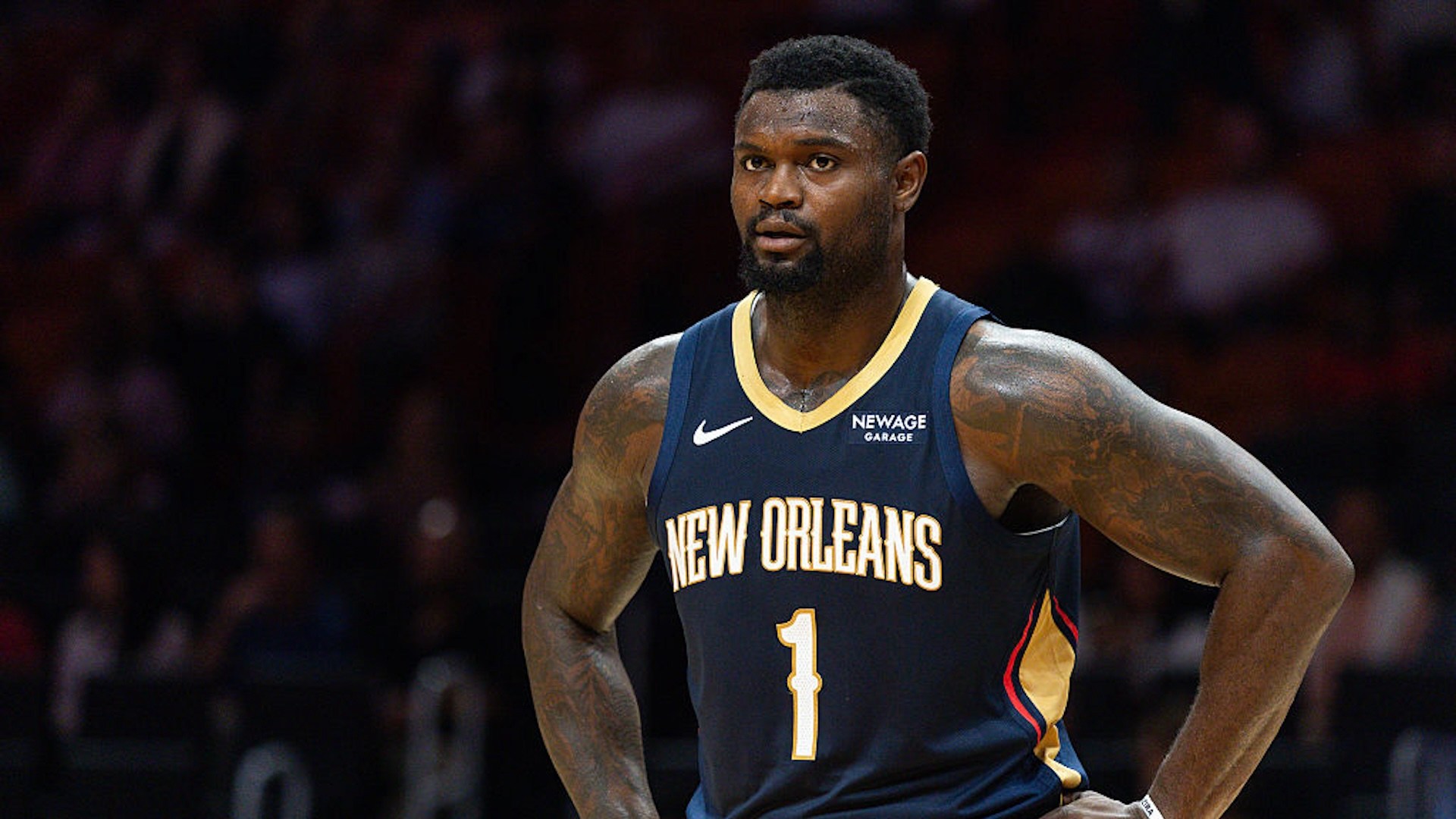
Speaking of Williamson, though, his max rookie extension goes through 2027-28. This is an untradable contract, and we know that because the Pels have tried and failed to do so many times. Williamson seems to have worked himself into shape, but that’s a storyline that seems to repeat every October at the Blender, only to be squandered by injuries or conditioning setbacks. Even at his best, the once-revered prospect is a limited weapon who thrives at one thing: lumbering downhill with his left hand, a weapon defenses can eliminate late in games when stars of Williamson’s caliber are rightly expected to take over.
Let’s see, what else? Oh, right: The blow to the Pels’ cap from Jordan Poole’s contract is $34 million this year. The shoot-everything-he-touches guard averaged about 23 minutes per game at 33 percent three-point shooting last year with New Orleans, showing streaky offensive brilliance punctuated by some truly dreadful shot selection. He loves cats, boosting the team’s off-court likability.
The Pels traded away Dyson Daniels in 2024; he went on to make the 2025 NBA All-Defensive first team in Atlanta. He made the All-Defensive second team in 2026. “That organization is cursed,” Daniels told NBC Sports shortly after the trade. “Every year there’s something new. I’m happy I’m not there anymore.”
Our Pelicans community could spiral out about this stuff all day. Did you know a recent Pelicans lottery selection, Jordan Hawkins, was waived by the Grizzlies before signing a two-way contract with the Bulls? Also, did you listen to Nate Duncan’s most recent podcast, where our most intrepid Pelicans reporter, Shamit Dua, said that the Weaver-Dumars partnership is “worse than what the national conversation has picked up on”?
Ever since Dumars took over, and fired everyone while installing his son Jordan in an influential, nebulous role, the Pelicans have projected that all of this is business as usual. This has not only created an enormous gulf between “what winning teams have done” and "what the Pelicans do," but has added an odd new dimension to what should be a familiar story about a basketball team sucking. It’s not just that the Pelicans are managed poorly; they are managed poorly with purpose and confidence.
Modern NBA teams are built around the pillar of three-point shooting and the spacing it creates. To see a team resist that approach, to an extent that feels nearly intentional, is truly fascinating. It’s remarkable to see an organization, in the optimization era, go against the largely agreed-upon set of best practices. The Pelicans in recent years have built a path to success so narrow that it’ll take something seismic to succeed—maybe the elimination of the three-pointer.
Looking at their player roster is like looking into a kaleidoscope: You see what you want to see, and every self-identifying Pelicans fan is trying to see something positive. Surely, when this article is published, everyone I go to games with will find this assessment blasphemous … until the games start.
Here’s the thing about Pelicans culture: The fanbase is willing, despite what the opening night resale market (woof!) might tell you. We live in one of the NBA’s smallest markets, but I have seen the building get packed for games of consequence, or even for festive local nights, like Halloween. We don’t have a baseball team (RIP Zephyrs), and we don’t have a soccer team in the top leagues. The vibes on Pelicans game nights can be very high, and the ticket prices can be very low. It’s not hard to imagine a version of the Pelicans that is pluckier, feistier, and much more well-managed than what we currently have. Such a team might be able to take advantage of the accessibility and pageantry that a provincial market like this one offers. Instead the team gets treated like the Benson family side-business, running under the umbrella of the New Orleans Saints. They even share a medical staff.
In the relocation/expansion era, the Pelicans aren’t going anywhere. They’re entrenched and deeply tied to the Saints operation, which obviously won’t be moving anytime soon. That means the team just kind of … exists, in an NBA where every team is operating under a more defined direction. Teams have trajectories, whether it’s making slow progress or ascending to the tier of contenders. The Pelicans, it would seem, simply aren’t interested in moving like that. They exist instead in an uncanny space: part depressing, part arresting, all confounding. The Pelicans are a cosmic outlier, playing along to an imperceptible rhythm. And, in the interest of getting through another season watching them, maybe there is something special and singular about that. I have to believe this. Flock up.