
Replay reviews suck.
Video replay once held so much promise in team sports. We would never have to watch another perfect game get ruined, never have to experience the agony of a blown call ending our team’s season.
Instead, we’ve mostly gotten tedious, largely illogical uses of replay. Goals are routinely called back in the NHL because a few inches of an attacking player’s skate crossed the blue line in an offside position, even if it happened a full minute before the puck went in the net; the use of VAR in the Premier League has been so disastrous that the phrase “well done boys, good process” resurfaces as a grim joke every time the replay officials make a mess of something; replay has somehow made the definition of a catch in football harder to agree on.
The NBA has been plagued by its share of these issues. You can hear a collective groan from the crowd anytime an NBA ref crew heads to the monitor. Reviews take way too long, and still haven’t been able to prevent high-profile, game-altering blown calls.
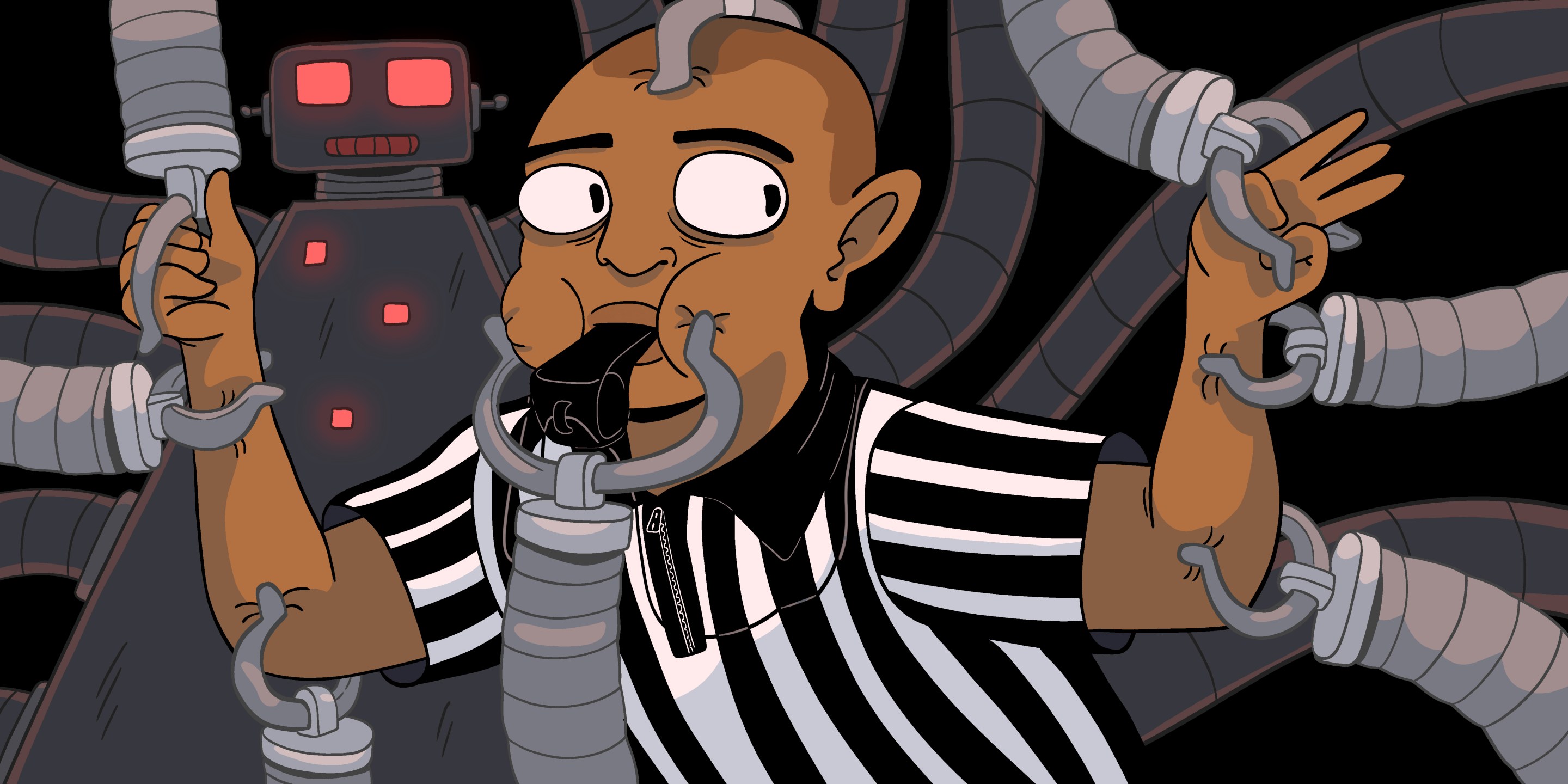
Quietly, though, and showcased by MLB’s instant success with its new ABS challenge system, technology has improved to the point where the original promise of replay in sports feels alive again—even in a more dynamic and free-flowing sport like basketball. NBA commissioner Adam Silver has made grand proclamations about the league’s growing suite of automated officiating tools, which he says will soon replace human refs entirely for certain objective call types.
Can the tech wizards working in the league office back up the big game their boss is talking? Perhaps more importantly, are refs themselves cool with robots doing their jobs?
Automation is already part of NBA officiating, albeit in a limited way.
The league debuted a goaltending and basket interference automation tool in its Replay Center at the start of the 2025-26 season, with human and machine working together. The ref assigned to that game in the replay center in Secaucus, N.J. uses video to identify the frame when a player touched the ball, then the NBA’s program determines the state of the ball at that moment using tracking data: Was it on an upward or downward trajectory? Had it hit the backboard first? Was it inside the basket cylinder when it was touched?
Tech is also helping with two- and three-point shot detection, one of the most common in-game tasks a replay center official is charged with. Refs in Secaucus review any made shot where even slight doubt exists about whether the shooter’s feet were behind the three-point line; virtually every corner three is reviewed this way because crowds often block the shooter’s feet on standard broadcast camera angles (these reviews are often done while play is still running). Until this year, refs used basic camera feeds for these reviews.
This year, though, the NBA has introduced what Tom Ryan, senior VP of basketball strategy, calls a “3D mesh” program to lend a tech-infused hand. It combines inputs from all the tracking cameras in each arena to create a three-dimensional rendering of the shooter’s foot and how it interacts with the floor, which refs in Secaucus can use as an additional “replay angle” of sorts for especially tight or obstructed calls (and which is also being pushed out to fans via broadcast graphics).
The system has already been used for dozens of close calls this year, per a league spokesperson, and Replay Center boss Kane Fitzgerald says the tool will only improve when additional high frame-rate camera feeds from specialized vantage points are incorporated over the next few weeks.
“We think we'll just continually get better at those and have less ‘call stands because it's not clear or conclusive,’ and more accurate decisions,” Fitzgerald tells me.
These existing automations are limited in scope and visibility. The goaltending/basket interference tool was used for just over 80 reviews last year, per the league spokesperson—not a huge number in a 1,230-game regular season plus playoffs. But Ryan says more cutting edge tech will soon be layered in for more frequent and visible uses.
The NBA even has its own testing lab within the Maverik Center in Salt Lake City, which doubles as the home of Utah Jazz G-League affiliate Salt Lake City Stars. Ryan says the league has demoed a huge range of tech, both during G-League games and other dedicated testing events: Optical tracking, LiDAR, infrared cameras, inertial movement sensors (IMUs) on the basket, and more. They often use this facility to perform “ground truth” tests to confirm a given application’s accuracy, placing cameras along the floor or in other locations that would never be accessible during live NBA games to ensure that the programs’ outputs reflect what’s actually happening.
The “connected ball” is perhaps the most interesting piece they’ve tested, both in the SLC facility and at other events like NBA Summer League. Optical tracking systems do fine with the ball’s flight, but can struggle with individual touches—vital info when making, say, an out-of-bounds call. A sensor-infused ball helps fill those gaps.
Ryan says the league did its most extensive blind test of a connected ball this past NBA preseason, deploying it in select games without telling any of the participants when it would or wouldn’t be used. They also interviewed over 100 players about their experience with the ball.
“We found no evidence that anyone can detect the connected basketballs,” Ryan says. “No impact on performance.”
Ryan says the balls will now be tested in every G-League game for the 2026-27 season, then likely again at 2027 Summer League, and could be used in real NBA games as soon as 2027 or 2028.
Tools like those set the table for the league’s next big goal: Using automation not just for challenges or score changes, but for active in-game adjudication of “black and white” calls like out-of-bounds, goaltending, or basket interference.
Fitzgerald says it currently takes replay center officials an average of 40 seconds for a definitive out-of-bounds decision. That’s far too long to stop a game and change a call on the fly.
“You need to make sure you’re looking at the play from two to three angles because there’s a little bit of depth perception, and it can be an illusion at times when you think the finger’s on the ball,” Fitzgerald says.
But that delay could drop precipitously in a future with a connected ball and improved machine learning programs. While they certainly aren’t there yet, Ryan says an ultimate goal is a latency of around half a second.
“Your whole stack needs to run and spit out an alert in-arena that says, ‘Stop the game, that was actually a goaltend,’” Ryan says. “Or, ‘Stop the game, the ball just touched the line.’”
Achieving those kinds of immediate alerts would also require sea changes in how refs communicate with the replay center. The current system relies on a dated mechanism where the refs walk to the scorer’s table, put on headphones, and watch replays on a monitor. (To the league’s credit, audio of the back-and-forth between refs at the scorer’s table and officials in Secaucus have begun showing up on certain broadcasts this year, similar to college football.)
The NBA has tested both headsets and wrist wearables on individual refs to modernize things here, plus a combination headset/wearable option.
Zach Zarba, a top NBA ref currently in his 24th season, tells me the wrist wearables—which were demoed during many 2026 preseason games—were generally well received by the officiating staff. Refs could receive both haptic and text notifications from the Replay Center for immediately identifiable error correction, triggering them to initiate a review. Fitzgerald says feedback was less positive on headset options, which caused distraction issues and inability to hear players or coaches on the floor. I’ve heard the same from referees in private conversations.
“[We’re] trying to get to a sweet spot where we can increase the accuracy, not ruin the game flow, but also not negatively impact the referee’s concentration on the floor,” Zarba says.
Silver and the NBA have stated even more aggressive ambitions: Before long, they want to use this combination of automation and improved communication to entirely remove certain calls from on-court officials’ plates.
"Those calls will be done by an AI-automated system with cameras lined around the court, and it'll take all of those so-called objective calls out of the hands of the referees,” Silver said during a March, 2026 appearance on the Pat McAfee Show. “It'll be instantaneous, it'll be automatic. Just play on."
Just one question, commissioner: Did you ask the refs what they think about that?
Among NBA referees I spoke to for this story, both on and off the record, there’s universal support for using improved tech to fix correctable errors, especially those that could swing game outcomes. If the robots truly prove capable of quickly reversing missed out-of-bounds or goaltending calls without interrupting the flow of the game, officials want to see it used.
“I think if the technology gets to the point where it's more accurate than a human, then we should use it,” Fitzgerald says. “The whole goal of the Replay Center is to get it right.”
Zarba and other officials I spoke to privately generally agree.
When the conversation turns to those calls originating from the machines, though, it gets thornier. Ryan has echoed Silver’s desire to totally remove these black and white calls from on-court officials.
“How do you take those moments away from the refs [and] allow them to focus on the things that humans are much better at?” Ryan says. “Every time this comes up, former referees that are on our staff [say], ‘I wish I would have had this so I didn’t have to focus on these parts of the game.’”
Current officials don’t seem quite so gung-ho about the idea.
Zarba raises the issue of potential impact on game flow if automated programs begin making calls themselves. Both he and Fitzgerald also flag inevitable tech glitch incidents—what if one happens during a vital moment of a playoff game, and no human ref was judging the call themselves?
“One of the tenets of our replay now is that you have to have a call on the floor as a failsafe in case of the rare occasion that the technology falters and doesn't work, that you have an existing call on the floor,” Zarba says. “A major part of all of our advanced replay stuff now starts with the call on the floor, and then whether there is clear and conclusive evidence to overturn that call. So when you talk about goaltending, when you talk about out-of-bounds, the idea that a referee would just ignore that and go about other things is difficult to imagine.”
An on-court representative speaking on behalf of the National Basketball Referees Union (NBRA) was more blunt:
The value of any new technology must be analyzed under the lens of its near and long-term impact on the officials' cognitive connection to the game. Young lawyers who have relied on AI to write their briefs find that they are tongue-tied when they appear in front of a judge. Journalists who have allowed a program to write their stories find that they cannot properly articulate questions to future interviewees.
We have no issue with challenge-related systems that allow for the review of important calls. However, any system that displaces officials from a spectrum of original call-making, thereby rendering a referee's cognitive connection to game flow sporadic, will have a deleterious impact on the sport.
This doesn’t read as an existential battle between humans and robots. No one has remotely suggested decreasing the refereeing workforce. Refs support changes that help them get calls right more often. Both Zarba and the NBRA representative emphasized the strong working relationship between the league and union, and no one expects this to become an overly contentious issue.
It’s clear, though, that the league’s brass and its officiating staff don’t quite see eye-to-eye on robots eventually making calls during NBA games.
“As the game becomes less human in some areas, we just always want to be cognizant and consider all the effects,” Zarba says.