

The Los Angeles Lakers are 15 games into the post-LeBron era, and things couldn't really be going better. A 118-114 overtime victory over the Hornets Tuesday night improved their record to 13-2, best in the NBA, and provided another reminder that this team is a much more fearsome and liberated than it has been over the last few seasons.
This game would have been an easy one for the Lakers to let slip. They were without secondary offensive engine Austin Reaves and defensive fulcrum Walker Kessler, and the Hornets, while quite bad, are the kind of team that can get one over on a better opponent through annoying persistence. The Hornets lead the league in three-point attempts per game, which is not a problem in the aggregate given that they are shooting 31 percent from deep as a team, but can be a problem on certain nights when their three-point shooting percentage creeps closer to league average. They just about got there on Tuesday, making 18 of an appalling 54 three-point attempts. They shot well enough to earn a 13-point lead going into the fourth quarter.
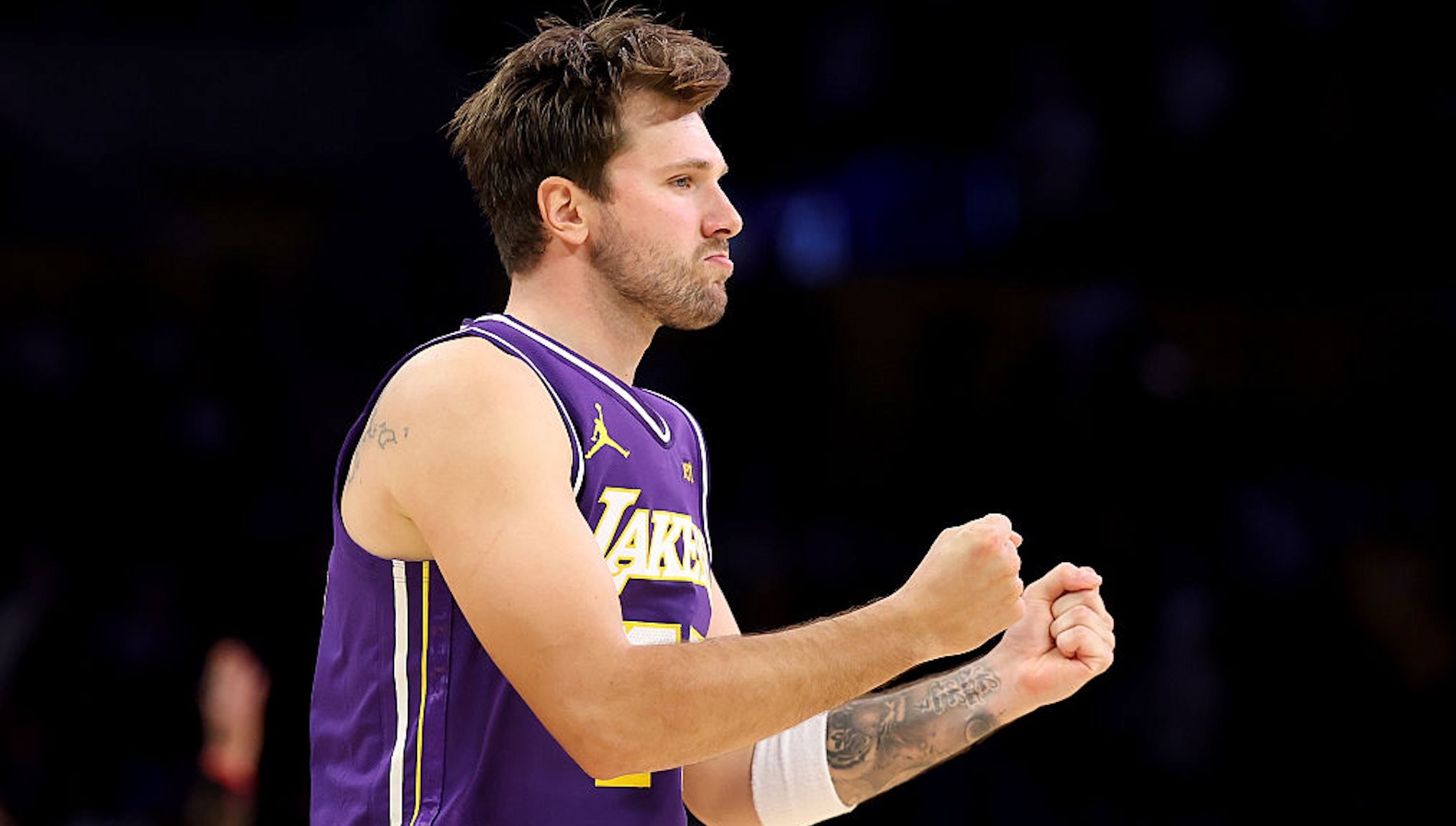
The Lakers are persistent, too. Nobody more so than Luka Doncic, who is somehow finding fresh frontier in this hyper-optimized era of the NBA. This guy has been doing crazy stuff: He leads the league in points per game (38.8), field goal attempts per game (25.4), three-point attempts per game (13.5), and free-throw attempts per game (10.8). It is not news to say that Doncic is an offense unto himself who is capable of melting any opponent in front of him—we saw him become precisely that in Dallas before a couple of idiots traded him away—but this version of Doncic feels new. James's exit has granted Doncic complete centrality within the Lakers' offense, and both he and JJ Redick appear zealously committed to making great use of his new circumstances.
It's not a stretch to say that if things continue like this, Doncic will end up owning the best offensive season in modern NBA history. He's currently edging out 2018–19 James Harden for most three-point attempts per game, and crucially making 40 percent of them. His 38.8 points per game put him in the middle of four Wilt Chamberlain seasons, and two points clear of the 37 points per game Michael Jordan scored in the 1986–87 season.
Watching Doncic assemble these numbers can at times be a maddening experience. Even knowing everything I know about Doncic and the modern NBA—that you really can never shoot too many threes, that everyone wants to win the possession game, that Doncic can make every kind of shot—there is still an occasional sickly feeling that arises when watching this man hoop. Doncic has been efficient, but the sheer volume of shots he's taking all but requires that he fire off several stomach-churning attempts per game. He can be in the middle of crafting a 45-point triple-double, but when he spins into a pull-up three from 29 feet with 19 seconds left on the shot clock, it can be difficult not to think about what all this might look like—how it has looked in the past—when his shot isn't falling in a game that really matters.
Doncic finished with 36 points, six rebounds, and seven assists in the win over Charlotte, but he almost shot the Lakers out of the game. He made just 13 of his season-high 34 attempts, and was 5-of-16 from three-point range. Without Reaves and Kessler around to try and stabilize things, it looked like this would finally be the game that Doncic lost by shooting too much. A thing that can be hard to remember about a guy who is scoring 39 points per game, however, is that he's also one of the league's best playmakers.
It wasn't Doncic's scoring that saved the Lakers in the fourth quarter, but his desire to get the ball to Quentin Grimes, the guy with the hottest hand on the floor. Grimes finished the game with 47 points and 10 made three-pointers. He outscored the Hornets by himself in the fourth quarter, putting up 21 points while making five of his six three-point attempts, including a last-second shot to send the game to overtime:
"I was too open," Grimes told reporters after the game. "I was like, 'Yeah, that's cash right there.'" Grimes can thank Doncic for all the shooting space, which was created by the kind of pass that only Doncic and a handful of other guys in the league can make: an off-balance, cross-court jump pass whipped straight into Grimes's shooting pocket. Doncic spent the whole fourth quarter trying to set up Grimes for those kind of shots, and was so committed to doing so that he was willing to ignore Redick's instructions. "Luka, when he got back in the game in the fourth, he kept he kept calling off every play I was calling and just saying, 'No, I'm trying to get Q the ball,'" said Redick after the game. Doncic attempted just three shots in the fourth quarter (the less said about overtime the better; the Lakers outscored the Hornets 7-3 while the teams combined to shoot 2-of-16).
Perhaps a playoff atmosphere will make the temptation to take the last shot in the middle of a bad shooting night too great for Doncic to resist, but for at least one game he showed that this historic offensive season he's putting together isn't the result of a single-minded dedication to getting shots up no matter the cost. Doncic is still a basketball player, one who can allow the flow of the game to guide his decision-making. If he can keep being that guy while also scoring 39 points per game, the Lakers will go on having the best offense in the league.