
The Chicago Bears are one of the most storied franchises in the NFL. One of just two charter members of the league still playing today (the other being the Cardinals, a somewhat less-storied franchise), the Bears have had a lengthy and stalwart kinship with the City of Big Shoulders.
That could change. Bears ownership announced on June 5 that they are focusing their attention on building a new stadium that not only isn’t in Chicago, but isn’t in Illinois at all.
“[T]he Chicago Bears Board of Directors met and voted to advance our stadium development project in Hammond, Indiana, with the exact site to be selected,” Chicago Bears Chairman George H. McCaskey and President and CEO Kevin Warren said in a statement. “We believe a world-class stadium project in Hammond will transform the region, connecting Northwest Indiana to the South Side of Chicago through the Loop and across neighborhoods and suburbs stretching north of the city. It will bring Chicagoland together and deliver new opportunities to its residents and businesses."
A new stadium in Hammond, Ind., is far from a done deal, and there is precedent for the Bears rattling relocation sabers and then staying home. In 1995, the Bears considered leaving the aging Soldier Field, the lakefront stadium they’ve called home since 1971. There were talks of moving to one of Chicago’s suburbs, and a proposal was floated for Planet Park, a mixed-use development in Gary, Ind., that would have included a golf course, amusement park, retail, and a new stadium for the Bears. (Since the Bears had started talking again about a new home, Gary leaders dusted off that proposal, but it got no real traction.)
At that point, the Bears had a lot of leverage. The Raiders had returned to Oakland and the Rams had moved to St. Louis, leaving the Los Angeles market without a pro football team for the first time in half a century. Baltimore was still on the prowl for an NFL franchise. (Word came out at the end of the year that they were getting the Browns, which meant it was Cleveland that was then looking for a team. In many ways, it still is.) The Bears got a $587 million renovation of Soldier Field and were content … for a while, anyway. The project was supposed to be funded by $100 million each from the Bears and the NFL, and $387 million in bonds backed by a Chicago hotel tax, but a 2022 report indicated that the public was on the hook—still!—for $640 million.
Now, the climate is far less hospitable for the Bears to play Chicago against the rest of the state. The Illinois legislature adjourned at the beginning of the month without passing a bill that could have allowed suburban Arlington Heights to create a stadium authority. Chicago Mayor Brandon Johnson believes it’s still feasible for the Bears to stay in Chicago, but the team has turned their sights to Northwest Indiana.
Believe it or not, they wouldn’t be the first NFL team to call Hammond home. In the prehistoric days of the league, the growing industrial town was home to a team known variously as the Bobcats, All-Stars, and the Pros. On-field success was limited, but Hammond was groundbreaking for its employment of African Americans in an era when segregation was the rule of the day. Hammond helped make the NFL viable—and then disappeared amid wholesale changes to keep the nascent league alive.
The first football game in America was a college game, Rutgers vs. Princeton on Nov. 6, 1869. The game, which resembled rugby more than what we now know as football, ended in a 6-4 Rutgers win and was so violent that a watching Rutgers professor yelled to the players, “You men will come to no Christian end!"
The first professional football player came along 23 years later, when Pudge Heffelfinger was paid $500 by the Allegheny Athletic Association for its game against the Pittsburgh Athletic Club in a heated intracity rivalry. It wasn’t long thereafter that teams were made up entirely of players who were being paid to play.
Football—pro, semi-pro, and amateur—existed in the shadows, a game so dangerous that it was nearly banned before new safety rules were implemented and the NCAA was formed in 1905. But while college and high school football increased in popularity in the early 20th century, professional football remained a niche sport, with semi-pro teams sponsored by local industries—in some cases rostered by players who worked at the sponsoring plant or mill—or teams organized and bankrolled by an athletic club or a local sportsman.
Paul Parduhn was one of those local sportsmen. He was the kind of guy every small city had: owner of Hammond’s Oldsmobile dealership and an investor across a wide variety of businesses, including oil and gas. He bankrolled a semi-pro baseball team and got into the football business as well, along with Alva A. Young, himself a former semi-professional athlete who’d gone to medical school and thus inevitably earned the nickname “Doc.” Parduhn and Young also enjoyed gambling, and had no qualms about wagering on their teams.
Among their earliest recruits were a pair of recent Illinois graduates, Paddy Driscoll and George Halas, who both dabbled in baseball too. The Hammond football team, known as the Clabbys in honor of local middleweight champion Jimmy Clabby, won the Midwest Professional Football League in 1917, but Parduhn had to pull the plug on the baseball team in the summer of 1918, citing financial losses and the unavailability of players, many of whom were in the service in the waning days of World War I. The football team also ended its season after just six games, as players were drafted or enlisted.
With the end of the war, football returned to Hammond in 1919, and Parduhn boasted of spending $20,000 to field the best team in pro football. Seeking a venue larger than Turner Field, the small ballpark Parduhn used for his baseball team, the football team would play their home games not in Hammond, but on the North Side of Chicago. Their home ballpark was built for the Chicago Whales of baseball’s upstart Federal League, but had become home in 1916 to the Cubs, and was called Cubs Park. (You know it under a different name. The Wrigleys would buy the team in 1921 and rename the ballpark after the 1926 season.)
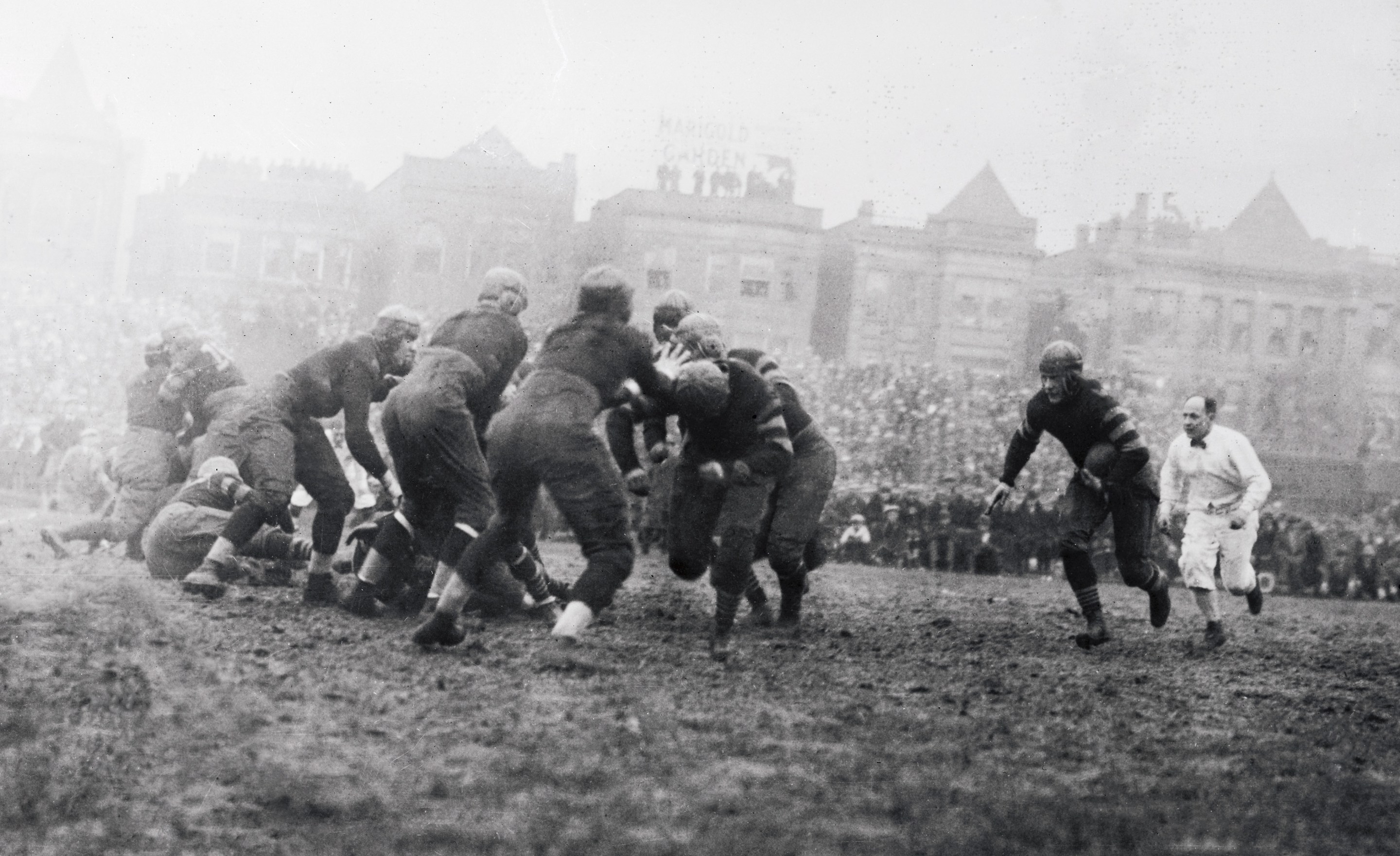
The Hammond All-Stars, as they were known, played two historic games at Cubs Park, both against the Canton Bulldogs. The Bulldogs, captained by Jim Thorpe, were regarded as the class of pro football at the time, having won two previous Ohio League championships. On Nov. 9, 1919, in front of a crowd that numbered more than 10,000, the Bulldogs and All-Stars battled to a 3-3 tie, with Thorpe kicking a field goal for Canton and Johnny Barrett kicking one for Hammond. The tie denied Canton a perfect season.
The two met again on Thanksgiving. This time, a crowd of more than 12,000 came to watch the teams do battle. Paddy Driscoll fumbled the opening kickoff, leading to a short field for the Bulldogs. Thorpe scored a touchdown and then booted the extra point for all the scoring in the game, a 7-0 Bulldogs win. Thorpe also distinguished himself on defense, with Grantland Rice recounting a tremendous goal-line stand when he sniffed out the All-Stars’ play and then threw Hammond’s runner for a five-yard loss. “At least 10 observers have written to say it was the greatest play they had ever seen,” Rice wrote.
These games are regarded as key demonstrations of the viability of professional football as a spectator sport. Both Driscoll and Halas were lured away from Hammond following the 1919 season, Driscoll to the Chicago Cardinals and Halas to the Decatur Staleys (who'd move and become the Chicago Bears two years later). In a sport replete with independent teams and loose geographical confederations, where poaching players with promises of higher paychecks was common, owners decided more organization was needed.
On Sept. 17, 1920, a group of team operators gathered in Ralph Hay’s Hupmobile dealership, on the bottom floor of Canton’s three-story Odd Fellows Building. Doc Young represented the Hammond Pros (so-called to distinguish them from the semi-pro Hammond Scatenas, owned by and named for a local grocer) at the meeting, which created the framework for the American Professional Football Association. Announced franchise fees were $100, a grandiose sum for local chamber-of-commerce types. “I doubt if there was a hundred bucks in the whole room,” recalled Halas, who was there, sitting on a running board of a Hupmobile. “We just wanted to give our new organization the façade of financial stability.”
The APFA, renamed two years later to the National Football League, started with 14 teams, many pre-existing as independents or in other smaller regional leagues. Five were from the Ohio League: the Akron Pros, the Canton Bulldogs, the Cleveland Tigers, the Columbus Panhandles, and the Dayton Triangles. Big cities like Detroit, with the Heralds, a team sponsored by a local newspaper, and Chicago, with the Cardinals, were represented, but most of the teams came from smaller towns in the industrial Midwest, like Rock Island, Ill., Muncie, Ind., and Hammond.
The NCAA was appalled by the idea of pro sports, saying at its 1920 winter meeting that no collegiate football player should play pro football. The Western Conference (now the Big Ten) went a step further and suggested annulling any varsity letter won by a football player who went on to play in the pros. Baseball, on the other hand, loved pro football, largely because they were able to rent out vacant ballparks in the fall and winter for football games. This would eventually be a factor in the NFL’s growth and development.
The APFA made it abundantly clear that they’d welcome anyone whose check cleared, expanding in its second year, from 14 to an astonishing 25 teams. New NFL President Joe Carr, an unheralded visionary of the game’s early years, imagined a league with eastern and western divisions, but he also saw the benefit of major and minor divisions to keep schedules full.
The Hammond Pros went 2-5 in their inaugural year in the APFA. They’d never win more games in a season.
But Doc Young wasn’t afraid to make bold moves, and signed several black players, no small feat in 1920s Indiana, which had become a hub for the newly revitalized Ku Klux Klan. Doc Young’s son Harry recalled growing up in an era where Klan funerals would parade down the street and it wouldn’t be uncommon to see signs that said “No Koons, Kikes, or Katholics.”
Of the 10 African-American players in the NFL’s first decade, five played for the Pros. In 1921, Doc brought Jay Mayo “Ink” Williams to town. (Harry Young, who described his father as colorblind, suggested that Ink Williams got his nickname “because of the way he smeared the opposing team.” Sure. That’s why.) Following his football career, Ink Williams would go on to greater success as a record producer, specializing in what were called “race records” for Decca.
In 1923, the Pros brought in Fritz Pollard, who had previously played for and coached the Akron Pros. He would take on coaching duties with Hammond as well. (Today, a nonprofit organization is named for him, dedicated to diversity and equity on NFL sidelines and front offices.)
Preferring the larger gates in Chicago, the Pros played just two league games in Hammond, both at Turner Field—now part of Turner Park, along the Calumet River. Williams and Pollard were the major contributors in one, a 7-0 win over the Dayton Triangles on Oct. 8, 1923. Williams recovered a fumble and ran 25 yards for the score. “Williams was easily the star of the day,” wrote the next day’s Lake County Times. “There is no greater end in professional football.” Pollard, who’d missed two field goals that day, booted the extra point. The only other game played in Hammond by the Pros was a 26-0 drubbing in the Pros’ final season in 1926 at the hands of Ernie Nevers and the Duluth Eskimos.
Pollard was called “one of the great ones” by no less an authority than Red Grange. Much like Thorpe in the previous decade, Grange was the most accomplished and most famous football player of the 1920s. He would also spell the Pros’ downfall.
Grange was signed by the Chicago Bears in 1925, and quickly became the biggest draw in the young league’s history, with crowds of more than 70,000 coming to see him play in New York at the Polo Grounds and in Los Angeles at the Coliseum. The following year, his manager, C.C. Pyle, demanded a higher salary and part ownership in the Bears. Halas said no, so Pyle leased Yankee Stadium and bid for his own NFL team, where he intended to take Grange as the box-office star. Thwarted, since the league had just added the New York Giants, Pyle then started his own league, the first of several to become known as the American Football League. Pyle’s league only lasted a season, but threw enough of a scare into the NFL that Carr thought major changes were needed to make the league sustainable.
At a special meeting at the Statler Hotel in Cleveland on April 23, 1927, Carr announced a drastic measure, slashing the league to 12 teams. The 10 that folded included the Pros, bringing an anticlimactic end to a team that had consistently struggled—a combined 7-28-4 record over seven seasons—but was still an important part of the NFL’s earliest history.
What’s in a name? Will they still be the Chicago Bears if they move to Hammond? Sports teams have long been a point of civic pride as well as a barometer for how eminent their hometowns are, or were. But there’s always been a little latitude on what constituted a “hometown,” even in the league’s early years.
The Rams are heralded as the first major-league West Coast team, leaving Cleveland for Los Angeles after their 1945 championship season, but in 1926, the NFL was home to the Los Angeles Buccaneers, a traveling team made up of California natives or players for California colleges, that played almost exclusively “road” games out east. The Oorang Indians were based in Larue, Ohio (1920 population: 795, still the smallest U.S. city to ever host a pro team), but were essentially a barnstorming team. The Hammond Pros were similarly road warriors.
The AFL’s Boston Patriots played at Fenway Park, but a condition of the AFL-NFL merger was that teams needed to play in venues of at least 50,000 seats. The Patriots left Boston for Schaefer Stadium in Foxboro, and were renamed the New England Patriots—a name that helpfully would have still been accurate had the Patriots followed through on plans to move to Hartford, Conn., in the late 1990s. That rule change also prompted the Bears to leave Wrigley Field, and for the Lions to decamp for the Pontiac Silverdome.
Sometimes, a hometown is just a legacy thing. San Francisco plays in Santa Clara. Washington plays in Landover. The only NFL team that actually plays its home games in New York is the Buffalo Bills (who haven’t played in Buffalo since 1972).
Moves within a metro area are generally taken with a grain of salt. But the Bears to Hammond feels different. Maybe it’s the crossing of state lines. Maybe it’s because it’s so shameless a financial hostage-taking attempt to squeeze hundreds of millions of taxpayer dollars. Maybe it’s because football stadiums now also need to be mixed-use cash cows, with all the attendant retail, housing, and other financial streams ultimately controlled by team ownership. It’s a different NFL.
At any rate, it’s a fine piece of cyclical irony. The Hammond Pros mostly played in Chicago. Now Chicago’s pros want to play in Hammond. Bet they won’t change the team name, though. Bad for merchandising.