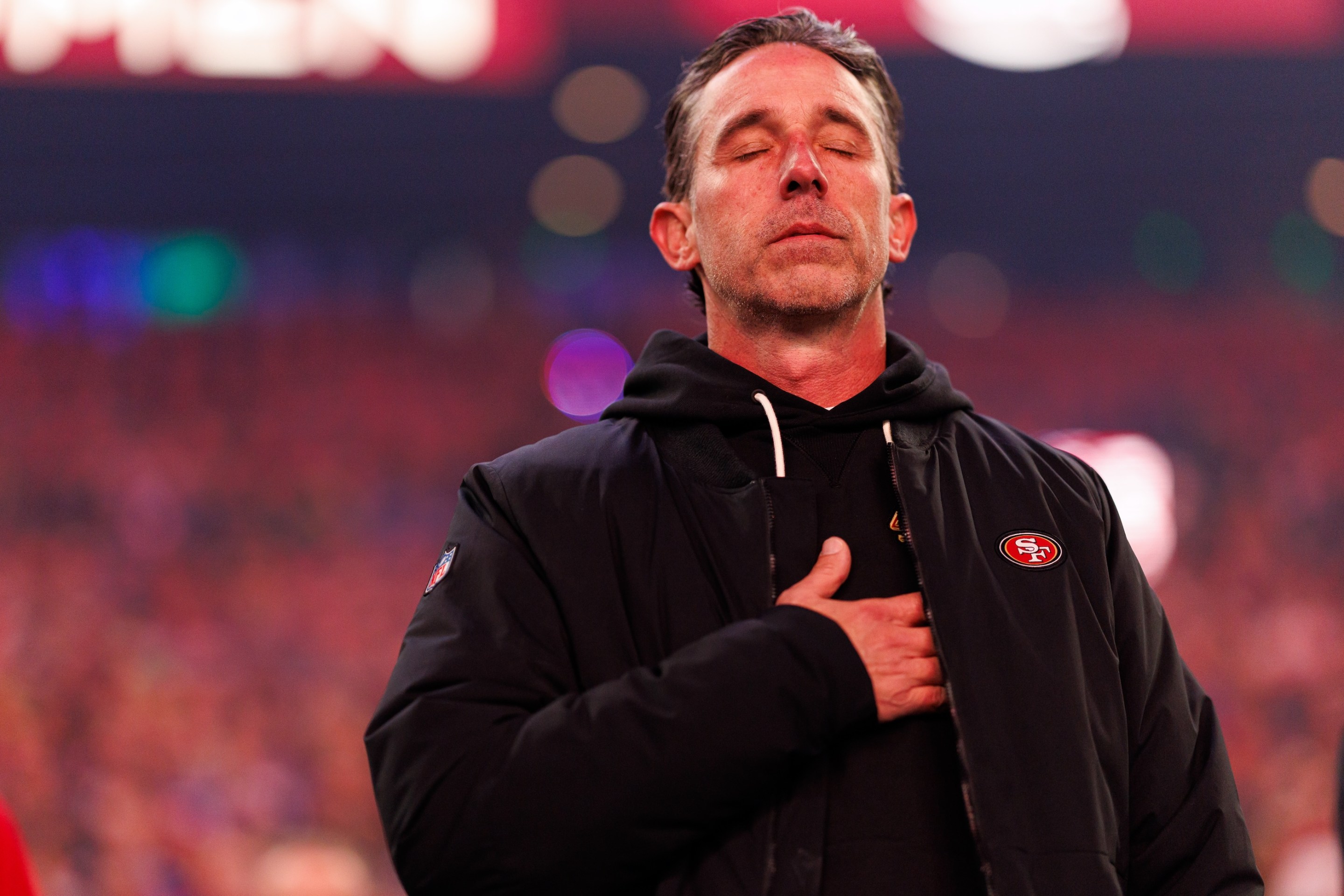
Well, that mystery has been solved. Kyle Shanahan was fishing around for his dropped phone while driving at 20 miles per hour when he crossed into the other lane and hit a car. There. Everyone satisfied? Great. Show yourselves out, and have a nice day.
Well, no. Of course not. Shanahan, the coach and chief architect of the San Francisco 49ers, has been and remains off work for an extended period of time because of the crash that neither he nor the officials and general population of Palo Alto, Calif., thought was noteworthy enough to mention for 11 days. He has a concussion, broken ribs, a broken nose, 40 stitches across his face and nearly lost an eye from the deployed airbag, which among other things means that he cannot perform his very public and vital duties protecting the nation from the absence of one-thirty-second of football.
And, well, nobody's required to buy any of that story, even Shanahan's belated acknowledgement that he was the one at fault rather than the 21-year-old woman driving the other car. These are not times in which anyone is or necessarily should be trusted; lying is everywhere, and liars are both prevalent and prolific. The biggest reason nobody's required to buy any of it is because of the 11 days when neither Shanahan, the 49ers, the Palo Alto police, nor TMZ's sprawling army of camera sleuths felt it worthy of mention. In doing so, they violated the basic rule of information control: The less you provide, the less control you have, because gossip abhors a vacuum, and the public will fill in the details we need to have in order to understand it in whatever way best suits our personalities, preconceptions, and sick senses of humor.
So all the parties involved that wanted so badly not to be involved are now paying for the 11 days it took for them to either give or concoct an explanation. The police, who tried to toss off a nobody was cited, nobody was impaired, we're cool here; the silence of the football team which surely knew that people will notice when an intact Shanahan is not in a room he is supposed to be in; Shanahan, who made himself public for a few local reporters to exonerate the woman in the other car—they are all in the crosshairs, because our instinct today is to trust nobody and nothing. It's not healthy, but it's not crazy either because we now quite reasonably expect to be lied to on a minute-by-minute basis. In that context, it makes sense why so many are so keen to see 11 days of silence and fill in the blank canvas with shades of brown.
But because the mea minima culpa came so much later than the original incident, Shanahan and the infamous delay proved solid fuel for talk shows across the country and even in Canada yesterday. The message was almost the same everywhere: "Why should we buy this if it took so long to cop to what he did?" There was no proof of falsehood, just the more nebulous but equally evocative grimaces that come with the discovery of an unpleasant smell. The evidence, such as it was, was in the delay itself.
This feeling that everything and everyone is fundamentally untrustworthy is less paranoia and more akin to a survival skill, and one made more necessary by the fact that the people telling the stories are less burdened by the shame of discovery. Kyle Shanahan did not create that dynamic, though as an easily recognizable football coach he is hyperaware of its uses and benefits. His job requires him to have explanations for everything even when he is only killing time until he discovers facts for which he needed those explanations. In short, lying is part of the gig.
For those 11 days, the story of the crash remained safe and dormant. And then the news broke, and those 11 days stopped representing blissful silence and became a condemnation of the police who tossed it off, the media who missed the story because there are no longer people in every newsroom who know how to ferret through police reports or have the time to do so, or the team that knew it had a problem and chose not to tackle it immediately. Somewhere in this tower of characters, someone made the decision to say nothing, and now even Shanahan's acknowledgement of culpability, spurred by his being upset that the woman was being blamed for the crash, is met with suspicion because of those 11 days.
It is all a grand lesson in the new rules of truth-telling. One lesson is that the truth has a short shelf life, and the longer it takes to get to it makes it seem less true. Two, public figures no longer get or should get the benefit of the doubt because they are so adept at (or pay people who are so adept at) manipulating the initial details to their (or their clients') benefit. Three, more and more liars are comfortable with the non-defense of "So what are you gonna do about it?" Donald Trump is probably the public figure most linked to this level of brazen shamelessness, but he didn't invent it as much as he made it the principle rule of engagement in all his deeds and words. A person does not get to be president acting that way unless they've spent decades getting away with it, or in a culture that hadn't long ago embraced the approach as its own.
So you are entitled to believe none of this Shanahan explanation if you so choose, because of those 11 days. Evidently nobody thought that anyone would notice or, more likely, cared what anyone would think. And now every potential explanation for what they eventually said or why they said it the way in they did can and should be viewed with suspicion and even contempt because of that delay. One wonders, amidst all the pundit-on-pundit sniping that passes for football coverage these days, what would have happened if they had all agreed not to say anything about it, or denied that Shanahan's injuries even exist. Some time in those 11 days someone surely suggested, "Let's tell them he's reinventing coaching by doing his job only with his mind," or "None of your business; and now, the comedy stylings of George Kittle," or even, "Call the Waymo people and pitch them on a driverless cars sponsorship." None of that's true, unless some of it is true, or unless it's even worse than that.
But hey, at least they all had those 11 days of relative peace and quiet, won at the low price of their credibility. Everyone satisfied? No? You're all pissed off? Great. Show yourselves out, and we'll see you all on Sept. 10.