
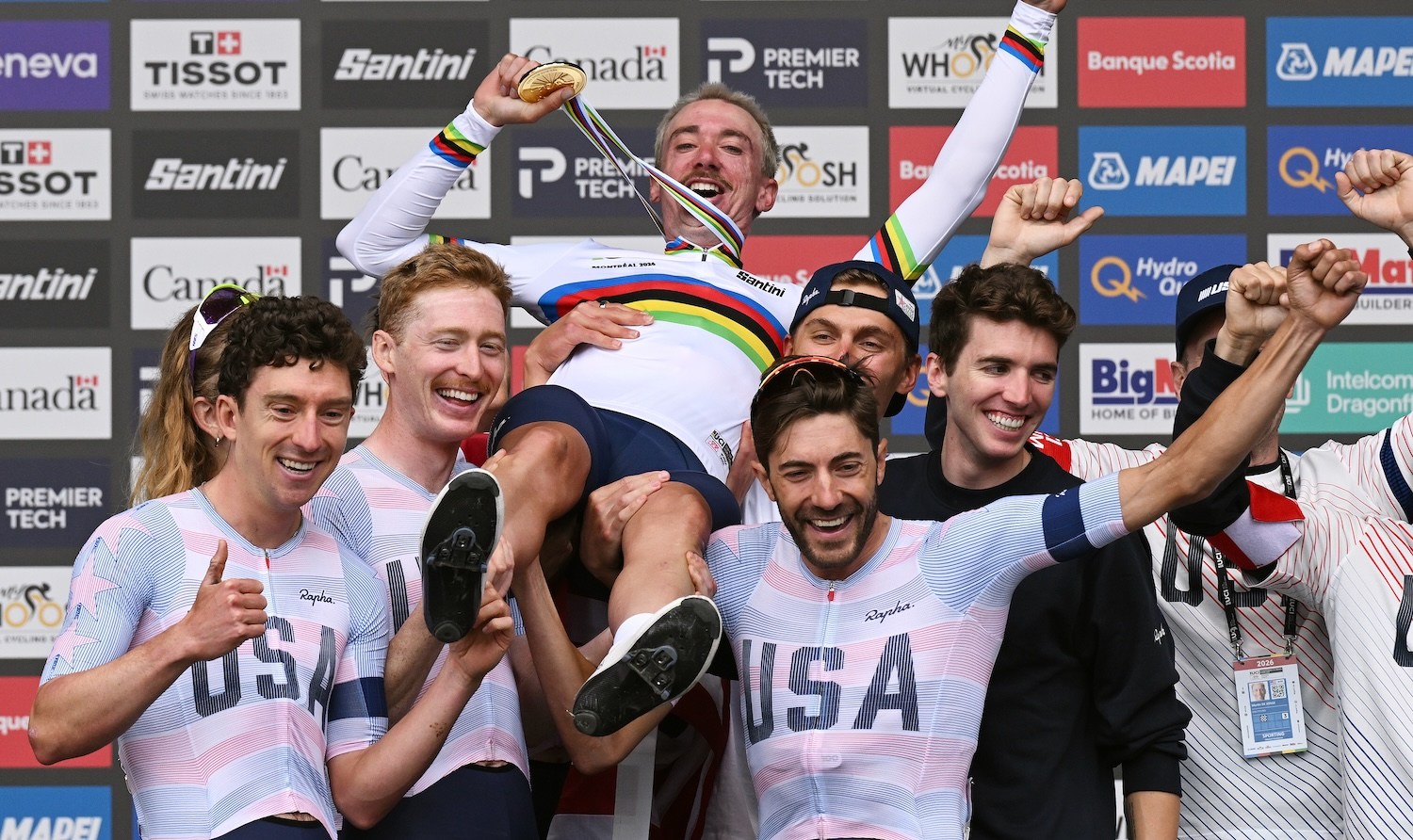
Inside the hundred-meter mark, after 273.3 kilometers of racing, Brandon McNulty looked back one last time to see the pack behind him sprinting it out for silver. He banged on his handlebars, put his hands to his head, and pumped his fist, seeming not quite sure how he should celebrate his country's first World Championship road race victory in 33 years and the biggest win of his career. McNulty's scattered exuberance tells part of the story, as does his teammate Quinn Simmons coasting in for fourth and Matteo Jorgenson celebrating as he crossed the line in eighth. The Americans raced a perfect race, delivering a shocker in the world's biggest one-day race thanks to one of the best tactical performances you'll ever see.
An unfortunate byproduct of Tadej Pogacar's typically thrilling dominance is that he obviates or at least neutralizes team tactics. It really doesn't matter how carefully you distribute satellite riders, gouge away at his teammates, or force him to do extra work, because he's so much better than everyone in the world that he can almost always go win the races he wants on pure strength. What are you supposed to do when Pogacar is simply riding alone off the front for 70 kilometers, faster than any one team's worth of riders could sanely chase? But Pogacar's recent crash at the Vuelta opened the door not only for Enric Mas to win a bike race instead of nobly and anonymously finish fifth, but for a new world champion for the first time since the Second Pogacar Inquisition began three years ago. There probably won't be many more good chances like this, so who would step into the vacuum?
Presumably, an elite one-day racer like Mathieu van der Poel or Wout van Aert, an on-form killer like Remco Evenepoel or Tom Pidcock, or a feisty nephew like Isaac del Toro or Paul Seixas. Anyone could look at the USA lineup and see their collective strength, though given the pedigree of the field, it would be tricky to imagine what specific edge any individual would have. Was Jorgenson really going to drop Evenepoel and del Toro on the climbs? Could this be the day Simmons learned how to race instead of simply ride? How was a domestique like McNulty supposed to dispatch so many hardened killers?
The trick was selflessness. Team USA's collective performance was a thing of beauty, a rare victory of pure teamwork. That began with patience. The team correctly calculated that France, Mexico, and Belgium would do a ton of work patrolling the front of the race early, and they let Bruno Armirail shred himself and waited as every one of del Toro's teammates burned themselves out early. Team USA's Kevin Vermaerke told Escape Collective, “The Montreal circuit does its own selecting, so there was no point spending bodies to control it." With 90 kilometers remaining, the USA correctly calculated that someone was going to try and blow the race up, winnowing the big group that had ridden at the front as France and Mexico burnt rider after rider. The threat at this point was one of the big-time climbers escaping on the most difficult section of the Voie Camillien-Houde.
So Larry Warbasse put Simmons in position, and when van Aert made his move and van der Poel inevitably followed, Simmons was ready to put in the effort to make the selection. He held on as the two superstars put in dig after dig, which was critical for McNulty's later success. By staying with the duo up front, Simmons put the onus on them to continue burning energy to drop him. Usually way too gung-ho about flaying his legs for its own sake, Simmons finally showed some restraint and sat on a wheel. His resolve paid off for everyone, with Jorgenson and McNulty both getting free rides in the group behind. Meanwhile, del Toro was showing both his strength and his youthful exuberance by continuing to attack, chase, and counter in an increasingly desperate attempt to either bridge the gap or trick someone else into doing it for him.
The Americans didn't take the bait. Instead, they watched with growing confidence as their biggest rivals all drained themselves. Eventually, van der Poel's insistence on dropping anyone who wouldn't work with him and del Toro's feverish series of accelerations coagulated the group. It was the perfect moment to attack, and everyone knew it. But who could have gone at that point? Maybe Evenepoel or Pidcock, though they'd be followed. The Americans were the freshest, and in perfect position to pull off the solo raid they'd been waiting all day for. Jorgenson went first, only for del Toro to respond and bring him back. McNulty attacked moments later, when del Toro was still recovering, and the group looked at each other as the Arizonan was given what would turn out to be a fatal gap. He had 33 kilometers to bring it home, a long solo for the rainbow bands.
McNulty wouldn't have gotten away if not for Jorgenson's looming presence. Jorgenson and Simmons (to a certain extent) were both far fresher than anyone else in the elite front group, so everyone knew that chasing McNulty, theoretically the least threatening of the trio, would mean setting up one of the others for a move. Team USA was making everyone dance to their tempo. "It does become like this game of, 'Okay, you're gonna catch me, but you're gonna be completely fucked,'” U.S. team director Mike Creed told EC. “Your fault for chasing me. You make the person pay for chasing you."
Various attempts were made to chase, with Jorgenson hot on the heels of anyone who tried to ride away from the group. McNulty started to falter on the final trip up the Camillien-Houde, and it seemed he'd be caught a few times. Evenepoel had a go, Pidcock and Seixas tried something and got within a few seconds, and Pidcock and Giulio Ciccone came very close before their fragile partnership dissolved. It did so under pressure of Jorgenson. He more or less forced them to choose between handing McNulty the title or handing it to him. They opted for passivity, and now Brandon McNulty is a most unlikely world champ.
This isn't so much because of his talent, but more so because of his role. McNulty is a domestique, usually gutting himself to set Pogacar and del Toro up, putting in massive shifts at the front of hard races and riding in minutes later, after one of his superstar teammates has won. His victory represents a collective triumph for the USA. Jorgenson and Simmons each could have raced differently and been in with real chances to win, yet they sacrificed probably their only real chances to become world champ to make sure McNulty got the win. Only one rider can wear the rainbow bands, but it took everyone to make Brandon McNulty a champion.