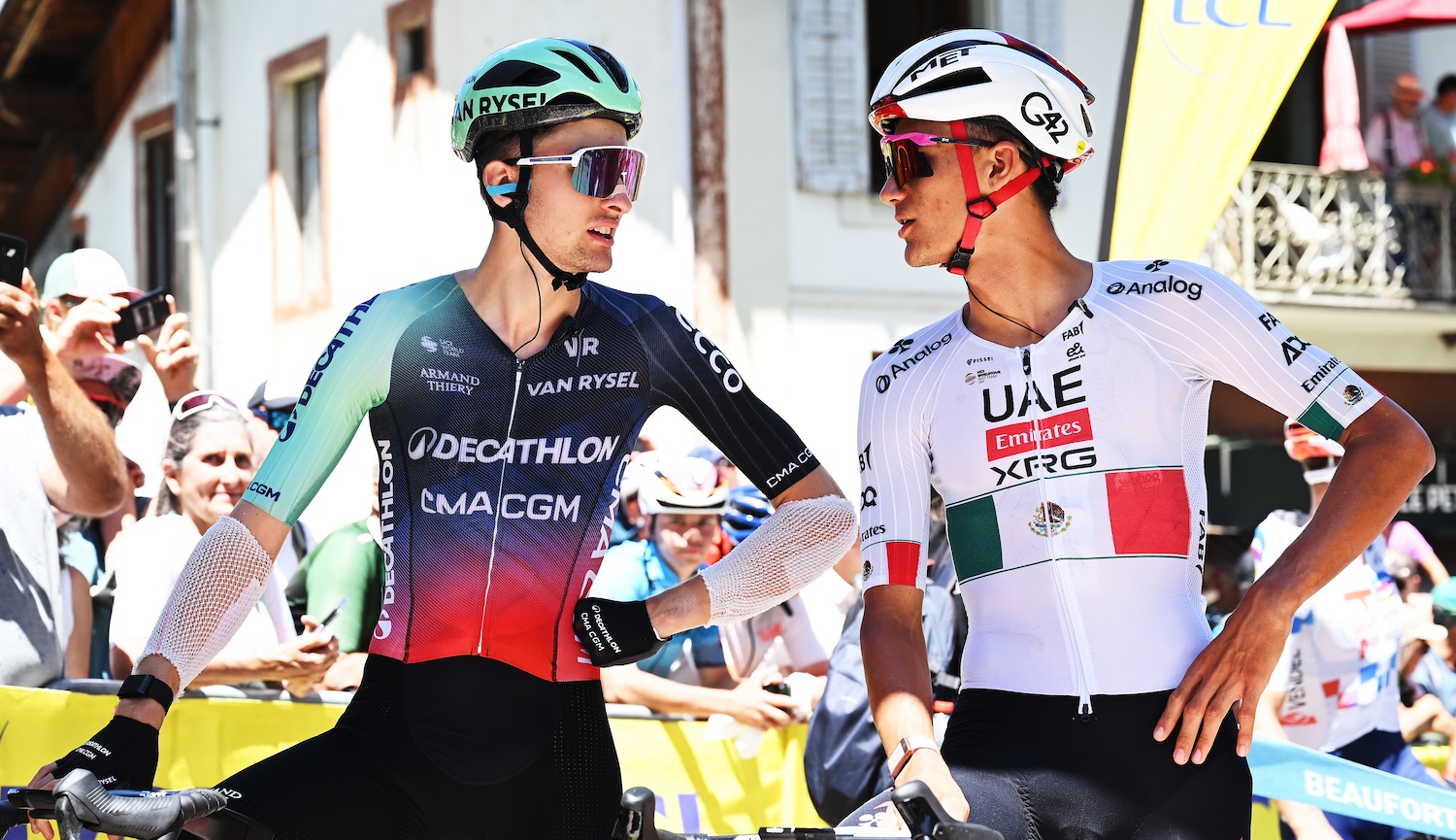
With the start of the 2026 Tour de France mere days away, most of the world's attention will focus on Tadej Pogacar and Jonas Vingegaard as they race for the yellow jersey. The sixth consecutive installation of the mega-rivalry is obviously of heavy interest, but I don't think it's the most fascinating two-up contest on the cards. Experienced champions necessarily duke it out every year; by contrast, something like the fight brewing between 19-year-old Frenchman Paul Seixas and 22-year-old Mexican Isaac del Toro is unprecedented, and far more compelling. That scrap says more about the future of cycling, less for the undeniable talent of these two riders in particular than for the simple fact of their youth.
The professional peloton has traditionally been an inhospitable environment for riders this young, yet cycling has been revolutionized by a profound youthward shift over the past half-decade. The shift goes far beyond this Tour's pair of golden children, who are merely at the vanguard of a broader youth movement that has swept through all of sports. Everywhere you look, younger athletes are excelling. A 19-year-old just won the French Open. The two best players on perhaps the best team at the World Cup are 18 and 23. The San Antonio Spurs relied on two rookies, a sophomore, and a 22-year-old to reach the NBA Finals in a playoffs largely short of consequential tricenarians. My Instagram feed is constantly showing me vertical videos of tyke-sized tennis children smacking crisp, ideal backhands.
The nurseries are empty, their young charges having transitioned more or less directly from childhood into terrorizing their predecessors. In the process, this cohort of precocious athletes is challenging all manner of long-held conventional wisdom and threatening to redraw the lines around the most important part of any athlete's career: their prime. So, under what circumstances did this youth movement get started? Is it a new, permanent state of affairs, or something more fleeting? Why are so many talented children taking over sports?
Cycling is where things have changed the fastest and most dramatically, which makes some crude sense: It's such a physically direct sport that's been quite historically averse to whippersnappers. You can see the flaws in the latter's logic through the former. Seixas and Del Toro aren't shooting jump shots, diagnosing coverages, or bashing into opponents; they're exercising against each other, which requires an unambiguous type of talent. You don't necessarily need experience to hit your numbers; you just need world-class legs and lungs.
And the pair is inarguably world-class. Each rider's results this season look like a Tour winner's, as they split the two biggest one-week races on the calendar and generally excelled in one-day (Seixas) and stage-racing (Del Toro) formats. After quite thrillingly following each other around en route to sharing the podium at Strade Bianche, they spent the first bit of the Tour Auvergne-Rhône-Alpes (formerly, and from this point on, known as the Dauphine) circling each other, only for Seixas to crash before the big mountain tests, which Del Toro aced in stunning fashion.
The standard for what a "good Tour" would mean for each rider is distinct, especially since when Del Toro rides out from Barcelona on Saturday's opening stage it won't be to win the yellow jersey for himself, but rather to help Pogacar do so. A big part of that job will be dealing with whatever Seixas is cooking up. Seixas may try for the higher stakes and greater demands of general classification glory, or he could more prudently ship a few minutes in the first week and focus on hunting stages later in the race. I don't think a 19-year-old French star at the Tour de France will go for anything so tame, especially since the races that have ensured Seixas's status as such a super-prospect have been the pair of one-days this spring in which he stepped to Pogacar's chest and declared himself unafraid. The primary lesson of the opening chapter of Paul Seixas's career is that the normal limits don't apply.
Del Toro, who has famously blown a Giro d'Italia he should have won with a bizarre day of anti-riding, faces a different sort of pressure. The young Mexican rider has been on a Pogacar-esque run since losing the Giro, and he induces the same excitement as Seixas. He is an electric racer to watch, in part for his smooth form on the bike but more for the obvious sense that we haven't yet seen the outer limit of what he's capable of. In France, Del Toro will be Pogacar's right-hand man, in charge of setting up Pogacar's attacks, keeping tabs on Vingegaard and anyone else who thinks they can challenge the champ, and perhaps even serving as a decoy if his own GC credentials warrant scrutiny. Del Toro's job is more tactically complex, and both will bear heavier expectations than most debutantes typically would. On legs alone, there's no reason to doubt either rider.
But the Tour is not raced on legs alone, and to the degree that anyone doubts Seixas and Del Toro, it's because cycling history says only the greatest-ever riders win anything when they're this young. Bernard Hinault doesn't think Seixas should ride the Tour, and several of Seixas's peers have cautioned him against moving too fast. For the majority of the sport's existence, young riders have had to earn their place on the biggest teams and in the biggest races through what can be understood as an apprenticeship system.
This is not dissimilar to the ball-sports phenomenon of the coach who hates playing rookies. In cycling, you'd work your way up at smaller races, and when you would get to ride in bigger races, your job would be to go back and fetch bottles for your leaders. A young rider's level of talent was irrelevant. They had to pay their dues first, and put their heads down to support those who came before them. "Cycling is a sport which embarrasses youth rather than rewards it," Lance Armstrong wrote in the same autobiography in which he erroneously claimed to be the youngest-ever Tour de France stage-winner.
As much as the logic of this system seems closer to folk mysticism than analytic performance science, it wasn't entirely without merit. The key is that Tour de France–level teams offered a level of support, training, and professionalism that surpassed anything any young rider could have had on a club team or in any other developmental environment. Nobody was teaching them how to eat so as not to bonk, how to optimize training in November to peak the following July, or sending them away to altitude camps before big races. Oftentimes, young riders wouldn't even get their first hyper-optimized bike fitting until after they signed their first big-time contract, just as an NBA lottery pick wouldn't get on a serious weight-training program until reaching the pros. Like their ball-playing peers, young riders would earn their spot on a WorldTour team by excelling at the lower levels, then they would be put into a rigorous program for the first time in their career, through which they'd get stronger and earn their spot. Elite talent and elite development were distinct spheres.
This was the case until the very recent past. Across sports, the defining phenomenon of prospecthood is the so-called professionalization of the lower levels. High school football teams have access to training methods and wells of coaching knowledge previously inaccessible to even the best college teams. Basketball prospects are learning the nuances of the game at an NBA level from the time they turn 13. The well of expertise that used to be the exclusive property of the best professional teams trickled down through the ranks thanks to former riders turning to coaching, the accessibility of training tools like Strava, and an increased public interest in and understanding of performance science.
So, yes, partially this is a tech story, though tech is simply one among many mutually reinforcing means to the much broader end of optimization. It's no coincidence that the tide of young athletes is coming in alongside rising athletic and competitive standards across sports. Again, cycling is where this is most apparent. In less than a decade, the sport has gotten faster at a staggering rate. Peter Sagan won Paris-Roubaix in 2018 with an average speed of 43.55 km/h. Wout van Aert won a spectacular edition of the race in 2026 going 48.91 km/h. The last-place finisher at this year's race was eight minutes faster than Sagan.
In the interval, the sport underwent a rapid technological and strategic professionalization. Rim brakes gave way to disc brakes, puncture-susceptible tubed tires were swapped out for tubeless, and cables disappeared inside frames, all sacrificed in the name of the holy church of aerodynamics. The sport reoriented around the metric of power. French guys who loved to race like doomed romantics, in love with the poetry of a futile attack and who mostly scried opponents' form based on the angle at which they contorted their faces in pain, were no longer competitively viable in a sport this hyper-refined. Heart, bravery, and willingness to suffer still matter, even in the more well-understood version of cycling we have today, it's simply that those factors are prerequisites, not as operative as they used to be.
(We see here an uneasy but I think telling parallel to the mostly misunderstood phenomenon of "analytics"; the thing so many people love about the sport is that essence of romantic suffering. I see why athletes would be mildly uneasy with what they see as an actuarial prescriptivism divorced from their experience on the court, field, or road, though that reaction misunderstands that the associated aesthetic changes are the effects, not the causes. To fear the bite of the calculator rat is to fail to see the larger ecosystem they serve. The point is and always has been winning.)
Because of the democratizing side effects of the internet, the increasingly globalized nature of the sport, and the sport's consumer-facing relationship with its own technology, this new stuff was also, for the first time, broadly accessible. Younger riders started to have more professional-style training and equipment from a much earlier age, right as teams began to shift away from the sort of pseudoscience that posited a rider needed to spend three years learning how to race before they could tackle a three-week Grand Tour. The new reality first came for the Tour de France in 2019, with the singular figure of Tadej Pogacar looming offstage for one more year. Despite 34-year-old contender Jakob Fuglsang's dismissal of 22-year-old Colombian Egan Bernal as too young, Bernal won that year's yellow jersey and became the youngest winner of the race in 110 years.
In 2020, Pogacar beat Bernal's record when he won as a 21-year-old. It would be a mild category error to read Pogacar's early-career dominance as more indicative of a youthward shift than a marker of his staggering natural talent, though in his case, both are real. Even having the latitude to lead a team at 21 required a novel acceptance of youth, and in the years since Pogacar's first yellow jersey, the sport has only gotten younger. Suddenly, teenagers who ascend to the professional ranks came in prepared to put down watts on their first day, and as the matter of being able to put down watts became increasingly central to how performance was assessed, there was no argument against letting them race.
One can also argue Pogacar's total dominance of the sport pushed the youth movement forward by simply obviating a whole generation of riders his age or older. As he has put together one of the greatest runs cycling has ever seen, anyone trying to put together a team capable of beating him has to understand that Jonas Vingegaard is the only one of Pogacar's peers capable of beating him, while the real hope lies in youth. This raises the uncomfortable matter of how valuable it is to employ older riders in a sport where a rider's prime happens earlier. Why pay 27-year-olds when you know the best riders from the next generation of 18-year-olds are ready to replace them?
Veterans are more useful in cycling than they tend to be in ball sports, where salary caps and more pronounced physical damage incentivize teams against paying established players and toward taking fliers on young players. There's still immense value in knowing how to manage a three-week effort. Vingegaard's team, Visma–Lease a Bike, still relies on the wizened Wilco Kelderman for some stuff, though they're throwing the fresh-faced Davide Piganzoli into the deep end in France despite the 23-year-old having just raced the Giro. As if that wasn't enough new blood, 22-year-old Per Strand Hagenes will also be making his Grand Tour debut as a windshield for Vingegaard.
The question is whether the trend will continue to accelerate, or whether things will level out once the last of the previous generation of riders leaves the sport. When the sport's 30-year-olds all came in as world-eating teenagers, will they really be so replaceable? I don't think so, since aging curves are gentler in cycling, though I think the fate of the mid-career veteran is more troubling in a sport where you have to worry about torn ACLs or calf strains.
A few years and several iterative rounds of optimization later, and we have a sport with a parabolic talent curve, where the best rider is head and shoulders above the rest, while the 150th-best rider is not that far away from the 15th. This makes the sport more exciting to watch, for the simple fact that new ground is being broken all the time. This brings us back to the Tour de France's pair of enfants terribles.
Del Toro's Tour debut is a sort of accelerated apprenticeship, one that syncretizes the old wisdom about needing to pay dues and the new orthodoxy that says anyone who is ready should ride. He's clearly being groomed as Pogacar's successor, and it will be fascinating to see how he handles the tactically and physically demanding job of being the best domestique in the race with whatever chances he'll have to ride for himself. The secret hope that so many people harbor for Del Toro is that he decides to stage a revolt and go after Pogacar. He seems like too good of a teammate to really push for that, though the origin of that hope is grounded in faith in Del Toro's talent. He might really be the truth.
So too might his French rival, against whom he'll be set. A few years ago, a rider like Seixas would have been brought along slowly, and we can see from how great he's been this season that doing so would have cost his team valuable wins. He is the most fascinating rider at the Tour de France because, like many brave riders, he's going to challenge Pogacar, though unlike most riders, there's actual reason to believe he might do it. This has me thinking back to Pogacar's first Tour. It seemed inconceivable that Pogacar could topple Primoz Roglic and actually go win the Tour, though once he did so, his reign felt inevitable. This is not to say I think Seixas is going to beat Pogacar, more that the spectrum of possibility is wide open. The future is out there, being raced in the present.