Patrick has spent the last three weeks following the Tour de France with our friends from Escape Collective. This post was originally published on Escape Collective on July 27. Defector readers can now get a six-month free trial of Escape Collective, with ad-free and independent coverage that goes beyond the Tour de France. Claim the offer here.
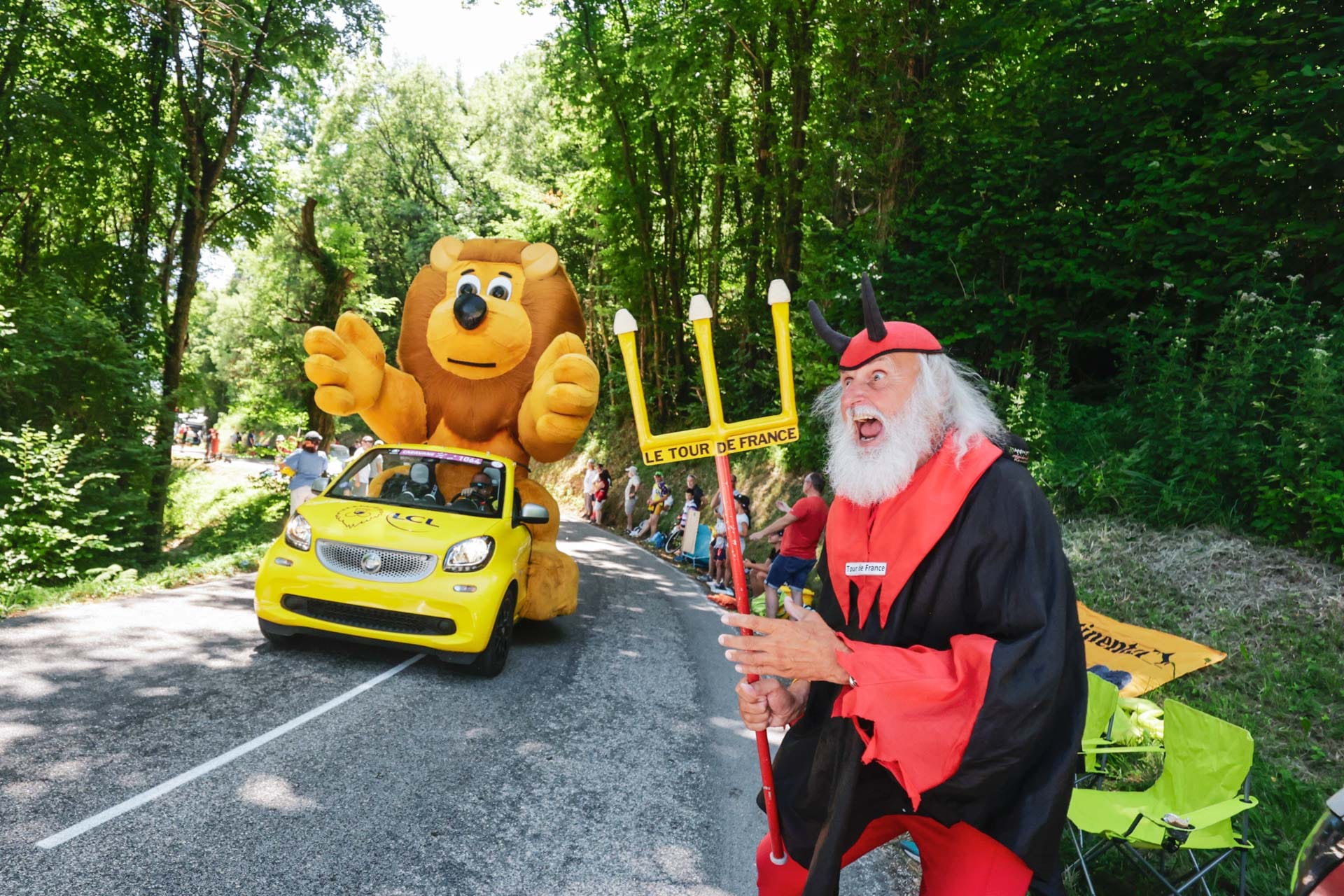
There was a point there, about three hours into a five-hour drive in 105 degree heat on the back of an enormous cauliflower, where it started getting old. And then, three things happened. In the space of 20 seconds, there was a sad-faced middle-aged man in a kind of regal medieval gown with fur sleeves and cuffs, standing a few meters away from a hauntingly still figure in a full fox suit complete with head; a few meters later, a five-year-old cosplayed as Tadej Pogacar, full UAE yellow kit and all.
This was not an atypical series of sightings, I should stress. But its barrage did snap me out of my funk and back to the very strange reality in which I found myself. After years surveying the Tour de France promotional caravan as a sociological phenomenon, I was now in the thick of it, on the Tour de France’s hottest day, on the race’s funniest vehicle.
A Bit Of Backstory
The Tour caravan dates back to 1930, an innovation of Tour de France creator Henri Desgrange. After coming up with the race itself to sell newspapers in 1903, Desgrange’s shrewd commercial mind turned to reforms: national teams instead of sponsored ones. The financial shortfall in this shift could, he correctly theorized, be funded by advertisers. In the first year, there were 40 vehicles in the caravan, traveling ahead of the race with decorated floats, cars, and trucks advertising and distributing produce. Cigarettes, alcohol, clothes, food: a bit of something for everyone.
In the years since, the caravan has morphed, silly vehicle by silly vehicle, into a massive drawcard for the roadside spectators. Some estimations suggest that as many as half of the people coming to the Tour de France are there for the freebies—and can you blame them? The bike race is gone in a minute. The publicity caravan, which comes through an hour or two before the bikes, is described on the Tour de France website as “a continuous show lasting more than 30 minutes” and “stretching 10 km” (6.4 miles), with 30 brands and 180 vehicles, multiple safety information cars, 12 republican guard riders and three medical vehicles. Can’t argue with that kind of value!
And what value. The free trinkets are many, with the students on the back of the vehicles throwing key rings, snacks, totes, and hats to the adoring crowd. The roadside becomes a feeding frenzy—boring biscuits are snatched out of the hands of children; grandparents go scrabbling in the dirt for pouches of detergent.
I’ve covered the Tour de France six times, and over that period the caravan has conspicuously changed. The maelstrom of single-use plastic has now been recognized as a bad look, and some of the things spectators snatch out of the air have become desirable cult items. There’s a roaring trade for Cochonou bucket hats, in a jaunty red chequerboard pattern; there are also enough people interested in the bad Cochonou sausages that an actual brawl broke out over some on Alpe d’Huez. All at once, it is low stakes and high stakes, commercial and camp.
A Choux-Fleur With Flair
I’d be mesmerized by the caravan even without roadside brawls in its wake, and no brand typifies its appeal better than E.Leclerc. One of France’s largest supermarket cooperatives, you might recognize its name (and spotty branding) from the KOM classification, but it also has perhaps the most loved caravan vehicles in the game. There’s an ATV with a big fiberglass melon around it, another that is a strawberry, and a huge bundle of leeks with smiley-faces and little rope beards. This year, E.Leclerc has splashed out on a new vehicle that might rival the leeks for popularity: a cauliflower. You can’t see these guys and not smile.
Which is why I’ve spent the last three years trying to get a coveted berth on an E.Leclerc float—not that they wanted me. Each time, they’ve come up with increasingly elaborate ways of telling me I can’t have a go. At first, it was the old French standby—a maddeningly non-specific “it is not possible”—but I tried different angles of attack: applying to drive the leek, applying to drive the cauliflower, and asking every E.Leclerc media employee I could find in the hopes of a different answer than a pouty shake of the head. I was resigned to my fate, and the final nail in the coffin was a message passed down the chain from the big dogs: E.Leclerc’s mandate was to focus on French media opportunities, so international sickos like me were out. I prepared to go scorched earth on E.Leclerc.
Luckily I didn’t, because a few days later, the friendliest media officer working for the Tour de France organizer came looking for me. There had been an opening on the cauliflower, for Stage 9 from Malemort to Ussel (could I tell you a single thing I remember about either of those places? I could not). The upside was that there was a spare seat. The downside was that it was a stage that nobody particularly cared about, and it would be the hottest day of a Tour de France already defined by infernal temperatures.
Still: would I ever get a chance like this again? Even if it meant that our little crew (me and Jonny from Escape and Patrick from Defector) needed to get on the road two hours earlier than usual to drop me off in time? Even if it meant that I would spend much of the day feeling like I was losing my mind? I had no choice in the matter.
A Dance Party In A Dead Zone
In the hours ahead of any Tour de France stage, in industrial wastelands on the edge of host-towns, the caravan descends. Its vehicles line the roads, and hundreds of promotional staff pile out of vans to take their place on their silly floats. Picture the most extroverted frat boys and cheerleaders, now make them deeply tanned and French. By day, they dance inexhaustibly to Europop and throw what they insist on calling “goodies”. By night, it’s a coming-of-age film: shared rooms in budget hotels, fevered holiday romances, boozy bacchanals every rest day.
To shake the dust off, each new day begins with a dance party. Blaring music draws the various promo staff towards a float where a man with no discernible rhythm leads proceedings. Very soon, there’s a swirling dance circle, girls up on guys’ shoulders, water being sprayed around from the centre of the pit. I feel compelled to get involved, but it feels private, almost: hundreds of horned-up youth in an endless golden summer, jumping in unison. It’s 10:00 a.m. and it’s already 91 degrees.
In the absence of any other introverts, I wander off in search of interviews. I find a driver for Panzani, a pasta and sauce brand which diffuses the smell of pesto as it drives along. “You smell pesto all day,” he tells me. “But I like pasta, and I like Panzani pesto, so it’s not sad for me. I get to Paris at the end, and I still want to eat pesto.”
The driver of the leek is already in position, and I corner him to find out literally everything. His voice is fucked, on account of all the partying. What is it like driving the most charismatic vehicle on the race? “It’s a privilege to be on the caravan at all, but to drive this one? It’s a real privilege,” he tells me. He’s beaten out 1,900 applicants for the job (myself among them) through a two-stage audition process involving a group interview and a video application. No driving test required: “It’s just a normal car,” he says of his six-metre long bundle of leeks. “Just a bit more long on the front and the back.” And most normal cars don’t have little rope beards or winky faces.
I have to hustle to get back to the cauliflower, so I drink half of a diabolical coffee and pour the rest out on a hedge. I’ve been told to meet the pilot of the melon, the leader of the E.Leclerc entourage. Helpfully, he is wearing a matching orange t-shirt, but I confirm I’ve got the right guy by asking “are you the melon man?” He agrees that he is, and introduces me to the cauliflower’s "animator"—a man that spends most of the next five hours yelling little jokes and throwing things at the crowd—who takes me under his wing. Antoine is in his mid-30s and is an actor from Toulouse the rest of the year, but for July he is the cauliflower’s heart and soul. He tells me to reapply sunscreen regularly, gives me a shrink-wrapped block of six water bottles, and ushers me to the staircase at the back of the vehicle.
What looks quite polished on the outside is distinctly homemade on the inside. MDF steps lead into a fibreglass and polystyrene interior. Little white balls of foam billow around my feet as I sit down, and an E.Leclerc social media guy takes a seat next to me. As we wait to drive off, Giosué tells me that he was “the strawberry” in 2024-25, but now he’s cutting together videos and filming spectator interactions. The strawberry ATV, he says, was fun to drive on mountain stages, but hard work on slow days: he mimes with arms outstretched to imaginary handlebars, lips flapping in a "brrrrrrr" for the motor. The caravan is precisely calculated for speed at a mellow pace of 25 mph, but the dominance of Tadej Pogacar has started messing that up. “Before Tadej, it was chill,” Giosué says. Some days now, though, the race organizers have to give them a hurry-up so that the Slovenian doesn’t run into interference at the back of the long caravan entourage.
It Begins
At 11:05 a.m., the cauliflower purrs to life and steers away from the hedge, where a group of Tourtel (a non-alcoholic fruit-beer) ambassadors take a panicked piss. Starting the day with an empty tank is sensible: to stay on schedule, each caravan vehicle is allowed only a single roadside toilet break of no more than five minutes.
A bumblebee startles Giosué just as the music starts up, and Antoine reaches back to pass me some earplugs. The cauliflower’s soundtrack is the jingle of E.Leclerc’s endorsed product range, Marque Repère, interspersed with fragments of a few different songs, before the jingle returns. Conservatively, I would say I heard it 100 times over the day. After two iterations, I ask Giosué if it makes you go crazy to listen to it all day. “Yes,” he responds, eyes slightly glazed.
We leave the industrial estate, and enter the route proper. All of Malemort seems to have come out to watch. An old guy takes a very earnest roadside photo with his phone torch on, and I’m sniped by water pistol from a distance. As we get up to speed, we whoosh past a company called SCAM Coopérative, and a roadside stall selling uncooked chicken. On an adjacent road, like some warped Escher painting (but cycling) the team buses arrive in the opposite direction. It’s going to be a long day for everyone.
In the back of the cauliflower there are so many spotty hats: five enormous sacks, stuffed to overflowing. Over the course of the day, Giosué will pass these precariously down to Antoine via hand and carabiner, at the risk of hundreds of spotty hats spilling all over the roadside.
Many of the hundreds of thousands of people on the roadside have gone to the effort of making elaborate nets or boxes or signs to attract the caravan’s attention. Giosué is particularly amped about one variant of these—a box in the shape of the E.Leclerc-sponsored KOM jersey—because he came up with the idea, made a video about it, and it “went viral” with more than 1 million views. After spending most of the year working on screens, he gets a bit emotional explaining the significance of seeing his IP in the wild: “Here, this is real. It tells me I do a good job every time I see a box in this vision.” At a point a few minutes later, his Garmin watch automatically starts an activity on the basis of his racing heart rate. “My friends on Strava will think, wow,” he laughs.
There’s hours still to go, but the heat is already starting to get to me, even with the breeze. I down a bottle of water, thinking all the time of what hell I’m about to put my bladder through until the toilet break. But by the time it comes, a kaleidoscopic few hours down the road, I couldn’t pee if I wanted to: it is too hot, too dry, too sunny, even though I drink two liters of water over the day. I reapply sunscreen every hour; I still end the day sunburnt. Antoine looks over his shoulder every so often to ask if I’m doing OK, and I give him a thumbs up.
While it isn’t comfortable, necessarily, it’s difficult to find any of this a hardship, mostly because everyone is so happy to see the cauliflower. A beefcake of a police officer’s face lights up in a huge smile as we drive past his roundabout, and I can lip-read the words "choux-fleur" as he turns to a vaping colleague. A bit down the road, a grizzled old Jayco-Alula soigneur who looks like he’s been around cycling since it was sepia takes his phone out for a picture. There’s also a bit of roadside flirting going on, either with the cauliflower or with its occupants: a woman strikes a coquettish Betty Boop kind of pose while blowing a kiss; a few minutes later another woman in a rubber frog mask does the same.
Giosué is right: the playlist does make you a little crazy as it loops. There’s half a Rosalía song (good) but also Shakira’s latest World Cup one (bad). He likes it, while I’m confused about how she keeps getting that gig. I posit that she has some Gianni Infantino kompromat, which Giosué doesn’t recognize as a joke. As we whoosh past screaming fans, I spend about five kilometers explaining that football’s bad bald man is (probably) not fucking Shakira.
We go through a gorgeous tunnel of emerald trees and onto one of the day’s climbs. The crowd is much thicker here, and more elaborately costumed. Spider-Man stands next to a guy in a Borat mankini with a thicket of dark pubes sticking out either side. A bit further on and a wizened older gent stands on the roadside in little apricot-colored budgie smugglers, hands on hips and belly thrust out. It’s a move so visually striking that even a seasoned caravan professional like Giosué remarks on it.
I’m not really sure what to do with my hands at first. There’s too many people to wave at, and there’s only so much enthusiasm I can muster for seated dance moves, but I want to do something, because it feels like that’s what the spectators expect. They’re so happy about the caravan going past, so why shouldn’t I be, about actually being in the caravan? I decide to dish out some high fives, leaning down to the side from my high perch. It goes well until some teenaged boys get a bit overexcited, and in the interests of not getting my elbow snapped I go back to some gentle fist-pumping in time to the Marque Repère jingle. I feel like a massive dweeb, but everyone on the roadside is dancing like no one’s watching, so it also feels right.
I’d been hoping to throw some spotty hats, but I don’t get a chance. I’m sitting on the back left seat of the cauliflower, and there’s a strict order to how the caravan progresses: a vehicle on the right, a vehicle on the left, back and forth. This ensures that the goodies are distributed evenly, and more importantly that nobody darts onto the road and gets pancaked by a huge picnic hamper on wheels. It’s kind of a miracle that this doesn’t happen anyway, but we only have one close call: an old lady who steps off the curb to beg Antoine for a hat, forcing the driver to swerve and Antoine to good-naturedly tell her off over the PA.
As we approach the finishing line, the blur of the day becomes more of a haze of little vignettes that stick in the mind, stretched along the 96 mile race route. The old man with a printed A4 page in a plastic sleeve which says "Bien-venue a Tour de France Caravan" in what looks like italicized comic sans. The four skittish Shetland ponies that got brought to see the bike race. The man who’s rigged up a series of klaxons to honk the tune "Baby Shark" as we pass by. The guy that takes off his sombrero, holds it to his chest, and dips into a deep bow to each vehicle.
We pull into Ussel, where I get bustled down the stairs of the cauliflower and emerge blinking and bewildered. I feel jet-lagged, or sun-struck, or both, and with a blast of police whistles the cauliflower speeds off to rest in some cursed parking lot somewhere until tomorrow morning. Our final stats: five hours, at an average speed of 23 mph, compared to Mathieu van der Poel’s winning speed of 27.73 mph.
As for me? I’m tired, and hot, and have no idea how the people of the caravan can keep this up for three weeks. I respect the hell out of it, though: the youthful energy to spend all these hours in the elements, spreading joy for 2,050 miles. The Tour de France caravan remains undefeated.