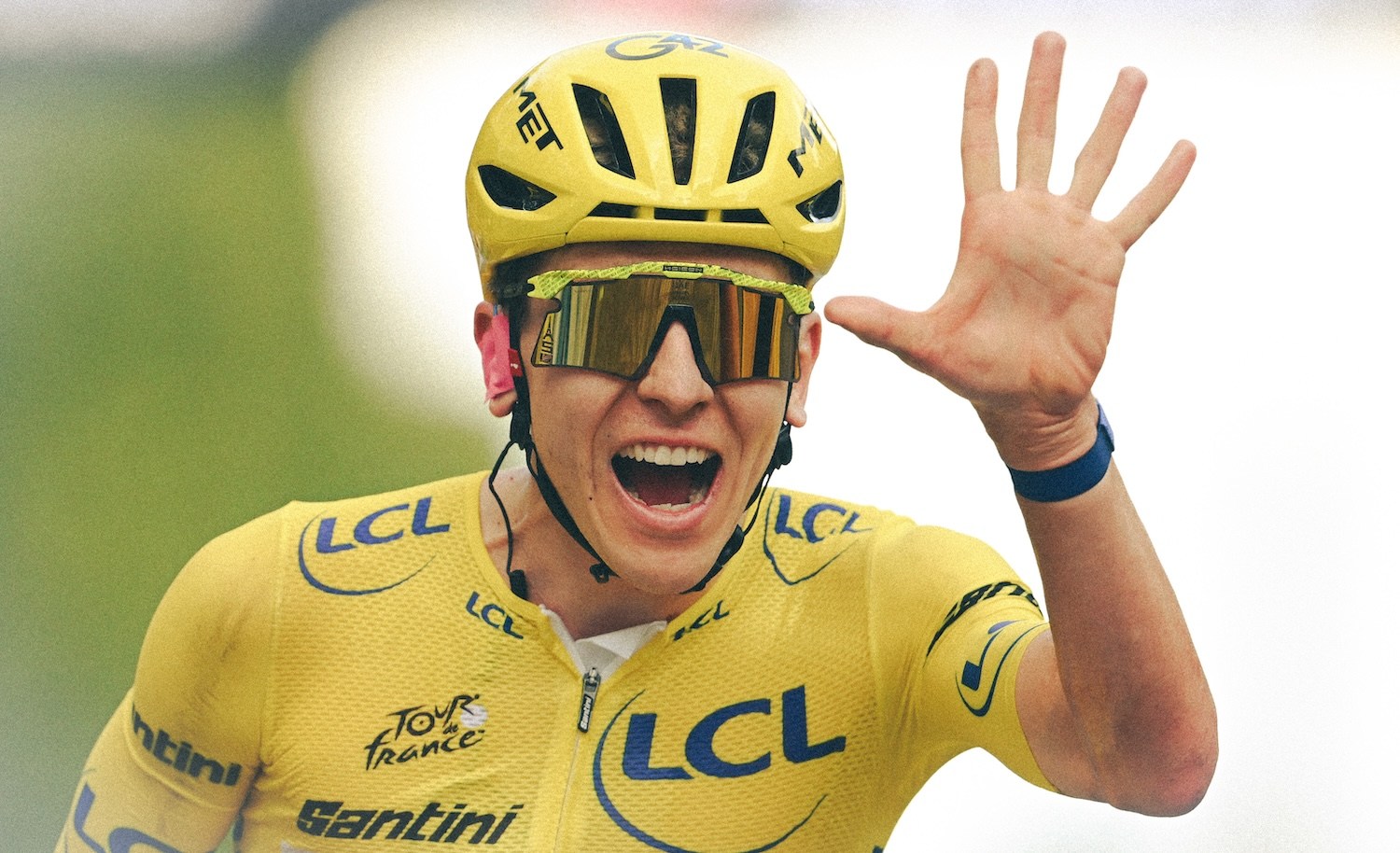
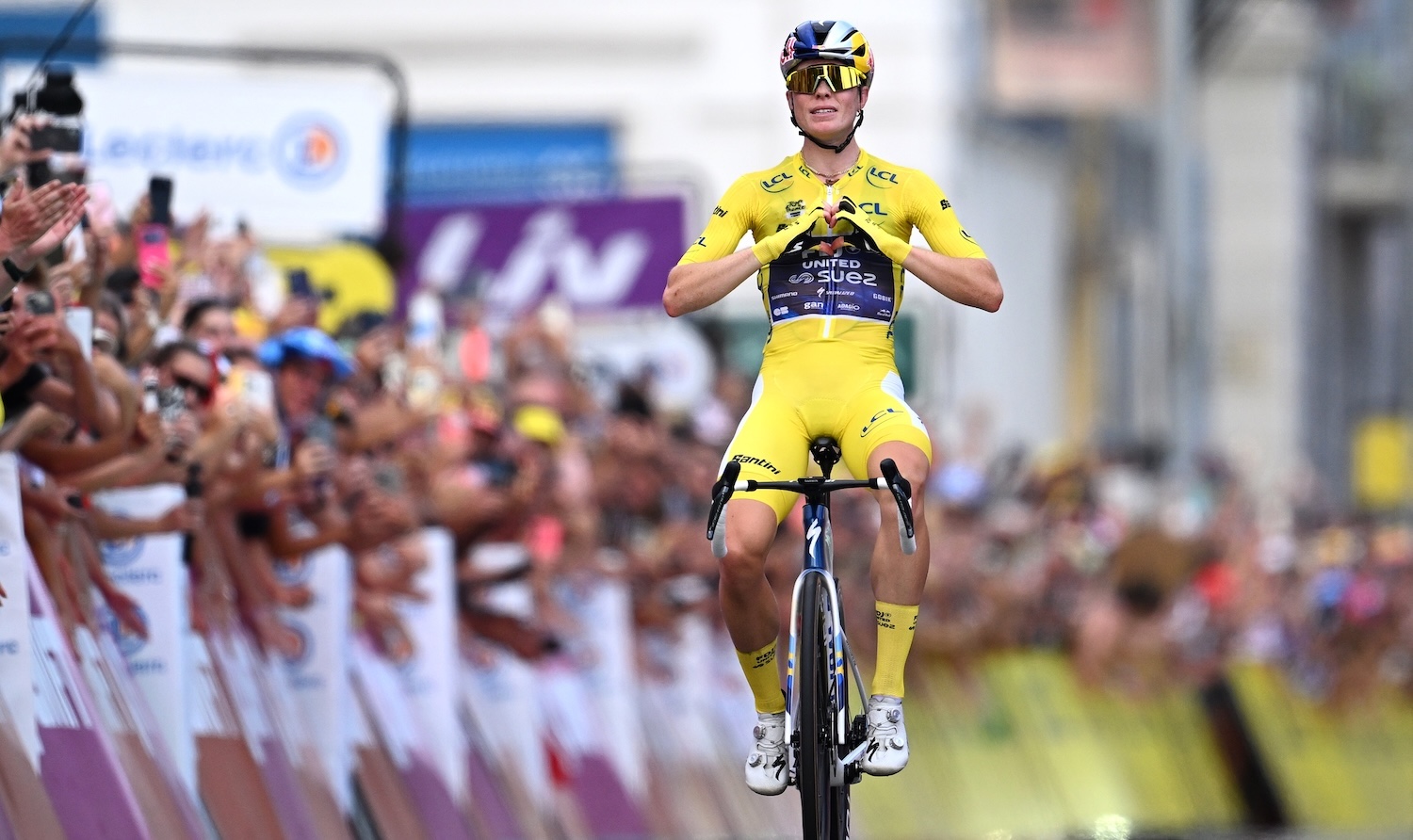
When Demi Vollering crossed the line in Nice on Sunday, she didn't just win her second Tour de France Femmes title. She provided a worthy finale for the best edition of the race yet.
The fifth running of the Tour was spectacular from start to finish. There were interesting winners throughout the race, an amazing general classification battle that came down to the final climb, and fresh, dramatic storylines almost every day. The Tour achieved a higher density of both intriguing stories and good racing in nine stages than the men's Tour did in 21, in the process raising questions not about the future viability of the race but about how big it can be.
Vollering is a totally worthy rider to earn the honor of becoming the race's repeat champion, though a test of the overall quality of a bike race is how much intrigue there is beyond the question of who wins the overall. It's useful, then, to review this one in chronological order.
Pre-Race
Coming into the race, the thing I was most interested in was the frankly astonishing saga around who the hell would lead UAE. Paula Blasi had been the revelation of this season, winning the Vuelta, the Volta a Catalunya, and Amstel Gold, and ripping it up throughout Ardennes season. A rider doing all that in her first season is clearly on a rocket ship, and watching Blasi flex her muscles in the first few months of the season, it was clear that nobody really knew the outer level of her talents. I couldn't wait to see Blasi go for it in her first Tour, probably seeing the UAE on her jersey and getting some faint 2020 Pogacar vibes. Instead, she was inexplicably relegated to super-domestique duty.
The world learned this when she did a pre-race interview with Dutch outlet In De Waaier: When Blasi casually mentioned she didn't think she could win the race, the baffled interviewer asked why. Blasi then revealed, for the first time, that she would be at the Tour riding in support of Elisa Longo Borghini and Dominika Wlodarczyk. In the interviewer's flustered response, you can see how confusing a strategic choice that is.
Blasi's director, Cherie Pridham, then gave an even more confusing follow-up interview, in which she waffled on answering the question of why they'd restrict one of the best riders of the season in service of two riders who clearly couldn't win the Tour. Eventually, she was forced to admit that Blasi is probably leaving the team after this season, which plays into her calculus.
When the race began, Blasi was pulling in the flats, sacrificing herself so Longo Borghini could finish a distant third. It was a great result for the Italian, though Blasi clearly had way more juice. Blasi eventually finished fifth overall and second in the white jersey competition, a jersey she probably could have won if her team hadn't been dumb. On the final stage, we saw the baffling spectacle of Blasi going to the front and putting in a hard pull in an attempt to distance Antonia Niedermaier, only to be pulled back to the pack by her director so she could look after Longo Borghini. Whose fault is all this? Per Longo Borghini, the media's, and not her own dumb team's mismanagement.
Another nauseating pre-race story was the TV coverage situation. With rights holders worried about low demand, only the final few hours of most Tour stages were broadcast live, and only three stages were shown in full. Given the incredible racing that unfolded, that decision, which riders and teams harshly criticized, is totally indefensible.
Stage 3
After Lorena Wiebes won her government-mandated pair of sprint stages, the race's parcours got intriguing and stayed that way. Stage 3 maybe profiled as a sprint stage, though Norwegian rider Sigrid Haugset put in a career-defining ride, breaking away solo with over 90 kilometers to go and staying away all day. That would be impressive no matter who was behind her, but she was in a two-up time trial against Lotte Kopecky, one of the best riders of her generation. Usually this sort of race is not that interesting to watch, but the theater of Kopecky almost making it, then fading as Haugset held strong, was spectacular.
Stage 4
The word surrounding Stage 4: bras. After a lot of pre-race buzz about the Stage 4 time trial, the controversy about artificially enhanced bust size came all the way to the fore. The theory is that larger-than-needed or extra-cushioned sports bras give riders a considerable aerodynamic advantage. The chest area is the site of considerable aerodynamic drag, and any filling in of that zone can save a bunch of energy.
AG Insurance-Soudal director Stijn Steels said the 2024 Paris Olympics road race was the first time his suspicions were raised. "There was a rider who suddenly had huge breasts," Steels told Het Laatste News. "Last year, many riders filled their bust area completely with ice or other items to create a larger volume, which gives a much better aerodynamic effect. It's only a few watts difference, but a few watts matter a lot in a time trial. It's possible and it does make a difference, but I wouldn't risk it."
The story achieved escape velocity from the cycling world, for obvious reasons, and the chance to talk about women's bodies for supposedly legitimate sporting reasons got a bunch of idiots to talk about the Tour for the first and hopefully last time. Before the stage, the UCI commissaires sent out a warning to all the teams that they would be watching them to see if anyone was trying any funny stuff. They conducted some inspections—it's not entirely clear what exactly this entails and what standards they hew to—despite failing to give riders and teams adequate notice. The riders' union was pissed. "We believe it is essential that the checks be carried out in a professional and respectful manner that fully safeguards the dignity and privacy of every rider," it said in a statement, "in order to prevent any misunderstanding, controversy, or unpleasant situations."
On the bike, Stage 4 marked the beginning of the end for defending champion Pauline Ferrand-Prevot, who looked like she'd never ridden a time-trial bike before.
bro https://t.co/hU97rcWlbi pic.twitter.com/DTuPc1KsMR
— Matthias #SiempreGino (@NairoInGreen) August 4, 2026
Stage 5
This was maybe the best day of Grand Tour racing I've seen since the 2023 men's Tour. The stage was well constructed, with eight categorized climbs all below Cat. 1 spread throughout the 140 kilometers of racing. It looked like a breakaway day, and maybe it would have been if the leaders weren't intent on racing it as hard as possible. This shit was all action from the moment TV coverage picked up. Everyone was attacking each other, with would-be contenders shredded as the true champions fought their way to the top. Longo Borghini? Toast. Blasi? Toast. Ferrand-Prevot? Even more toast.
A mighty trio of Demi Vollering, Kasia Niewiadoma-Phinney, and surprise yellow-jersey holder Marlen Reusser made it to the line together. Halfway through the race, the true hitters showed themselves for the first time. This would be no Ferrand-Prevot repeat, no surprise UAE win. It would be a race between the two best Grand Tour riders of this generation, plus some possible intrigue if Reusser could hold on. The trio all had wildly different strengths, which made the fight to come that much more fun. Niewiadoma-Phinney launched her sprint hilariously early, only for Vollering to come around her and take the win.
Stage 7
For the first time in Tour history, the peloton was going to tackle the imposing Mont Ventoux. The Giant of Provence is a beast, 15.7 kilometers at 8.8 percent, almost all on treeless, exposed slopes. Niewiadoma-Phinney made a tactically brilliant move, attacking early into the brutal headwind, and forcing Vollering and Reusser to figure their shit out. They did not. Rather than immediately recognizing the threat when Niewiadoma-Phinney went, Vollering looked over at Reusser. She then spent the climb attacking Reusser instead of working with her to pull back the obviously massive threat up the road, and she eventually shipped 76 seconds to the 2024 champion.
Stage 8
Vollering then struck back. Stage 8 looked like another breakaway day, or perhaps even one for the sprinters, but Vollering used the finale of the stage to try and break her rival. It worked, as Niewiadoma-Phinney cracked on one of the final little hills on the run-in to Nice and Vollering picked up 17 seconds and took back the yellow jersey. But it was an extremely controversial run-up. The final, uncategorized hill came immediately after a corner. Niewiadoma-Phinney was in third wheel heading into the corner, but she had to stop pedaling briefly after Vollering's teammate Celia Gery swung wide and seemed to push Niewiadoma-Phinney into the barriers.
After the race, Niewiadoma-Phinney confronted Gery, who doesn't really speak English and didn't really respond. She then gave a brutal quote, expressing deep frustration that she had been pushed into the barriers. "So I feel like if they want to compete, they should compete fairly and not look to block me into the barriers, because I felt like it is so childish, and honestly I lost all respect for them for that," she said.
Stage 9
It all came down to the final day, a very demanding circuit race in Nice featuring four laps of the Col d'Eze. Only eight seconds separated Vollering and Niewiadoma-Phinney, so whoever was better on the day was going to win the yellow jersey. Before the stage, Vollering hit back at her rival. "I have a lot of respect for Kasia, but I was a bit disappointed when I saw her interview yesterday after the finish," she said. "She attacked my teammate. I don't think that is fair when you are that emotional. I mean, I haven't forgotten what she did when I was on the ground two years ago. She is not the one to speak about fair play."
Vollering is referencing an infamous incident in the 2024 Tour, when she fell close to the finish of Stage 5. Her team failed to help her out, inflaming an already tense state of affairs between Vollering and the team she would soon seek revenge against. She would later lose that Tour to Niewiadoma-Phinney by just four seconds. Calling out Niewiadoma-Phinney for not waiting for her is ridiculous, because A) Niewiadoma-Phinney wasn't on her team and was under no obligation to wait, and B) Vollering's own team cost her, so she should have directed her anger toward them.
On the final lap of the Col d'Eze, the two titans threw everything they had at each other. They dropped everyone else in the race as they attacked each other back and forth. At the very top of the final lap, it was Vollering who broke Niewiadoma-Phinney.
This is basically everything you could want out of a Tour de France. The race has been decided on the final climb before, but not this dramatically, and not after such amazing racing. The only question now is whether they should expand the race to at least two weeks, or keep it at nine and maintain this level of frenzy. Either way, they should start broadcasting all of it.