
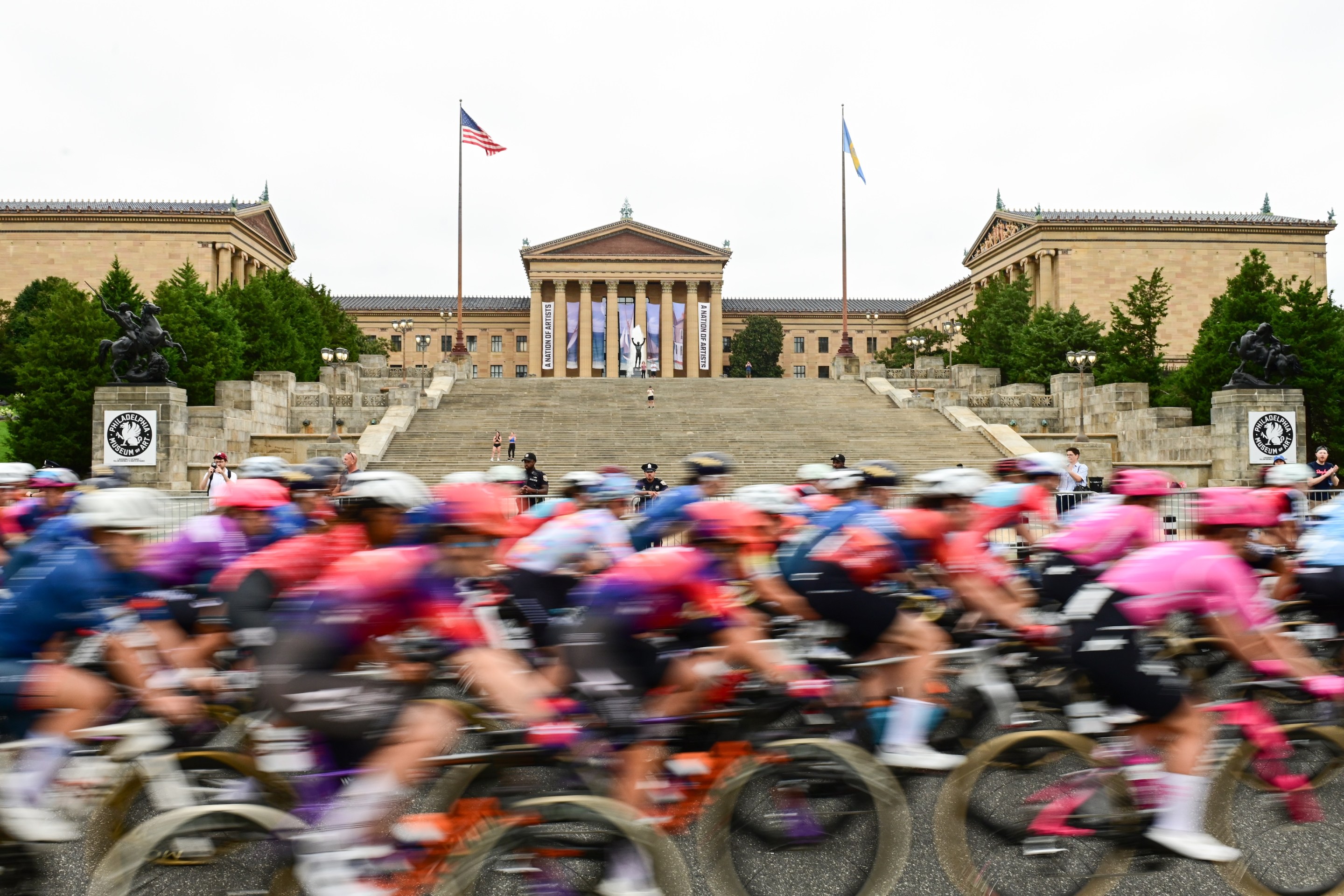
PHILADELPHIA — The Benjamin Franklin Parkway was designed in 1917 by French architect Jacques Gréber in the European style of boulevard, specifically inspired by the Champs-Élysées, which means it is a thematically apt and suitably picturesque locale for the end of a cycling race and a horrible—I mean absolutely dogshit, for all involved parties—road. On Aug. 30, the first Philadelphia Cycling Classic in a decade, by simple virtue of being a cycling race that necessitated mass closure of roads to their invasive predators (cars), rendered the Parkway back down to its theoretical beauty: a shaded, expansive corridor connecting City Hall to the Philadelphia Art Museum, one which happens to be flanked by flags.
Pedestrian traffic was dictated by volunteers in bright orange shirts. Sometimes the impending cyclists were well-telegraphed by the blaring horns of incoming organizer cars, but other stragglers were conveyed by word of mouth. "Batter up!" one volunteer yelled, before the whistling and cowbells commenced for a lone cyclist. When the volunteer waved a crowd of pedestrians by to the shaded side of the road, she directed us to pause halfway and look to the left for potential cyclists.
I stood somewhere between India's and Iceland's flags to watch the final stretch of the women's race, mostly on a gigantic screen set in the middle of the road. The crowd was a mix of locals, legitimate enthusiasts of the sport of cycling, more general enthusiasts of cycling in general, and foreign tourists. To my left were three older men who had done some amateur bike races before. To my right, past India, was a crowd of spectators sitting on bleachers.
As with most racing sports, it is much easier to follow on television than in person. The TV showed the riders' final ascent up the Manayunk Wall six miles away in Northwest Philly; the smaller, final loop about Lemon Hill; the Iroquois sculpture in Fairmount that meant the riders would arrive at the start-finish line soon. It showed, in the final moments, an EF Education–Oatly rider trying, and failing, to convince others in a small breakaway group with a meager lead to pull with her, the group bunching up again for a sprint finish, and a crash in the peloton that threw everything into disorder. And then it showed Canyon-SRAM's Chiara Consonni sprinting for the victory.
But what watching in person lacks in context, it more than makes up for in intensity. Watching the approaching cyclists while pressed up against the barricades, one thinks they can imagine what it will be like to see everything. But mostly it is a blur, wind brushing past. Tens of bodies, some inches away, flashing by between an inhale and an exhale.
With all the road closures, local SEPTA bus lines that would ordinarily lead directly to Manayunk were detoured. Perhaps it still would have been possible to take the 9 or the 124 if necessary, but it was very difficult to tell, thanks to SEPTA's inscrutable detour map, which the agency is now, I can only assume, trying to erase from memory. Thankfully, there was still regional rail, and PHLASH was running a free shuttle from around the Parkway to Manayunk. There was enough time between the end of the women's race and the start of the men's to travel to Manayunk. The walk to the shuttle passed by a crowded fan zone. The bus itself was full of spectators when it pulled away, including a chatty older man who helped provide context for the race.
The last edition of the Philadelphia Cycling Classic was in 2016, before the race was canceled for lack of sponsors. One spectator on the shuttle complained about the commentary repeatedly emphasizing the AmeriGas propane distribution company. "I wish they'd tell me who these people [the cyclists] are, but thank you to AmeriGas," he said. Thanks to AmeriGas—and, more earnestly, local community organizers—the race has been resurrected, though perhaps not at nearly the level of global significance in once boasted.
"Back in the day, Lance [Armstrong] won a billion dollars here," the older man said. He said that Manayunk in particular was perfect as a race course because of the number of local bars and dives there. He said that in the last edition of the race, there hadn't even been a helicopter to take overhead footage. He spoke about, for some reason, Richard Carapaz at the Tour de France, and Sepp Kuss nearly going off a cliff.
For all the sponsorship struggles that plague American cycling, the temporary death of the Philadelphia Cycling Classic surely could not have been due to any local shortage of enthusiasm. Another spectator had done the charity race in the morning—"Well, some people treated it like a race," he said—that allowed people to make a loop of the course. Even then, early in the morning, there were people cheering for them.
If the Parkway portion of the race was a completionist loop of the primary cultural tourist destinations in Philly, Manayunk was just a neighborhood. The Manayunk Wall itself, which peaks at a 17-percent grade, runs from Levering Street onto Lyceum Avenue through a residential neighborhood: porches, stoops, things of that nature. The crowd on the Parkway had nothing on the crowd in Manayunk. On my walk down, before the race began, I passed by a half-dozen house parties, some pumping music. A roofing company strung together three signs across the porch to advertise. A banner on one porch declared the Manayunk Wall "the Alpe d'Huez of Philadelphia." Signs taped by the race organizers to the barricades and telephone poles implored fans to "Enjoy the Philadelphia Cycling Classic RESPONSIBLY!" expressing a "ZERO-tolerance" policy toward such things as public urination. A man embarking on the much-harder quest of going up the wall compared the elevation change to Pittsburgh.
The most wonderful things about a neighborhood cycling race are, first, the sense of community and, second, the ready availability of things to do other than simply watching the race. Manayunk's Main Street is crowded with local bars, all of which had their doors and windows open to look out onto the race. The men's race started while I was on Main Street; a dog dutifully made way for me to watch at the barricade as an early breakaway led out the rest of the peloton onto Levering Street to cowbells and raucous cheers.
In the 20 or so minutes in between laps, Main Street was mostly just a pedestrianized road. I joined a wave to cross the street and go grab lunch, where I could see the race from the upstairs window as I sipped a shooter of tomato soup. When the riders passed by for the second time, the waitresses in the mostly empty restaurant excitedly ran to the window. "Did it start?" one asked. Then she laughed. "I have no idea what's going on!" Another was sad to have missed seeing the riders come by, and delighted to learn that there would be plenty of other opportunities.
I debated the benefits and merits of trying to go back up the Wall to see the riders climb. On one hand, I would almost certainly regret not doing so. On the other, I was worried the sidewalks would be too cramped for easy movement, or the barricades too crowded to cram around. Neither were concerns, thanks in part to the diffusion of spectators across porches and, in one case, a woman who had clambered out of her window to sit on a chair on her roof, holding a sign that said, "I've seen drunks walk this faster." I passed by a seating arrangement of two lawn chairs, a wooden bench, and two wooden dining table chairs. Due to a lack of foresight, I failed to count the number of dogs I saw across all the barricades, but the number certainly reached double digits.
The Wall was the only place to see riders for more than a few seconds at the time. All respect to the lady with the sign, I'm not sure I have seen drunks walk up a slope as steep as the Wall before. I settled at a bend next to a fan who was cheering loudly for Quinn Simmons, really the only spectator I would hear rooting for a specific result. He shouted, as the school of cyclists moved past at a comprehensible speed, "Come on, Quinn! Let's go, Quinn!" (Spoiler alert: Simmons would, as an upset, not actually win the race; that honor would go to Tim Torn Teutenberg, whom I now consider a Philly legend.)
After the peloton went by and out of sight past a left-handed bend, another reason for the lack of overcrowding became apparent: Some spectators cycled out to grab a meal or find another spot to watch, and others would cycle in to take their place.
The men's race began at noon and would not be over until after 4 p.m. Unlike most other sporting events, the Philadelphia Cycling Classic is set in the local neighborhood streets of a city and has enough repetition to free up time to do other things. I grabbed a second coffee, popped by some very specialized bookstores (in order: romance, comic books, horror), and walked to West Laurel Hill Cemetery to visit Dan McQuade.
Without the race, the walk would likely have been unpleasant. The sights along the road were mostly just warehouses and nondescript apartment buildings, but with only amateur cyclists riding the route as an auditory backdrop, it wasn't so bad. The Pencoyd Bridge has a lovely pedestrian walkway. Progressing through a tunnel onto a windy, sidewalk-less road leading to an entrance to the cemetery, I experienced only one or two moments of bodily fear of being run over by a car. I walked up to roughly where I remembered the burial being, though most of February has melted together in my memory, and I had a hard time reconciling with how everything now looked all green and blooming. I couldn't find Dan, in the end, but I think I passed by close enough to say hello.
Dan would have had recommendations for where I should go eat lunch, and opinions on where I had eaten lunch without his recommendations to go by, and oddities to check out. He would have also had thoughts on the race itself and almost certainly would have known or uncovered weirder and more specific things about it than I had overheard. At times I am overwhelmed by the concept of anything more than one or two months into the future. I thought, standing at the Manayunk Wall, that next year I should drag more people here with me, and then was bowled over by an over-blooming sensation of scope. Things happen: a crash in the peloton, two meters before a cliff, a car, whatever.
On the Parkway, as I was watching the ending of the women's race, I tried to get a photo of the peloton on an old film camera my friend gave me. The first time they zipped by, I underestimated the speed and proximity with which everything passed. "They went so fast, I tried to get a picture, but I think I missed it," I told the woman next to me on the barricade, inanely. The riders looped back around, out of sight behind the art museum, then around Lemon Hill; as they came back down Kelly Drive, the woman looked and me and said, "Well, here you go, you get another chance!"
I walked back across the Pencoyd Bridge, as the sky started to spit without much conviction. A few minutes into the walk back down Main Street, I heard behind me, quickly approaching, the sound of organizer car horns and cowbells and cheering: Of course, the race was still going on.