


I can't say that "amount of that dog in them" has always factored into my evaluation of a tennis prospect, but it should, and with Mirra Andreeva, it was always the central factor. In civilian life, being well-adjusted as a good thing, but in tennis, its opposite can be a kind of performance-enhancing drug.
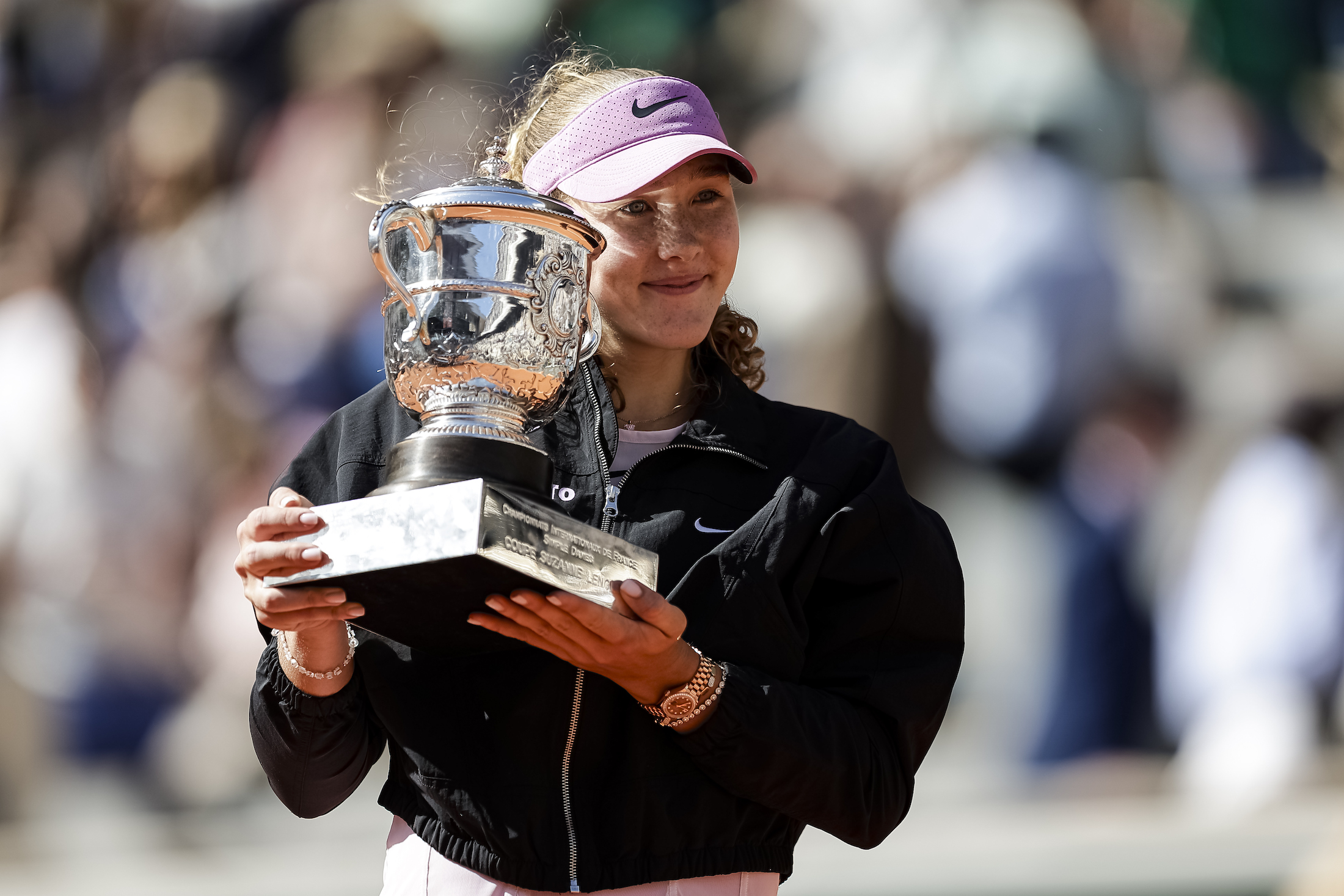
Back at the 2024 Australian Open, Andreeva was a 16-year-old flying into the fourth round. To get there, she had to make a dramatic comeback from 1-5 down in the third set. During the match, she bit her own arm in anger. Noted grit-possessor Andy Murray admired her grit as he watched on TV. Andreeva played astounding tennis, and more astounding still is what she said after, when most players would have been awash in gratitude. “Fourth round is nothing," she said afterward. "Maybe if I win a Slam, I have to win three more matches, and it’s really tough to win seven matches in a row. I don’t think that I did something incredible. I have time to do it, I hope." From that fearsome moment onward, I knew she would win one of these, and on Saturday, she completed that quest, winning the Roland-Garros title 6-3, 6-2 over Maja Chwalinska.
In the years since proclaiming that the fourth round of a major—which would amount to a lifetime accomplishment for the vast majority of tennis players, not least a 16-year-old—was "nothing," Andreeva has only refined her game. Back then she already had the technical and tactical foundation in place, especially her note-perfect backhand, smooth movement, and ability to anticipate her opponent's next play. In the years since, she's become taller and stronger, and the teenage counterpunching has matured into a more assertive game style. On top of the already cunning point construction, she's been able to juice up the groundstrokes; over the last season and change she's even become an excellent server, which is more of less a prerequisite for a multi-Slam champ in the modern game.
Andreeva's partnership with Conchita Martinez, herself a former teen prodigy who rose as high as No. 2 in the world, is one of the game's best player-coach relationships to follow. That's because it's hilarious to watch a good-natured personality like Martinez wrangle a pupil as challenging as Andreeva, who admitted once that she can be "a little brat." In recent months, the brat-like behavior manifested as a tantrum at Indian Wells that climaxed with her yelling "Fuck you all!" twice at the crowd on her way off the court as a spectator literally clutched at her necklace. Then came a third-round match at Madrid, where she blew a big lead in the deciding tiebreaker and, at the change of ends, told her box, "I’m not a champion. I’m not a champion. I will lose." (She went on to win.)
Andreeva has made a habit of thanking herself in her victory speeches, which was initially inspired by Snoop Dogg. When she won the title on Saturday, her sponsor was ready to go, outfitting her in a jacket that had printed on it, twice, "I want to thank myself." Later she showed up in Martinez's press conference and asked her coach a question: "What is the best thing about working with Mirra Andreeva?" Martinez said she liked beating her charge at Uno. "That's it? Have fun," said the newly crowned Roland Garros champ, before leaving the press conference room. A laughing Martinez shouted, "I'm fired."
This was an anarchic Roland-Garros from start to finish, and Andreeva's opponent in the final was a major source of that anarchy. The diminutive Chwalinska, who was ranked No. 114 before the tournament, won three rounds of qualifying to enter the main draw, then took out four seeded players with her thrilling brand of junkball: choppy two-handed slices, moonballs, unpredictable changes in depth and height, dropshot-lob combos, ghosting forward to the net. Chwalinska embodies all the touch and court sense that the old heads complain has been stripped out of a sport now dominated by blind power. I'm eager to see what aspects of this miraculous run translate to future tournaments and court surfaces, now that she's rocketed up 93 places in the rankings and will have easy entry wherever she likes. It's fun to see her machinations at work, and she got traction for a brief spell in the first set, when she led 3-2, before Andreeva won nine games in a row to close out the competitive portion of the match. Unlike the opponents that Chwalinska toppled on her her way to the final, Andreeva boasts qualities that immunized her to that tricky game style: a return game good enough to immediately punish weak serves; enough change-of-pace tricks in her own bag, including a great forehand slice; rally tolerance to survive long and weird points; net skills honed by plenty of doubles play. What worked against, say, Qinwen Zheng or Diana Shnaider wasn't going to work against Mirra Andreeva.
Though she has beaten them all in the past, this final didn't require Andreeva to take on any of the tour's three dominant players: Iga Swiatek, Aryna Sabalenka, or Elena Rybakina. But it still required her to navigate windy conditions, a crowd largely pulling for the underdog, and the novelty of her first Slam final after years of anticipation and expectation. Future tests may be trickier, in pure tennis terms, but she has already locked in one. Not that anything about her brief and tempestuous career indicates that she'll rest on her laurels. One Slam is nothing, after all.


![USA's Ben Shelton celebrates his win against Spain's Carlos Alcaraz during the men's singles quarter-final tennis match on day ten of the US Open tennis tournament at the USTA Billie Jean King National Tennis Center in New York City on September 9, 2026. (Photo by Leonardo MUNOZ / AFP) / “The erroneous mention[s] appearing in the metadata of this photo by Leonardo MUNOZ has been modified in AFP systems in the following manner: [USA's Ben Shelton] instead of [Spain's Carlos Alcaraz]. Please immediately remove the erroneous mention[s] from all your online services and delete it (them) from your servers. If you have been authorized by AFP to distribute it (them) to third parties, please ensure that the same actions are carried out by them. Failure to promptly comply with these instructions will entail liability on your part for any continued or post notification usage. Therefore we thank you very much for all your attention and prompt action. We are sorry for the inconvenience this notification may cause and remain at your disposal for any further information you may require.”](https://lede-admin.defector.com/wp-content/uploads/sites/28/2026/09/GettyImages-2293730421.jpg?resize=2880%2C1920)