
Before Sunday, Wout van Aert's professional cycling career looked most like a testament to the irresistible force of entropy.
Before Sunday, the Belgian had never won either of the two biggest one-day races on the calendar, suffering untimely crashes and mechanicals, always seeming to get injured at the wrong time, and occasionally being a victim of his own strength, the sort of rider nobody would work with. Before Sunday, van Aert's glaring inability to win Paris-Roubaix—the race that means the most both to him personally and to Belgian fans collectively—despite finishing in the top 10 all the time, and looking like one of the most talented and natural bike riders of his generation, had begun to feel like it would be the first line when the story of his career was written. Before Sunday, you could look at van Aert as a tragic figure, haunted by the twinned misfortune of regular-old bad luck on the bike and the bad timing of happening to race at the same time as Mathieu van der Poel and Tadej Pogacar. Before Sunday, you could get away with saying "Wouth Place," to denote a specifically van Aertian genre of bungled win. Before Sunday, you could look at van Aert—world cyclocross champion, one-time Monument winner, author of defining Tour de France performances—and see a rider who could have been more, a 31-year-old who wasted the best chances he would ever get to take a career-defining win. Before Sunday, you could read van Aert's 10 top-10s and zero wins at the two cobbled Monuments as a reminder of cycling's cruelty and painfulness, that losing is the background radiation of the sport and that winning offers but a temporary escape.
After Sunday, nobody will ever look at Wout van Aert that way again.
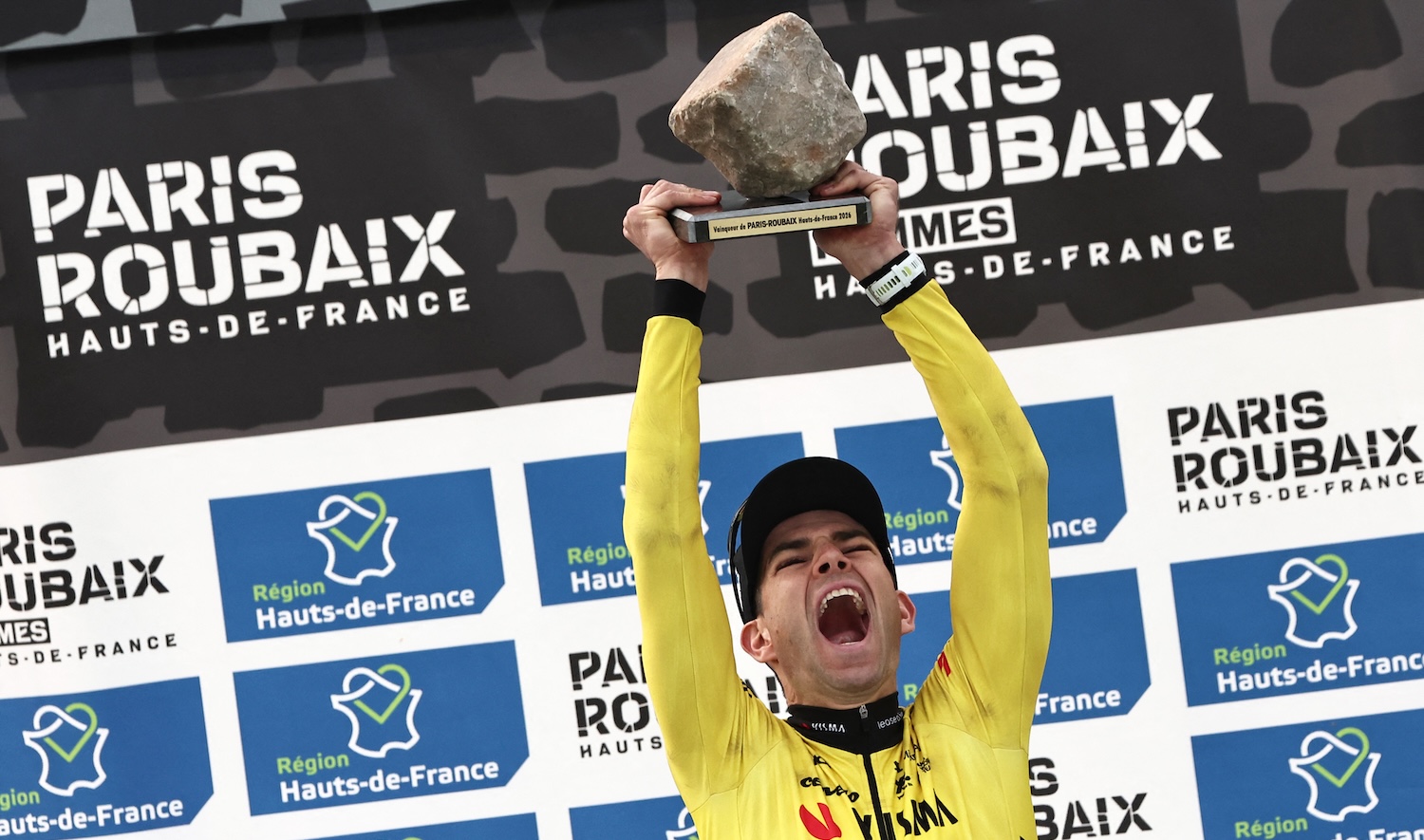
Van Aert won the stunning 123rd edition of Paris-Roubaix after five hours and 16 minutes spent bouncing over thousands of jagged cobbles, riding into the Roubaix velodrome with Tadej Pogacar and dispatching the world champion with an authoritative sprint. This will feel like redemption, the sort that will cast the preceding nine seasons as prologue to van Aert's triumph. But I don't think we should forget the times van Aert fell short, whether by hubris, bad luck, or soul-shredding proximity to the sport's pair of immortals. Without those trials, Wout van Aert wouldn't be the rider or champion he is today; not only do they make his win all the more satisfying, they suggest something much grander about the generative power of failure. Losing, for van Aert, is not the omnipresent condition from which rare, precious wins are quarried, but rather the substance that winning is crafted from.
Pogacar and his dominant team dictated the action, as they do in every race they contest. UAE seized control early, refusing to allow an early breakaway to ride up the road by maintaining a furious tempo. The theory was to make the race as difficult and selective as possible so other contenders would be isolated and exhausted when the time finally came for Pogacar to attack, since winning virtually required him to enter the velodrome alone. By the time the serious positioning battle within the peloton started ahead of the ferocious Trouée d'Arenberg, Pogacar, van Aert, and several other big-time contenders had suffered a series of mechanical issues, forcing them to churn through spare bikes and spend precious energy chasing back on. It was a fast, nervous race, a reminder that Paris-Roubaix is survived, not tamed.
But everyone who mattered was there, 100 kilometers from the finish, when van Aert's Visma team played their first card: Matthew Brennan. Van Aert glued himself to the young British hotshot's wheel as Brennan turned himself inside out for five minutes, only peeling off once he'd delivered his team leader to the cobbles in first position. (Brennan was spent; he veered off the front as if he'd led out Jonas Vingegaard into a Tour de France climb.) Van Aert then took over, drilling it hard and forcing what would turn out to be the decisive selection on the day. Halfway through the forest, van der Poel suddenly veered out of the pace line to van Aert's left. The three-time defending champion's bike was exploding.
The Arenberg forest is home to the most foreboding stretch of road anywhere in the cycling season. It is not just that the road is a rotting mouth of unbrushed teeth reaching up to gnash riders' wheels to pieces. Arenberg is too narrow for team cars to get in good position to help the dozens of inevitable punctures and flats that the road produces. In other words, disaster struck van der Poel at precisely the worst possible moment. After the mechanical failure, he flagged down his teammate Jasper Philipsen and took his bike, but found himself unable to clip in. Van der Poel walked back to retrieve his own bike, which Tibor del Grosso was helpfully fitting with his own front wheel. The Dutchman got going, only to puncture again before getting out of the forest. By the time he'd cleared the trench, he was two minutes behind a large, determined group of strong riders.
Thus the dynamic for the rest of the day cohered. With van der Poel going all-out to cut into the gap, the rugged lead group looked to Pogacar to hold him off. The world champion was now isolated, as Florian Vermeersch fell hard in Arenberg and was forced to abandon. Van Aert was in perfect position, with teammate Christophe Laporte in the group to look after him and let him conserve his energy for the fight to come.
Over the next 45 minutes, poor Filippo Ganna made his way out of then into then back out of the group, a bunch of Red Bull guys fell victim to bad luck, and van Aert and Pogacar both got onto new bikes and had to spend fuel to power back to the relative safety of the group. Meanwhile, van der Poel improbably narrowed the gap to as little as 20 seconds. Pogacar was not too excited about towing heavy hitters like van Aert and Mads Pedersen around, but the group recognized its common need to put van der Poel away before he could work another miracle, so enough riders chipped in to keep the Dutchman just out of reach as they collided with the Auchy-lez-Orchies à Bersée sector.
That's the moment van Aert won the race. He attacked just before the cobbles, hitting the sector at speed and with a small gap. Pogacar quickly leapt onto and past his wheel, shedding the remnants of the group in the process. The two riders realized the race was theirs if they wanted it, formalizing an uneasy alliance.
At this point, Pogacar's win condition was as clear as it was difficult: He had to ditch van Aert. Pogacar repeatedly attacked on the cobbles, smoothly accelerating away, yet van Aert never let him keep a gap, visibly throwing his big body forward across the adversarial terrain. Pogacar even made a move on an uphill section of tarmac, but nothing could dislodge van Aert. They mostly worked together, though van Aert played his hand perfectly, understanding that Pogacar had more of an incentive to keep van der Poel and Laporte away. This meant he was taking pulls when it mattered less, and sheltering within the lee of Pogacar's wheel for prolonged stretches.
After Pogacar's back wheel slid out on the Carrefour de l'Arbre, he made a miraculous recovery but seemed to lose his nerve, accepting that he was not going to get rid of van Aert. For his part, the Belgian finally had luck go his way, as his bike did not explode before getting to the velodrome. Pogacar, the man who had won every race he entered this year, would have to beat van Aert, a two-time Champs-Élysées winner, in a sprint.
He did not. Unlike the times Wout van Aert crashed, punctured, crashed and punctured, missed the winning move, suffered debilitating injuries, suffered debilitating illness, went too early, or went too late, he was finally in position to win, and he did, leaving no doubt in the sprint finish. The gathered thousands roared and watch parties around the world exploded in histrionics. Every cycling fan I know admitted to tearing up, as did van Aert, overwhelmed with the pure crystalline emotion of ecstatic joy. He pointed to the sky, paying tribute to his former teammate Michael Goolaerts, who suffered cardiac arrest and died during van Aert's 2018 Paris-Roubaix debut. After crossing the line, van Aert collapsed, sobbing, as van der Poel and the others left strewn in his wake came to congratulate him.
"Winning this race means basically everything to me," van Aert said at the finish. "You never stopped believing," said the TV interviewer, an assertion van Aert disagreed with. "I did stop believing a lot of times," he said. "But the next day, I always woke up and fought for it again."
In other words, there was nothing to be redeemed. Sometimes you eat shit, sometimes you win. Either way, you keep riding. Van Aert broke his ankle in January; he was riding nine days later.
It is perfect that van Aert's mythical cobbled Monument win came at Paris-Roubaix, not the Tour of Flanders, because the Hell of the North is the single most punishing race on the calendar. I mean that both physically and also in the sense that it is a race that must be survived as much as it can be won. Paris-Roubaix extracts its pain toll from everyone. The winner isn't necessarily the race's strongest rider, but rather its least harmed. Strength, luck, and skill matter, though not without persistence. Van Aert was both the most persistent rider and the smartest on the day, playing every decision more or less perfectly. He's done that before plenty of times, only today he was also lucky; rather, he was not unlucky.
Van Aert is among the most beloved riders in the peloton. As I watched him and Pogacar circle the velodrome, not realizing I had forgotten to breathe, I pondered why that is. While Pogacar and van der Poel are more accomplished and have legions of supporters who shower love on any road they race on, their stories are unrelatable. Van der Poel races as if he were born spontaneously from some crook in the cobbles, an almost elemental cycling spirit, while Pogacar's insatiable hunger and streamlined perfection are alien wonders there to be marveled at. Both men are uncannily lucky but, crucially, both have experienced the same generative failure van Aert has.
It's just that their narrative arcs were shorter. Their persistence has not been called upon, stretched and tested like van Aert's has. To return to the notion of Wout van Aert as tragic figure, bound to burst into atoms before winning the big one, what defines him as a competitor is not that he's fallen short so many times, but that he has fought back to the top so many times. There is no entropy to van Aert's story, just a long, harmonious spiraling into control. He has the win of a lifetime. What follows will be, simply, more. That's what racing is.