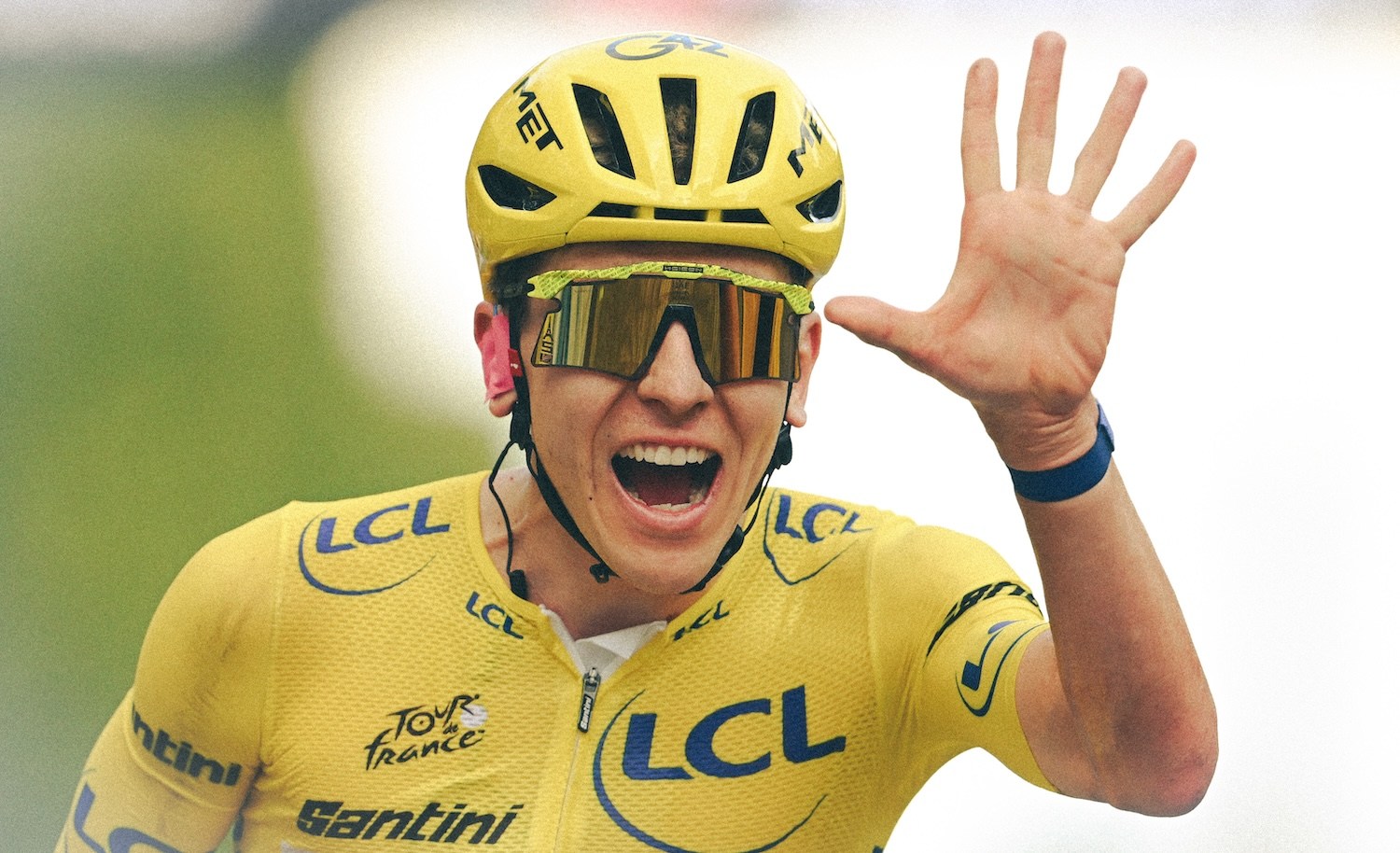

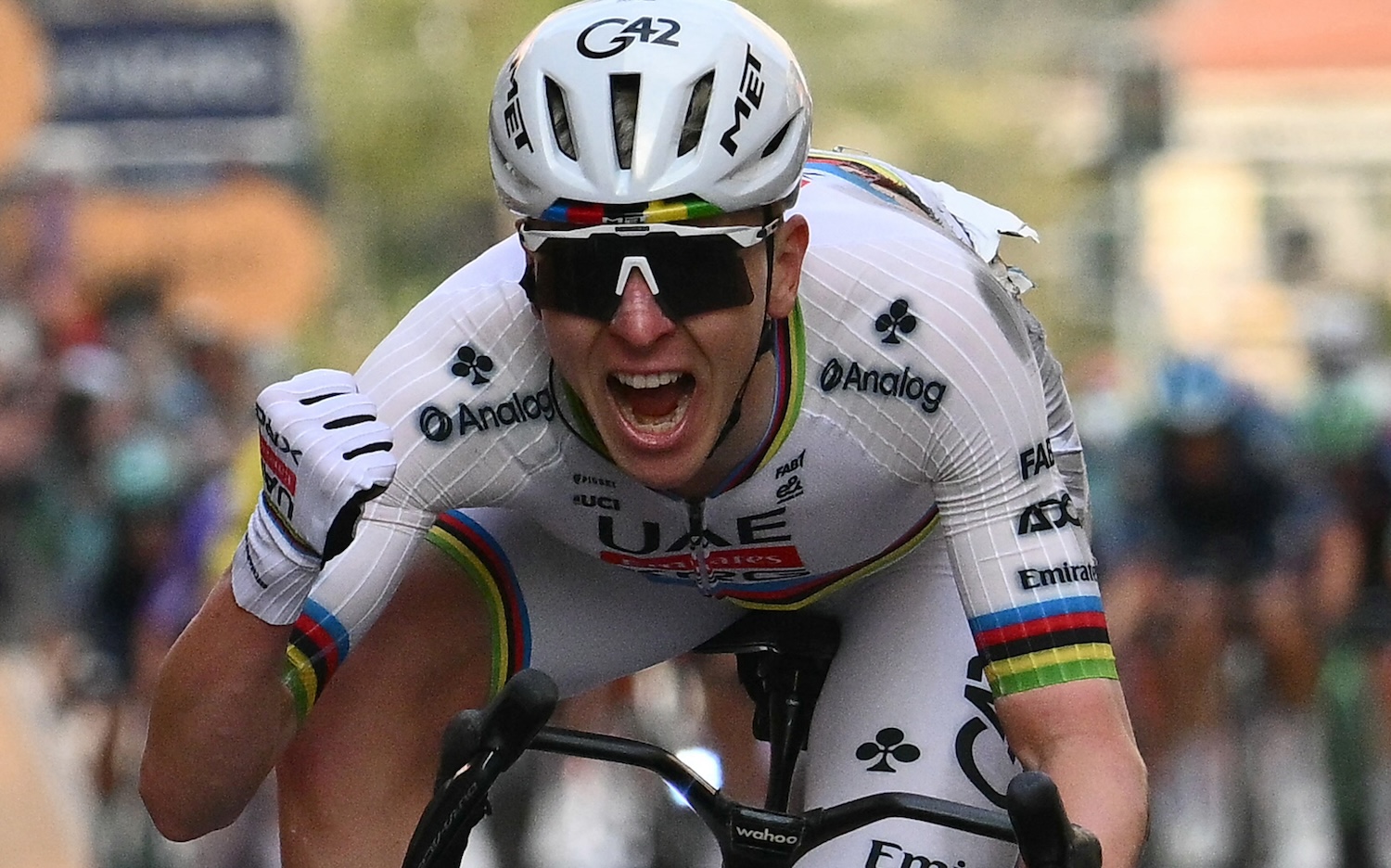
Here is a loose rule that you can use to determine whether or not Tadej Pogacar is going to win a bike race: If you can see the flank of an asscheek protruding through his tattered skinsuit, nobody is beating him.
One year after winning Strade Bianche with his butt flapping in the wind following a heavy crash on a descent, Pogacar again fell hard just before the business end of Milan-San Remo on Saturday. The Slovenian world-conqueror was deep into his second attempt at winning La Classicissima when he went down at what felt like the worst possible time, mere kilometers away from the foot of the Cipressa. The race's penultimate climb was the springboard from which he and Mathieu van der Poel launched their winning move last year, and it was once again the lynchpin of his team's strategy. With his left flank spangled with gore, could Pogacar recover in time to make a move? Would he even have the juice to make such a move stick?
Absolutely, yes. Pogacar won in a photo-finish sprint against Tom Pidcock on the Via Roma, after six-and-a-half hours of racing. He has now won four of the five Monument classics, not to mention almost every single other moderately significant race in the sport. Tadej Pogacar has nearly completed cycling at age 27, though unlike so many of his previous classics wins, this was no procession. Pogacar had to scrap for his place in history.
Milan-San Remo is the most structurally interesting race in cycling. There is nothing like it: 270 kilometers of uneventful riding across the Po Valley, where little happens except for a gradual softening of legs ahead of the finale, which is the most exciting 15 minutes in bike racing. The Cipressa and the Poggio, the two climbs that face the riders in the final 25 kilometers, are objectively unspectacular. Because of where they are in the race, however, they are always decisive, and often in surprising ways. Sometimes a daredevil flies away on the final descent and stays away, sometimes a bunch of guys escape on the Poggio and contest a really goofy sprint, and sometimes nobody gets sufficient enough distance from the peloton and a sprinter wins.
The theoretical problem facing Pogacar here is that Milan-San Remo simply isn't hard enough for him to destroy the field from a long way out then stay away. The topographically interesting parts of the race are too close to the line and too gentle for him to get the sort of gap that forces commentators to spend the final, anticlimactic hours of races discussing his legacy. He would have to fight with other guys, many of whom can outsprint him—namely, last year's winner Mathieu van der Poel. That competitive dynamic is part of what makes Milan-San Remo so special: The two finishing climbs are not so difficult that the big-dog sprinters can't get their cartoon-ham quads over the top. If you wanna beat those guys, you have to make sure your group gets to the finish before theirs. Van der Poel is the only rider who's beaten Pogacar with any regularity over the past three seasons, because he can sometimes match his uphill power and can almost always outsprint him. Unlike most every other race, there's no easy path for Pogacar. Being strong would not be enough, he would have to be the best racer on the day.
Which brings us back to Pogacar's crash before the Cipressa. At that point, third-in-command Jan Christen had already crashed out, leaving Brandon McNulty in charge of bringing Pogacar back to the front. The American put in a heroic turn, nimbly squirming his way through the peloton and all the way to the front right on time to turn on the jets. First McNulty and then Isaac del Toro started hammering it, an obvious setup for a Pogacar attack. When the world champion went, only Tom Pidcock and van der Poel could follow, though right away, the viewer could see a slight lag to van der Poel's response. Pogacar's breakmates wisely forced him to do the majority of the work, and the trio opened up a 30-second gap by the time the chase organized itself.
A heroic turn at the front from Trek's Mathias Vacek, master of the heroic turn at the front, reduced the gap to nearly 10 seconds by the foot of the Poggio, though it was clear by this point that Pogacar wasn't coming back. This is the point of going on the Cipressa: keep any climber-types off your wheel while forcing anyone working for a sprinter to do a ton of work. When they hit the Poggio and Pogacar attacked again, van der Poel was instantly distanced, hanging his head in pain as Pidcock dutifully held Pogacar's wheel. Pidcock flirted with attacking down the backside, though they rode into town together.
Knowing that Trek and Alpecin were organizing a chase, Pidcock had to work a little to make it to the line with Pogacar, and though he won the game of chicken and forced Pogacar to lead out the sprint, he couldn't quite power past him at the line. Pogacar won La Classicissima by half a bike length. Four seconds behind the pair, the people's champion Wout van Aert tried and succeeded in a bold solo attack, barely holding off the sprinters to get on the podium. Pidcock will be devastated to have been best of the mortals, in position to win after having raced a perfect race and out-powering Mathieu van der Poel only to lose on the line, but he has the consolation prize of knowing Pogacar won't be defending this title. "If I come back to San Remo, it will only be to eat focaccia," Pogacar said.
The only big races Pogacar has yet to win are Paris-Roubaix and the Vuelta a España. The latter is a formality if he decides he wants it, while the former is more suited to his trademark style than Milan-San Remo was, even if van der Poel will be gunning for revenge. The level of dominance he's exercised over the peloton has been impressive, though quite often very boring. I worried in the week before Milan-San Remo that Pogacar would find a way to strangle the suspense out of the most unwieldy one-day race too, running a solo time trial as the peloton gaped open-mouthed, nervously racing each other for second place. Dominance at that level is more boring in cycling than in any other sport, and thankfully Pogacar had to win it the hard way—which is to say, with his ass out. To return to that rule, it's ultimately redundant. The determinant factor in whether or not Tadej Pogacar will win a bike race is if he starts the bike race.