

Americans are forever returning to their origins, because we are always beginning again. At the start of the 20th century three-fourths of my ancestors were still in Europe; my mother’s parents did not come over until the end of the second World War. To think of all the accidents and contingencies that brought me here, to this laptop in this café writing about the latest film by James Gray, is enough to trigger vertigo in anyone. Where does my story start? With my birth, or when my parents met on an airplane, or when my dad’s grandparents met as new immigrants in Queens? Is it only beginning now, as I type these words? Has it even begun yet?
I think Gray might understand. A director of New York City crime sagas and classically-toned period pieces, his films probe the intimate in search of the mythic, and frequently achieve a kind of outer borough biblicality. Paper Tiger, his latest and quite possibly his best, is a story of shifting loyalties inside a Queens family called the Pearls. Irwin (Miles Teller) is an engineer, a “facts and figures” guy with a moderately successful small business, a house in Fresh Meadows, and a sea of expenses rising all around him. His wife Linda (Scarlett Johansson) wants to move to suburban Great Neck; his sons need tuition for private school and the Ivy League stamp that Irwin believes will vault them out of the ethnic middle class and allow them to achieve what their Pratt-educated father never could.
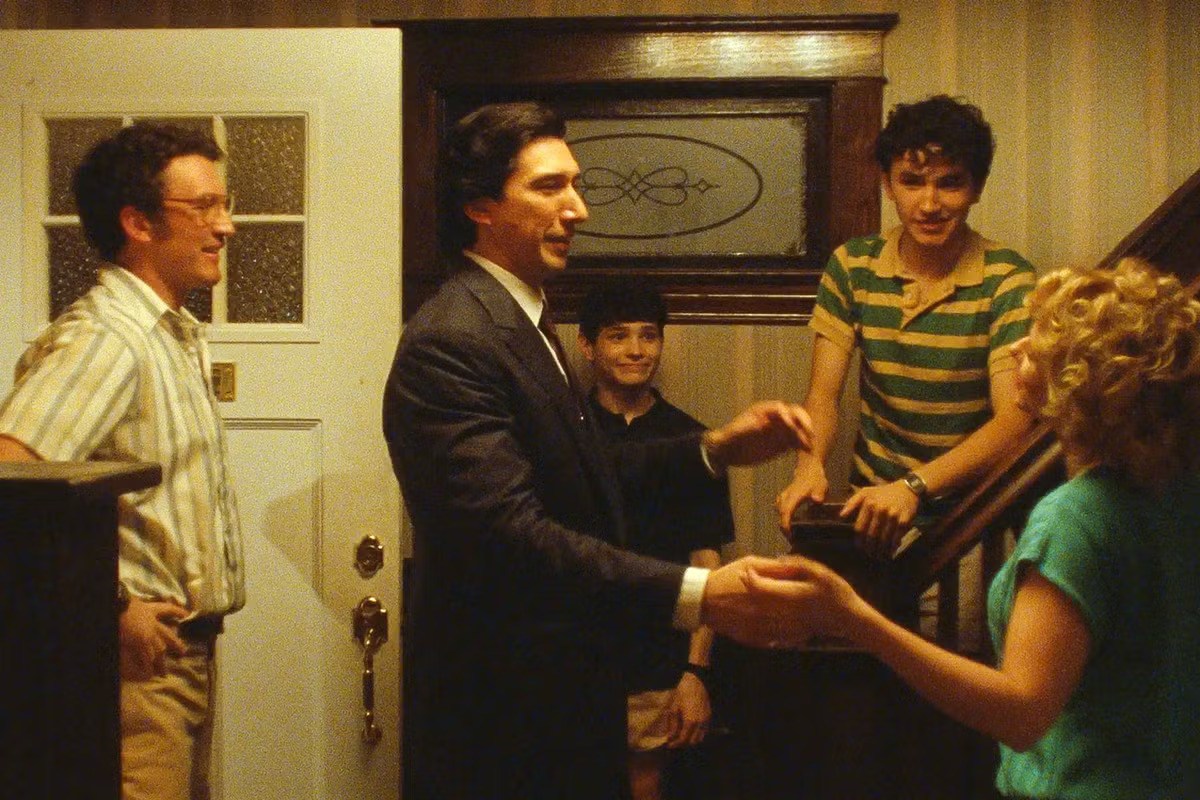
Over Labor Day weekend of 1986, the Pearls are visited by Irwin’s brother, Gary (Adam Driver), a recently-divorced ex-cop with shiny suits, a sports car, and seemingly liquid cash flow. Swooping into their two-story brick home with a steak meal hand-delivered from Peter Luger’s, he wants to cut Irwin in on a lucrative opportunity, joining their security and engineering knowledge to consult on the clean-up of the outlandishly polluted Gowanus Canal. New York is changing, the Italian mob is in decline, and the canal’s new landowners are all Russian Jews like the Pearls, though of more recent vintage. “Communism’s over,” Gary explains. “Everyone wants their piece of the pie.”
Today you can drive from Fresh Meadows to Gowanus in about 40 minutes, but in the 1986 of Paper Tiger, the gulf between them is of cosmic proportions. Then the most polluted waterway on the eastern seaboard, the canal shimmers with phosphorescent petroleum run-off, and its banks are lined with scrap piles, empty warehouses, and fly-by-night operations like the company that the brothers plan to help. It is a place of shadows, a murky zone where much is deliberately hidden, and the rest willfully ignored. By treating their new business as an essentially practical matter—one grounded in permit clearance and pollution clean-up—Gary and Irwin allow themselves to ignore the sketchy business hours and paranoid practices of their new partners, pocketing tens of thousands of dollars for barely any work. Finally, the American dream of easy money seems to be working out for the Pearls; finally, they’re about to get in on the ground floor.
Or maybe somewhere deeper underground. When Irwin makes an unannounced night-time survey visit to the clean-up site, he is ambushed by Russian mob enforcers, who beat him up, steal his ID, and threaten to kill his whole family. In the crime movie metaphysics, he is the civilian who wants only to dip his toe into the underworld, and ends up drowned. Yet Gary, the ostensible power-player, also seems out of his depth. After arranging a sit down with a Brighton Beach mobster named Semion Bogoyavich (Victor Ptak), he does everything—negotiating with friends in the NYPD, taking on an enormous debt—to get his brother off the hook. Everything, that is, except what Bogoyavich really wants: use his connections at the airports and Port Authority to aid Bogoyavich, and look the other way. “Be a friend,” says Semion. Unfortunately for Gary, he would rather be a brother.
Paper Tiger opens with a quote from the Greek playwright Aeschylus: “Let there be wealth without tears; enough for the wise man who will ask no further.” These lines, from Agamemnon, are delivered by the play’s chorus as they reflect on the Trojan War, a decade-long conflict sparked by an act of greed and ending in fire and ruin. “Let me attain no envied wealth,” they later say, “let me not plunder cities, neither be taken in turn, and face life in the power of another.” Better to be an honorable pauper than a king in bloody disgrace.
These are ancient, epic concerns, yet Gray has long deployed them, no matter the material. (At a New York Film Festival press conference, Gray and Driver chopped it up about the Sophocles play Philoctetes, while Teller gazed off into the distance.) Across nine features in the last 32 years, Gray has transformed a cop drama into a treatise on brotherly love; explored the relationship between familial responsibility and civic corruption; examined the self-warping dimension of the immigrant experience; and even traveled past the edge of the solar system in search of an absent godlike father.
There is tremendous range here, but the details emerged much closer to home. Gray was born in 1969, and grew up in a Russian Jewish household in what he once described to the New Yorker as “the Archie Bunker part of Queens.” He was an artistic kid, with little support from his family. His parents were professors at Queens College and the New York Institute of Technology; both seem to have been distant and tremendously depressed. In the mid-’90s his mother died of glioblastoma, and his father pled guilty to bribing a city official and billing the MTA for undelivered parts.
Gray parceled out bits of this story into his different films: maternal illness in Little Odessa, transit fraud in The Yards. There are many imperious but impotent fathers, powerful but corrupted elder brothers, young men constantly stumbling past the boundaries of what society and family will permit. His first three films, all outer-borough crime dramas, shuttle between the city’s metropolitan core and its ragged peripheries: Coney Island, Flushing, Brighton Beach. Yet they are more like neorealist family dramas, majestically elemental in their images of abandoned factories, frozen winter streets, riverside patches of sawgrass and reeds. Even as he expanded into romantic tragedies and historical epics, his style has remained pointedly classical in its tension between the gorgeously composed and the vividly real.
Yet however much I love these earlier films (Two Lovers and The Immigrant are particularly good) there is a kind of distance to them, a studious peering-in on a world of criminals and gangsters to which the films do not really belong. A film like We Own The Night transcends simple cop/criminal binaries, unearthing crime at the heart of mundane domestic life. But its characters often fall prey to the systems they inhabit, and their individual stories end up dwarfed by the grand drama unfolding around them. They feel incidental, and perhaps they are. Yet Gray is so adept with gesture, and so keenly delivers the shock of self-revelation, that you sometimes wish there was more to be revealed. Gray seemed more comfortable and commanding at being inside of a moment and a system than within a relationship or a psyche. In his adroit grasp of genre, and his reverence for the different wings of the New Hollywood—Coppola, Scorsese, Lumet—he has sometimes drifted a bit too far from himself.
Perhaps Gray even agrees. His 2022 film Armageddon Time adapted a short period of his own childhood, when he was moved into private school, and into the orbit of upper-class Queens. The narrative drips with guilt over the opportunities for social mobility and escape offered to young white men like himself, but it only comes fully to life in scenes involving his parents, played by Jeremy Strong and Anne Hathaway as members of the working middle class, ground-down and exhausted by their inability to fully transcend their origins.
Their generation has long been Gray’s core subject, and he planned to bring both actors back for Paper Tiger. I’m glad he didn’t; the film works better without a sequel framework, and gifts his new stars with a chance to do career-best work. Johansson replaces Hathaway’s steely rage with a kind of dazed remove, a stunned inability to communicate the sudden catastrophe unfolding all around her. Teller is even better, so bumbling and sentimental and absolutely unprepared for the disasters to come. These changes all make Paper Tiger a significantly more probing work, a clear-eyed plunge into the formative disillusionment of the director’s private and artistic life.
Here is a story about the love between brothers, but also the silence within a family, the harm done when partners in a marriage decide to shield one another from disasters to come. Irwin hides the mob threats until they break into the family home; Linda, for her part, conceals a terminal brain cancer diagnosis from her husband and children, a deception which empowers her to speak about the Russian mob with the FBI. Gary’s attempts to handle the situation founder on his unwillingness to either take a bribe or to rat his brother out; this looks like integrity, but it is also an annihilating arrogance.
This is all the stuff of grand crime drama, but for the first time Gray approaches the material without the shield of genre. He is revisiting so many of his past gestures, right down to a climactic shootout in a field of reeds. Yet Paper Tiger feels cumulative rather than repetitive, a skeleton key for his output to date. Gary, Irwin, and Linda feel like inhabited characters, not described archetypes viewed from afar. Gray’s swift, assured images convey the immense sweep of private life, a zone inescapably touched by the movements of wider society but fundamentally intimate in its contours. The film’s grainy stock and orchestral score promise something gorgeous, classic, but the results are darker, murkier, more shadow than flash.
In their journey from Fresh Meadows to Brighton Beach, the open market to the black, the Pearls stand in for a whole frustrated generation, believing itself fundamentally in the right, yet willing to bend any rule in its favor. Gray has spent his career peering into the world that made him; with Paper Tiger, he has finally allowed himself back inside.