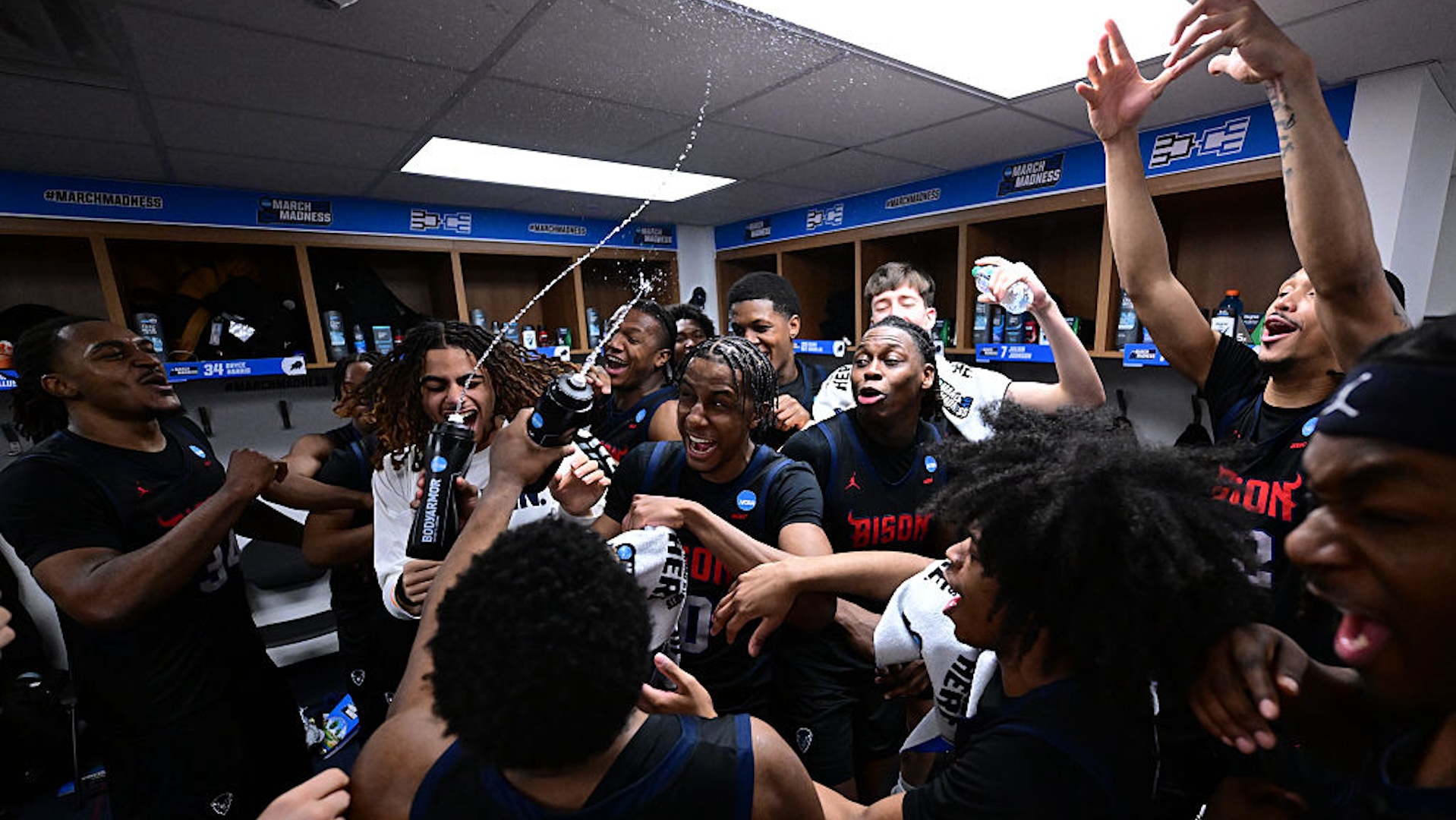
March came in like a lion last night. An off-balance three-pointer from UMBC at the buzzer caromed off the backboard, allowing Howard University to survive a crazy and clutch comeback and advance to the main pool of the NCAA men's tournament.
Howard’s win, which was in a “first four” play-in game but is being accepted as the first March Madness win in school history, made me really happy. Like all of D.C., I need bread and circuses out the wazoo these days. But there’s more to it here. Howard University’s sports have been a punchline or worse my whole life, and since before I was even around, and that's a mighty long time.
I learned too much about Howard’s athletic awfulness when I covered D.C. sports for Washington City Paper, beginning in the 1990s. My education started when I wrote about the school’s 1996 basketball team, which was in the middle of the worst losing streak in the NCAA at the time. I was surprised how administrators, despite running a school located smack in the middle of the best basketball city in the country, seemed so cozy with being notably lousy. It occurred to me then that the school leaders wanted to be known as a place that “grooms David Dinkinses, not Darryl Dawkinses.”
The Howard football team, for example, boycotted a 1936 game against Virginia Union after the school refused to serve them breakfast. The Washington Post reported the team and supporters marched on Georgia Avenue NW, a main D.C. thoroughfare that borders the campus, chanting “Food! Food! Food!” and carrying placards saying “We Want Ham and Cabbage for the Team!”
Howard football players went public with tales of going hungry again in 1980. Starting tailback Ivan Thompson told Michael Wilbon of the Washington Post that the school reneged on a promise to provide a meal plan, causing him to go foodless “for days at a time” at various points midseason. Wilbon ended up doing a series of reports about the conditions athletes at Howard had to put up with. Teammates told Wilbon that head coach Floyd Keith had assaulted Thompson when he showed up for practice after his story ran. Several players told Wilbon they routinely sold blood to a local hospital at $13 a pint to come up with food money. Keith denied any physical altercations with Thompson, but admitted kicking him off the team for not apologizing for going to the media. The reports led to a players boycott of the 1981 Howard athletic banquet, but not a complete overhaul of the sports programs. Keith stayed on the job until 1983.
I got calls from members of the baseball team in 2002 letting me know how dire their situation was. The players had been at a tournament in Florida a couple months earlier and were told to go shopping locally to find hats for the upcoming game. “The hats didn’t even have an ‘H’ on them,” team member David Durand told me at the time. “We didn’t need ‘throwback’ uniforms. We were already wearing them.” At the end of the spring semester, Howard administrators told the team the school was dropping their sport immediately. The news came too late for players to shop around for a new place to play for the fall semester, since all scholarships were already spoken for by then.
“When I leave Howard University, I’d like to think I’ll leave as a better person than when I came to campus,” Durand said at the time. “But I know I’m not leaving here a better baseball player.”
Also, for the last quarter-century I’ve lived about a mile up Georgia Ave. NW from the school. And during the dark days, I have occasionally attended basketball games at Howard’s great field house, Burr Gymnasium, and imagined how incredible and gladiatorial the atmosphere would be in there if only the team got really good. So for decades I've been hoping for hints that the Dinkins-not-Dawkins ethos was disappearing. And a big one came in 2019 with the hiring of Kenny Blakeney as basketball coach. Blakeney’s a DeMatha alum, which carries lots of weight in the prep and AAU basketball universes, particularly in the DMV, and I figured his hardwood renown would help reverse the historic aversion hoops talent, local and otherwise, had for attending Howard.
And Blakeney’s lived up to the hopes. After his first season he got a commitment from Makur Maker, the school’s first five-star recruit. And in 2024, he landed Blake Harper, the sleeper phenom from Gonzaga College High School, the D.C. Catholic league powerhouse located less than a mile and a half from Howard’s campus. Alas, both those players left after just a season, Harper for Creighton and Maker for parts unknown. (What the hell was Makur’s deal, anyway? Two games and gone? After all that hype? Seriously!) But Howard’s winning more than ever. Blakeney’s 2023 squad ended Howard’s 31-year March Madness drought, and he brought them back again a year later. His late-model squad won the 2025-26 MEAC regular-season crown and conference tournament.
And last night’s game was glorious. Sure, it was a play-in game against a school that, other than one magical night in 2018, is known mostly for chess. And yeah, beating UMBC only earns them the chance to get slaughtered by Michigan tomorrow in the real first round of the tournament, and likely means Blakeney will hang a shingle at a Power Four school next season. But what the hell: This was still the biggest win in Howard basketball history, and the clutch play of Cam Gillus, a local kid from Sidwell Friends who likely wouldn't have worn a Bison jersey in generations past, helped put 'em over. I was giddy enough after the buzzer to jump in the car with my teenage kid to drive down Georgia Ave. NW to check out what I was sure would be a raucous campus-wide victory celebration.
Nah. There was nothing. I did a couple laps around the school and went over every cross street. Barely a sign of life. I was sad for sure. Wins like these don’t grow on trees, particularly at Howard. Guess studies still come first. Oh well. Thanks for the thrills, Blakeney et al. Now I’m really excited for the rest of the tournament.